
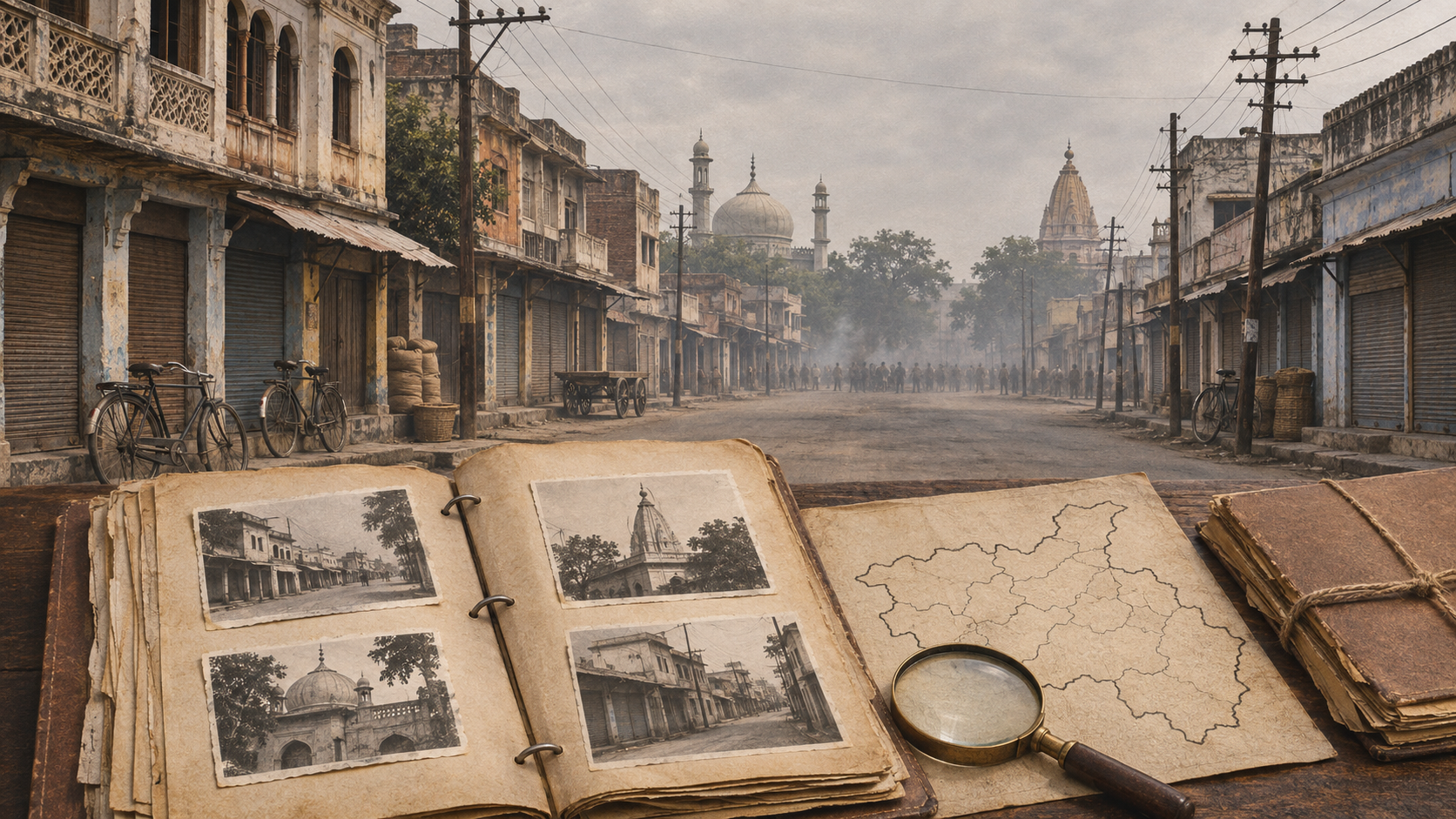
If you are asking whether Moradabad’s declining Hindu population share overturns the familiar account of Muslim suffering in August 1980, the honest answer is no. It does, however, expose how incomplete a one-scene account of the violence can be. Long-term demographic change is important context, but it cannot tell you by itself who provoked a confrontation, who fired, who fled, or why a temple remained inaccessible.
You do not have to choose between recognising Muslims reportedly killed by the Uttar Pradesh Provincial Armed Constabulary and investigating Hindu displacement, commercial loss, institutional closure, or alleged political incitement. A trustworthy reconstruction must test all of those claims separately. That is also the most effective way to prevent Hindu experience from being dismissed as a rhetorical reaction rather than examined as history.
Keep the event, responsibility and aftermath separate
The label “1980 Moradabad riots” compresses several questions into one phrase. They overlap, but they are not interchangeable:
- What happened during the confrontation? This includes the conduct of the crowd, the police and the PAC, as well as the identities and circumstances of those killed or injured.
- Who initiated or escalated the violence? This requires evidence about particular leaders, organisations, officials and groups at particular moments.
- What happened to Moradabad’s communities afterward? This includes migration, demographic change, abandoned property, lost businesses, access to temples and the durability of communal fear.
One prominent interpretation describes the August 1980 episode as a mass killing of Muslim worshippers by the PAC. The opposing case alleges that Indian Union Muslim League leaders Dr Shamim Ahmad and Dr Hamid Hussain incited the violence, while also directing attention to Hindu losses that received less sustained notice.
Neither proposition automatically disposes of the other. Evidence that state personnel killed Muslim civilians would not prove that no political actor helped provoke or escalate the wider riot. Evidence of incitement by named leaders would not make every Muslim casualty an aggressor or justify unlawful force. And neither finding, on its own, would settle what Hindu residents experienced in the days and decades that followed.
This distinction changes how you read confident statements about Moradabad. Ask which question a piece of evidence answers. A casualty record can establish a death, but not necessarily the entire chain of responsibility. A speech can bear on incitement, but not prove what every listener subsequently did. A displaced family can establish a serious local consequence, but not quantify a district-wide pattern. Precision protects the victims whose experiences broad slogans usually erase.
What the demographic claim can and cannot prove
The demographic case is striking: Hindus are reported to have constituted 61.41% of Moradabad district in 1951 and less than 50% by 2012. If the two figures use comparable boundaries and definitions, they indicate a substantial change in the district’s religious composition. That change deserves an explanation. It should not be waved away merely because Muslim casualties were reported in 1980.
But population share is a ratio, not a headcount and not a record of motive. A community’s percentage can fall even while its absolute population grows, if another population grows faster. A changing share can reflect different birth and death rates, net migration, altered administrative boundaries, classification practices, or several of these mechanisms at once. The two endpoint figures alone cannot tell you which mechanism operated in Moradabad.
The unit of analysis matters just as much. A district is not the same thing as Moradabad city, a particular ward, a market neighbourhood or the area immediately surrounding the 1980 confrontation. If someone moves between those units without warning, the argument may sound coherent while comparing different populations. Before repeating the claim, check that every percentage refers to the same geographic unit.
The endpoint also requires definition. Because the claim uses 2012, you should ask what population dataset produced that figure, what boundary it used and whether it is directly comparable with the 1951 baseline. A precise-looking percentage does not answer those questions for you.
Most importantly, a 1951-to-2012 comparison spans far more than the 1980 riot. It can reveal the direction of long-term change, but it cannot assign that change to a single event without intermediate evidence. If the riot caused a significant Hindu exodus, you would expect to find a chronological concentration of departures, property transfers, school withdrawals, business closures or neighbourhood-level change after the violence. That is a testable proposition. It is stronger than simply placing a riot date beside two distant demographic endpoints.
| Claim to examine | Evidence that would directly test it | What it cannot establish alone |
|---|---|---|
| PAC personnel killed Muslim worshippers in August 1980 | Named casualty records, medical and inquest records, operational orders, contemporaneous official communications, judicial material and findings from any formal inquiry | Who initiated every phase of the riot, whether political incitement occurred, or what Hindu residents experienced elsewhere |
| Named Muslim League leaders incited the violence | Contemporaneous speeches, recordings or transcripts, police records, sworn testimony, legislative proceedings and formal findings that distinguish allegation from conclusion | The conduct or culpability of every Muslim present, or the lawfulness of every subsequent police action |
| Hindu population share fell from 61.41% in 1951 to below 50% by 2012 | Population tables using consistent religious definitions and comparable district boundaries, plus intermediate observations and an explanation of the 2012 estimate | Whether Hindu headcount fell, why the share changed, or whether the 1980 riot caused the change |
| Hindu families lost homes or businesses, and a temple remained closed for decades | Dated property, commercial, trust, administrative and court records, supported by specific testimony and a clear chronology | How widespread the pattern was across the district without additional cases and population-level evidence |
Hindu losses need their own evidentiary record
A narrative that begins and ends with police firing can make Hindu losses disappear without ever disproving them. That is not a neutral outcome. It narrows a complex riot to the moment that best fits one moral frame and leaves displacement, intimidation, commercial change and damage to religious continuity outside the picture.
Two claims deserve case-level investigation: the departure of Banwari Lal Gupta’s family from a long-established business and home, and the reported 44-year closure of the Gaurishankar temple. These claims are consequential because they concern more than sentiment. A family business carries accumulated capital, customer relationships and local standing. A closed temple interrupts worship, management and a community’s visible continuity in place.
Yet their importance is precisely why they should be documented carefully. For the business claim, identify the premises, the owners before and after the departure, the nature of any transfer, the date operations ceased and the evidence connecting the departure to communal pressure. Property deeds, business registrations, tax or licence records, market directories and dated testimony can turn a general story into a verifiable case history.
For the temple claim, establish when ordinary access stopped, who controlled the site, whether a police, court, municipal or trust decision kept it closed, and when access resumed. A statement that a temple was locked for 44 years is powerful, but the mechanism matters. A documented security restriction, an unresolved title dispute and coercive exclusion are different historical claims even when worshippers experience the same locked door.
Do not treat such cases as decorative anecdotes added after the main story. Build a file for each one. Record the names, address, dates, responsible institution, surviving documents and points on which witnesses disagree. Then look for comparable cases. A repeated pattern across independently documented households, markets and temples can support a broader conclusion; one case, however serious, cannot carry the district by itself.
This standard is not an obstacle to a pro-Hindu account. It is what makes that account difficult to dismiss. The answer to selective memory is not a competing simplification. It is a fuller record in which Hindu victims are named, losses are specified and causal claims are no broader than the evidence permits.
Build a defensible Moradabad chronology
If you are researching, teaching or writing about Moradabad, a chronology will serve you better than a collection of quotations. Build it in the following order:
- Write each disputed proposition as a separate sentence. Do not begin with “what happened in Moradabad.” Begin with narrower propositions: who allegedly called for what action, which unit used force, which person died, which family left, which business changed hands, or when access to a temple ended.
- Fix the time and place for each proposition. Separate the immediate August 1980 confrontation from later communal violence and from decades of demographic change. Mark whether an item concerns the city, the district, a neighbourhood, a market or a religious site.
- Separate actors rather than communalising every action. Distinguish PAC personnel, civil police, named political leaders, organised groups, crowds, shopkeepers, worshippers and ordinary residents. Write “a named leader allegedly incited a crowd” when that is the claim; do not replace it with “Muslims did this.” Apply the same discipline to Hindus and state agencies.
- Grade the supporting material. Put official records, court material, property documents and contemporary legislative records in one tier; contemporaneous reporting in another; later testimony in a third; and political commentary in a fourth. A later assertion may tell you what to investigate, but it should not silently acquire the status of a contemporary record.
- Track contradictions instead of hiding them. Record competing casualty numbers, incompatible sequences and disagreements over instigation in adjacent columns. Note what evidence would resolve each conflict. An unresolved contradiction is a finding about the limits of the record, not permission to choose the preferred version.
- Test causal claims against timing. If communal pressure is said to have driven Hindu migration, look for departures and property changes concentrated after episodes of violence. If a temple closure is linked to the riot, establish the order that created or prolonged the closure. If a demographic trend began earlier or accelerated later, revise the explanation accordingly.
- Publish the narrow conclusion first. State what is established, what is strongly supported, what remains alleged and what is still unknown. Readers can then distinguish evidence from editorial judgement.
MP Jyotirmoy Basu’s intervention in the Lok Sabha is relevant to this reconstruction because it places part of the counter-narrative in a parliamentary setting. But parliamentary presentation does not eliminate the need to inspect the underlying figures, their definitions and the event sequence they were meant to support. The authority of the venue and the reliability of each claim are related questions, not identical ones.
The same discipline should govern comparisons with Jallianwala Bagh or other massacres. Such analogies communicate moral scale, but they can also smuggle in conclusions about intent, command responsibility and the character of the crowd. Establish those elements from Moradabad’s own record before using another event as a template.
Key takeaways for judging the competing claims
- The demographic shift is a real question, not a complete answer. The reported decline from a 61.41% Hindu share in 1951 to below 50% by 2012 calls for explanation, subject to verification of geography and data. It does not identify the mechanism by itself.
- Event evidence and demographic evidence work on different scales. Records of an August 1980 killing can establish immediate victims and perpetrators. A multi-decade population series describes long-term composition. Neither substitutes for the other.
- Muslim casualties do not erase Hindu losses. Police violence against Muslims, alleged political incitement, Hindu displacement and restrictions on a Hindu temple can coexist in the same history. Each still needs independent proof.
- Incitement must be attributed precisely. Where responsibility is alleged against Dr Shamim Ahmad and Dr Hamid Hussain, retain the names and the status of the claim until contemporaneous evidence or a formal finding establishes more.
- Cases of displacement and temple closure should become documented files. Dates, addresses, ownership records, administrative orders and corroborated testimony are more useful than repeatedly circulating a broad conclusion.
- A rigorous pro-Hindu history acknowledges every civilian victim. It does not need to minimise Muslim deaths to demonstrate that Hindu insecurity, economic loss or demographic decline also deserves investigation.
The most responsible formulation available now is a limited one: Moradabad’s reported demographic change and specific claims of Hindu displacement and temple closure make any exclusively Muslim-victim account inadequate, but those facts do not independently prove who caused the 1980 violence or why the district’s religious composition changed. That sentence leaves room for further evidence without surrendering the Hindu questions that a narrow account omits.
When you next encounter a sweeping claim about Moradabad, reduce it to one actor, one action, one place and one period. Then ask for the record that proves that sentence. Do that consistently for the PAC, political leaders, Hindu families, Muslim casualties, businesses, temples and demographic figures. The result will be less dramatic than a communal slogan and far more durable as history.


References

Leave a Reply
You must be logged in to post a comment.