If you encountered the public ceremony at Bageshwar Dham and are deciding whether to celebrate, defend, question, or share it, the most dharmic response is neither silence nor triumphalism. Welcome a freely made choice, then ask whether the people at its centre were treated as persons rather than symbols.
That standard gives you a practical way to judge this event and others like it. Establish what is known, protect freedom of conscience, follow the applicable law, provide sustained spiritual guidance, and refuse language that turns one family’s decision into a contest between communities.
Begin with what is known, and mark what is not
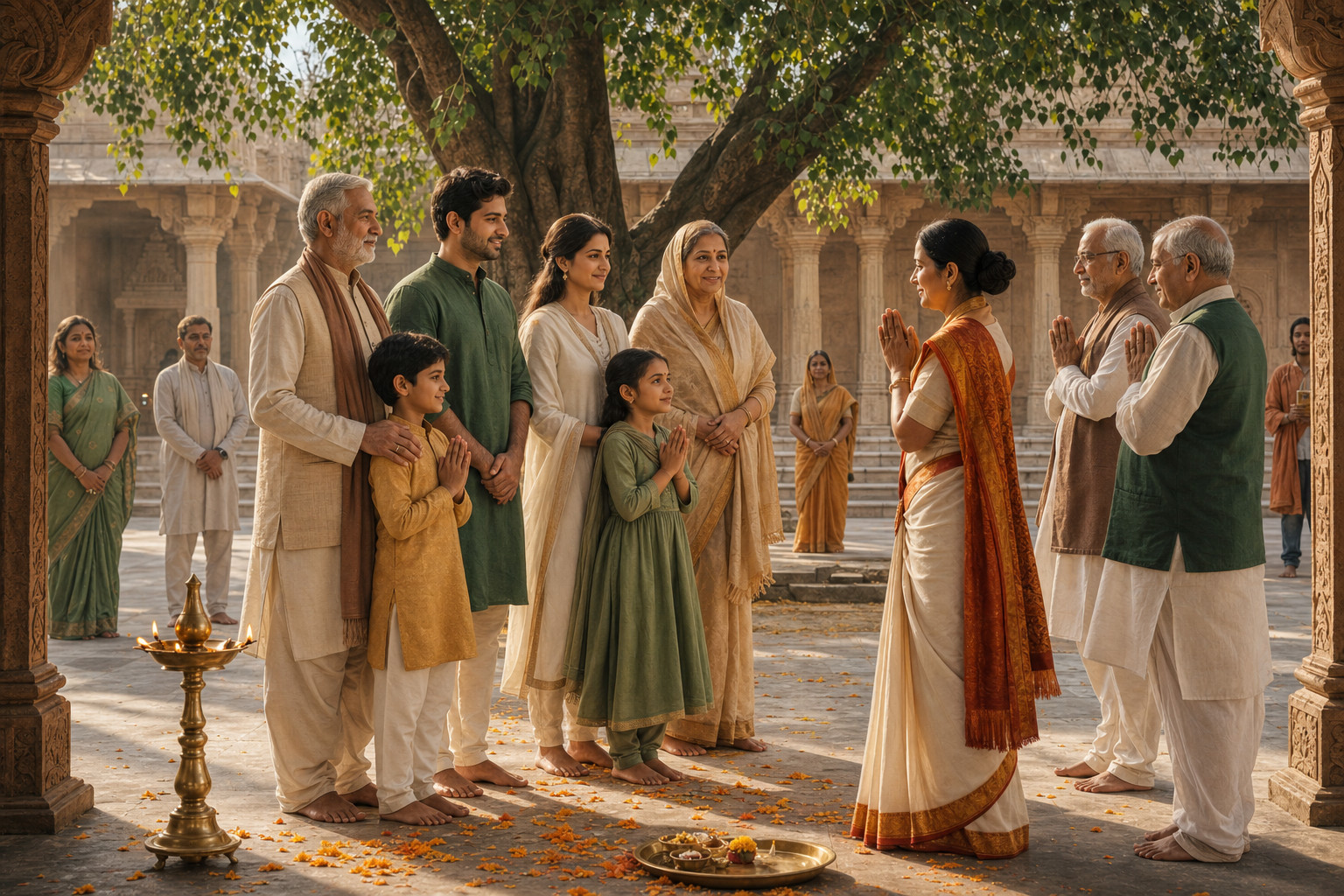
On April 1, 2026, at Bageshwar Dham in Chhatarpur, Madhya Pradesh, public reporting described a family formerly identifying as Muslim choosing to embrace Sanatan Hindu Dharma. The reported name changes were Anwar to Arjun Singh and Hasina to Priya Singh.
Those details establish a public event. They do not reveal every private conversation, the full history behind the family’s decision, or the exact sequence and meaning of each ritual. If you discuss the case, keep that boundary visible. Say that the family was reported to have made this choice; don’t invent motives, ancestral histories, pressures, or theological conclusions that the available facts do not establish.
This distinction matters because a claim can move through three different levels without anyone noticing. A reported name change is a fact about the ceremony. Freedom of conscience is a principle by which the ceremony should be judged. A claim that the event proves the victory or defeat of an entire religious community is an inference, and an unsound one. Keeping those levels separate protects both truth and the family.
The setting helps explain the event’s visibility. Bageshwar Dham is associated with large devotional gatherings, pravachans, community rites, and events connected with Dhirendra Krishna Shastri. A public devotional centre can offer fellowship and a clear point of entry. Its reach also creates a greater duty of care: the larger the platform, the easier it is for a personal spiritual decision to become a spectacle.
Freedom of conscience is the non-negotiable test
Article 25 of the Constitution of India protects the "freedom of conscience and the right freely to profess, practice and propagate religion," subject to public order, morality, health, and other fundamental rights. That protection is not reserved for choices that attract social approval. It applies to the adult who enters the Hindu fold, the person who remains in another tradition, and the seeker who is still uncertain.
For a Sanatan community, this makes voluntary consent more than a legal formality. Satya requires honest representation. Ahimsa rules out pressure and intimidation. Seva cannot be made conditional on adopting a belief. A ceremony ceases to be worthy of Dharma if assent was obtained through coercion, deception, or a promised benefit tied to the change of faith.
Several Indian states regulate religious conversions through Freedom of Religion statutes. Depending on the applicable law, declarations to the District Magistrate and prescribed timelines may be involved. Requirements differ, so organisers should not rely on a generic online checklist or assume that a religious rite completes every civil procedure.
- Confirm the free choice of each adult without relatives, organisers, donors, or cameras directing the answer.
- Explain the proposed rites and their meaning in language the person understands, while leaving room to decline or postpone.
- Ask a qualified local lawyer or the relevant district administration which declarations, notices, documents, and deadlines apply before fixing the public ceremony.
- Obtain separate permission for photographs, video, names, interviews, and social-media distribution. Consent to a religious rite is not automatic consent to publicity.
- Keep religious initiation separate from civil record changes. A devotional name adopted during a ceremony does not by itself complete the administrative process for changing a legal name.
Skipping an applicable procedure can expose both the family and organisers to investigation or a legal dispute. When the facts involve minors, contested consent, family threats, or uncertainty about a state statute, general religious guidance is not enough; obtain case-specific legal advice before proceeding.
The ceremony should open a path, not complete a performance
A public affirmation may be memorable, but it cannot carry an entire spiritual life. Shuddhi, paravartana, and nama-karana belong to different ritual and historical vocabularies. They should not be treated as interchangeable labels, nor should a new name be presented as proof that every question of identity has been settled.
Names can nevertheless carry real spiritual intention. Arjun evokes the Mahabharata’s seeker-warrior, called to discern Dharma under pressure. Priya conveys what is dear or beloved. Singh is used across communities, including Hindu and Sikh lineages, and is not an exclusively sectarian marker. The right pastoral question is therefore not, "What must these names mean?" but, "What commitments do the people adopting them want the names to remind them of?"
The receiving community should then turn symbolism into practice. A newcomer does not need an indiscriminate bundle of mantras, sectarian claims, dietary rules, festivals, and philosophical schools on the first day. Sanatan Dharma already possesses a vocabulary for spiritual plurality. Ishta-devata allows devotion to a chosen form of the Divine, while the maxim Ekam sat vipra bahudha vadanti expresses the recognition that truth may be spoken of in many ways.
Begin with four practical questions. What simple daily sadhana can the person understand and sustain? Which prayer should be taught with its meaning rather than as unexplained sound? Who will answer questions after the public attention fades? How will the person maintain loving family relationships where relatives continue to practise another faith?
A sound first step might be one short daily prayer, an explanation of basic puja, access to a readable translation, and a named mentor who does not punish doubt. The point is not to manufacture instant uniformity. It is to help a seeker move from a public affirmation to informed, voluntary, and steady practice.
A dharmic welcome continues after the cameras leave
The receiving community carries the heavier obligation once the ceremony is over. New adherents may need help understanding temple customs, household worship, samskaras, festivals, and the differences among Hindu sampradayas. They may also be navigating grief, disagreement, or distance within their existing family. A welcome that offers applause but no companionship abandons them at the most difficult stage.
Assigning a trustworthy mentor is more useful than surrounding someone with competing instructors. The mentor should distinguish essential ethical commitments from local custom, explain when practices differ among families or sects, and make it safe to say, "I don’t understand yet." Accessible translations matter for the same reason: recitation becomes more durable when the practitioner knows what is being invoked and why.
Do not require a denunciation of the former faith as the price of acceptance. A person can affirm Sanatan Dharma without being trained to insult relatives, erase childhood memories, or perform hostility for an audience. This restraint does not weaken Hindu conviction. It shows confidence that Dharma can be chosen for its own spiritual and ethical worth.
The broader dharmic family offers compatible disciplines for this kind of welcome: ahimsa and anekantavada in Jain thought, karuna in Buddhism, and seva alongside Ik Onkar in Sikh tradition. These are not claims that the traditions are identical. They show that firm commitment and respect for another person’s dignity can coexist.
Key takeaways
- Welcome a change of faith as an exercise of conscience, not as the defeat of another community.
- Verify the unpressured consent of every adult and check the current state and district procedures before the ceremony.
- Treat ritual affirmation, adoption of a devotional name, legal name change, and long-term spiritual practice as distinct steps.
- Provide understandable prayers, basic instruction, a reliable mentor, and space for questions after the public event.
- Ask separately before publishing names, images, testimony, or private family history.
Speak in a way that strengthens Dharma, not hostility
The phrase ghar-wapsi is sometimes used for a return to a perceived ancestral fold. It can be meaningful when the people making the transition understand their own journey that way. It should not be imposed as a ready-made story when their reasons are personal devotion, philosophical conviction, marriage, cultural affinity, or something they have chosen not to disclose.
Before sharing a photograph or headline, inspect the language around it. Does it state the reported facts? Does it affirm free conscience? Does it preserve equal human dignity? Does it avoid claiming knowledge of motives that the family has not publicly explained? If the wording fails those tests, revise it before giving it a larger audience.
A responsible public statement can be simple: "We welcome a freely chosen embrace of Sanatan Dharma, support compliance with the law, and respect the dignity and conscience of every community." That sentence celebrates Hindu fellowship without turning Muslims, Christians, Sikhs, Buddhists, Jains, or anyone else into targets.
Public restraint also protects the new adherents. Sensational language can increase family tension, expose them to unwanted scrutiny, or make their continued religious development feel like a performance for strangers. If organisers want the event to bear lasting fruit, they should measure success by the quality of teaching, fellowship, and seva available afterward, not by the reach of a video clip.
If you are a temple volunteer, attendee, donor, or online commentator, make your next action concrete: verify the facts before sharing them, remove language that degrades another faith, and ask what ongoing mentorship has been arranged. An embrace becomes recognisably dharmic when the seeker remains more important than the headline.