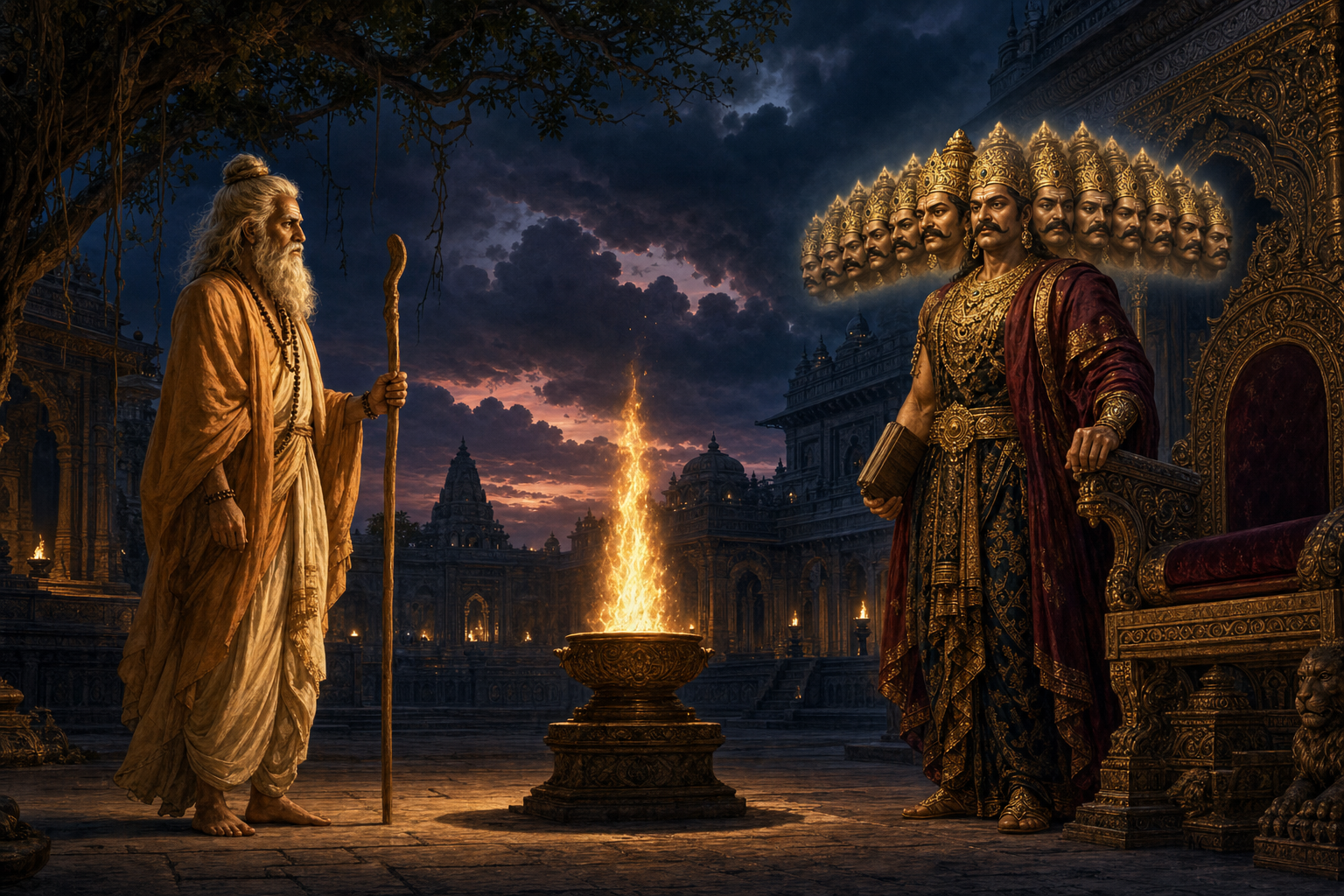
You may have heard that Sage Vasishta cursed Ravana and thereby ensured his defeat. If you are trying to separate the Ramayana’s textual record from later katha, the right response is neither a dismissive “that never happened” nor an unqualified repetition of the tale.
The more useful question is what kind of truth the tradition is preserving. The encounter places an extraordinarily learned ruler before a sage who represents disciplined counsel. It then asks you to notice the point at which knowledge stops correcting a person and starts defending whatever that person already wants.
First, place the Vasishta-Ravana encounter correctly
The core Valmiki Ramayana does not contain a stand-alone episode in which Vasishta visits Ravana’s court and explicitly curses him. The encounter belongs to the wider world of later Ramayana tellings, regional traditions, oral kathas, and interpretive retellings.
That distinction matters. Calling every later episode “Valmiki” weakens trust and prevents careful reading. Rejecting everything outside the earliest narrative is equally limiting. Itihasa lives not only through one textual layer but also through recitation, commentary, regional memory, performance, and moral instruction. Those forms do different work and should be identified honestly.
When you hear the claim that “Vasishta cursed Ravana,” ask three questions. Is the speaker claiming that the scene occurs in the core Valmiki narrative? Is it being presented as a later katha? Is “curse” being used as a supernatural sentence, or as a compact statement of moral cause and effect? These questions let you respect the tradition without confusing its layers.
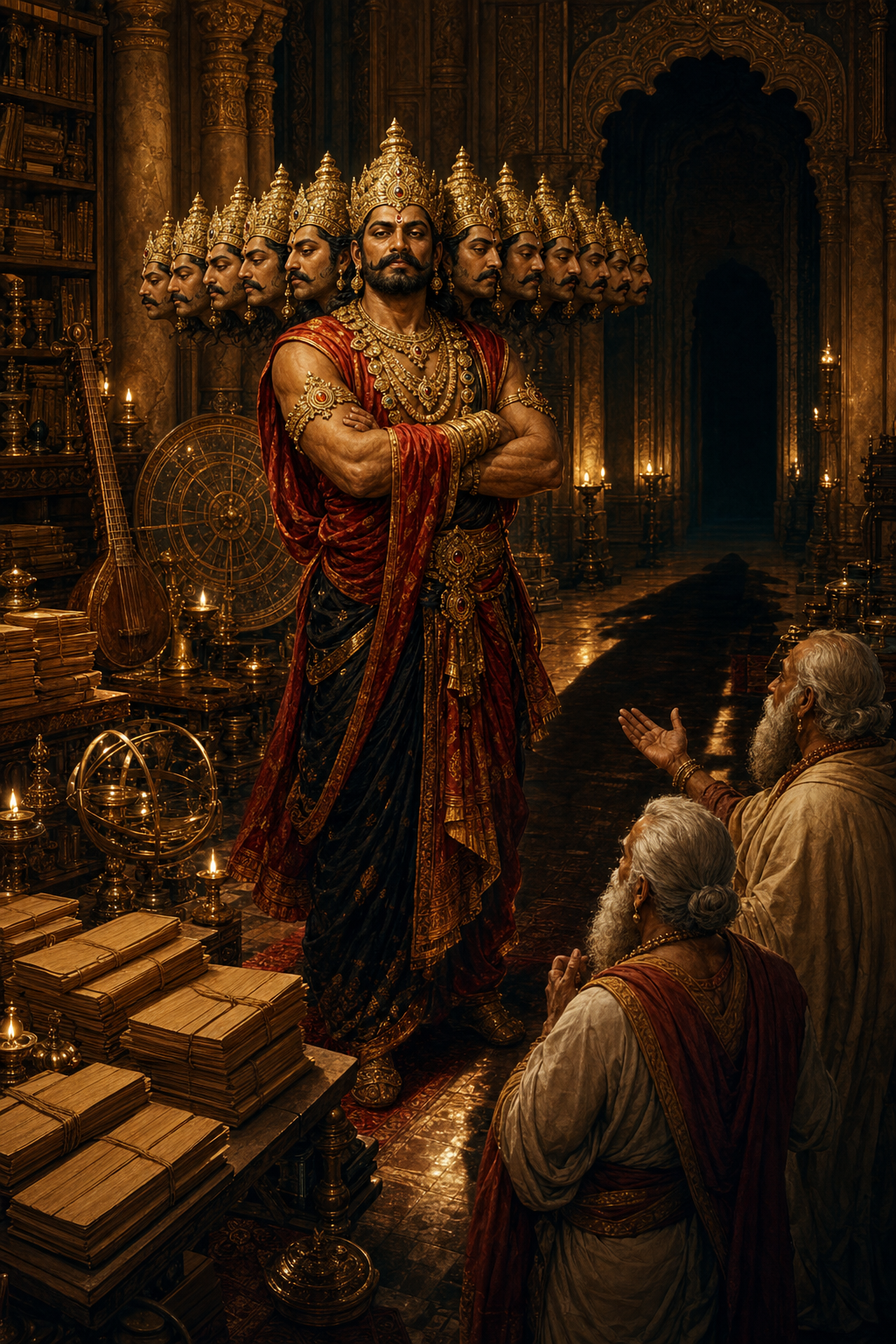
In the later narrative, Ravana invites Vasishta to Lanka amid royal splendour, learned Brahmanas, ministers, and warriors. The setting turns the meeting into a test. Ravana possesses wealth, power, learning, and confidence, but does he possess the self-command that makes those attainments trustworthy? Vasishta’s warning answers that question conditionally: if pride rules the intellect, the intellect will fail when its owner needs it most.
Vasishta represents the counsel that power must not control
Vasishta is not merely an impressive sage introduced to humble an impressive king. As purohita and counselor of the Ikshvaku or Suryavamsha rulers of Ayodhya, he represents an essential principle of rajadharma: sovereign power must remain answerable to a standard it did not invent for its own convenience.
This is the equilibrium traditionally expressed through kshatra and brahma-tejas. Kshatra supplies the courage and force needed to protect social order. Brahma-tejas supplies moral orientation, restraint, continuity, and the freedom to tell a ruler that victory does not make every action righteous. Neither principle is an excuse for passivity. The point is that force must be governable by dharma.
Vasishta’s association with Nandini, the wish-fulfilling cow coveted by kings, reinforces the same boundary. Royal force encounters something it cannot rightfully possess merely because it has the capacity to seize. The lesson is institutional as well as spiritual: a ruler is safest when at least one respected voice cannot be bought, frightened, promoted, or absorbed into the court’s machinery.
You can use that standard when evaluating leadership in a family, institution, temple committee, company, or government. Do not ask only whether a leader seeks advice. Ask whether any adviser can contradict the leader without being humiliated or expelled. A room full of experts is not a council if everyone has learned to predict the desired answer.
Ravana’s tragedy is not ignorance but captured intelligence
Ravana remains compelling because he cannot be reduced to an unintelligent villain. Ramayana traditions remember him as a learned king, a devotee of Shiva, and a master of fields including grammar, music, and statecraft. His failure therefore carries a sharper warning than the defeat of a simple fool would carry.
Learning gives you more ways to perceive truth, but it can also give ahamkara more sophisticated ways to avoid truth. Once desire has selected the conclusion, an educated mind can manufacture arguments for it, reinterpret warnings as insults, and portray surrender to impulse as principled resolve. Knowledge has then become counsel for the ego rather than a means of correcting it.
The abduction and continued detention of Sita expose this inversion. Ravana does not lack enough information to reconsider. He receives counsel from Vibhishana, confronts the evidence supplied by Hanuman’s arrival in Lanka, and later faces Angada’s embassy. Each encounter gives him another opportunity to restore Sita, avert destruction, and preserve what can still be preserved.
His refusal is especially revealing because Vibhishana’s advice joins rajadharma to practical statecraft. Returning Sita is not merely an appeal to private virtue. It is also the rational way to prevent a ruler’s personal wrongdoing from becoming a kingdom’s catastrophe. Ravana instead treats correction as disloyalty and public reversal as unbearable humiliation.
From there, errors compound. He underestimates the Vanaras because their outward form does not fit his idea of a formidable coalition. He discounts Rama because he measures strength mainly through familiar categories of imperial power. He prefers information that preserves his self-image and continues committing resources after the moral and strategic case has collapsed.
This is moha operating through intelligence. Ravana can still reason, but pride has decided which facts are admissible. If you want to detect the same danger in yourself, notice the moment when your response to unwelcome evidence shifts from “Is this true?” to “How dare this person say it?” That shift does not prove the criticism is correct. It does show that status has begun interfering with judgment.
A dharmic curse can describe causality without erasing agency
The word shapa is often flattened into the idea of a magical punishment imposed from outside. In many didactic narratives, however, a curse also compresses moral causality into memorable form. It identifies a disposition, names the consequence toward which that disposition tends, and leaves the person to continue choosing.
That is the most coherent way to understand Vasishta’s warning. It does not need to mean that Ravana becomes a helpless puppet of fate. It means that knowledge severed from vinaya becomes self-subverting. A proud ruler repeatedly rejects correction; rejected correction produces worse decisions; worse decisions isolate the ruler further; isolation makes the next correction even easier to dismiss.
The familiar maxim vidya dadati vinayam, “knowledge gives humility,” should therefore be read as a standard for genuine education, not an automatic promise about every educated person. Accumulated information is not yet vidya in its fullest civilizational sense. Learning becomes luminous when it makes a person more teachable, more exact about the limits of personal judgment, and more responsible for the effects of action.
Other prophetic episodes surrounding Ravana make the same moral structure visible. Nandi’s curse after Ravana mocks him at Kailasa anticipates a decisive role for Vanaras. Vedavati’s vow points toward the consequences of Ravana’s violation of women. King Anaranya of the Suryavamsha declares that a descendant of his line will end Ravana’s tyranny. These traditions do not excuse Ravana’s choices; they show choices accumulating into a destiny shaped by adharma.
This reading also prevents a common mistake about karma. Moral causality is not the same as crude instant punishment. Ravana’s capacities continue to function for a long time. Lanka remains powerful. His earlier attainments do not vanish at the first wrongful decision. The danger is precisely that success can continue long enough to persuade a person that repeated wrongdoing has no cost. By the time the cost becomes undeniable, many easier exits have already been refused.
Humility is a method of keeping knowledge usable
Humility does not require pretending that you know nothing, apologising for competence, or surrendering judgment to every critic. Vinaya is disciplined receptivity. It keeps the path between evidence and decision open, especially when the evidence threatens prestige.
A capable leader needs more humility, not less, because success changes the information environment. People become reluctant to deliver bad news. Past victories make present intuitions feel infallible. Public commitments make reversal look costlier than escalation. Ravana’s court shows what follows when deference to office becomes insulation from reality.
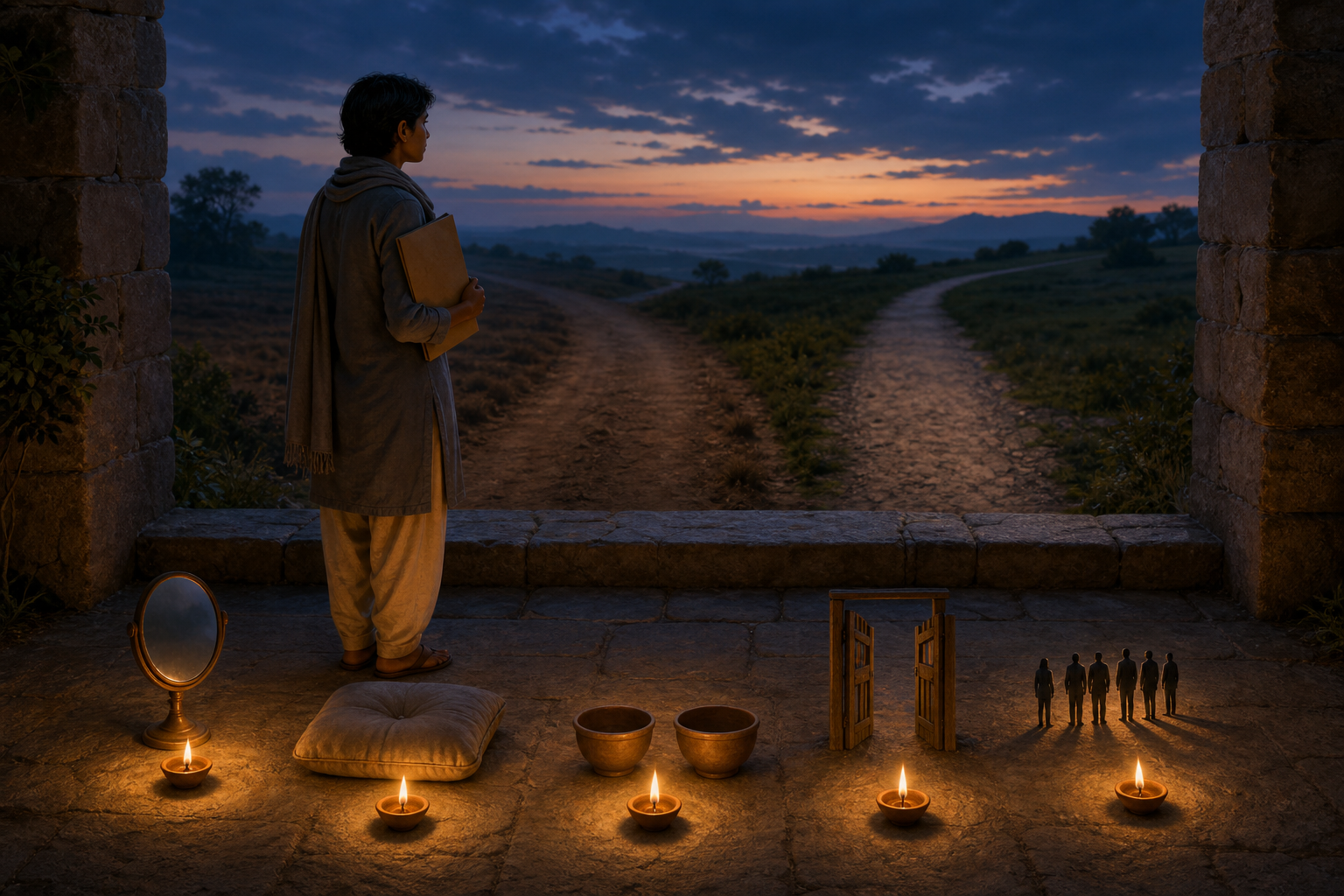
You can turn the Ramayana’s warning into a concrete discipline. Before a major decision, identify one person who is allowed to argue the opposite case. Ask that person to name the strongest fact you may be minimising. Then state in advance what evidence would make you change course. If no conceivable evidence could do so, you are no longer investigating; you are defending an identity.
When a trusted adviser objects, separate four questions that pride tends to collapse into one: Is the claim true? Is it relevant? Is the proposed remedy proportionate? Was it expressed respectfully? Poor expression can be corrected later. It does not make accurate information false. Ravana’s pattern begins when the discomfort of being contradicted becomes more important than the substance of the warning.
There is also a dharmic test beyond personal advantage. Ask who bears the cost if you are wrong. Ravana turns an offence rooted in his own desire into suffering for his family, defenders, and kingdom. Accountability means that authority cannot privatise glory while distributing the consequences of error to everyone else.
The pan-Dharmic resonance is strong. Buddhism treats mana, or conceit, as a condition that clouds discernment. Jain thought understands pride as a kashaya that contributes to karmic bondage. Sikh teaching identifies haumai as a central obstruction to truth. The vocabularies differ, but each tradition asks you to inspect the self that wants to possess knowledge, merit, power, or spiritual distinction.
Key takeaways: test whether your learning still serves dharma
- Locate the tradition before debating the claim. The explicit Vasishta-Ravana curse scene is associated with later tellings, not a stand-alone episode in the core Valmiki Ramayana.
- Judge learning by its effect on teachability. If greater knowledge makes correction less possible, knowledge is being recruited by ahamkara.
- Protect the dissenter before a crisis. Advice has little value when an adviser is safe only while agreeing with the person in power.
- Define a reversal condition in advance. Name the evidence that would make you apologise, return what was wrongly taken, abandon a plan, or change course.
- Track who will pay for your persistence. A leader’s refusal to lose face can transfer the cost of one error to an entire community.
- Do not mistake delayed consequences for vindication. Adharma can coexist with impressive short-term power while steadily destroying the judgment needed to preserve it.
The next time your expertise is challenged, pause before proving that you are the cleverest person in the room. Ask what Vasishta’s presence in Ravana’s court is designed to ask: can truth still reach you when accepting it carries a cost? Your answer will show whether knowledge remains a servant of dharma or has become armour for the ego.