
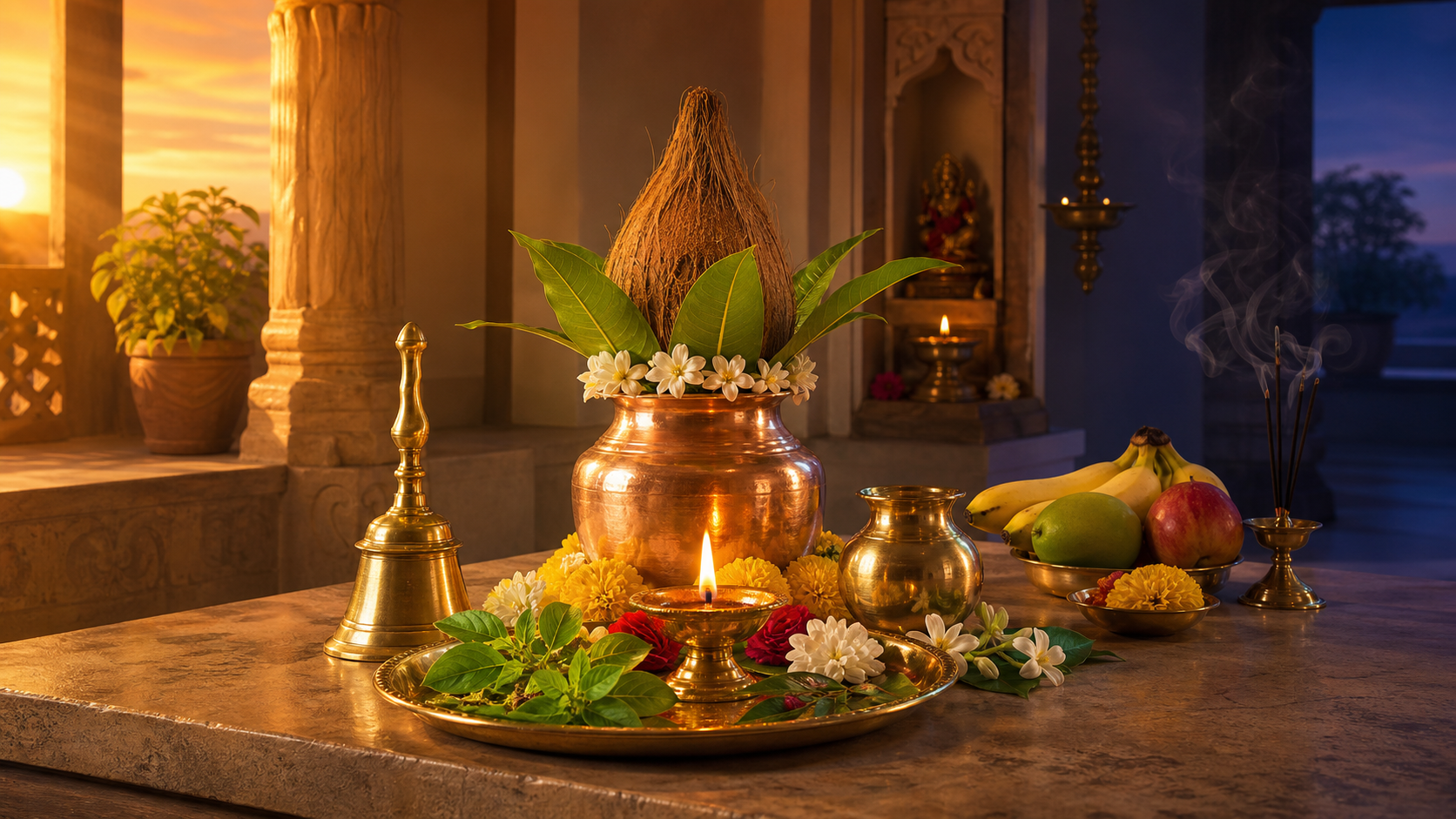
If you are arranging puja, vrata, travel, or the start of an important task on April 9, the main question is not simply whether the date is auspicious. You need to know which tithi governs the relevant part of your day and whether the timing has been calculated for the place where the activity will occur.
Thursday, April 9, 2026 begins under Krishna Paksha Saptami in most regions. The working transition to Krishna Paksha Ashtami is around 6:00 PM. Use that as a planning marker, not as a universal minute: your location, time zone, daylight-saving convention, and chosen Panchang method can shift the boundary.
Key takeaways for April 9
- April 9, 2026 is a Thursday, with Krishna Paksha Saptami prevailing at sunrise in most regions.
- Saptami continues until approximately 6:00 PM; Krishna Paksha Ashtami follows.
- For an ordinary sunrise-based daily Sankalpa, Saptami is the principal tithi of the day. An evening observance may fall under Ashtami after the locally verified transition.
- On Thursday, Yamaganda occupies the first eighth of daylight, Gulikai the third eighth, and Rahu Kalam the sixth eighth.
- Do not copy clock times from another city. Calculate avoidance periods from the local sunrise and sunset where the activity will take place.
- Nakshatra, Chandra Rashi, Yoga, and Karana should be confirmed through one trusted regional Panchang rather than guessed from the civil date.
April 9 Panchang at a glance
| Panchang point | Working reading | How to use it |
|---|---|---|
| Vara | Thursday | Use the Thursday assignments when calculating Rahu Kalam, Yamaganda, Gulikai, and Choghadiya. |
| Tithi at sunrise | Krishna Paksha Saptami in most regions | Use Saptami for the usual sunrise-based daily reckoning and Sankalpa, unless your tradition prescribes another rule. |
| Tithi transition | Approximately 6:00 PM | Confirm the local minute before an observance that depends on Ashtami having begun. |
| After the transition | Krishna Paksha Ashtami | Relevant to evening worship or vrata traditions that give weight to the tithi prevailing at night. |
| Nakshatra and Chandra Rashi | Location-dependent confirmation required | Check the lunar mansion and the Moon’s sidereal zodiac sign in your chosen local almanac. |
| Yoga and Karana | Local Panchang confirmation required | Include them before treating any candidate period as a complete Shubh Muhurat. |
The evening change matters because a tithi does not begin or end at midnight. It is an astronomical division based on the changing angular separation between the Moon and the Sun. Each completed interval of 12 degrees marks another tithi, giving 30 tithis across a synodic lunar month. The average tithi lasts about 23 hours and 37 minutes, but the actual duration varies. That is why one civil date can contain parts of two tithis.
This distinction prevents a common mistake. April 9 is not uniformly Saptami from midnight to midnight, nor is the entire date Ashtami merely because Ashtami arrives before the day ends. The relevant tithi depends on the time of your observance and on the rule followed by your sampradaya.
Localize the Panchang before choosing a time
A date-level Panchang gives you the structure of the day. It cannot give everyone the same clock time. Before placing an activity on your calendar, make these checks in order:
- Set the place of the activity. If you live in one city but will conduct the puja, ceremony, journey, or signing in another, use the second city’s location.
- Choose one computational tradition. Drik and Vakyam Panchangs can differ, and geocentric or topocentric adjustments may move a boundary by measurable minutes. Use the method followed by your family, temple, or sampradaya when one has already been established.
- Record local sunrise and sunset. These anchor the weekday caution periods and the daytime Choghadiya. Do not assume a 6:00 AM sunrise or a 6:00 PM sunset.
- Confirm the Saptami end time. Start with approximately 6:00 PM, then replace it with the time shown for your location and time zone.
- Record Nakshatra, Chandra Rashi, Yoga, and Karana. The Nakshatra is the lunar mansion in operation at sunrise for the day’s basic reading, while Chandra Rashi is the Moon’s sidereal sign. Note any transition that occurs near your proposed activity.
- Calculate the caution periods and identify candidate Muhurtas. Only then should you compare Abhijit Muhurat and favorable Choghadiya with the needs of the activity.
Keep all these values from the same Panchang whenever possible. Mixing a sunrise from one service, a tithi boundary from another city, and a Choghadiya table based on a third convention creates false precision. A beautifully exact clock time is not useful if its inputs belong to different locations or almanac systems.
Calculate Thursday’s caution periods correctly
Rahu Kalam, Yamaganda, and Gulikai are not fixed clock appointments. Each is assigned to one of eight equal parts of the local daylight interval. Since April 9 falls on Thursday, the first segment is Yamaganda, the third is Gulikai, and the sixth is Rahu Kalam.
The daylight-segment method
Let local sunrise be S and local sunset be T. Subtract S from T to obtain the daylight duration, then divide that duration by eight. Call the resulting segment length L. Thursday’s periods are then found as follows:
| Period | Thursday segment | Calculated window | Practical treatment |
|---|---|---|---|
| Yamaganda | First | S to S + L | Avoid choosing it for the launch of a new undertaking. |
| Gulikai | Third | S + 2L to S + 3L | Set it aside when screening a fresh beginning, subject to your tradition’s rules. |
| Rahu Kalam | Sixth | S + 5L to S + 6L | Do not initiate important new work during this window. |
For arithmetic illustration only, suppose sunrise were 6:00 AM and sunset 6:00 PM. The daylight duration would be 12 hours, making each segment 90 minutes. Yamaganda would run from about 6:00 to 7:30 AM, Gulikai from about 9:00 to 10:30 AM, and Rahu Kalam from about 1:30 to 3:00 PM. These are not universal timings for April 9. Replace both ends of the illustrative day with your actual local sunrise and sunset.
These periods are most useful as filters for starting something new. They do not mean that ordinary duties must stop or that the entire Thursday is unfavorable. Remove the unsuitable intervals from your schedule, then assess what remains.
Layer Abhijit Muhurat and Choghadiya
Abhijit Muhurat is generally treated as a favorable interval around true local solar noon. For practical planning, it is often taken as roughly 24 minutes before and 24 minutes after that point. Use a local calculation rather than assuming that solar noon is exactly 12:00 on the civil clock.
Choghadiya offers another practical layer. Daylight and nighttime are each divided separately into eight equal periods, beginning at local sunrise and sunset. Amrit, Shubh, Labh, and Chara are generally treated as favorable qualities; Udveg, Rog, and Kaal are generally avoided for auspicious beginnings. The order is weekday-specific, so use Thursday’s sequence from the same regional Panchang that supplied your sunrise.
A sensible screening sequence is to set aside Rahu Kalam, Yamaganda, and Gulikai, locate a favorable Choghadiya or the local Abhijit interval, and then check the five limbs of the Panchang: Tithi, Vara, Nakshatra, Yoga, and Karana. Favorable combinations such as Siddha, Amrita, or Sarvartha Siddhi matter when they actually occur, but their presence on April 9 must be confirmed locally. A favorable Choghadiya alone is a candidate window, not a complete Muhurta for every ceremony.
Plan worship around the Saptami-to-Ashtami change
The sunrise rule and the worship-time rule answer different questions. If you are making an ordinary daily Sankalpa based on the tithi at sunrise, Krishna Paksha Saptami is the appropriate starting point in most regions. If a specific evening observance requires Ashtami to be in force, wait until the locally confirmed transition rather than relying blindly on the general 6:00 PM marker.
For a simple Saptami practice, you can give the day to steady japa, svadhyaya, or quiet seva. These do not require you to manufacture an elaborate observance without lineage guidance. The waning fortnight naturally supports a quieter rhythm: less display, more attention, and a clearer return to regular sadhana.
After Ashtami begins, some Devi and Bhairava traditions place greater emphasis on restraint, inward worship, and devoted remembrance. Monthly Ashtami vrata rules are not identical across lineages. Some give importance to the tithi at night, while others apply rules concerning sunrise, predominance, or the time of a prescribed puja. Follow the rule of the vrata you are actually undertaking, not a generic label found on a calendar.
- If your household follows sunrise tithi for daily observance, treat April 9 primarily as Saptami.
- If your evening puja requires Ashtami, verify that Ashtami has begun in your locality before making the Sankalpa.
- If your family Panchang differs slightly from the approximately 6:00 PM transition, preserve the established family or temple method rather than switching systems for convenience.
- If you are considering a fast, fit its austerity to your health and to competent lineage guidance. A vrata should strengthen attention and devotion, not turn avoidable strain into a measure of piety.
- If the activity is a major samskara or another consequential religious undertaking, ask the officiating purohit to choose the full Muhurta. A daily Panchang overview is not a substitute for the activity-specific rules used in such decisions.
The tithi change does not by itself make everything before 6:00 PM auspicious or everything afterward unsuitable. Tithi is only one limb of the Panchang. Use it to determine the day’s lunar character, then use the other limbs and the appropriate tradition to decide whether a particular time fits a particular act.
Avoid the Panchang mistakes that change the answer
- Treating 6:00 PM as exact everywhere: use it as the broad Saptami-to-Ashtami marker, then confirm the minute for your location.
- Using your home city’s timings while traveling: calculate for the place where the action or worship occurs.
- Copying fixed Rahu Kalam hours: Thursday determines the segment number, but local sunrise and sunset determine the clock time.
- Equating one favorable label with a complete Muhurta: an Amrit Choghadiya or Abhijit interval remains only part of the decision until Tithi, Vara, Nakshatra, Yoga, and Karana have been considered.
- Guessing Nakshatra or Chandra Rashi from the date: verify both through a location-aware sidereal almanac, especially when a transition is close to your planned time.
- Combining Drik and Vakyam values without noticing: use one system consistently unless your purohit deliberately reconciles the two.
- Forcing one observance rule on every sampradaya: sunrise predominance is common for daily reckoning, but deity-specific and nighttime vrata can apply different criteria.
Regional variation is not a defect in Hindu timekeeping. Panchang practice joins astronomical calculation to the local horizon and to a living ritual tradition. Differences of a few minutes can arise from location, computational school, topocentric or geocentric treatment, time-zone settings, and daylight-saving conventions. The right response is consistency and local verification, not the search for one clock reading that must govern the whole world.
Your practical plan for April 9
- Before April 9, select the city, time zone, and regional Panchang you will use.
- Record that location’s sunrise, sunset, and exact Saptami end time.
- Calculate Thursday’s first, third, and sixth daylight segments for Yamaganda, Gulikai, and Rahu Kalam.
- Check the local Abhijit interval and Thursday Choghadiya, then screen the candidate time through Tithi, Nakshatra, Yoga, and Karana.
- Use Saptami for the ordinary sunrise-based daily reckoning; use Ashtami for an evening practice only after its local onset.
- For a vrata or major ceremony, let the rules of your sampradaya, family tradition, temple, or officiating purohit settle any conflict.
This careful use of lunar time also points toward a wider Dharmic inheritance. Buddhist Uposatha observances, Jain vrata and parva, and historical Sikh use of the Bikrami framework all preserve relationships with lunar or lunisolar time, even though their liturgical rules remain distinct. Shared calendar grammar can reveal kinship without erasing those differences.
For April 9, begin with one firm action: open the Panchang for the place where you will actually be, and replace the approximate 6:00 PM transition with its local value. Once that is done, the day becomes much easier to plan with both precision and respect for tradition.