
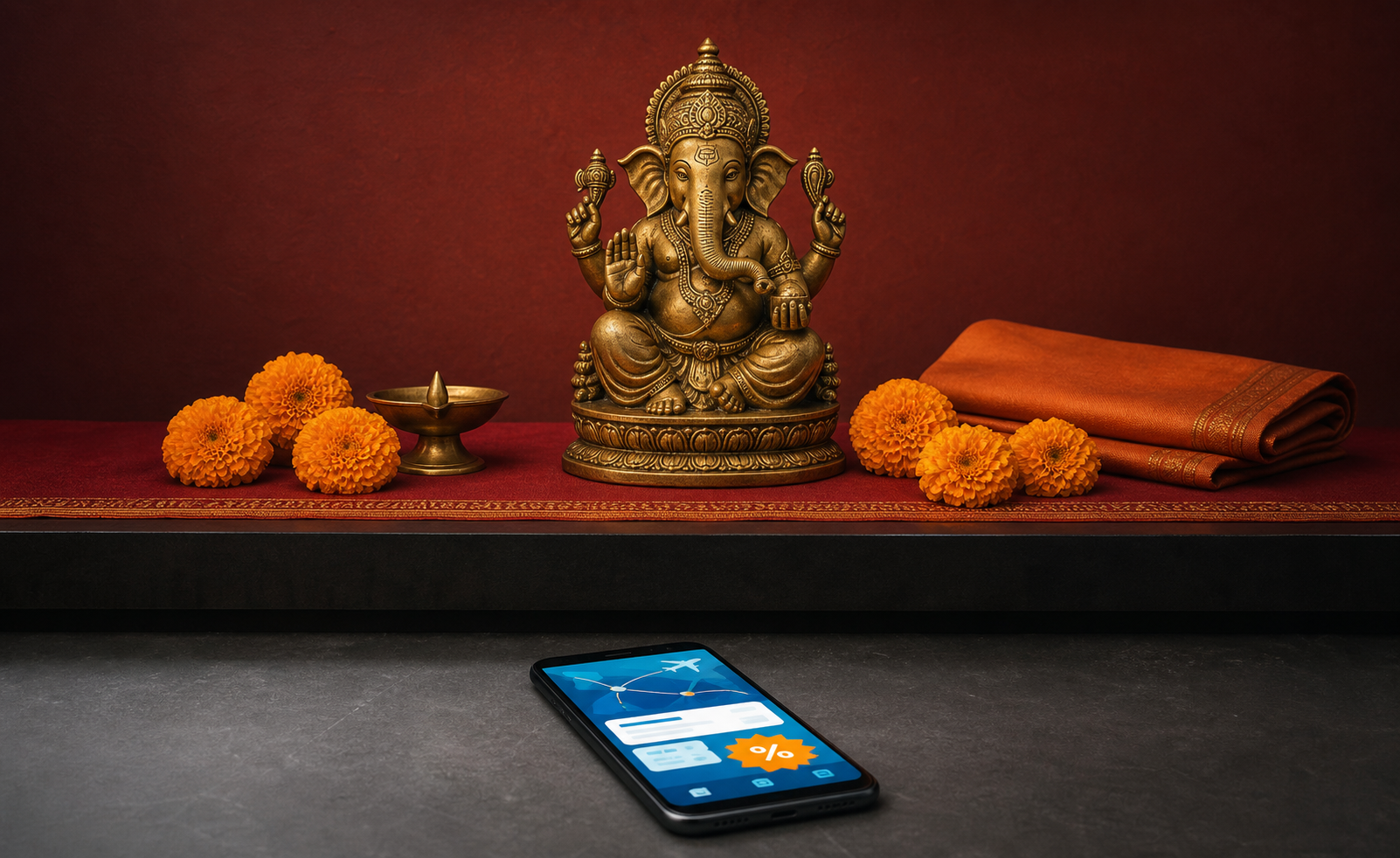
If you encountered the anger over ConfirmTkt’s use of Bhagwan Shri Ganesha and wondered whether to complain, boycott, or wait for more information, start by separating the confirmed act from the claims gathering around it. A precise objection is harder to dismiss and more likely to produce a real correction.
The central question is not whether a Hindu festival may ever appear in advertising. It is whether a sacred form was treated with the dignity appropriate to it, or reduced to a device for selling a cashback offer. That distinction should guide both your judgement and your response.
What can actually be confirmed about the controversy

ConfirmTkt faced strong criticism from Hindus after an image of Bhagwan Shri Ganesha appeared in a promotional cashback offer connected with Ganesh Chaturthi train bookings. Hindu Jagruti Samiti demanded an apology from the company.
Those are the facts on which a responsible discussion can stand. They establish the promotional use, the festival connection, the cashback element, the criticism, and the demand for an apology. They do not, by themselves, prove what the designers intended. Nor should you assume, without direct evidence, that every description circulating online accurately reproduces the complete advertisement or ConfirmTkt’s subsequent position.
This limitation matters. If you call an insensitive creative decision a deliberate attack without evidence of intent, the argument shifts away from the advertisement and toward your wording. The company can then dispute the accusation instead of answering the underlying concern. Say exactly what happened: a sacred image was used in a cashback promotion, some Hindus found that use disrespectful, and a clear remedy was requested.
Why the commercial context matters more than mere visibility

For many Hindu devotees, an image of Bhagwan is not interchangeable with a decorative festival symbol. It participates in a living relationship of reverence. A marketer may see a familiar seasonal image that attracts attention; a devotee may see a sacred form being enlisted to move a customer toward a transaction. The controversy arises from that difference in meaning.
Yet the presence of a deity in commercial communication is not automatically disrespectful. Businesses routinely acknowledge festivals, serve pilgrims, support celebrations, and communicate with communities in culturally recognisable ways. The line is crossed through treatment and context, not through visibility alone.
Use four questions when judging a religiously themed advertisement:
- What role does the sacred image play? A respectful festival greeting differs from making Bhagwan appear to endorse a purchase, coupon, discount, or cashback mechanism.
- How has the image been treated? Look for distortion, comic manipulation, careless cropping, demeaning placement, or copy that trivialises the deity. Do not allege one of these details unless you can point to it in the original creative.
- What surrounds the image? The same depiction can carry a different meaning beside a devotional greeting than beside an aggressive sales instruction. Read the image, words, offer, and placement as one communication.
- What happens after an objection? A company can make a poor cultural decision without hostile intent. Its response reveals whether it takes the affected community seriously: Does it examine the complaint, correct the material, and explain how recurrence will be prevented?
This test keeps the standard coherent. Hindus need not demand that Bhagwan Shri Ganesha disappear from public or commercial life. We can instead insist that sacred imagery not be converted into a disposable sales prop. That is a clearer principle for brands, designers, devotees, and neutral observers alike.
How to object without weakening the case

If you want ConfirmTkt to act, a focused complaint will do more than an angry message built from assumptions. Use a sequence that preserves evidence, identifies the precise problem, and asks for an outcome the company can implement.
- Locate the original creative. Save the complete advertisement if it is still available, including its words, image, platform, and surrounding context. A cropped repost can conceal information that changes how the material should be assessed.
- Describe only what you can see. State that Bhagwan Shri Ganesha’s image was used in connection with a Ganesh Chaturthi cashback promotion. If a particular pose, phrase, placement, or alteration concerns you, identify it precisely. Do not enlarge the allegation beyond the evidence.
- Explain the religious issue in one or two sentences. Tell the company that devotees regard the depicted form as sacred and that using it as a mechanism for promoting cashback can turn reverence into sales leverage. This gives a marketing team something more useful than a bare declaration that people are offended.
- Request a concrete remedy. Ask the company to withdraw or replace the disputed creative if it remains active, acknowledge why the use caused concern, apologise without shifting responsibility to the audience, and add a religious-imagery review step to future campaigns.
- Keep collective pressure disciplined. Share the verified creative and the requested remedy, not personal information about employees or unsupported claims about motives. Threats, abuse, and harassment are wrong in themselves and make it easier for the substantive complaint to be ignored.
- Judge the response, not just its speed. A meaningful resolution should address the sacred-image concern directly. A generic statement about unintended feelings, without saying what will be corrected, leaves the practical issue unresolved.
A boycott is a personal and collective choice, but it should have a defined purpose. If you choose not to use a service, say what would cause you to reconsider: removal of the creative, an unambiguous apology, or a credible prevention measure. Pressure without a stated path to resolution can express anger, but it gives the company no test for earning back trust.
Key takeaways
- The confirmed dispute concerns ConfirmTkt’s use of Bhagwan Shri Ganesha in a cashback promotion tied to Ganesh Chaturthi train bookings.
- The strongest criticism addresses the commercial use of a sacred form; it does not require claiming that every festival-themed advertisement is objectionable.
- Do not turn insensitive impact into an allegation of deliberate anti-Hindu intent unless evidence establishes that intent.
- A useful complaint identifies the exact creative, explains the religious concern, and requests removal or replacement, acknowledgement, an apology, and a preventive review process.
- Evidence-based, non-abusive advocacy protects the dignity of the cause and makes corporate accountability easier to measure.
What a credible resolution should look like

An apology alone can become ceremonial if nothing changes behind it. The useful standard is correction plus prevention. If the disputed advertisement remains active, the immediate correction is to remove or replace it. The public acknowledgement should then identify the actual error: sacred imagery was placed in a commercial cashback context that devotees regarded as disrespectful.
Prevention requires a modest but real internal change. Before publishing festival campaigns, a company should ask whether a deity is being honoured, merely decorating the layout, or being made to sell the offer. When the campaign uses a sacred figure, someone with genuine knowledge of the tradition should review the complete creative rather than only an isolated illustration. This is not a demand for brands to avoid Hindu culture. It is a demand that engagement with Hindu culture be informed and respectful.
Hindu advocacy is most persuasive when it combines firmness with accuracy. You do not need to minimise the concern, and you do not need to embellish it. If you decide to act on this controversy, begin with the original creative and send one precise request for correction. Then assess ConfirmTkt by what it actually changes.