
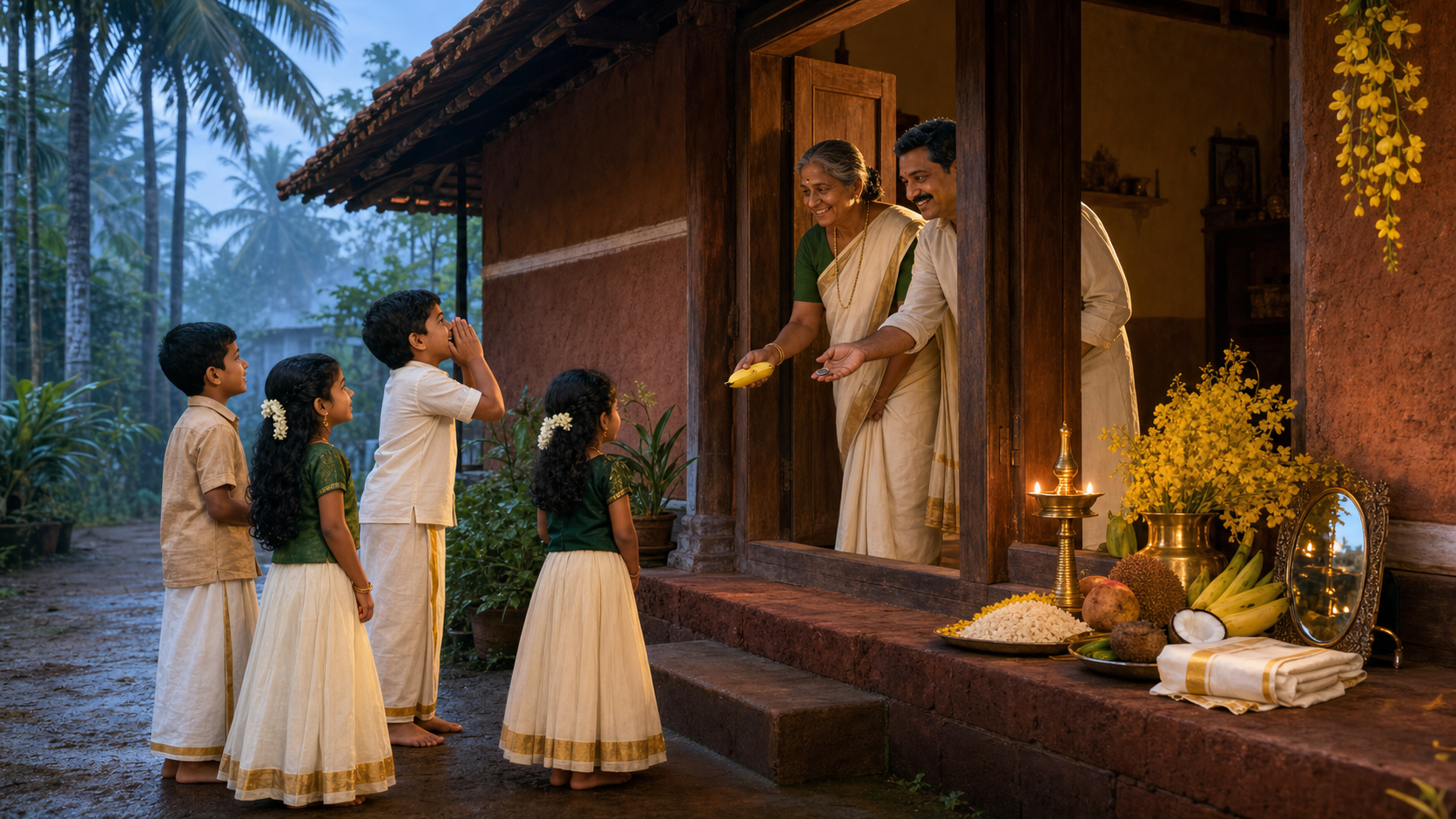
If your family remembers the call vishukaniye, vishukaniye but no longer remembers the full custom around it, you do not need to invent an elaborate festival programme. Vishukkani Vili is built from a few intimate acts: prepare the kani, let children carry the Vishu greeting from door to door, welcome them, and give something modest with goodwill.
The detail worth protecting is the relationship between those acts. The children are not simply collecting treats, and the households are not passive stops on a route. Each threshold extends the auspicious first sight of Vishu from one family into the surrounding community.
What happens from the first sight to the first call
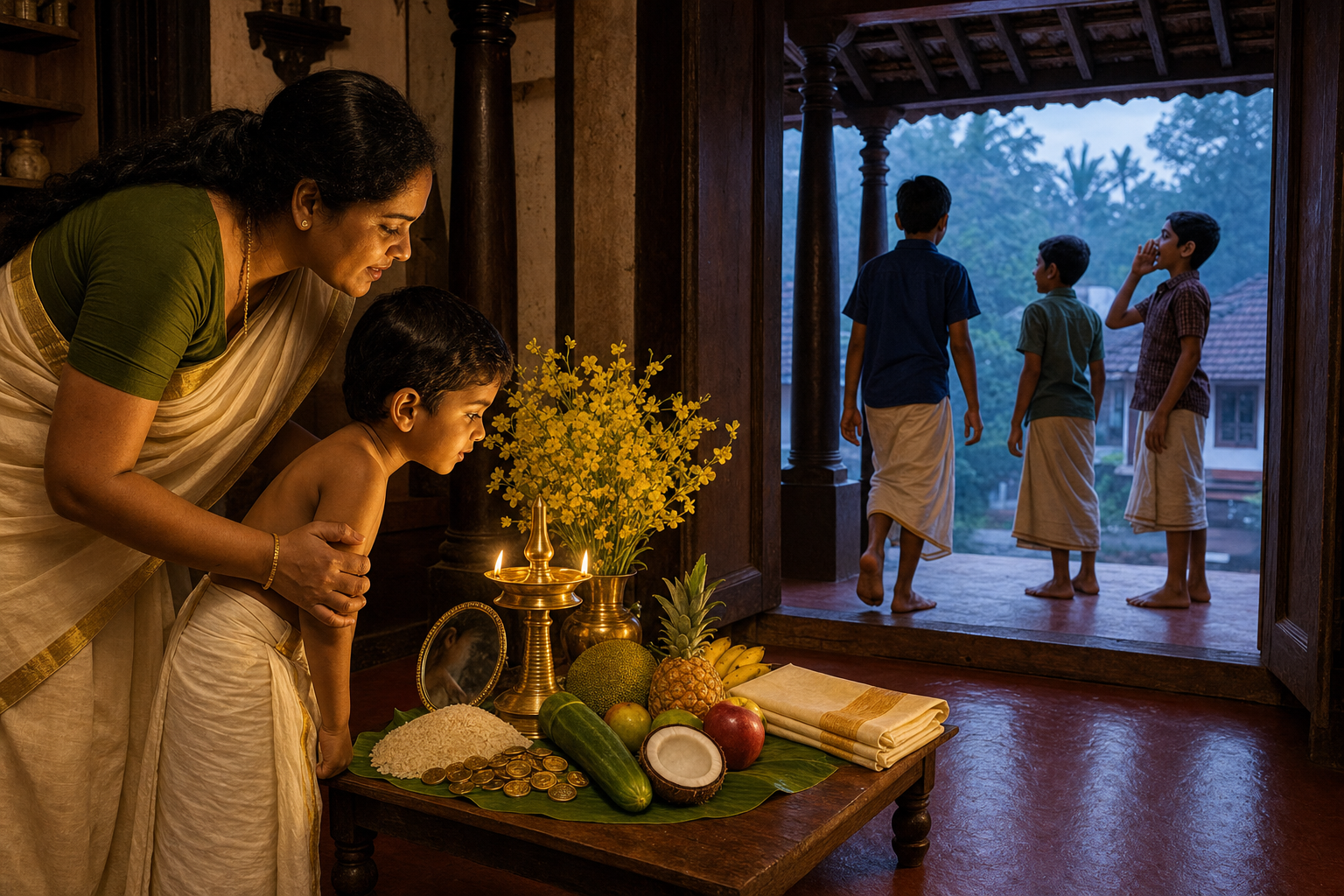
Vishukkani Vili becomes easier to understand when you see it as the second movement of the Vishukkani ritual. The household first receives the year’s auspicious sight. The children then take its goodwill into the lanes of the village.
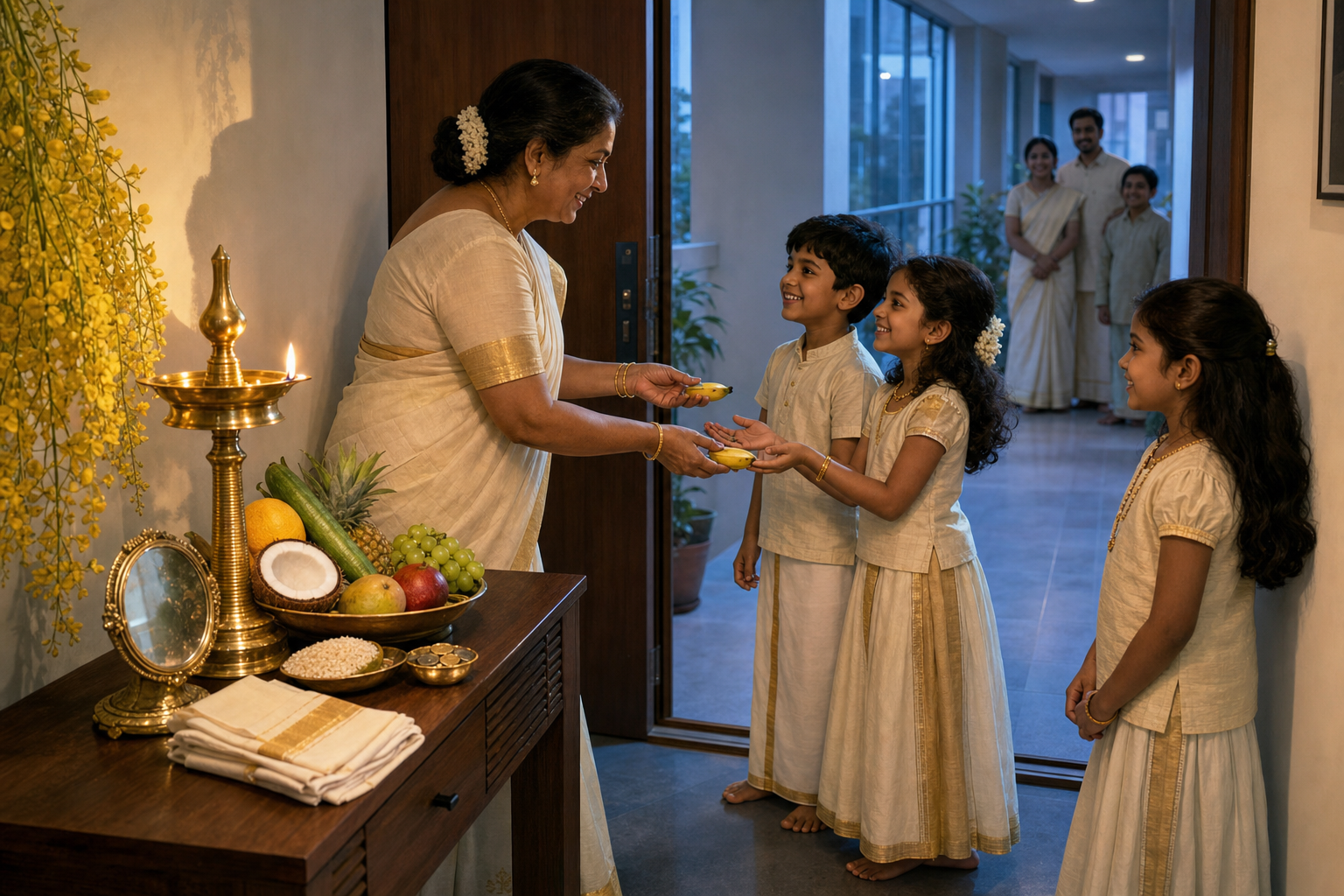
- The Vishukkani is prepared the previous night. A typical arrangement places a lit nilavilakku, a val kannadi or hand mirror, golden kani konna flowers, paddy or rice, seasonal produce, coins or gold, betel leaves and areca nut, a sacred text such as the Bhagavad Gita or Ramayana, and an image or murti of Sri Krishna or Guruvayurappan before the family.
- The family receives the first sight at dawn. Vishukkani means the auspicious first sight. Opening one’s eyes to a carefully composed scene of sacred presence, light, harvest and sufficiency establishes the ritual mood for the new year.
- Children move from house to house in groups. Their repeated call, vishukaniye, vishukaniye, announces that Vishu’s auspiciousness has arrived at another threshold. In some North Malabar hamlets the children add gentle clapping; elsewhere the voice alone is enough.
- The household answers with welcome. Elders may briefly invite the children to see the family Vishukkani and then give vishukkaineettam, fruit, coconut, puffed rice or homemade sweets. The gift is a blessing and an act of hospitality, not payment for a performance.
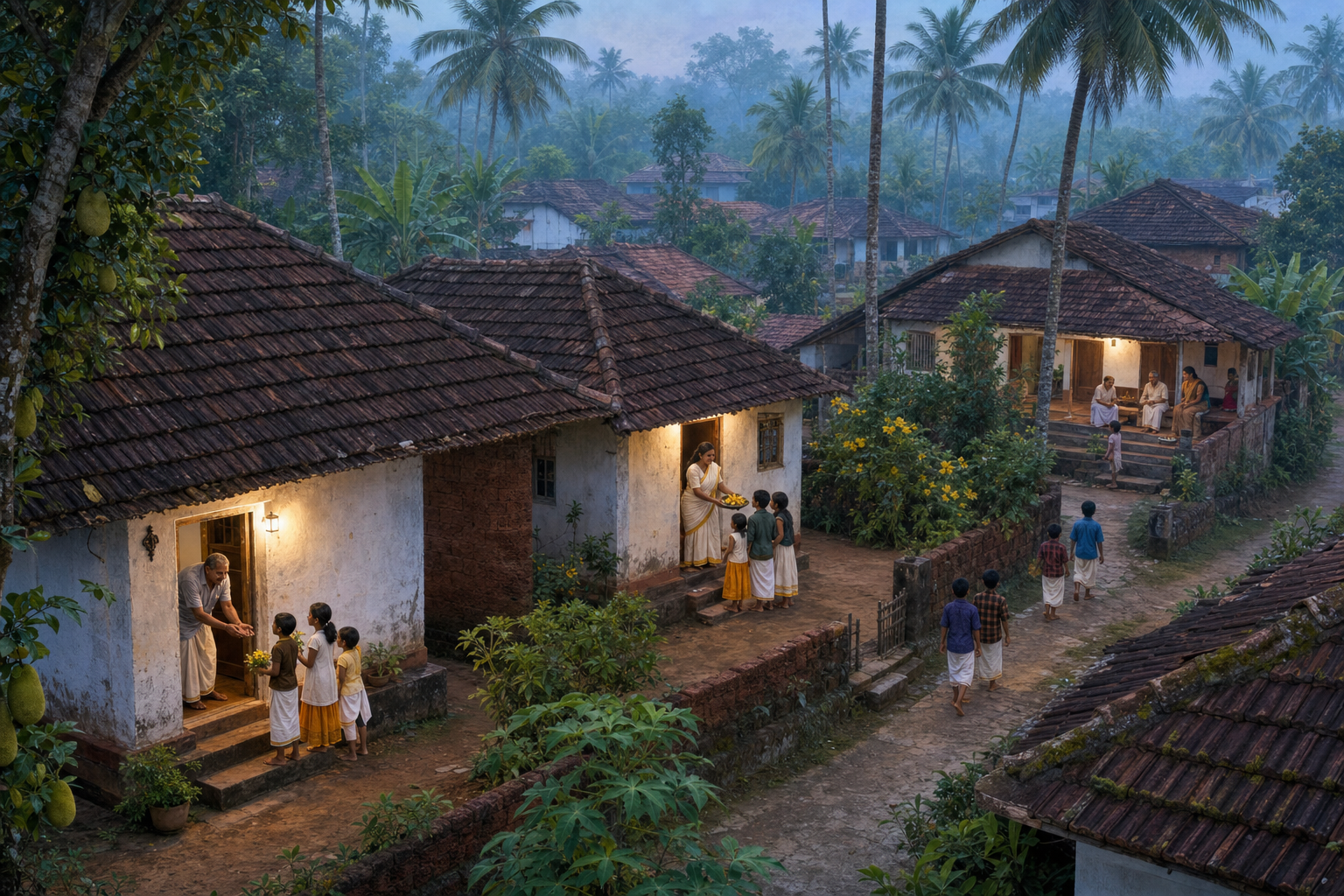
This simple sequence is associated particularly with village communities in Kannur, Kasaragod and the northern parts of Kozhikode. Its recognizable centre is the children’s rhythmic call answered by household goodwill, not elaborate choreography or a fixed public script.
That distinction matters if you are documenting or reviving the custom. Do not correct a local cadence merely because another village claps differently. Ask older residents what children called, which houses they visited, how households responded, and which gifts were customary in that locality. Record those details before designing invitations or schedules. Local variation is part of the inheritance.
Why a private Vishukkani becomes a village blessing
Vishu marks the Sun’s sidereal entry into Medam, corresponding to Mesha Saṅkrānti. It therefore retains an important place as Kerala’s ritual and astronomical new-year marker even though the civil year is often counted from Chingam. The name is etymologically connected with vishuvam, or equinox, while the present observance follows sidereal Aries ingress because precession has separated that ingress from the seasonal equinox.
You do not need to give children a lecture on astronomical precession before the procession. You should, however, avoid describing Vishu as merely Kerala’s version of 1 January. A clearer explanation is that Vishu locates the turning of the year within solar time, local season and household worship. Vishukkani Vili then gives that cosmic marker a social expression.
The kani itself joins several kinds of abundance without reducing prosperity to money. The lamp and sacred image or text establish sanctity. Paddy, rice, fruits and vegetables place cultivation and nourishment in view. Coins or gold acknowledge material means. The mirror, flowers and carefully ordered whole turn these things into something to behold rather than merely possess.
The yellow kani konna is especially important to the sensory memory of Vishu. Its April flowering provides a local seasonal sign, so the new year is encountered not only through a calendar calculation but also through the colour and texture of Kerala’s landscape. When possible, use locally available flowers rather than treating the kani as a shopping checklist detached from place.
Vishukkani Vili adds a third scale to this arrangement. Solar time becomes a household sight, and the household sight becomes a neighbourhood exchange. Children supply the connecting movement. They cross the distance between homes, while each elder answers with dāna, generosity, and mangala, auspicious goodwill.
This is why vishukkaineettam should remain modest. The coin or note represents an elder’s blessing and the passing of responsibility to a younger generation. Bananas, coconut, grains and sweets echo the kani’s language of nourishment and sufficiency. If the children begin comparing who collected the most, bring their attention back to who welcomed them, what they saw, and how the same greeting connected different homes.
A route through the village also reveals something that a private celebration cannot: whether neighbours still recognize one another as participants in a shared moral world. Every answered call says that the children belong at the threshold and that the household accepts a duty to return auspiciousness with generosity.
A faithful way to organize Vishukkani Vili this Vishu
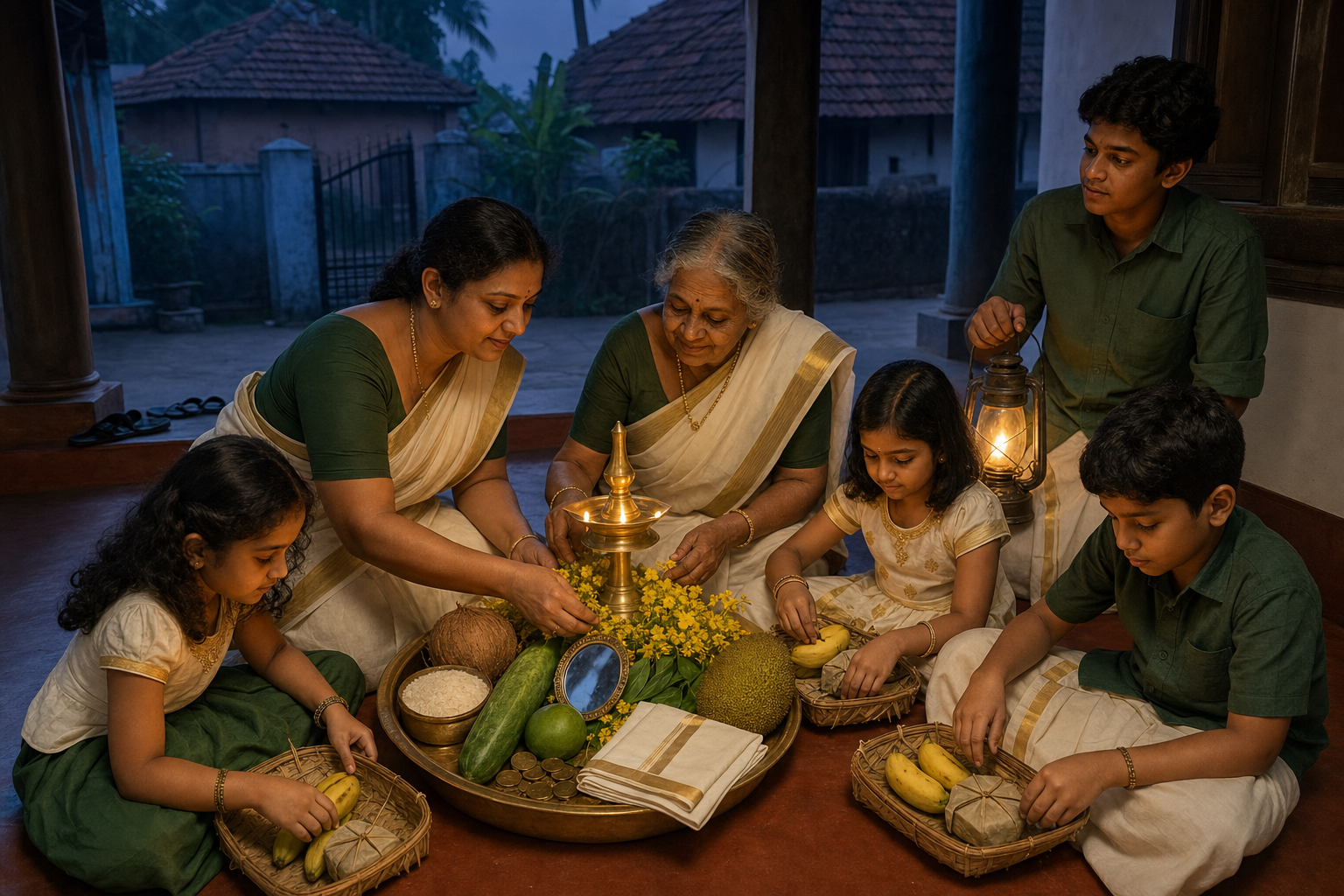
If the practice has faded where you live, start with the smallest complete form. A short route that preserves the call, welcome and blessing carries more meaning than a large cultural event that turns children into performers.
- Recover the local form first. Speak with elders from the same village, ward or family network. Ask for the exact call, its rhythm, whether clapping accompanied it, the usual route, and how a household answered. Where memories differ, retain the variation instead of manufacturing a single authoritative version.
- Prepare participating households. Each family should arrange its own Vishukkani the previous night and decide whether children will be invited to view it. Tell hosts when the group is expected so the threshold encounter remains warm rather than disruptive.
- Choose an early-light route. The custom belongs to Vishu dawn, but visibility and children’s safety matter. Use a clearly understood circuit through participating homes, an apartment compound or a compact diaspora cluster. An adult can remain nearby for safety without taking over the children’s call.
- Keep the vocal form simple. Children need the locally remembered cadence of vishukaniye, vishukaniye, not a staged script. Add gentle clapping only if it belongs to the area’s practice. Amplification, costumes and competitive rehearsal are unnecessary.
- Include every child equitably. Do not reserve the leading place for the most confident child or organize groups by how much they might collect. Shorten the route, pair children who need support, or provide a fixed point of participation when that enables a child with differing abilities to join meaningfully.
- Prepare small gifts in advance. Suitable choices include modest vishukkaineettam, bananas, coconut, puffed rice or homemade sweets. Consistency across children is more important than expense. Avoid turning the exchange into a display of household status.
- Protect the threshold etiquette. Children call from the entrance and wait to be welcomed. A family may offer a brief darshan of its kani, give a blessing and present the gift. No household needs to expose a private worship space, and no child should treat entry or a particular gift as an entitlement.
- Finish without a scoreboard. Do not rank routes, publish collection totals or reward the group that visited the most houses. Let the children talk instead about the calls, flowers, lamps, people and foods they encountered. That conversation preserves cultural memory better than a tally.
Households should also avoid overpackaging. Locally sourced flowers, reusable lamps and minimal wrapping keep the celebration close to the ecological character expressed by the kani. If food requires packaging for hygiene or transport, use only what is necessary rather than creating a separate festive product around every gift.
What must remain, and what can adapt to a new setting
Preservation does not require pretending that an apartment tower or a diaspora temple is a North Malabar village. It requires knowing which elements carry the meaning and which are simply local logistics.
| Keep at the centre | Adapt to the locality |
|---|---|
| Vishukkani prepared for the family’s first sight | The exact combination of customary items that the household can obtain |
| The group call vishukaniye, vishukaniye | Local cadence and the presence or absence of gentle clapping |
| A Vishu-dawn or early-light visit | The length of the circuit and number of participating homes |
| A household welcome and modest blessing or gift | Coins, fruit, coconut, puffed rice or homemade sweets |
| Children as active bearers of the greeting | Nearby adult support, accessibility arrangements and route coordination |
| Shared auspiciousness rather than collection or performance | Village lanes, an apartment compound, a small home cluster or a temple-centred gathering |
Apartment associations can set a brief, clearly communicated circuit within the compound. Participating flats can mark their willingness to receive the group, while homes that need quiet or privacy can opt out without embarrassment. The children still make the call at distinct thresholds; gathering everyone on a stage for one recital would change the relationship that gives the custom its meaning.
Diaspora communities can connect a small cluster of homes or organize a temple-centred sequence in which families form recognizable receiving points. Do not measure authenticity by the number of doors. A handful of genuine welcomes retains more of Vishukkani Vili than an oversized programme in which the call is separated from hospitality.
Photographs may preserve a family record, but they should not make children repeat the call for the camera or hold up every household encounter. The living act comes first: a voice sounds, a door answers, and a blessing passes between generations.
Key takeaways
- Vishukkani Vili carries the auspiciousness of the household Vishukkani into the surrounding community through children’s dawn visits.
- The recognizable call is vishukaniye, vishukaniye; clapping and cadence can vary by locality.
- Vishukkaineettam, fruit, coconut, puffed rice and homemade sweets are blessings within a gift cycle, not payment for entertainment.
- Vishu’s solar timing, the household’s first sight and the village exchange form one connected ritual logic.
- Apartments and diaspora communities can change the route and coordination while keeping the call, welcome, modest gift and inclusive participation intact.
- The best preservation work begins by recording local memory before standardizing or staging anything.
If Vishukkani Vili has become faint where you live, choose one workable circuit before the next Vishu. Ask an elder for the local cadence, invite a few households to prepare, and give the children room to carry the greeting themselves. Success is not the size of the route or the value collected. It is the moment a child calls and a neighbour answers.