
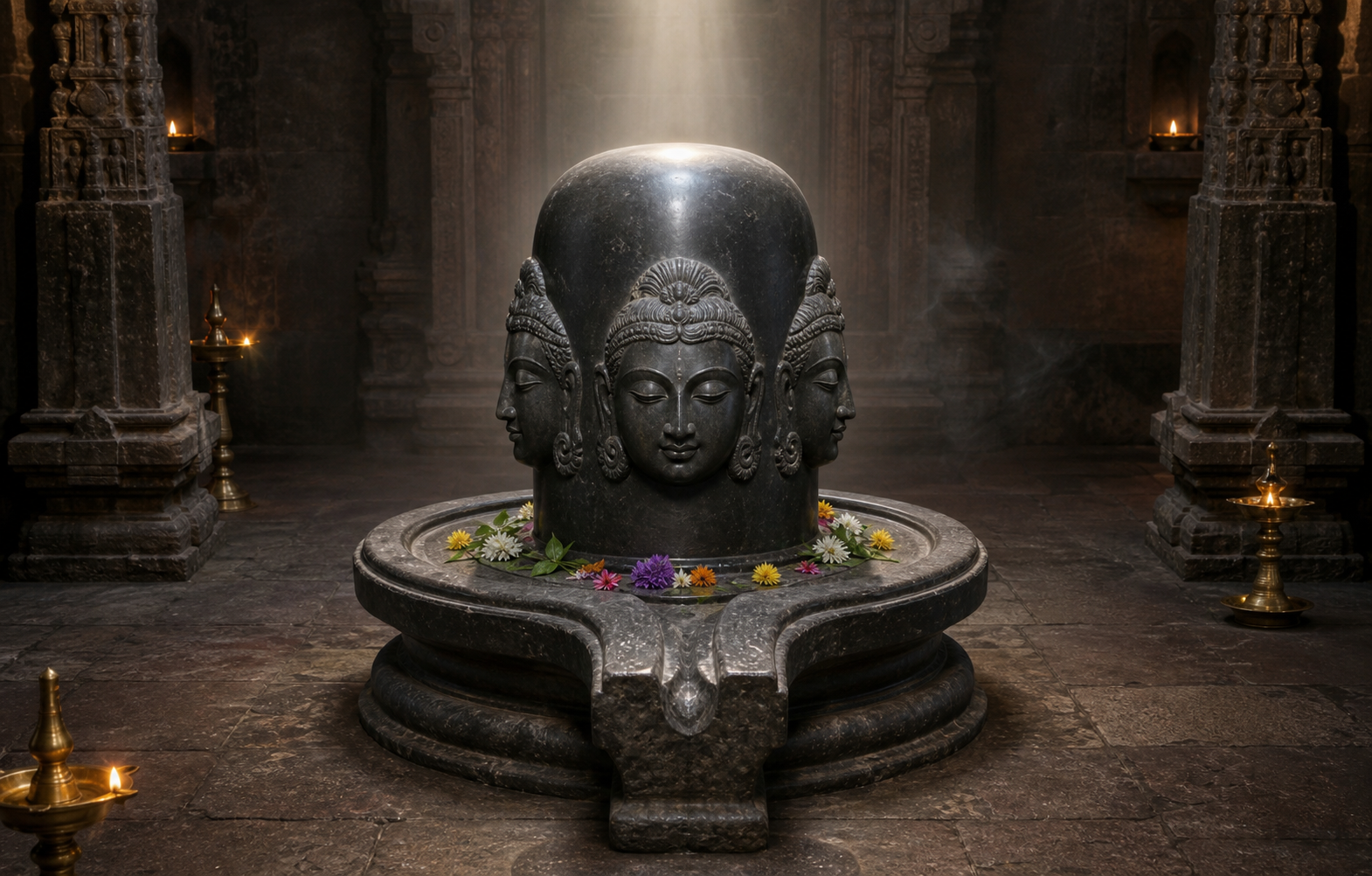
If you have stood before a Panchamukha Shivalinga and counted only four faces, the apparently missing fifth face is the key to the whole form. Ishana does not face another point on the horizon. It opens upward, so its meaning cannot be understood as merely one direction alongside four others.
This is why Ishana is identified with Sadashiva. The name of the face, its position, its cosmic act and its metaphysical meaning all meet at the summit. Once you keep those layers distinct, the icon stops looking like a collection of divine masks and becomes a precise map of manifestation, concealment and liberating grace.
Keep the face, the direction, the act and the tattva distinct
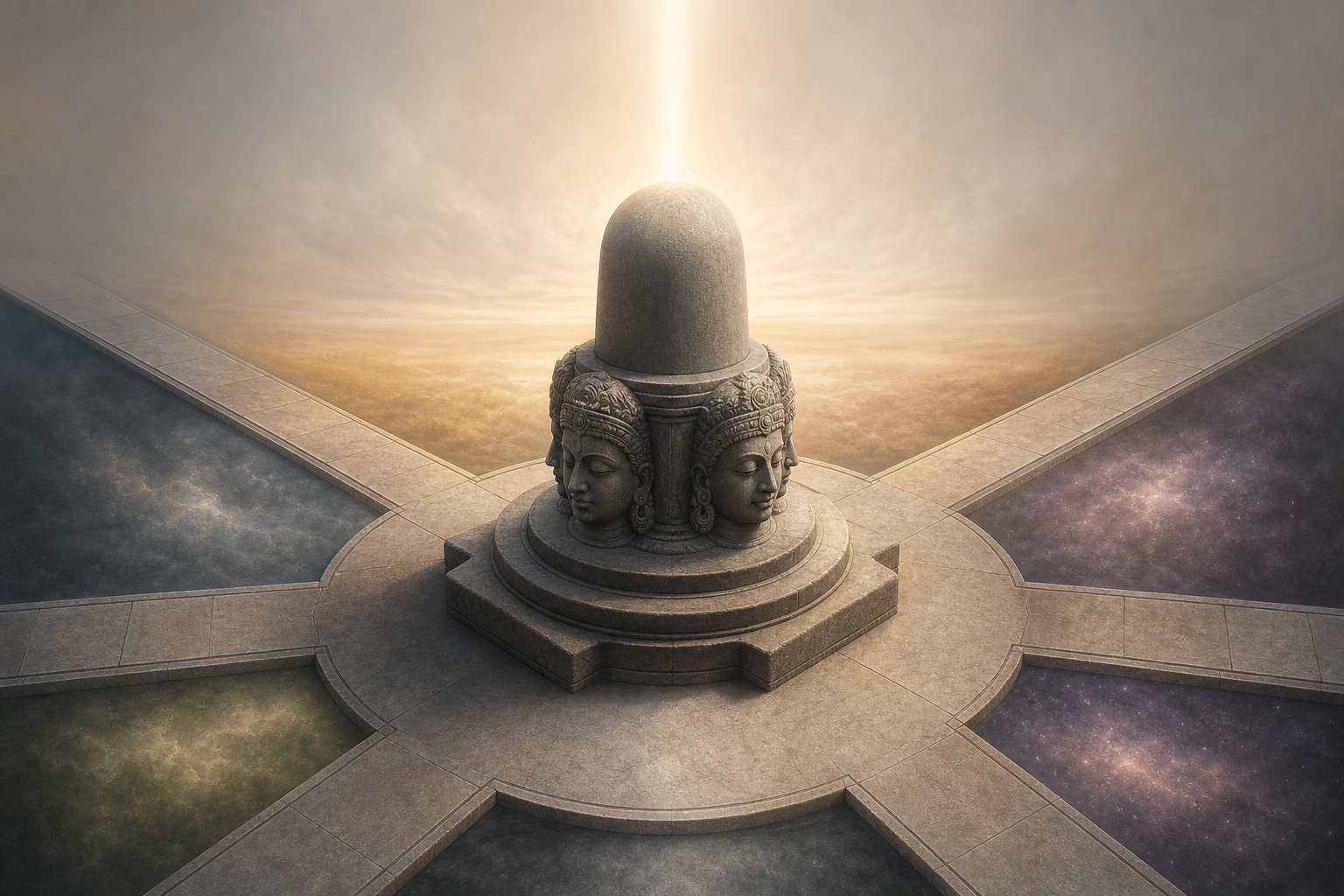
The Panchamukha form presents Shiva through the five Brahmas and five cosmic acts. Sadyojata, Vamadeva, Aghora, Tatpurusha and Ishana are distinct expressions of one Shiva, not five independent gods competing for rank.
| Face | Orientation | Cosmic act | What to notice |
|---|---|---|---|
| Sadyojata | West | Srishti, creation | Forms and conditions arise |
| Vamadeva | North | Sthiti, preservation | What has arisen is sustained |
| Aghora | South | Samhara, dissolution | Form is withdrawn rather than made permanent |
| Tatpurusha | East | Tirodhana, concealment | Reality can be present without being recognized |
| Ishana | Zenith | Anugraha, grace | Concealment is overcome through liberating disclosure |
This is a widely used liturgical mapping, but it should not be turned into a rigid chart with which to correct every temple, manual or lineage. Shaiva traditions preserve variations in their directional and symbolic correspondences. The stable point needed here is that Ishana occupies the zenith and commonly bears the function of anugraha.
Five related terms can now be separated cleanly:
- Ishana identifies the upper Panchabrahma face.
- The zenith is its iconic orientation.
- Anugraha is the cosmic act associated with it.
- Akasha, or space, is its elemental and contemplative correspondence.
- Sadashiva names the ever-auspicious reality disclosed through this culmination.
These are not five interchangeable words. If you ask which face crowns the Panchamukha form, the answer is Ishana. If you ask what theological reality that face manifests, the answer is Sadashiva. If you ask what Shiva does through it, the answer is anugraha. If you ask what kind of field best symbolizes its unbounded character, the answer is akasha.
This distinction also prevents the most common mistake: Sadashiva is not a sixth face placed above the five. Within this schema, Sadashiva is the identity revealed by Ishana, the fifth and upward face.
Why the zenith makes Ishana the face of Sadashiva
A horizontal direction marks a position within a field. East is not west; north is not south. The four lateral faces can therefore articulate distinguishable operations within cosmic manifestation. They tell you how the world arises, continues, returns and becomes veiled.
The zenith changes the grammar. It does not add a fifth competing quarter to the horizon. It points beyond the enclosed field of cardinal opposition. Ishana is therefore supradirectional: present to every direction without being confined to one of them.
Do not read this as a claim that Shiva lives at a physical altitude. The upward orientation is theological rather than geographical. It trains your vision to move from bounded functions toward the consciousness in which every function occurs.
The names reinforce that movement. Ishana comes from a verbal root carrying the sense of ruling or exercising lordship. In this setting, sovereignty does not mean domination by one being over other beings. It means pervasive presence: nothing falls outside Shiva’s awareness. Sadashiva means the ever-auspicious. The term points to beneficence that does not appear briefly and then disappear, but belongs to the nature of pure consciousness itself.
ईशानः सर्वविद्यानाम् ईश्वरः सर्वभूतानाम्
Ishana mantra
The invocation venerates Ishana as lord of all knowledge and lord of all beings. Those two claims belong together. Knowledge is not presented as cold observation from outside the universe, while lordship is not presented as coercion. Ishana knows because consciousness pervades; Ishana cares because no being is outside that pervasive reality. This union of omniscience, sovereignty and auspiciousness explains why the upper face is called Sadashiva.
Akasha carries the same lesson. If you reduce it to the patch of blue sky visible above a temple, you miss its function. Space accommodates forms without becoming any one form. Likewise, Ishana signifies the unbounded awareness within which creation, preservation, dissolution and concealment can appear. Grace is the recognition of that underlying field, not one more event jostling among the other four.
How to read a Panchamukha Shivalinga in a temple or image
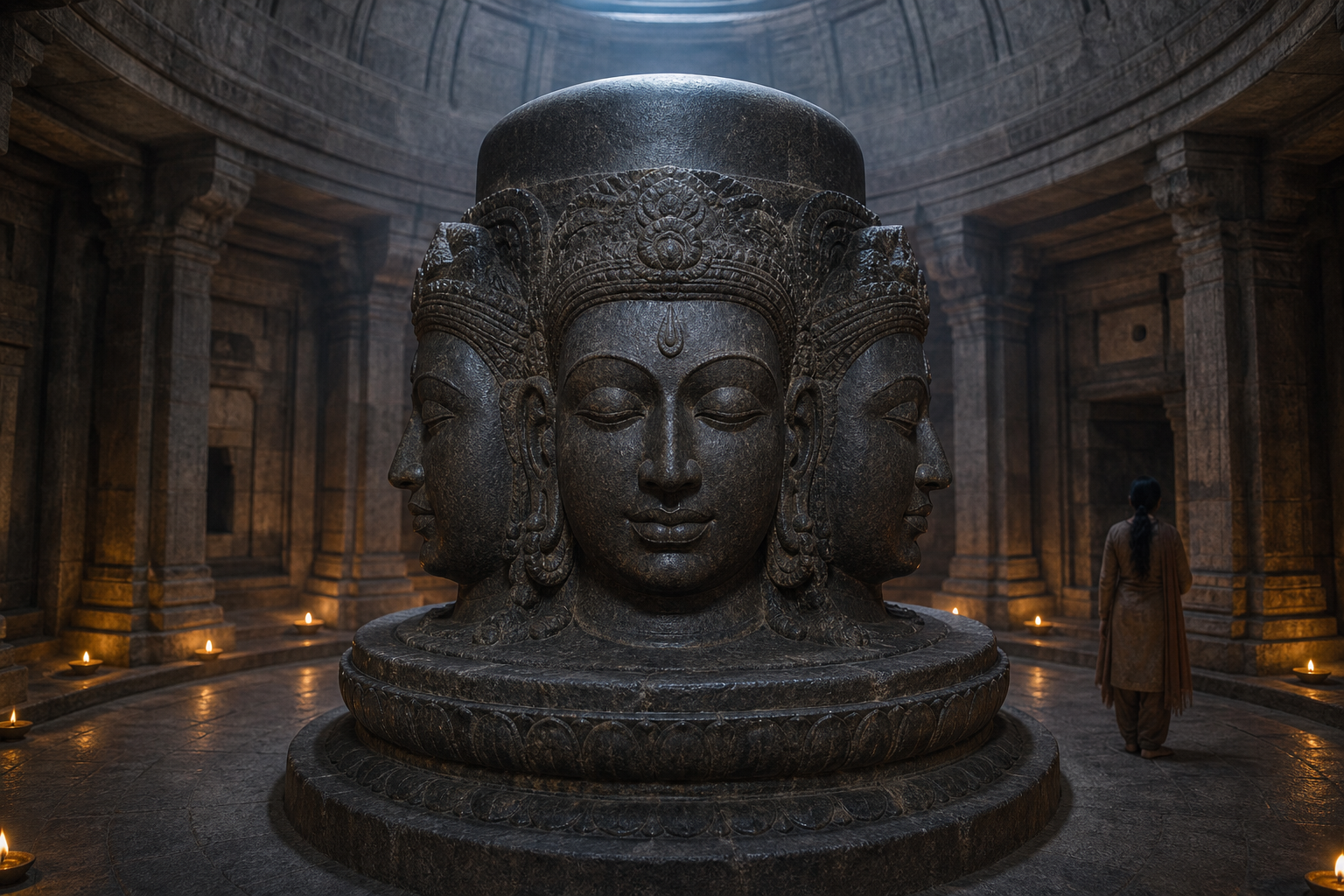
A Panchamukha Shivalinga does not always display five equally accessible profiles. Four faces may emerge from the shaft while Ishana is rendered on, indicated by or understood at the summit. From floor level, the fifth face may be difficult or impossible to see. Its visual elusiveness is meaningful: transcendence is present, but it is not circumscribed by the same horizontal field as the other faces.
Use the following sequence when you encounter the form:
- First distinguish the lateral field from the summit. Do not begin by counting only the profiles visible from your standing position.
- Establish the icon’s orientation if the temple, catalogue or guide identifies it. If no orientation is supplied, do not assign east, west, north and south from facial appearance alone.
- Read the four lateral faces as differentiated cosmic functions. They belong to the manifest field rather than representing four separate Shivas.
- Look to the crown, whether or not a complete face is visible. Ishana completes the form precisely by exceeding the horizontal circuit.
- Connect the summit with anugraha. The final theological movement is not merely upward motion; it is the disclosure that releases consciousness from misrecognition.
This approach is especially useful when viewing a photograph or museum display. A frontal image can make a Panchamukha linga look incomplete because the camera records only one side and often cannot show the apex. Before concluding that a face has been lost or omitted, check whether Ishana is represented at the crown or presupposed by the form.
Ritual makes the same structure audible. In Panchabrahma worship, the invocations move through the differentiated faces and culminate in Ishana. During abhishekam or nyasa, the upward-directed conclusion closes the sacred circuit. The sequence leads the worshipper from the operations governing manifested existence toward the grace by which their ground becomes known.
Watch for that transition when you attend worship. The significant moment is not simply that Ishana is mentioned last. The change in orientation interprets the sequence: creation’s drama does not end in endless concealment, but in the possibility of release.
What Sadashiva tattva adds to the icon
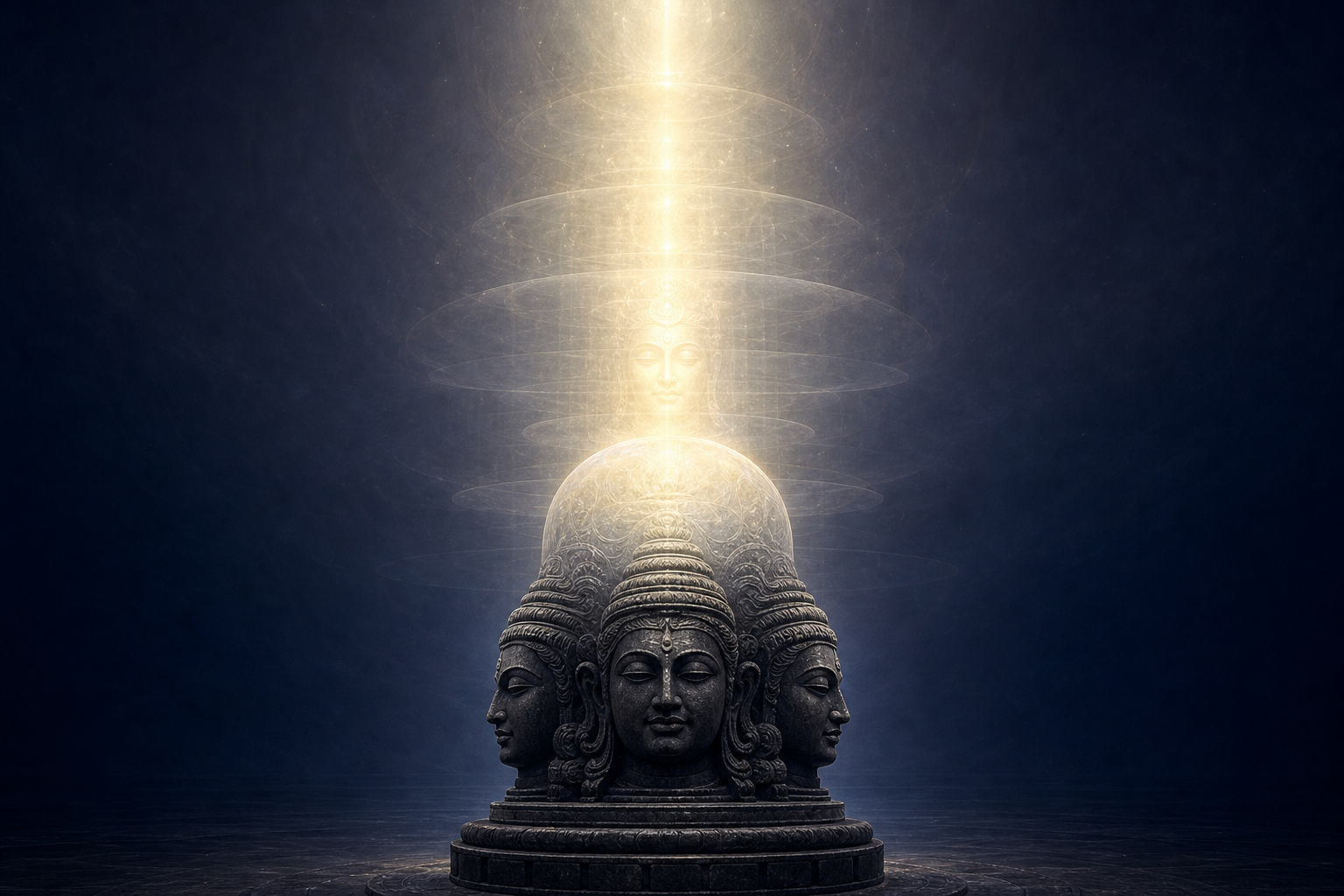
The icon gives you the spatial grammar; tattva theology explains the state of consciousness it expresses. Here it is important not to flatten distinct Shaiva schools into a single vocabulary. Shaiva Siddhanta and Kashmir Shaivism illuminate the Ishana-Sadashiva relationship from related but not identical philosophical architectures.
Sadashiva in Shaiva Siddhanta
Shaiva Siddhanta places Sadashiva within the pure, or shuddha, order above maya. This matters because maya is the field of limitation and differentiation. Sadashiva cannot therefore be understood as another object produced inside that field.
At this level, consciousness shines with unified subjectivity while the universe is already intimated within it. Shiva is not absent from manifestation, yet consciousness is not reduced to a finite object among other objects. Anugraha follows from this purity. Grace is not an occasional mood in the deity or an arbitrary prize awarded from outside; it is the revelatory radiance by which bound awareness is awakened.
When you connect this account to the image, the upward face becomes easier to read. Ishana does not abandon the four cosmic operations. It shows the level from which those operations are held without bondage to them. Sadashiva names that ever-auspicious condition.
Sadashiva in Kashmir Shaivism
Kashmir Shaivism describes Sadashiva tattva through the polarity of aham and idam, the self-luminous subject and the appearing this. At this threshold, aham has primacy, but idam has not been erased. Consciousness recognizes manifestation without surrendering its sovereign luminosity.
The aham here is not the everyday ego defending a personal history. It is universal subjectivity, the awareness by which any limited identity or object can appear. Nor is Sadashiva an empty oneness in which the universe becomes meaningless. The universe is incipiently present, but it is known as inseparable from consciousness.
This provides a particularly exact way to understand grace. Anugraha does not import Shiva into a place where Shiva was previously absent. It removes the failure to recognize consciousness as the ground of experience. Ishana is the face of that disclosure because its upward orientation refuses to confine awareness to any one object, function or direction.
The two lenses should be held with care. You can recognize their shared emphasis on a pure order beyond maya and on grace as revelation without pretending that every technical term has the same role in both systems. When studying a particular commentary or receiving instruction in a lineage, let that system define its own tattva relationships.
Bring the Ishana-Sadashiva distinction into practice
You do not need to reproduce a formal temple rite to benefit from the theology. In fact, a short explanation is not sufficient authority for improvising an Agamic nyasa. If you have received a lineage practice, follow its mantra, sequence and ritual discipline. For personal reflection, use the Panchamukha structure as a contemplative map rather than presenting your exercise as prescribed liturgy.
A simple reflection can proceed as follows:
- Recognize the field around you. The four directions represent the differentiated world in which forms arise, endure and pass away.
- Recall the five acts in order: creation, preservation, dissolution, concealment and grace. Notice that concealment is included in divine activity rather than treated as a power outside Shiva.
- Let the upward direction function symbolically. You are not trying to locate Shiva overhead; you are loosening the habit of treating awareness as one bounded object within experience.
- Rest in spacious attention. Let thoughts arise and dissolve without chasing or suppressing them. Akasha is the cue: awareness accommodates appearances without being exhausted by any appearance.
- Conclude with gratitude and responsibility. If grace discloses a presence shared by all beings, its ethical expression is greater compassion, not spiritual self-importance.
Some contemplative settings connect So’ham with Panchabrahma recollection. If So’ham already belongs to your practice, Ishana can mark the point at which the mantra ceases to be merely a repeated sound and directs attention toward self-luminous awareness. Do not force techniques from different systems into a homemade ritual. The theological principle is portable; formal ritual authority is lineage-specific.
The same distinction can refine ordinary puja. Petition naturally has a place in devotion, but Ishana invites you to end with gratitude rather than another request. Grace, in this theology, is not proof that every desired outcome will occur. It is the possibility of recognizing Shiva through and beyond changing outcomes.
Key takeaways
- Ishana answers which Panchabrahma face crowns the form; Sadashiva answers what that culmination reveals.
- Sadashiva is not a sixth face added to the Panchamukha Shivalinga.
- The zenith signifies transcendence of directional limitation, not a physical location where Shiva resides.
- Anugraha is the fifth cosmic act and the decisive meaning of the Ishana face.
- Akasha symbolizes awareness spacious enough to contain manifestation without being confined by it.
- Shaiva Siddhanta and Kashmir Shaivism offer complementary readings, but their technical vocabularies should not be collapsed.
The next time you see a Panchamukha Shivalinga, begin with one deliberate act: locate the summit before counting the faces. Then read the form from the horizon toward the zenith. That movement will show you why Ishana and Sadashiva meet in one face without becoming merely two names for the same thing in every context.