
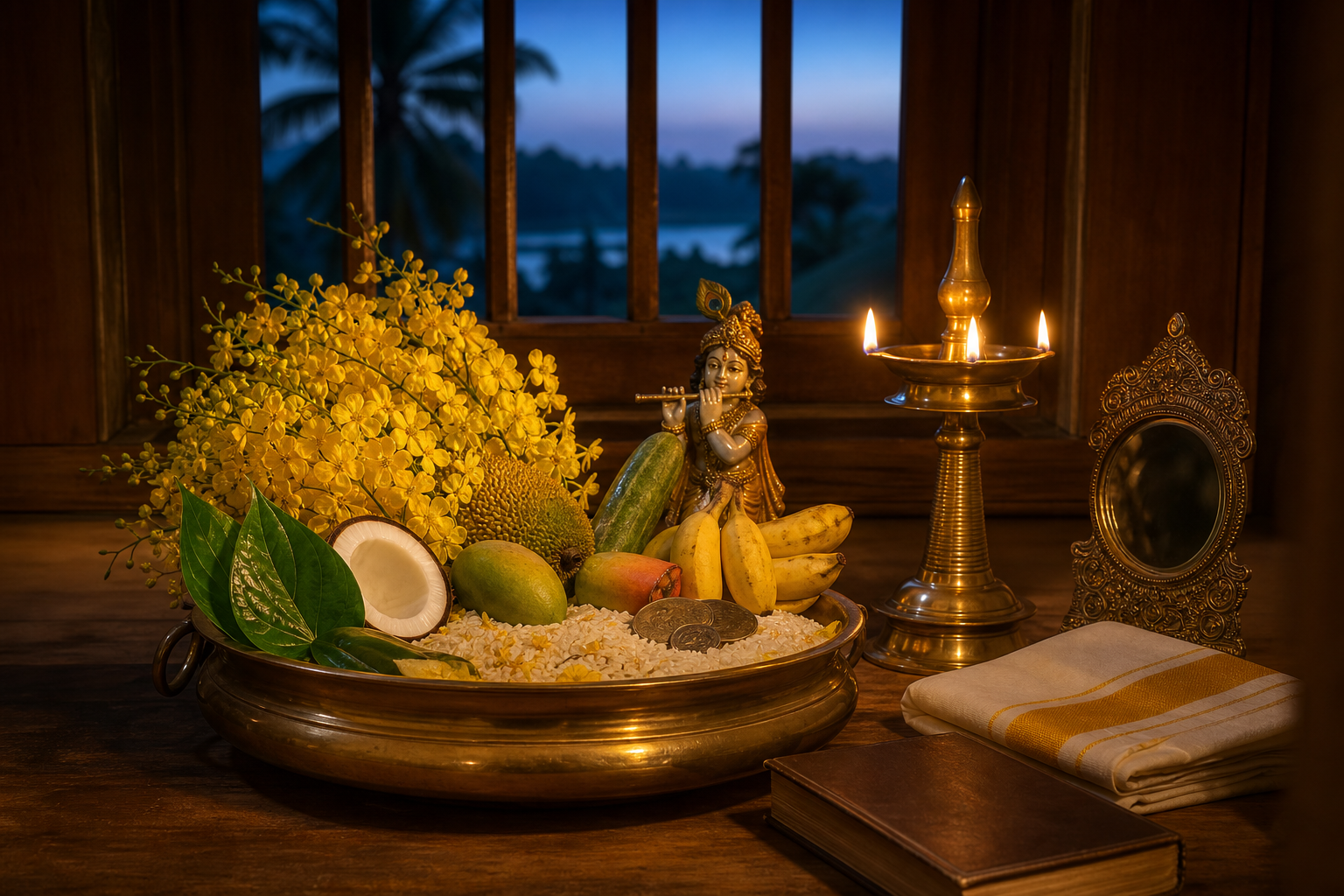
If you are preparing Vishukkani and wondering which details are essential, begin with one distinction: you are not assembling a display for its own sake. You are choosing the first scene your household will meet at the solar year’s threshold.
That makes the practice both simpler and more demanding. A modest kani can be complete when it brings together light, nourishment, self-reflection, knowledge, responsible prosperity, and the golden sign of Kerala’s season. Here is how to prepare it without turning a living tradition into either a shopping list or decorative excess.
Know what Vishu, Vishukkani, and Kanikonna each mean
Vishu is the solar observance. It marks Surya’s passage into sidereal Aries, or Mesha, and the beginning of Medam in Kerala’s solar calendar. It usually falls on April 14 or 15 rather than on a permanently fixed Gregorian date. In 2026, Vishu falls on April 14. Your local panchang or temple announcement should settle the exact observance and dawn schedule for your location.
Vishukkani is the ritual of the first auspicious sight. Kani refers not merely to the objects on an altar but to the act of beholding them at dawn. The family deliberately places light, food, wealth, learning, nature, and the divine within one field of vision. The point is not that a glimpse of valuable objects mechanically guarantees prosperity. The practice trains your first attention of the year toward what ought to be cultivated and shared.
Kanikonna is the golden-flowered tree that gives the kani its unmistakable seasonal identity. Known botanically as Cassia fistula, it flowers across Kerala’s pre-monsoon summer, with peak blooming commonly occurring from March through May. Its pendant yellow clusters make the arrival of Vishu visible in the landscape before any calendar is opened. The meeting of golden blossom, rising sunlight, and the solar new year is why konna is more than an attractive addition to the altar.
Keep the three roles clear and the rest of the observance becomes easier to understand: Vishu tells you when the threshold comes, Vishukkani tells you how to meet it, and Kanikonna brings Kerala’s living season into the ritual.
Build the kani around meanings, not a shopping list
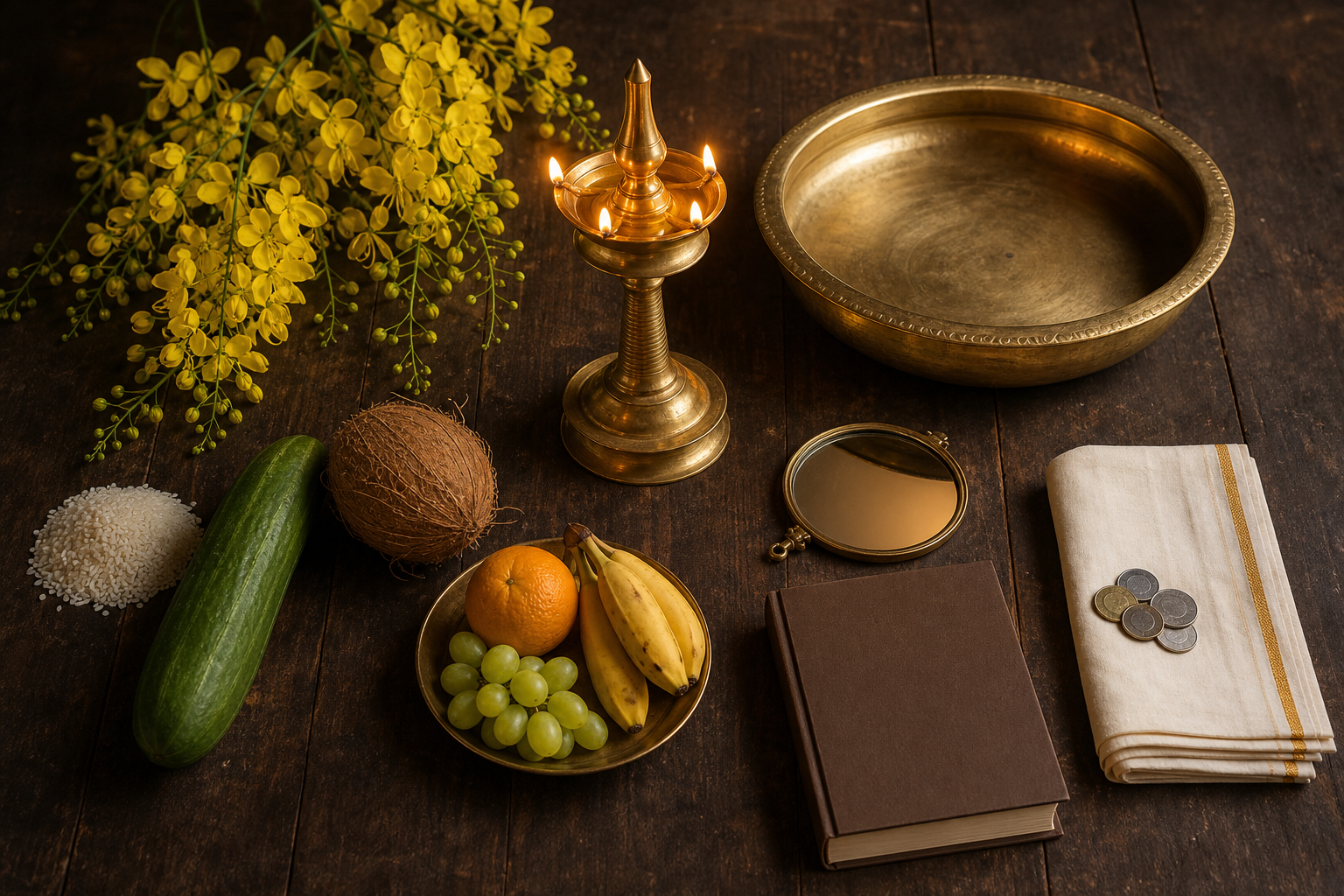
The familiar Vishukkani contains an uruli or another clean metal vessel, rice or grain, seasonal produce, a nilavilakku, a vaalkannadi, coins or gold, sacred literature, a deity’s image or murti, and Kanikonna. Some households also include a nirapara filled with rice, betel leaves and arecanut, or a fresh cloth. These are not random signs of plenty. Each part gives abundance an ethical direction.
| Element | What it places before you | How to use it thoughtfully |
|---|---|---|
| Nilavilakku | Illumination and the removal of inner darkness | Position the flame so it lights the deity, flowers, and mirror without scorching nearby objects. |
| Vaalkannadi or metal mirror | Self-reflection within the sacred scene | Angle it so the flame and divine form are reflected. Make sure its base is secure. |
| Raw rice, paddy, or other grain | Food security, agricultural continuity, and gratitude | Let the vessel appear full, but use an amount that can remain clean and be put to respectful use afterward. |
| Cucumber, mango, jackfruit, plantains, and other seasonal produce | The nourishment offered by land, labour, and season | Use what is locally available and sound. Vishukkani does not require you to buy every named fruit. |
| Coins or gold | Material capacity and responsible prosperity | A few clean coins are sufficient. Do not borrow ornaments or overspend to make the arrangement look affluent. |
| Sacred text | Knowledge as the guide for action | Place a text honoured in your household, such as the Bhagavad Gita or Srimad Bhagavatham, where it receives the lamp’s light. |
| Image or murti of Vishnu or Krishna | The divine centre of the first sight | Arrange the remaining objects around this centre rather than allowing wealth or decoration to dominate it. |
| Kanikonna | Renewal, Surya’s radiance, and Kerala’s season | Place the yellow racemes prominently, but take only the blossoms you need and avoid damaging the tree. |
You do not need a large uruli, expensive jewellery, or a perfect catalogue of produce. If space or availability is limited, preserve the relationships: a steady light, a divine focus, grain or food, a reflective surface, a sign of honest prosperity, a source of sacred knowledge, and fresh flowers. Use a clean vessel you already possess rather than treating Vishu as a reason for competitive consumption.
Composition matters because the kani is meant to be seen as one whole. Place the deity or sacred image at the visual centre. Let the lamp illuminate rather than obscure it. Angle the mirror so it gathers the flame and divine form into its reflection. Use Kanikonna to connect the parts rather than piling the flowers so densely that everything else disappears. A restrained arrangement often expresses the purpose more clearly.
Prepare the night before so the dawn remains undisturbed
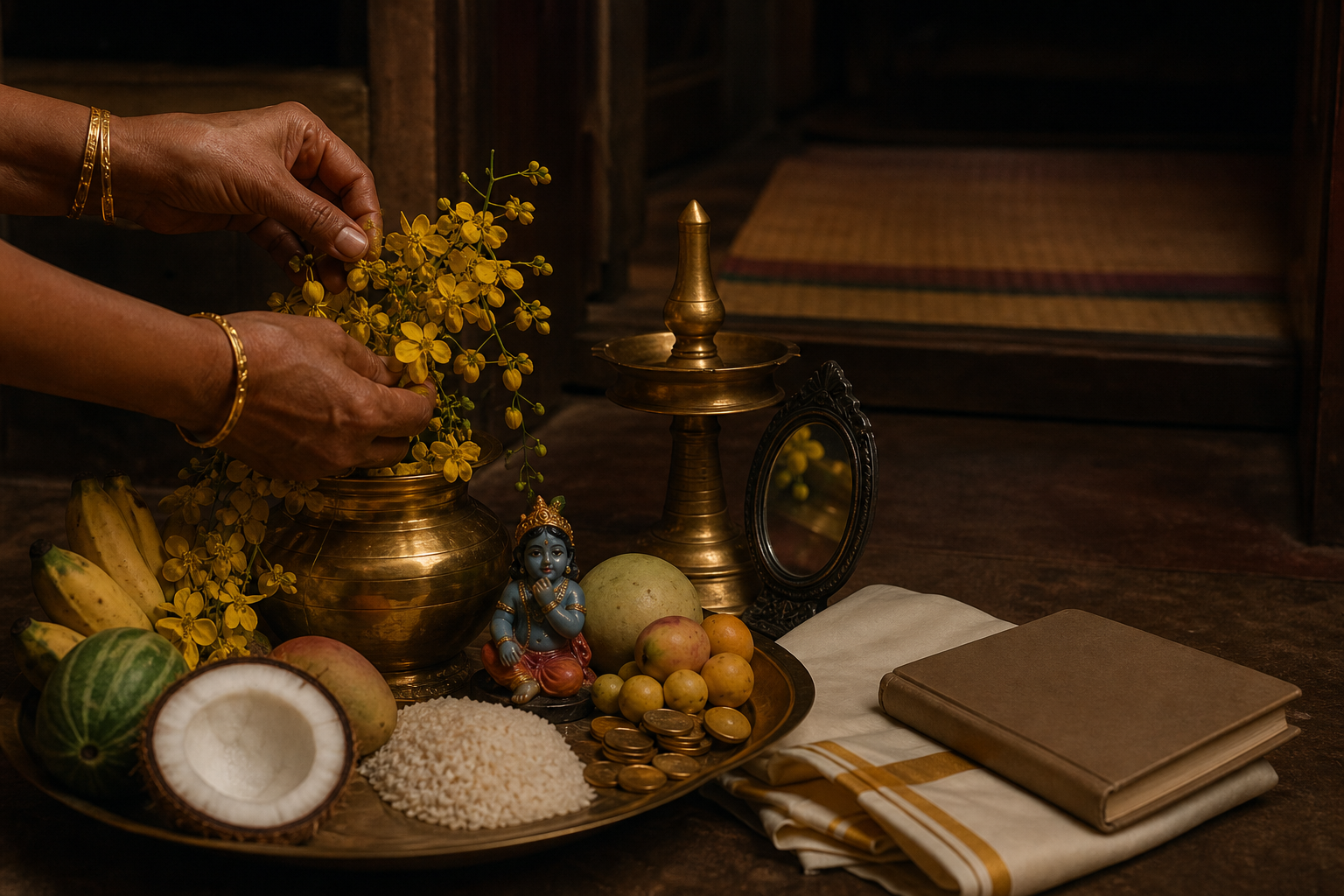
The most common practical mistake is leaving every decision until morning. Vishukkani depends on a quiet first encounter, and that quiet is difficult to preserve if someone is searching for lamp oil, washing fruit, or rearranging a mirror while the household waits. Complete the material work the previous evening.
- Confirm the date and local dawn time. In 2026 the observance is on April 14, but sunrise varies by place. If your family observes the kani during Brahma Muhurta, use a local panchang or a trusted temple notice; the period is traditionally understood as beginning roughly 96 minutes before local sunrise.
- Clean the altar and the area around it. Choose a place where the arrangement can remain undisturbed overnight and where children or pets will not knock it over.
- Place the deity’s image or murti first. If you include a sacred text, handle it reverently and keep it away from oil, flame, damp flowers, and unstable vessels.
- Fill the uruli or other vessel with clean raw rice or grain. Arrange seasonal vegetables and fruit around it. Wash produce early enough for it to be dry before it is placed near a sacred text or polished metal.
- Set the mirror at a stable angle. Test its position using the unlit lamp so you know that it will reflect the flame and divine form when viewed from the family’s standing or seated position.
- Add fresh Kanikonna near the end of the preparation. Keep blossoms in a cool, clean place before arranging them, and prefer fallen or easily reached racemes when collecting your own.
- Prepare fresh wicks and oil, but do not leave the lamp burning unattended overnight. Keep loose cloth, dry leaves, flower wrapping, and other combustible material away from the flame.
- Clear the path from the sleeping area to the altar. If children or elders will approach with their eyes covered, remove stools, cables, vessels, and anything else that could cause a fall.
At the chosen time, light the lamp and pause before bringing the rest of the household. The traditional experience is deliberate: family members are guided with eyes closed or gently covered, then allowed to behold the illuminated kani as their first significant sight. Children should be guided by the hand, never expected to walk blindly on their own.
Let the first moment breathe. You may remain silent, chant the name of Vishnu, or recite a verse from a sacred text according to your family practice. Vishu kaineettam can follow, with elders giving children and dependents coins or modest gifts. This is not merely pocket money attached to a festival. It places generosity immediately after the vision of prosperity and teaches that wealth reaches its dharmic purpose through responsible giving.
The rest of the day may include temple darshan, visits, fireworks where customary and safely permitted, and a Vishu sadya. The meal’s range of tastes gives the household another practical lesson: a good year is not expected to contain sweetness alone. Gratitude and steadiness must be carried through life’s contrasting experiences.
If you plan to receive Vishukkani at a temple
Do not assume that an ordinary opening time or dress practice will apply on Vishu. Check the temple’s verified notice close to the date, arrive early, and expect festival queues. Carry water where permitted, identify a resting place if you are accompanying an elder or young child, and keep enough flexibility that a delayed darshan does not become a source of agitation.
At Guruvayur Sri Krishna Temple, men traditionally enter the inner precincts in a mundu without a shirt, while women commonly wear a sari, set mundu, or modest salwar kameez. Photography is restricted, phones should be silenced, and offerings should go through established counters. Chennai’s Mahalingapuram Ayyappan Temple generally has less restrictive dress expectations, but modest clothing and quiet conduct remain appropriate. Festival schedules at both temples can change to manage the devotional flow, so verify rather than relying on a previous year’s routine.
Treat Kanikonna as a living calendar, not disposable decor
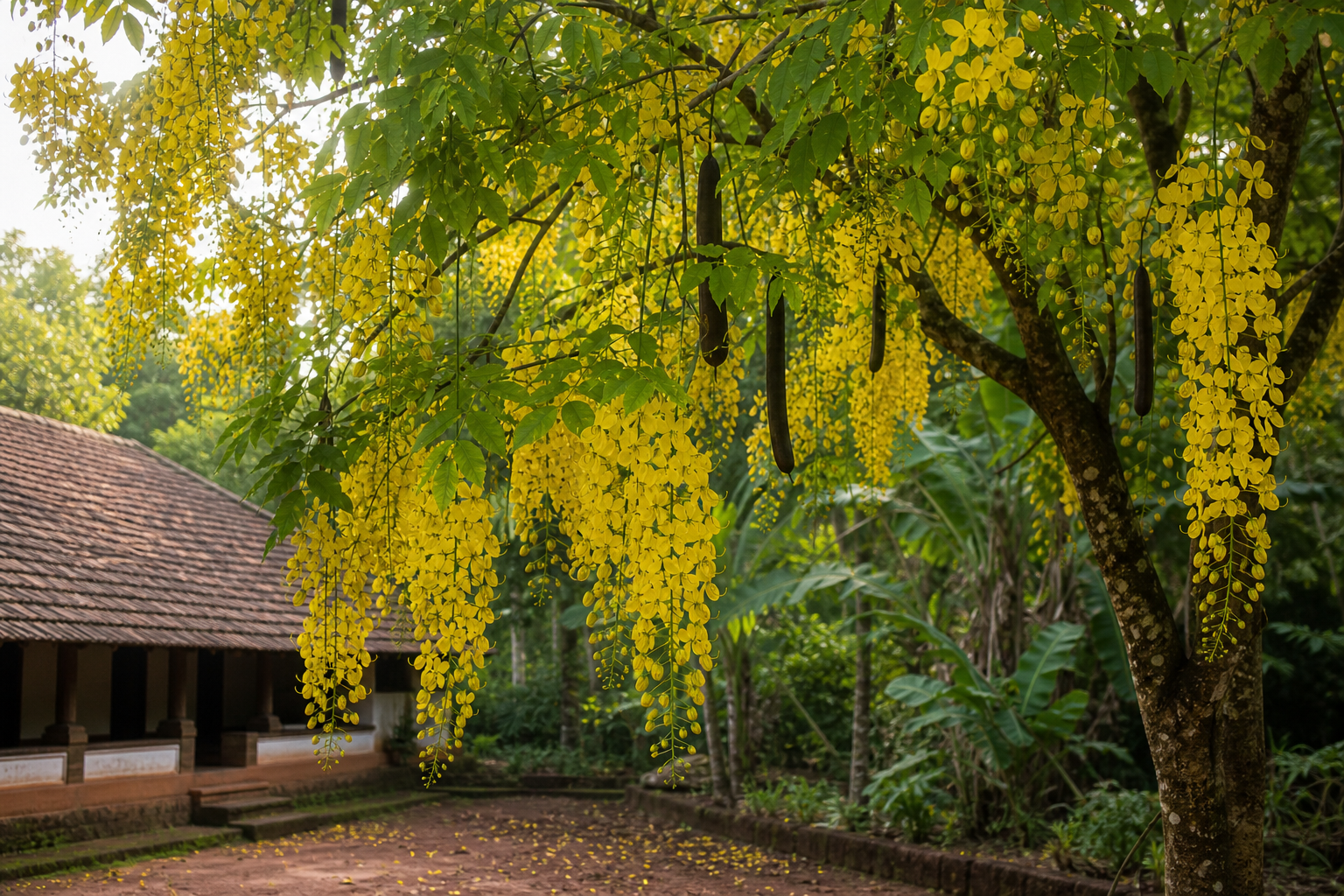
Kanikonna is Kerala’s state flower and one of the region’s clearest seasonal signs. Cassia fistula, a member of the Fabaceae family, is a deciduous tree that commonly reaches 10 to 20 metres. Its bright yellow, five-petalled flowers hang in racemes commonly measuring 20 to 60 centimetres. Long cylindrical pods develop later, holding numerous seeds in dark, sticky pulp.
The tree’s main flowering period comes during the late dry season before the southwest monsoon. Accumulated heat, day length, and moisture stress appear to help coordinate blooming, while altitude and local microclimate can move a particular tree’s display forward or backward by days or weeks. If the tree near you flowers earlier or later than expected, do not read the variation as a bad sign. Kanikonna responds to an actual landscape, not to a printed date alone.
That ecological fact should change how you collect the blossoms. Konna supplies nectar to bees and other insects during a season when floral resources may be limited. Take only enough for your household’s kani. Prefer fallen or easily reached racemes. Do not break young branches, climb an unsafe tree, or strip a public specimen so that one altar can appear more abundant. The flower represents plenitude most convincingly when the living tree remains able to nourish the wider community of life.
If fresh Kanikonna is unavailable where you live, especially in the diaspora, use other fresh yellow flowers as a respectful substitute. Do not pretend that the substitute is konna; explain the difference to children. The honest sentence is simple: this yellow flower carries the place of Kanikonna in our kani this year. That preserves the tradition’s meaning without manufacturing botanical authenticity.
A Kerala oral tradition gives the flower a devotional language. A boy named Unni, moved by stories of Bala Krishna at Ambadi, longs to make a fitting offering. On Vishu morning he finds the Kanikonna in golden bloom and offers its flowers to Krishna. In some tellings the tree bends toward the child; in others the unexpected flowering answers his devotion. Treat this as living folklore rather than a historical report. Its enduring instruction is that sincerity, not grandeur, makes an offering worthy.
Kanikonna also has an Ayurvedic identity under the Sanskrit names Aragvadha and Rajavriksha. Traditional practice uses mature pod pulp as a laxative and employs parts of the plant in certain classical preparations. Ritual familiarity is not medical instruction, however. Do not eat or prepare the pods, pulp, bark, or other parts as a home remedy merely because the tree stands in your garden or its flowers appear in the kani. Correct identification, indication, preparation, and dosage belong with a qualified Ayurvedic practitioner.
See the shared solar rhythm without erasing local traditions
Vishu belongs distinctly to Kerala, but its solar threshold is part of a wider civilizational rhythm. Communities around the same period observe Puthandu in Tamil Nadu, Pohela Boishakh in Bengal, Bohag Bihu in Assam, Pana Sankranti in Odisha, and Vaisakhi in North India and Sikh tradition. Their rituals are not interchangeable. Their proximity nevertheless reveals how regional calendars can answer one celestial transition through different languages, foods, histories, and forms of worship.
The golden shower tree carries another connection beyond Bharat. In Thailand it is known as dok khun or Ratchaphruek and is honoured as the national flower, with its golden colour associated with prosperity and merit in a Theravada Buddhist setting. You do not need to claim that every culture gives the tree the same meaning. The more useful insight is that seasonal beauty can become an ethical reminder in more than one Dharmic society: receive abundance with gratitude, use it with restraint, and let renewal improve conduct.
Key takeaways
- Vishu is the solar threshold, Vishukkani is the first-sight observance, and Kanikonna is the seasonal flower at its visual centre.
- For 2026, Vishu falls on April 14. Use a local panchang or verified temple notice to determine the correct dawn timing where you live.
- Prepare the altar, grain, produce, mirror, flowers, sacred text, and unlit lamp on the previous evening so the morning can remain quiet.
- Arrange each object for what it asks you to practise: illumination, nourishment, reflection, knowledge, generosity, and responsible prosperity.
- If Kanikonna is unavailable, a fresh yellow flower is a respectful substitute. Name it honestly instead of presenting it as the traditional species.
- Harvest sparingly, avoid breaking branches, and remember that the blossoms still belong to a living tree and its pollinators.
Before the next Vishu dawn, choose one intention for each major element in your kani: what you will learn, what you will share, what you will protect, and what darkness you will work to remove. Then the first sight will not end when you turn away from the lamp. It will give you a practical measure for the year that follows.
References
- DharmaRenaissance Blog – Vishu’s Timeless Golden Bloom: Kanikonna’s Legend, Botany, and Shared Dharmic Symbolism
- DharmaRenaissance Blog – Vishukkani Darshan 2026: Sacred Sunrise at Guruvayur and Chennai Mahalingapuram – A Complete Guide