
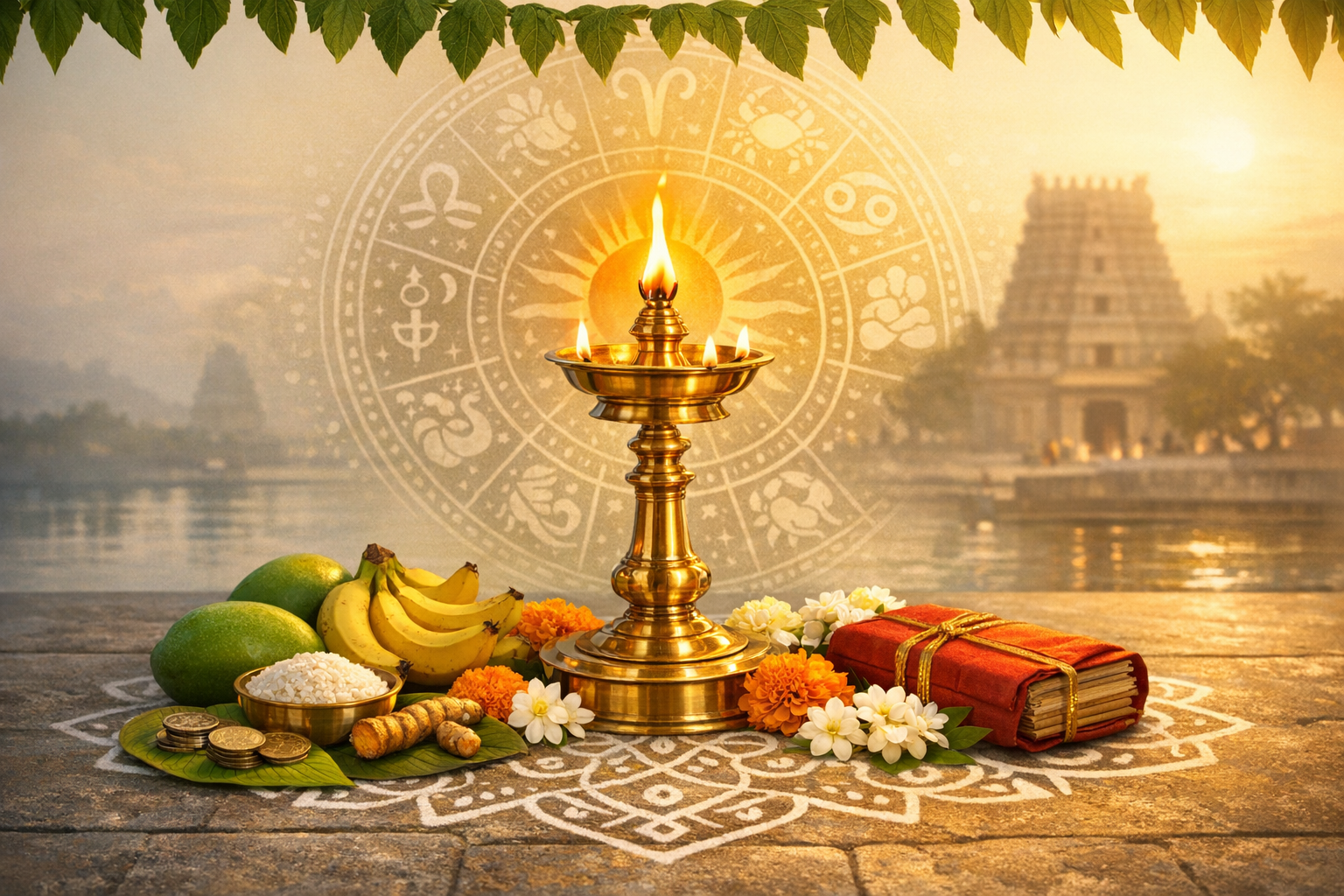
Puthandu 2026, also known as Chithirai Vishu or Varusha Pirappu, arrives on 14 April 2026 with the Sun’s ingress into sidereal Mesha (Mesha Sankranti), inaugurating the Tamil Varuda that runs from Chithirai 1 through the last day of Panguni Masam. This Varuda carries the traditional cyclical name Parabhava Nama Varsha in the 60-year Samvatsara sequence. Across Tamil households and the global Tamil diaspora, this day blends solemn ritual, familial warmth, and a forward-looking spirit grounded in dharmic values that prize self-cultivation, community harmony, and reverence for knowledge.
While Puthandu is Tamil Nadu’s solar New Year, it resonates across the dharmic world. In Kerala, Vishu aligns closely; in Sri Lanka and Southeast Asia, cognate solar New Year observances occur in mid-April; and Sikh communities mark Vaisakhi at the same seasonal threshold. This convergence underscores a shared Indic time-reckoning that links Hinduism, Buddhism, Jainism, and Sikhism through cyclical rhythms of nature, gratitude for harvests, and practices that cultivate compassion, restraint, and clarity of purpose.
From an astronomical and calendrical perspective, the Tamil calendar is solar-sidereal, guided by Surya’s entry into Mesha. Chithirai marks the opening month, followed sequentially by Vaikasi, Aani, Aadi, Avani, Purattasi, Aippasi, Karthigai, Margazhi, Thai, Maasi, and Panguni. Almanac calculations in Tamil Panchangam (often derived from Drik or Thirukkanitha methods) determine the precise Sankranti timing, sunrise considerations, and day-long observances. The label Parabhava Nama Varsha functions as a mnemonic and cultural marker rather than a rigid determinant of outcomes; individual effort and ethical intent remain paramount in dharmic thought.
Varuda Rasipalan 2026–2027 is traditionally assessed by tracking slow-moving graha transits. Most of this Tamil year sees Shani in Meena (Pisces), emphasizing contemplative discipline, water-related themes, and long-horizon commitments. Guru (Jupiter) begins in Mithuna (Gemini) and moves into Karka (Cancer), its exaltation sign, approximately around mid-2026 (dates vary by ayanamsa and local Panchangam); this shift typically enhances education, nourishment, and protective influences. Rahu remains in Kumbha (Aquarius) for much of 2026 before transiting to Makara (Capricorn) near the close of the calendar year, with Ketu correspondingly moving from Simha (Leo) to Karka (Cancer). These transits form the technical backdrop for Rasi-based guidance below, which should be treated as general orientation rather than individual horoscope judgment.
Methodologically, year-ahead Rasi Palan emphasizes Guru’s and Shani’s drishti (aspects), nodal axes, and how these shape the 12 houses from each Rasi. Quarterly and monthly nuances often hinge on faster-moving grahas (Budha, Shukra, Kuja) and periodic retrogrades. Given Panchang variations and regional traditions, muhurta planningespecially for marriage, griha pravesh, investments, and upanayanambenefits from consulting a local scholar who uses your place-specific Panchang and, where desired, your individual chart.
Mesha Rashi: The year opens with Guru in Mithuna (third from Mesha), spurring skill-building, networking, and short-distance coordination. After Guru’s move to Karka (fourth), domestic comfort, property decisions, and inner stability receive a lift. With Shani in Meena (twelfth), prudent budgeting, sleep hygiene, and spiritual practice are beneficial. Health routines that emphasize breath, moderation, and regularity reduce fatigue. Family relationships gain from patient dialogue and acts of service.
Vrishabha Rashi: Early-year Guru in Mithuna fortifies second-house themesspeech, savings discipline, and steady nourishmentwhile later transit to Karka (third) can activate learning sprints, certifications, and purposeful travel. Shani in Meena (eleventh) favors structured gains from networks and institutions, provided expectations remain realistic. Agricultural, food-related, and artisan ventures benefit from incremental scaling. Periods of mental busyness respond well to contemplative pauses.
Mithuna Rashi: With Guru initially in Mithuna and then into Karka (second), confidence, counsel-giving, and tangible resource-building come to the foreground. Shani in Meena (tenth) demands professionalism, documentation, and clear boundaries at work. Health-wise, sustainable routinesnot sudden overhaulsprove durable. Family responsibility may expand; careful calendaring avoids burnout. Ethical speech and fair dealing become quiet catalysts for growth.
Karka Rashi: Early Guru in Mithuna (twelfth) indicates expense control, rest, and inward study; the subsequent exalted Guru in Karka is auspicious for visibility, education, and renewed vitality. Shani in Meena (ninth) guides long-range learning, pilgrimage planning, and alignment with mentors. Domestic decisions mature after mid-year. A measured digital diet and consistent sleep support emotional equilibrium, a hallmark need for this watery sign.
Simha Rashi: Guru in Mithuna (eleventh) first supports aspirations, senior guidance, and collaborative gains; later, Guru in Karka (twelfth) advises measured spending and discreet preparation. With Shani in Meena (eighth), resilience, research, and intergenerational planning come into focus. Rahu’s presence in Simha’s opposite sign until late 2026 can create relational crosscurrents; clarity and compassionate listening steady partnerships. Energy management through disciplined daily habits is key.
Kanya Rashi: Guru in Mithuna (tenth) endorses professional elevation through teaching, advisory work, or process excellence; after the move to Karka (eleventh), networks mature and peer recognition grows. Shani in Meena (seventh) requires steadiness and fairness in agreements, with careful attention to timelines and shared duties. Digestive balance, ergonomic care, and mindful breaks maintain stamina. Academic and vocational skills strengthen through iterative practice.
Tula Rashi: Guru in Mithuna (ninth) uplifts dharma, higher education, and purposeful travel; its shift to Karka (tenth) can crystallize responsibilities and leadership. Shani in Meena (sixth) is often favorable for conquering clutter, health lapses, and litigation when combined with steady effort. The year rewards routine service, accuracy in records, and empathic teamwork. Family elders’ counsel proves especially helpful around key decisions.
Vrischika Rashi: Guru in Mithuna (eighth) initially invites research depth, documentation, and financial prudence; once in Karka (ninth), blessings flow through learning, teachers, and merit-building actions. Shani in Meena (fifth) emphasizes patient mentorship, children’s education, and creative discipline. Emotional intensity is shaped by reflective practice and tangible seva. Measured risk-taking, not impulsivity, preserves gains.
Dhanu Rashi: Guru in Mithuna (seventh) engages partnerships, contracts, and public interface; transit to Karka (eighth) subsequently advises privacy in financial negotiations and a focus on health insurance, compliance, and safeguards. Shani in Meena (fourth) highlights responsibilities at home, real-estate organization, and elder care. Grounding rituals around sunrise or sunset stabilize mood and decision quality.
Makara Rashi: Guru in Mithuna (sixth) encourages systems thinking to handle workload and wellness; after moving to Karka (seventh), relationship building, client rapport, and diplomacy strengthen. Shani in Meena (third) rewards persistent effort, documentation, and skill iteration. Siblings and colleagues become allies through clear, timely communication. Moderation in diet and posture-aware work habits enhance stamina.
Kumbha Rashi: Guru in Mithuna (fifth) inspires study, pedagogy, and creative problem-solving; shift to Karka (sixth) advises methodical health maintenance and efficiency upgrades. Shani in Meena (second) underlines budget clarity, ethical speech, and long-term resource planning. With Rahu in Kumbha for much of 2026, curiosity can scatter unless channeled; choosing a few high-impact goals curbs diffusion of effort.
Meena Rashi: Early Guru in Mithuna (fourth) spotlights home learning, comfort upgrades, and environmental balance; the move to Karka (fifth) is auspicious for education, progeny matters, and refined arts. Shani transiting Meena (first) prioritizes sober self-assessment, posture and foot care, and steady life-architecture. A balanced weekly rhythmcombining work, study, physical movement, and quietudeproves transformative over the Varuda.
Festivals across the Tamil months punctuate the year’s rhythm with study, devotion, and community service. Chithirai opens with Puthandu and the famed Chithirai Thiruvizha in Madurai. Vaikasi celebrates Vaikasi Visakam with devotion to Murugan. Aani features Aani Uthiram and special abhishekam to Nataraja. Aadi highlights Aadi Perukku and Amman festivals that honor rivers and fertility. Avani includes Avani Avittam and Gokulashtami, while Purattasi is cherished for its Perumal Saturdays and ancestor remembrance at Mahalaya Amavasya.
Aippasi often hosts Deepavali and Skanda Shashti vratam, followed by Karthigai Deepam, especially grand at Tiruvannamalai. Margazhi is the devotional heart of the year, with Vaikunta Ekadashi, Tiruppavai recitation, and Arudra Darisanam. Thai brings Pongal, Mattu Pongal, and Kaanum Pongal, uniting agrarian gratitude with family bonding, and culminates in the fervor of Thai Poosam. Maasi features Maasi Magam’s sacred bathing rites and often Mahashivaratri. Panguni Uthiram celebrates divine marriages and consummation of vows, gracefully closing the Varuda.
Because muhurta quality depends on Panchang variablestithi, vara, nakshatra, yoga, karanatogether with sunrise at a given locale, individuals planning marriages, griha pravesh, or major openings should consult a regional Panchangam. Avoiding major dosha combinations and eclipsed periods while favoring strong lunar paksha and compatible nakshatra pairs remains a time-tested approach. When personal charts are considered, alignment between transits and natal strengths further refines timing.
Rituals on Puthandu often include a lamp-lit altar with fruits, flowers, grains, coins, and scriptures, symbolizing abundance and learning at the year’s outset. Simple Panchopacharagandha, pushpa, dhupa, deepa, naivedyaembodies gratitude and restraint. Traditional foods prepared mindfully nurture satva. Many families begin the Varuda with annadanam or small acts of service, honoring the dharmic thread that binds Hinduism, Buddhism, Jainism, and Sikhism: compassion, non-harm, truthfulness, and disciplined self-cultivation.
Health and well-being across 2026–2027 benefit from steady breathwork, posture awareness, and seasonal diets that respect local climate. Saturn’s placement in watery Meena invites attention to sleep, hydration, and gentle endurance practices such as walking and yoga asanas. Jupiter’s mid-year strengthening in Karka supports education, caregiving, and nourishment; channeling this into planned study, community teaching, and family care yields outsized returns.
For students and professionals, the Varuda favors deliberate goal-setting in Chithirai, execution sprints in Vaikasi and Aani, consolidation in Aadi and Avani, and thoughtful review at Purattasi’s cusp. The devotional arc from Aippasi through Margazhi steadies attention and deepens purpose, while Thai and Maasi are favorable for skill application, outreach, and ethical enterprise. Panguni’s vows and thanksgiving close the cycle with clarity and gratitude.
As with all Rasipalan, these indications are cultural and pedagogical rather than fatalistic. Individual agency, ethical conduct, learning under able teachers, and regular self-audit shape outcomes more powerfully than transient celestial factors. In that spirit, Puthandu offers a luminous starting point: to study sincerely, serve generously, and walk a path that honors the unity in India’s dharmic traditions while celebrating the diversity of their practices.
Inspired by this post on Hindu Pad.
