
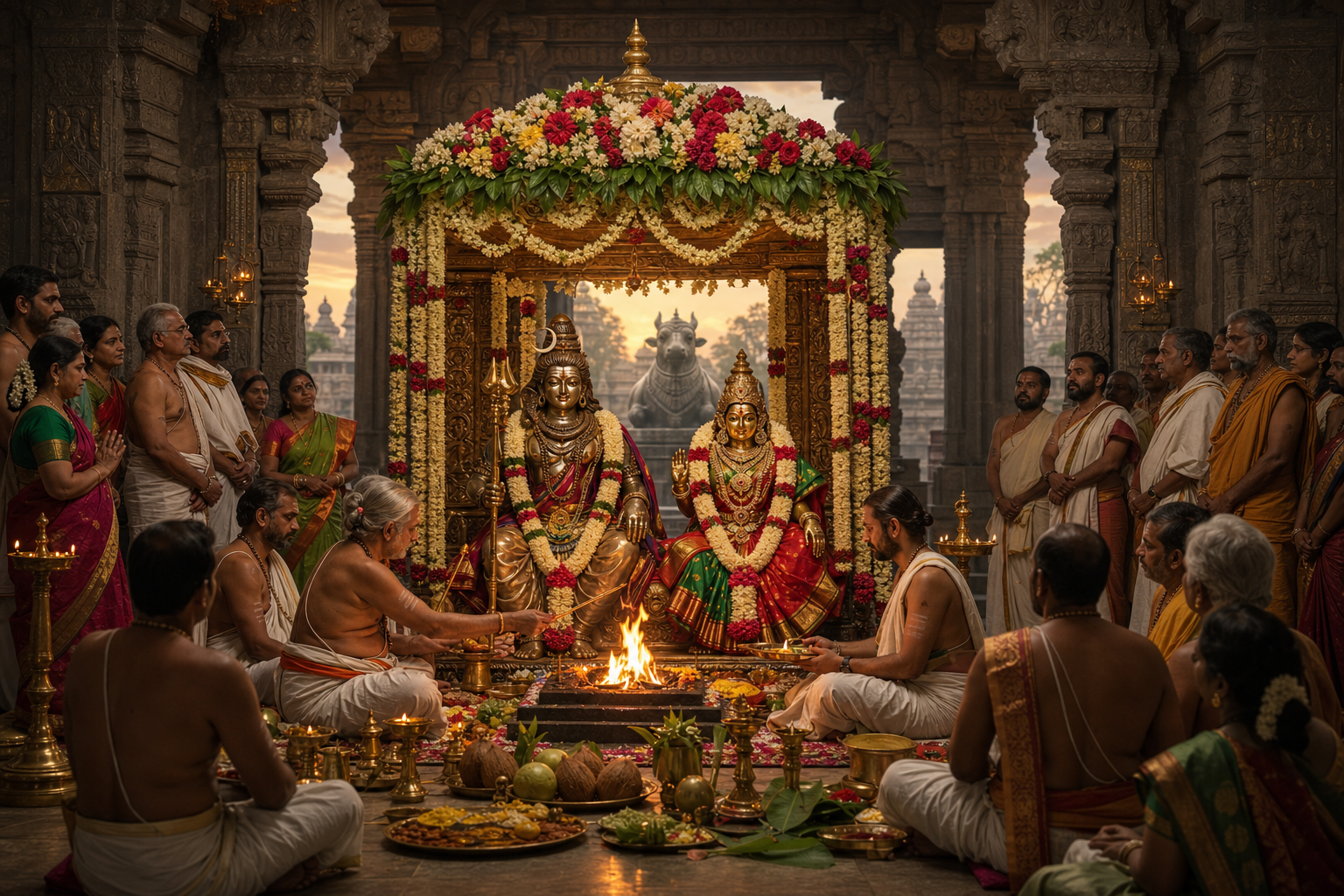
You see a temple announce Shiva-Parvati Kalyanam, but the notice leaves practical questions unanswered. Is the wedding held during the Maha Shivaratri vigil or the next day? Are you meant to fast through it? What should you watch for when the priests begin a sequence of unfamiliar rites?
The first step is to separate the local schedule from the deeper pattern. Your temple’s calendar decides when the ceremony occurs. The tradition itself shows you how Shiva’s inward freedom and Parvati’s creative power belong together—and how that union should change the way you approach relationships, duties, and spiritual practice.
First, separate the Shivaratri vigil from the Kalyanam
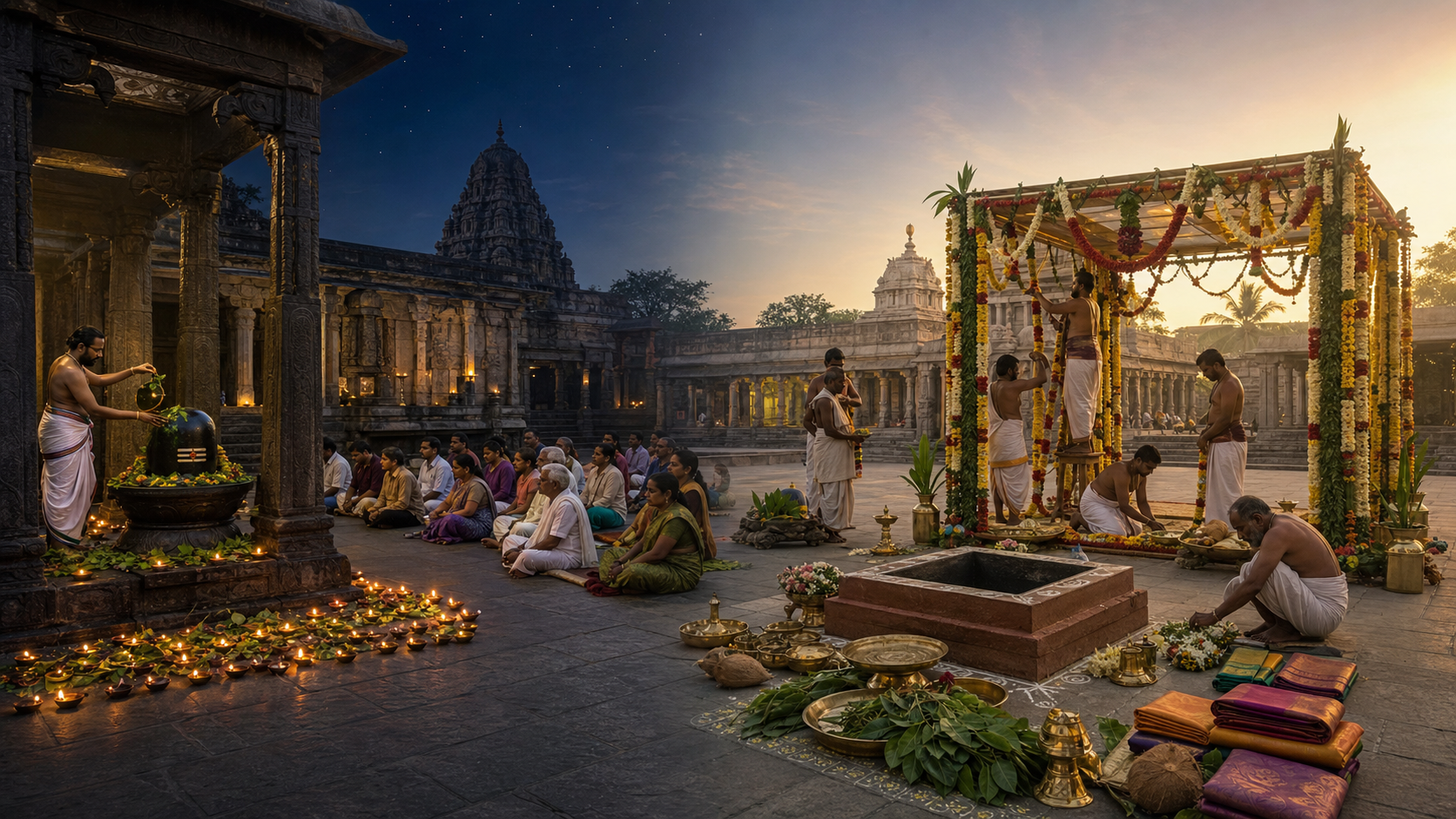
Maha Shivaratri falls on Krishna Paksha Chaturdashi in the Magha or Phalguna month, depending on whether the regional calendar follows the Amanta or Purnimanta system. Its central observance is a night of upavasa, jagaran, abhishekam, mantra, and four successive periods of Shiva worship. Nishita Kaal, around midnight, is especially associated with Lingodbhava—the revelation of Shiva as immeasurable light.
Shiva-Parvati Kalyanam commonly follows on the next day, although some temples place it immediately after the night-long vrata and Lingodbhava worship. This is a meaningful sequence, not merely a scheduling convenience: the vigil turns the mind toward the Absolute beyond form, while the wedding brings that realization into relationship, responsibility, and the sustaining order of life.
| Moment | Usual place in the observance | What it emphasizes | What you should do |
|---|---|---|---|
| Vrata and jagaran | Maha Shivaratri night, with four puja periods | Discipline, devotion, and continuous remembrance of Shiva | Choose a form of fasting and vigil appropriate to your capacity, then follow the temple’s puja times. |
| Lingodbhava worship | Nishita Kaal, around midnight | Shiva as the infinite reality that cannot be measured or contained | Confirm the exact local time; do not assume that a wedding announced for the festival occurs at midnight. |
| Shiva-Parvati Kalyanam | Often after the vigil or on the following day | The union of consciousness and energy expressed through sacred relationship | Check whether the Kalyanam is listed as a separate event with its own arrival time. |
Regional practice matters. Major Shaiva kshetras in Andhra Pradesh and Telangana often hold prominent Kalyanotsavams around Maha Shivaratri. Several Tamil temples celebrate divine weddings during Panguni Uthiram or within the Chithirai festival cycle. Communities in Bengal and the Himalayan region may emphasize the vigil and abhishekam before enacting the wedding locally on the following day. A generic festival date therefore cannot replace the calendar published by the temple you plan to visit.
The sacred story explains why the ascetic Shiva marries
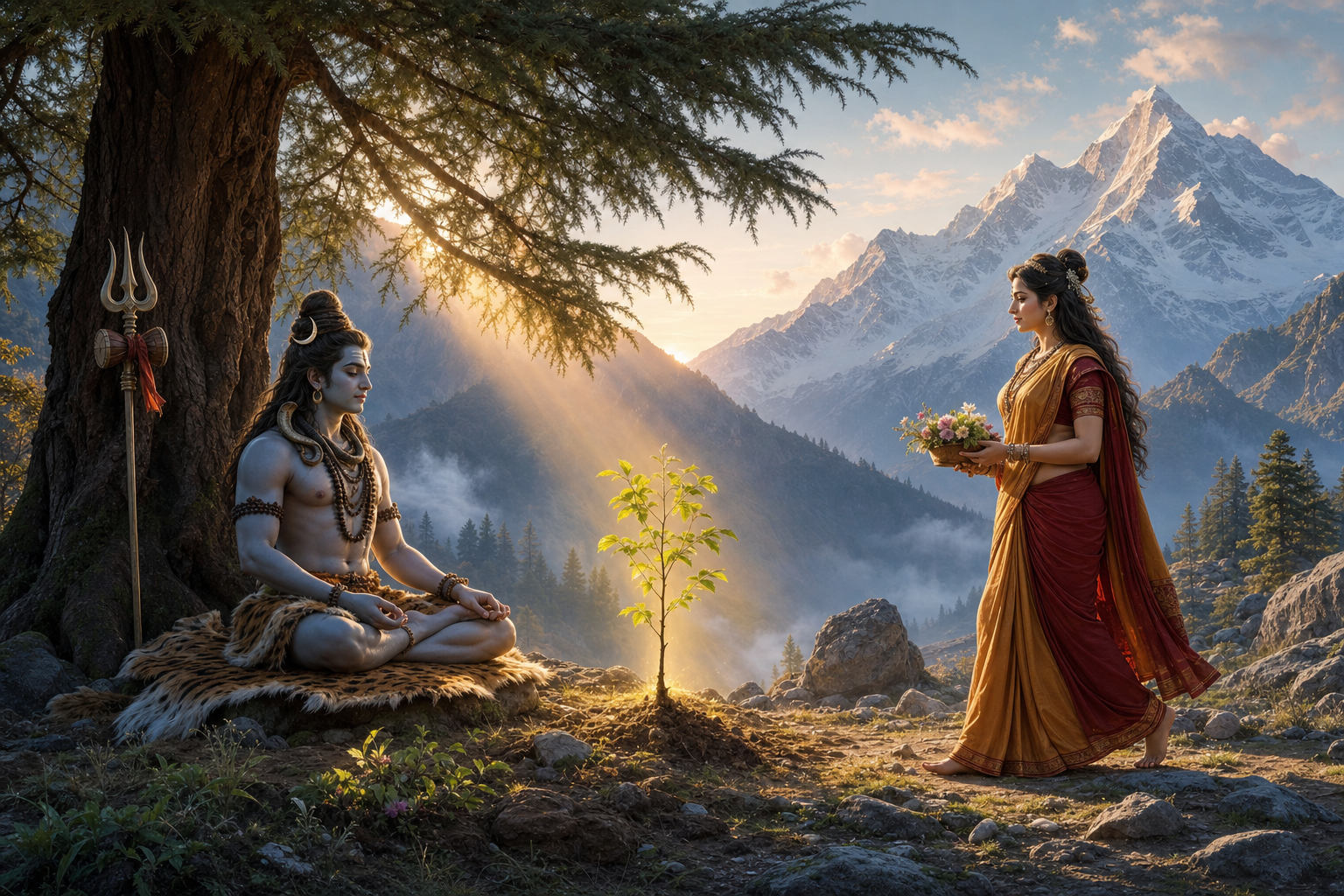
The theological arc appears in the Shiva Purana’s Rudra Samhita, the Skanda Purana, the Linga Purana, and Kalidasa’s Kumarasambhava. After Sati gives up her life at Daksha’s yajna, Shiva withdraws in cosmic grief. The Goddess is reborn as Parvati, daughter of Himavan and Mena. Her tapas is not a decorative prelude to marriage; it reveals steadiness, spiritual agency, and unwavering recognition of Shiva.
The Devas seek the marriage because creation requires more than withdrawal. Shiva must remain the free ascetic without abandoning the welfare of the worlds; Parvati must manifest creative power without being separated from pure consciousness. Their union therefore restores balance while preserving both poles. If you reduce the ceremony to a divine romance, you miss its demanding insight: renunciation and responsibility are not enemies when both are rooted in dharma.
The traditional wedding assembly makes this cosmic meaning visible. Vishnu performs Kanya Daanam as Parvati’s divine guardian, Brahma serves as the yajna officiant, Narada brings sacred sound, the Sapta Rishis bear witness, and the Devas and Ganas gather around the couple. These roles are preserved in the Kalyanasundara Murti tableau found in South Indian bronzes, murals, and temple ritual.
When you encounter this iconography, begin with the hands. Shiva extends his hand toward Parvati; she receives the moment with both reserve and resolve. Vishnu stands beside the bride, and Brahma tends the sacred rite with ladle and kusha. Narada’s veena indicates that sacred sound helps consecrate time itself. Learning these figures before your visit turns a crowded visual scene into a readable theology.
Read the wedding sequence as a map of dharmic union
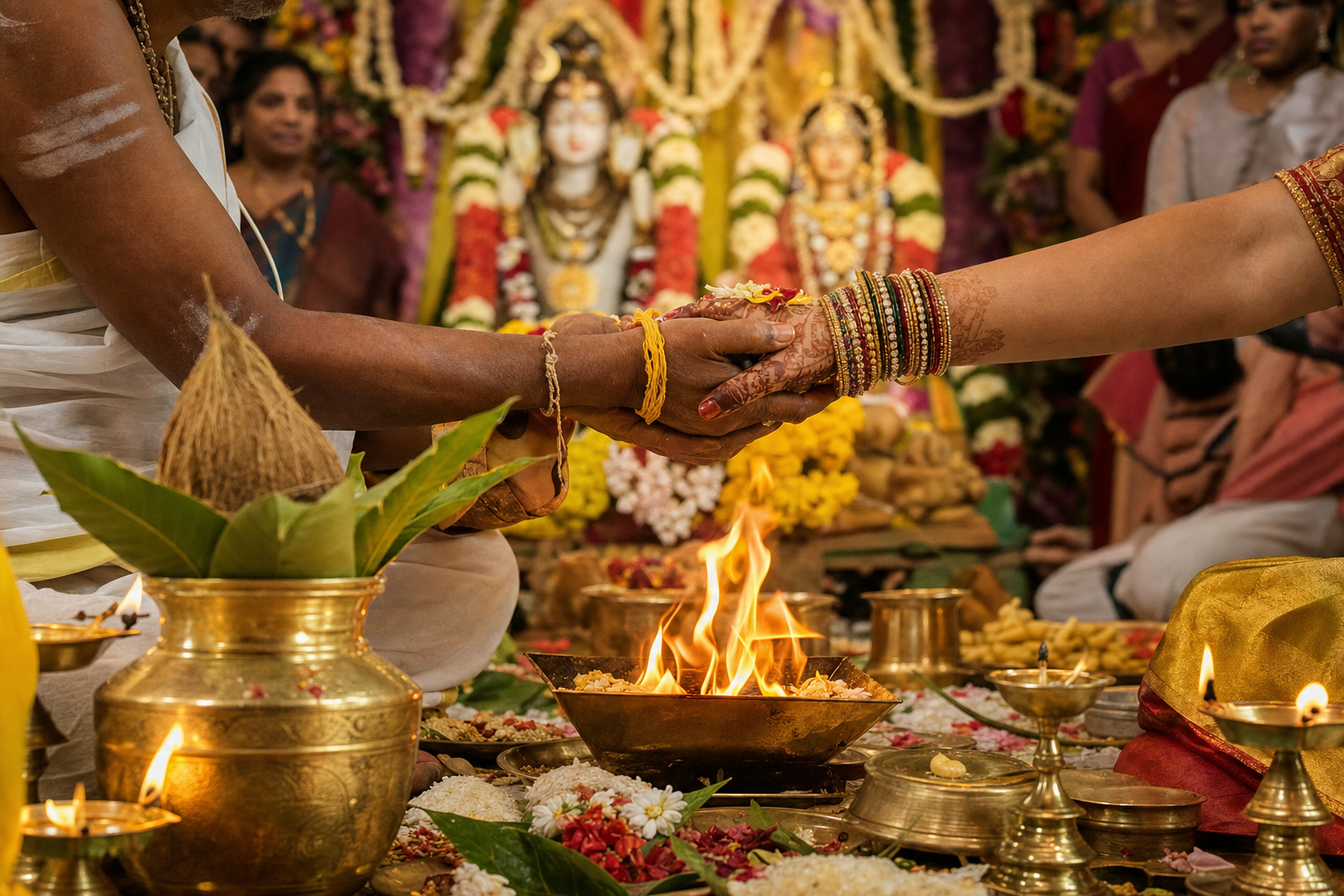
Temple orders differ, and not every Kalyanotsavam displays every component in the same way. The underlying form is a Vedic wedding adapted to the divine couple. As a devotee, you usually witness and respond; you are not expected to duplicate the priests’ actions. Watch for these major transitions:
- Ankurarpana, Punyaha Vachana, and Ganapati Puja: seeds may be sown as a sign of auspicious growth, the ritual field is purified, and obstacles are addressed before the marriage begins.
- Vara Puja and Kanya Puja: Shiva is welcomed and honored as the groom, while Parvati is worshipped as the bride rather than treated as a passive participant.
- Kanya Daanam: Vishnu, in the traditional divine tableau, solemnly gives or entrusts Parvati to Shiva before the assembled witnesses.
- Panigrahana: the joining of hands makes mutual acceptance visible. This is one of the clearest moments to contemplate partnership as a freely embraced dharmic bond.
- Mangalya Dharana: the auspicious thread is offered or tied, signifying protected continuity and the public establishment of the union.
- Saptapadi: the seven steps place shared vows before Agni. Their horizon includes dharma, artha, kama, and moksha—not desire or prosperity cut loose from moral and spiritual purpose.
- Ashirvadam and prasada: benedictions complete the wedding, and the congregation receives the blessing through sacred food and shared celebration.
The materials tell you what kind of marriage is being blessed
The visible objects are not ornamental extras. Each one directs attention toward a quality that must be cultivated:
- Agni witnesses the vows. Offerings into the fire express the surrender of private will to a larger sacred order.
- Mangalya represents auspicious continuity and protection, directing attention beyond the excitement of a wedding day toward the endurance of a bond.
- Akshata and turmeric-colored rice express wholeness, abundance, fertility, and blessing. Offer them only when temple volunteers or priests indicate the proper moment.
- Kalashas invoke divine presence through consecrated water. In a home observance, they can also serve as simple representations of Shiva and Parvati.
- Bilva leaves remain closely associated with Shiva worship and are interpreted through the three energies of will, knowledge, and action.
- Mantra and sacred music carry the rite from one stage to another. Sri Rudram, Chamakam, Sri Suktam, Shaiva stotras, Tevaram hymns, bhajans, and the Panchakshari mantra may be heard according to local tradition.
If the Sanskrit sequence is unfamiliar, do not spend the entire ceremony trying to identify every word. Follow its architecture instead: purification, welcome, consent, commitment, shared vows, blessing. That pattern will keep you oriented even when the local liturgy is elaborate.
Let the divine wedding examine your household dharma
Shiva represents consciousness, stillness, and inward freedom. Parvati represents Shakti: energy, manifestation, nurture, and the power that sustains the worlds. Neither is complete as a description of lived spiritual life when isolated from the other. Stillness without dharmic action becomes withdrawal; activity without awareness loses direction.
This is why the Kalyanam speaks directly to householders. It refuses the assumption that moksha belongs only to those who abandon social responsibility. Shiva does not cease to be a yogi when he becomes a husband, and Parvati’s household role does not diminish her tapas or sovereignty. Their marriage places inner freedom and faithful responsibility within one spiritual vision.
You can use the ceremony as an annual examination of a marriage, family, friendship, or community responsibility. The following questions are reflection prompts, not translations of a fixed Saptapadi mantra sequence and not replacements for the liturgy used by your temple:
- Are our livelihood and use of resources serving shared welfare, or merely feeding private status?
- Which desires need restraint so that affection remains aligned with dharma?
- What will we do when illness, loss, fatigue, or disagreement tests our promises?
- Do our daily words show the mutual respect that our ceremonial ideals proclaim?
- How are we sustaining learning, transmitting memory, and honoring ancestors without becoming trapped in empty habit?
- What responsibility do we share toward neighbors, community, other beings, and the natural world?
- Which spiritual discipline keeps liberation in view while we pursue ordinary duties?
Choose one question, not all seven, for immediate action. A household that selects a single neglected duty and assigns it a day, person, and recurring practice has understood more of the Kalyanam than one that admires the symbolism but changes nothing.
The ceremony can also create ethical resonance across Dharmic traditions without erasing their differences. The pairing of wisdom and compassion, disciplined vows, ahimsa, grihastha dharma, and seva gives Buddhist, Jain, Sikh, and Hindu communities a shared civilizational vocabulary. The theology and ritual form remain distinctly Shaiva; the wider connection lies in treating relationship as a field of virtue and spiritual companionship.
Participate with clarity at a temple or in your home
Before attending a temple Kalyanotsavam
- Confirm two times: the Maha Shivaratri night worship and the Shiva-Parvati Kalyanam. They may be consecutive, separated by several hours, or listed on different festival days.
- Use the temple’s panchang and notice: Amanta and Purnimanta month names, regional festivals, and local Agamic practice can affect how an observance is announced.
- Choose an appropriate vrata: fasting and vigil are disciplines, not competitions. Follow a form consistent with your health, age, capacity, family tradition, and acharya’s guidance; do not turn an unsafe austerity into a test of devotion.
- Prepare one congregational response: steady japa of Om Namah Shivaya lets you participate without guessing at priestly mantras.
- Wait for instructions before offering akshata: throwing rice at the wrong stage distracts from the rite and creates unnecessary disorder near the deities.
- Bring a wedding invitation only where permitted: families often seek the divine couple’s blessing for an upcoming marriage, but the temple decides how and when invitations are received.
- Prepare children before arrival: show them Shiva, Parvati, Vishnu, and Brahma in a Kalyanasundara image, then ask them to watch for the joining of hands, mangalya, seven steps, and final blessing.
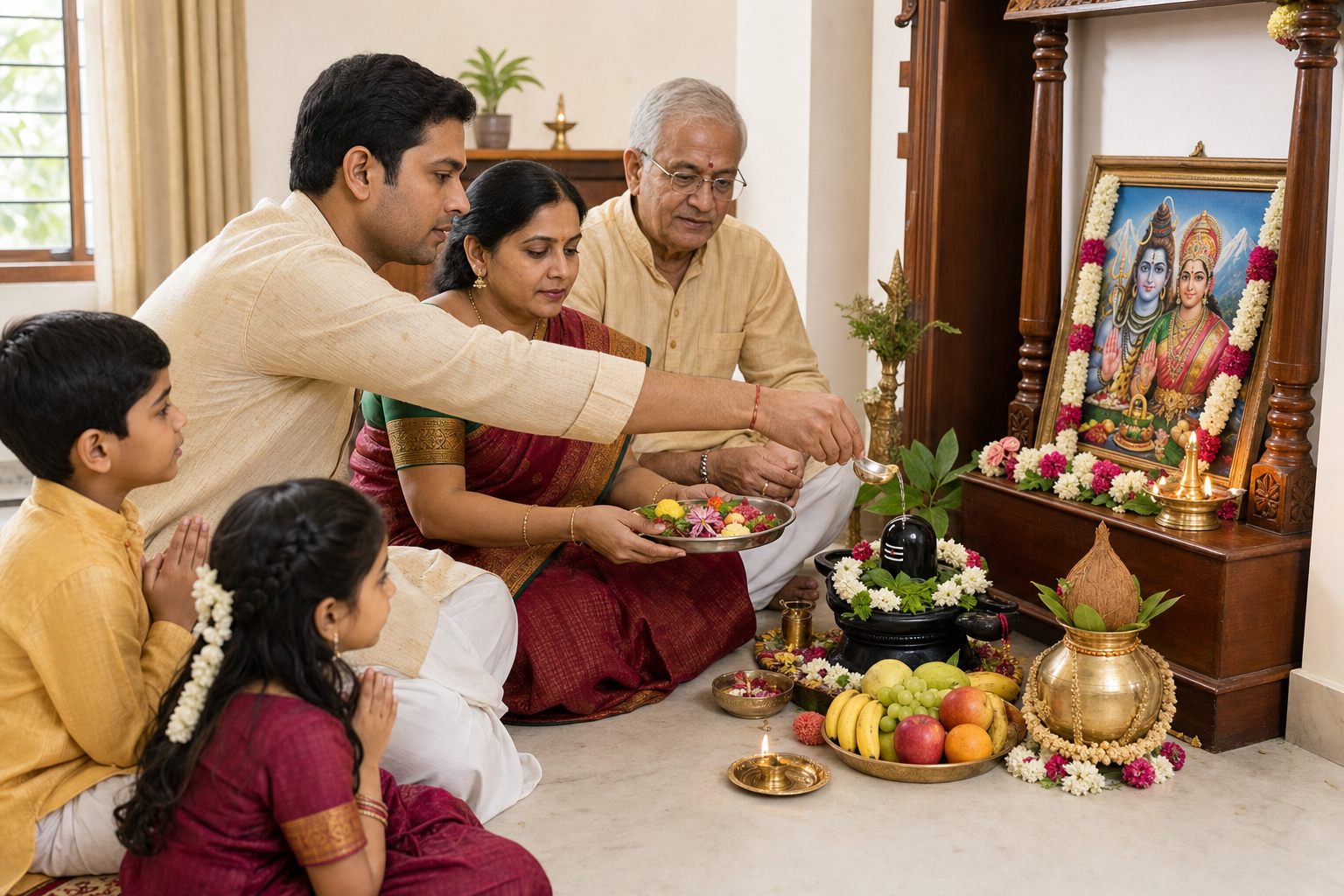
A simple symbolic observance at home
A household puja should remain simple and should follow family tradition or local acharya guidance. It need not imitate the scale or priestly functions of a temple Kalyanotsavam. Where such an observance is permitted, use this basic devotional sequence:
- Clean the puja space and arrange suitable murtis, images, or kalashas of Shiva and Parvati at an east-facing altar. Do not pour abhishekam liquids over an image or murti not made to receive them.
- Make a clear sankalpa. State that the worship is offered for harmony, dharmic responsibility, spiritual companionship, and the welfare of the household.
- Begin with Ganapati Puja, then perform Rudra Abhishekam if this belongs to your practice. Otherwise, offer water and flowers while repeating Om Namah Shivaya.
- Adorn Shiva and Parvati and perform a brief Vara Puja and Kanya Puja, giving full reverence to both forms.
- Offer a clean thread or small ornament symbolically as mangalya. Speak seven short household intentions in language everyone present understands.
- Complete the worship with arati, prayers for mutual respect and steadiness, and the distribution of prasada.
You do not need to improvise a homa or reproduce a Vedic fire ceremony at home. Agni rites require appropriate knowledge and safe arrangements; the simple adaptation above reaches its proper conclusion with mantra, symbolic vows, arati, and prasada. Coherence matters more than adding ceremonies you have not been taught.
Key takeaways
- Maha Shivaratri’s midnight worship and Shiva-Parvati Kalyanam are connected, but they are not necessarily held at the same time.
- The movement from Lingodbhava to Kalyanam carries the devotee from the unbounded Absolute into dharmic relationship and responsibility.
- Panigrahana, Mangalya Dharana, Saptapadi, Agni, akshata, and kalashas each reveal a different dimension of enduring sacred partnership.
- A temple attendee should follow the local schedule and priestly directions; a home observance should remain symbolic, disciplined, and within the guidance of family tradition or an acharya.
- The most useful offering after the ceremony is one concrete change in how you share duty, resources, restraint, learning, service, or spiritual practice.
Before the next Kalyanam, save your temple’s exact ceremony time and choose one relationship or duty that needs greater steadiness. When Shiva and Parvati join hands, name that commitment silently. After prasada, give it a place on your calendar. That is how darshan begins to become practice.
References
