
If you are putting Vishnupathi Punyakalam on your family calendar, save the eight dates below first. Then add the exact local Punya Kaal separately. A date copied from an India-based calendar can be a useful planning anchor, but the correct worship window depends on the place where you will actually observe it.
This calendar gives you both parts of the plan: the 2026-2027 dates and a practical method for turning each date into a properly timed observance. You will also know what to do when travel, daylight saving time, a missed window, or another sacred occasion complicates the schedule.
Vishnupathi dates to save for 2026 and 2027
Vishnupathi occurs when the Sun enters Kumbha, Vrishabha, Simha, or Vrischika in the nirayana, or sidereal, zodiac. These are four fixed-sign solar transitions spaced roughly three months apart. Each transition is a Sankranti and provides a quarterly point for worship of Sri Hari, recitation, charity, and renewed spiritual discipline.
| Year | Solar ingress | Vishnupathi date in the Indian calendar framework |
|---|---|---|
| 2026 | Kumbha Sankranti | 13 February 2026 |
| 2026 | Vrishabha Sankranti | 14 May 2026 |
| 2026 | Simha Sankranti | 17 August 2026 |
| 2026 | Vrischika Sankranti | 16 November 2026 |
| 2027 | Kumbha Sankranti | 12 February 2027 |
| 2027 | Vrishabha Sankranti | 14 May 2027 |
| 2027 | Simha Sankranti | 17 August 2027 |
| 2027 | Vrischika Sankranti | 16 November 2027 |
Use these as planning dates, not as universal clock-time muhurtas. The local date can move by a day outside India because the sankramana moment falls at different civil times around the world. If a South Indian temple calendar lists Haripada Punyakalam, especially in Tamil Nadu, it is referring to this same observance.
How to find the correct Punya Kaal where you live

The Sankranti date tells you which transition is being observed. The sankramana time tells you when the Sun enters the relevant sidereal sign, while the Punya Kaal tells you when the prescribed acts should be performed under the rules of the panchang you follow. Keeping those three details separate prevents the common mistake of observing the right occasion at an imported or inapplicable local time.
- Select the city where you will physically observe Vishnupathi. Do not leave the panchang set to your hometown if you will be travelling.
- Use a reputable regional panchang that calculates nirayana solar positions. Check whether it identifies its ayanamsa; Lahiri, also called Chitra Paksha, is a commonly used standard.
- Find the exact Kumbha, Vrishabha, Simha, or Vrischika sankramana time for that city and time zone.
- Copy the published Punya Kaal into your calendar. Some traditions use a window of approximately sixteen ghatis, or about 6 hours and 24 minutes, from the ingress, but sunrise rules and regional conventions affect its practical application. Do not manufacture a window by simple addition when your panchang already supplies one.
- Add a Maha Punya Kaal only when the panchang or temple schedule explicitly gives it. It is a narrower interval and should not be assumed for every Vishnupathi.
- Check the entry again if daylight saving time begins or ends before the observance. A saved time-zone conversion can become wrong even though the Indian date has not changed.
A useful calendar entry contains five fields: the local civil date, exact sankramana time, Punya Kaal start, Punya Kaal end, and any published Maha Punya Kaal. Add the name of the panchang or temple schedule you used. That note will save you from having to reconstruct the calculation on the morning of the observance.
For a temple programme or a formal family sankalpa, let the temple’s announced schedule or your sampradaya’s panchang govern. The general dates above help you prepare; they do not override a lineage-specific rule.
A practical household observance you can prepare in advance
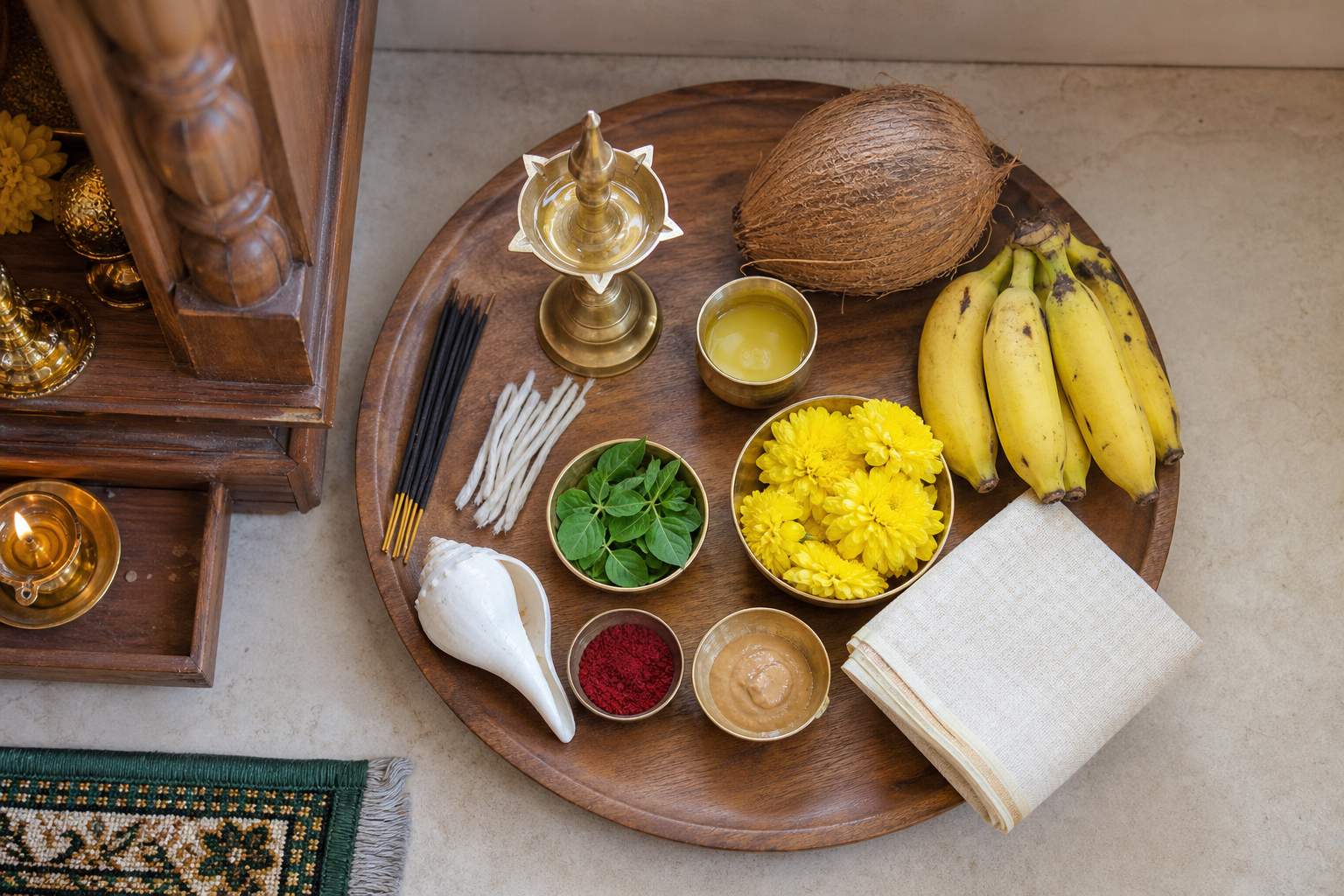
Do not leave the calendar entry at the vague instruction to perform puja. Decide beforehand what you will recite, what you will offer, and how you will complete dana. That preparation allows the actual Punya Kaal to remain focused on devotion rather than last-minute gathering.
- Before the window begins, prepare a clean worship space, deepa, clean water, tulasi, naivedya, and anything required for your planned charity. If your established practice includes panchamrita and abhisheka, have those arrangements ready as well.
- Take snana at or shortly before the Punya Kaal. Begin with achamana according to your practice, light the deepa, and make the sankalpa. If you do not know a formal Sanskrit wording, state the intention plainly: during this Vishnupathi Punyakalam, you are worshipping Sri Hari and undertaking dana with devotion.
- Perform abhisheka to a Saligrama or Vishnu murti with clean water or panchamrita where this accords with your household tradition. Continue with tulasi archana, dhupa, deepa, and naivedya.
- Choose a recitation you can complete attentively. Vishnu Sahasranama, Purusha Sukta, Narayana Suktam, and selected chapters of the Bhagavad Gita are appropriate options. You need not turn the morning into a race to finish all of them.
- Offer simple sattvic naivedya. Suitable choices include freshly prepared rice dishes, seasonal fruit, milk-based sweets, or panakam, with tulasi offered according to your custom.
- Complete dana during the principal window when possible. Annadana, vastra-dana, support for a temple or educational effort, help for a community kitchen, and service to elderly or vulnerable people all place devotion into the service of lokasangraha.
When you have only a short window
A shorter observance can still be deliberate. Complete snana, light the deepa, make your sankalpa, offer tulasi or a simple naivedya, recite a manageable Vishnu nama or chosen passage, and carry out the dana you prepared. This is a practical simplification, not a universal ritual minimum; retain any non-negotiable elements taught by your family, guru, or sampradaya.
If you keep a Saligrama or follow an established Agamic procedure, do not discard its rules merely to fit a generic checklist. The calendar should serve the tradition you actually practise.
What to do when the date, window, or schedule changes
Most timing problems can be handled without guesswork once you identify what changed:
- If you are outside India, calculate for your own city. The local observance may begin on the previous or following civil date even though an Indian calendar shows one fixed date.
- If you cross a time zone, use the destination’s panchang and local time. Do not merely convert a calendar notification created for your usual location.
- If you miss the exact sankramana moment but remain within the published Punya Kaal, perform the observance during the remaining portion of that window.
- If the entire Punya Kaal has passed, many traditions allow worship during the broader day. Some also permit the core worship at the next available sunrise with a kshama-prarthana. Because this concession is not identical everywhere, follow your regional or sampradaya convention.
- If Vishnupathi coincides with Amavasya, a grahana, or another observance carrying its own timing rules, do not decide priority from a generic festival list. Use the combined instructions in your regional panchang or the schedule published by the temple you attend.
- If the temple programme begins at a different time from your household calculation, determine whether the temple is following its own location, almanac, or Agamic schedule. Attend according to the temple announcement while retaining your household practice as directed by your tradition.
Clock precision matters because this is a sankramana-centred observance, but precision should not become anxiety. When an unavoidable lapse occurs, the appropriate response is sincere worship, the permitted alternative in your tradition, and kshama-prarthana rather than inventing a more convenient muhurta.
Key takeaways
- Save four Vishnupathi planning dates in each year: the Kumbha, Vrishabha, Simha, and Vrischika Sankrantis.
- For 2026, the Indian dates are 13 February, 14 May, 17 August, and 16 November. For 2027, they are 12 February, 14 May, 17 August, and 16 November.
- Use a nirayana regional panchang to obtain the local sankramana, Punya Kaal, and any stated Maha Punya Kaal. An India-based clock time is not automatically valid abroad.
- Prepare the puja and dana before the window: snana, sankalpa, Sri Hari worship, an attentive recitation, sattvic naivedya, and charity form a workable household plan.
- Recheck the calculation after travel or a daylight-saving change, and seek temple or sampradaya guidance when Vishnupathi overlaps another time-sensitive observance.
Open your calendar now and enter all eight dates, with a reminder to consult your local panchang before each one. Then choose the recitation and dana you intend to complete. Vishnupathi works best as a quarterly discipline when preparation begins before the sacred window opens.
References
