
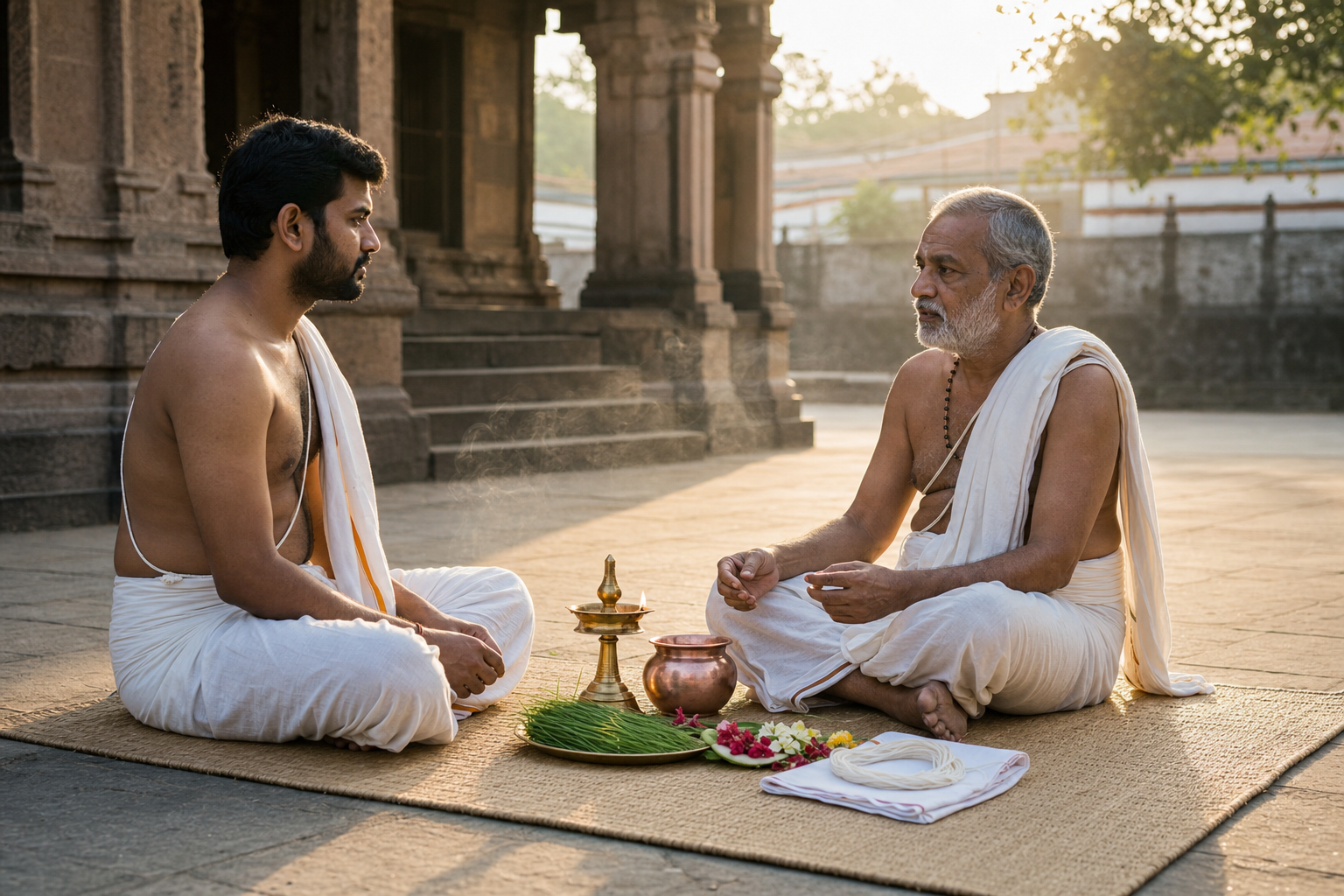
If you need one date to reserve for Samaveda Upakarma in 2026, mark September 13. That is the date for Samaveda followers, so do not automatically use an Upakarma date announced for another Vedic tradition.
The date, however, is only the first decision. Your local starting time, ritual sequence, eligibility, mantras and required materials should come from the acharya, priest, temple or family authority responsible for your Samavedic practice. Confirm those details before arranging travel or buying a generic Upakarma kit.
The Samaveda Upakarma date to reserve in 2026
Samaveda Upakarma falls on September 13 in 2026. Most Tamil, Malayalam, Kannada and Telugu panchangams cited for the observance agree on that date. This broad agreement is especially useful when relatives or members of a Samavedic community are coordinating across different regions of Bharat.
Write the occasion in your calendar as “Samaveda Upakarma – September 13, 2026.” Naming the Veda matters. A notice that merely says “Upakarma” may refer to a different Vedic affiliation, and a nearby ceremony need not be the correct one for your lineage.
If you live outside India, treat September 13 as the date to investigate rather than guessing how an Indian panchangam applies to your location. Ask a competent authority whether the observance in your city remains on that civil date and what local time should be followed. A calendar entry copied from another time zone cannot settle that question by itself.
The calendar date does not determine the whole ritual
Agreement among regional panchangams answers the most visible question: which date should be set aside? It does not make every Samavedic household interchangeable. Vedic observance is transmitted through lineage, teaching and disciplined recitation, so the correct procedure cannot be reconstructed from the festival name alone.
Before treating any public announcement as a complete instruction, confirm these points:
- Does the ceremony explicitly serve Samaveda followers?
- Which family or Samavedic tradition will govern the procedure?
- What is the local reporting time and ritual starting time?
- Who will guide the mantras and correct the recitation?
- Who in your household is expected to participate?
- Which materials must each participant bring, and which will the venue provide?
- Are there preparatory disciplines or household instructions that must be followed?
These are not minor administrative questions. They prevent a common mistake: finding a conveniently timed Upakarma gathering and assuming that the word “Upakarma” makes it suitable for every Vedic lineage. If the organiser cannot tell you whether the event is Samaveda-specific, keep looking or consult your family acharya.
A preparation sequence that avoids last-minute improvisation
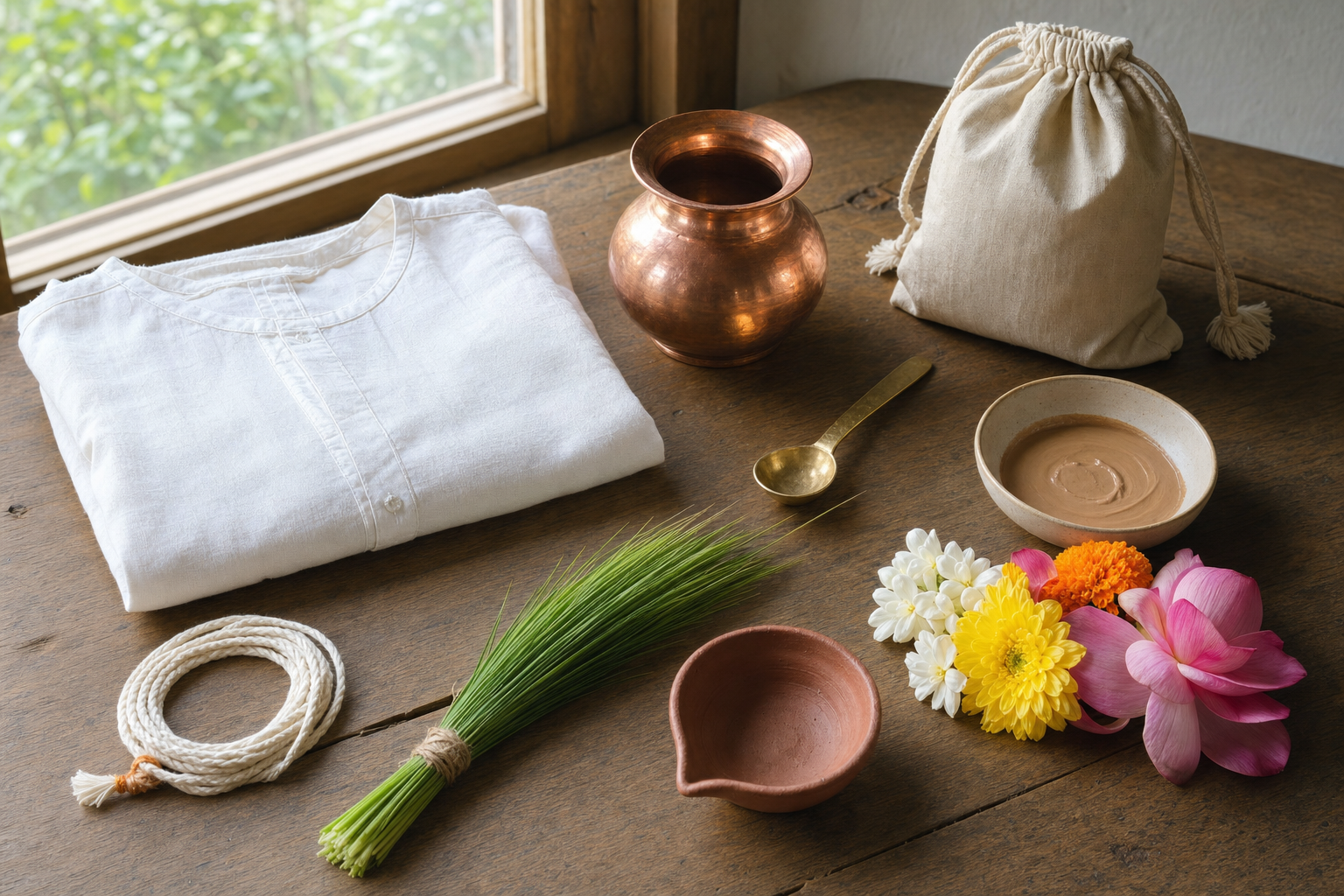
You do not need to invent a universal ritual checklist. You need to establish the right chain of guidance. Work through the following sequence while there is still time to correct a misunderstanding.
- Confirm that your household observes Samaveda Upakarma. If you know only a family surname, gotra or regional identity, do not assume that it establishes the Vedic affiliation; ask an elder or acharya directly.
- Identify the person or institution whose procedure you will follow. This may be a family acharya, a Samavedic priest or a temple conducting the observance for your tradition.
- Give that authority your actual location. Ask for the applicable civil date and local time rather than forwarding a screenshot from another city.
- Request the full materials list from the officiant. Do not combine several online lists, because an item included in one tradition may be unnecessary in another.
- Ask whether participants must prepare any text, mantra or recitation in advance. Obtain the version used by the person guiding the ceremony instead of arriving with an unrelated booklet.
- Confirm the practical arrangements: venue, arrival time, expected duration, dress requirements and whether registration is necessary. These details come from the local organiser, not from the calendar date.
- Protect the day from avoidable conflicts. Upakarma is a religious observance, not a short errand to fit between unrelated appointments.
If you are arranging the observance for a family group, send one consolidated set of questions to the officiant. That is more reliable than allowing each participant to collect fragments of advice from different calendars, videos and messaging groups.
Keep the renewal of Vedic study at the centre
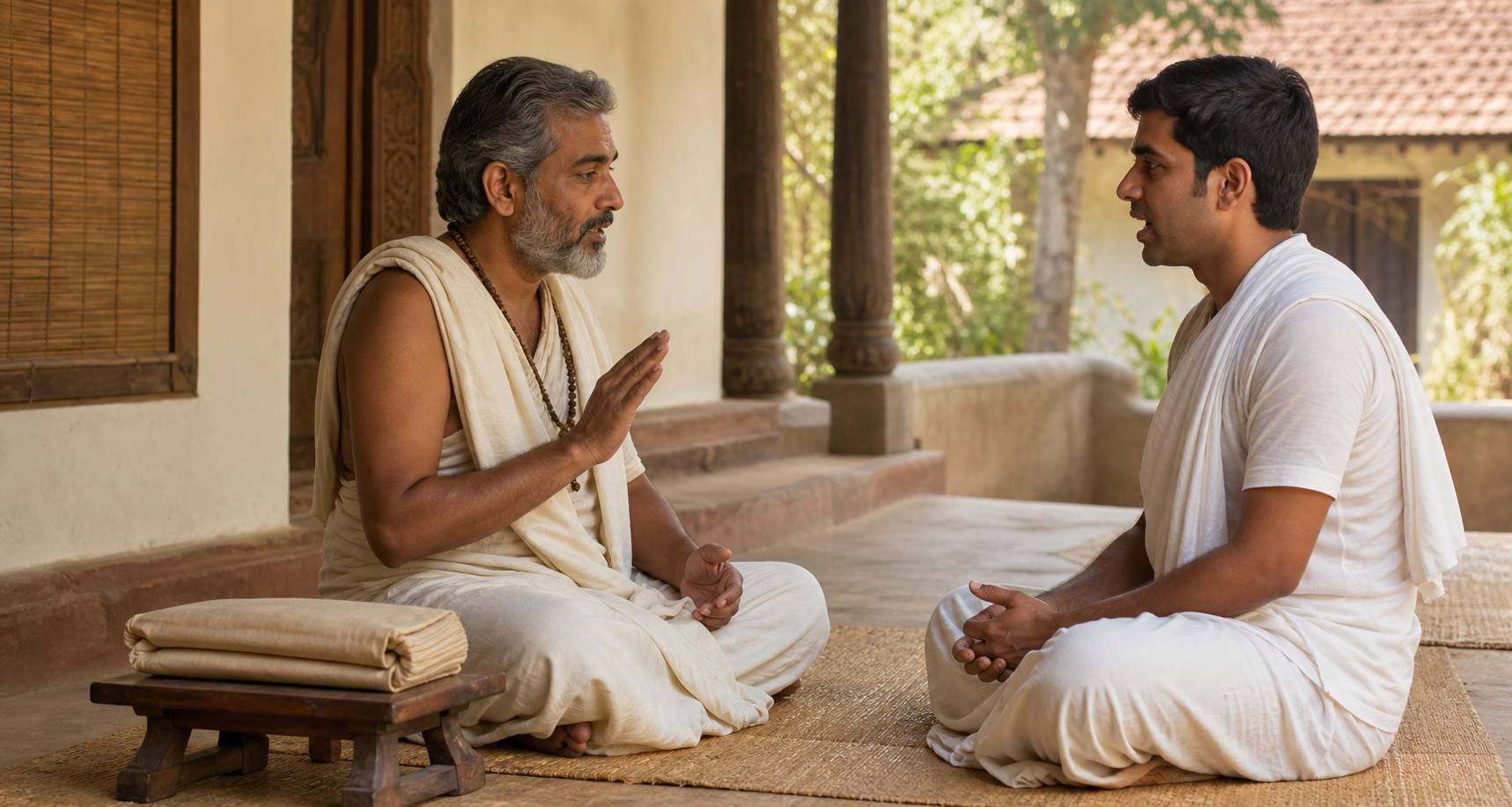
Upakarma is best understood as a renewal of one’s responsibility toward Vedic learning and discipline. In a Samavedic context, that orientation matters because the Sama tradition is not merely a label attached to a festival date. It is a living mode of preserving sacred sound through instructed practice.
Where changing the yajñopavita is prescribed as part of the observance, it should not be mistaken for the entire purpose. The visible act belongs within a larger recommitment to study, correct conduct and faithful transmission. Reducing Upakarma to purchasing a thread and repeating an unfamiliar recording reverses the proper order: the lineage and discipline give meaning to the external action.
You can make that meaning practical by asking your teacher one question before the ceremony: “What should I resume, revise or learn after this Upakarma?” The answer may be modest, but it turns the observance toward continuity. A renewal rite should shape what follows it, not disappear once the ceremonial materials are put away.
If you are separated from your family tradition
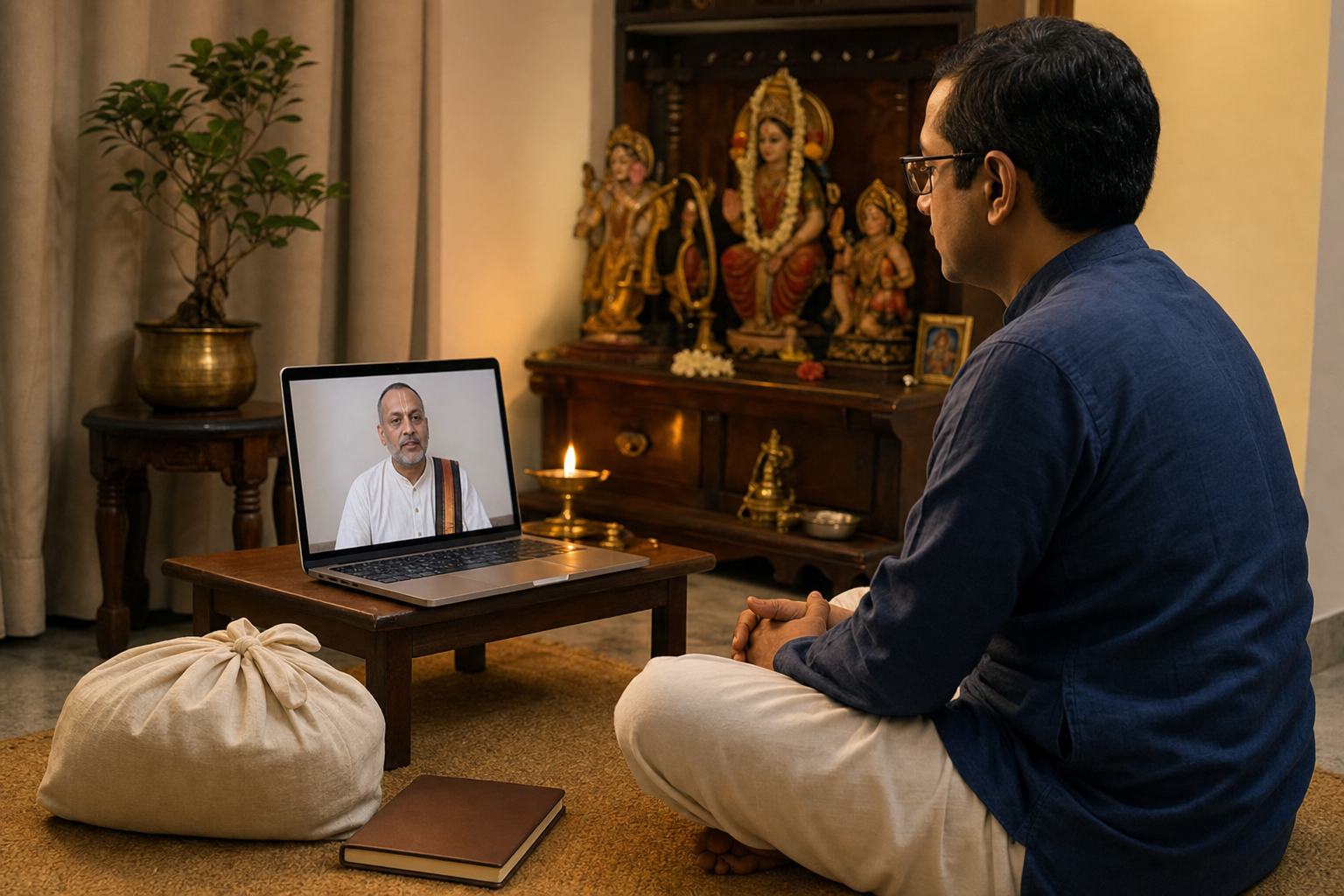
Distance from elders or a traditional centre is now a common practical difficulty. It does not make every online ritual interchangeable. Begin with the nearest reliable connection to your own tradition and widen the search only as necessary.
- Contact family elders who can identify the Vedic affiliation and the customary teacher or priest.
- Ask that teacher for a referral if distance prevents direct participation.
- Contact temples specifically about Samaveda Upakarma rather than asking only whether they hold “an Upakarma.”
- If remote guidance is offered, confirm that the teacher considers it appropriate for your circumstances and follow that teacher’s complete procedure.
- If you still cannot establish the relevant tradition, do not assemble a ceremony from unrelated recordings. Use the time to recover the missing family information and seek competent guidance.
A useful enquiry is precise: state that you are asking about Samaveda Upakarma on September 13, give your city, explain what you know about your family tradition and say exactly what remains uncertain. That gives an acharya enough context to correct you without requiring a long exchange.
Key takeaways
- Reserve September 13 for Samaveda Upakarma in 2026.
- Do not substitute an Upakarma date or ceremony intended for another Vedic tradition.
- Confirm the applicable local time with a qualified acharya, priest or Samaveda-specific organiser.
- Use the materials, mantras and sequence prescribed for your lineage; a generic online checklist is not enough.
- Treat the observance as a renewal of Vedic study and discipline, not merely as an external change.
Put September 13 in your calendar now, then send one precise message to your family acharya or intended temple: confirm that the ceremony is for Samaveda followers and ask for the local time, preparation and materials. That single step will resolve more than collecting another page of unsourced ritual instructions.