
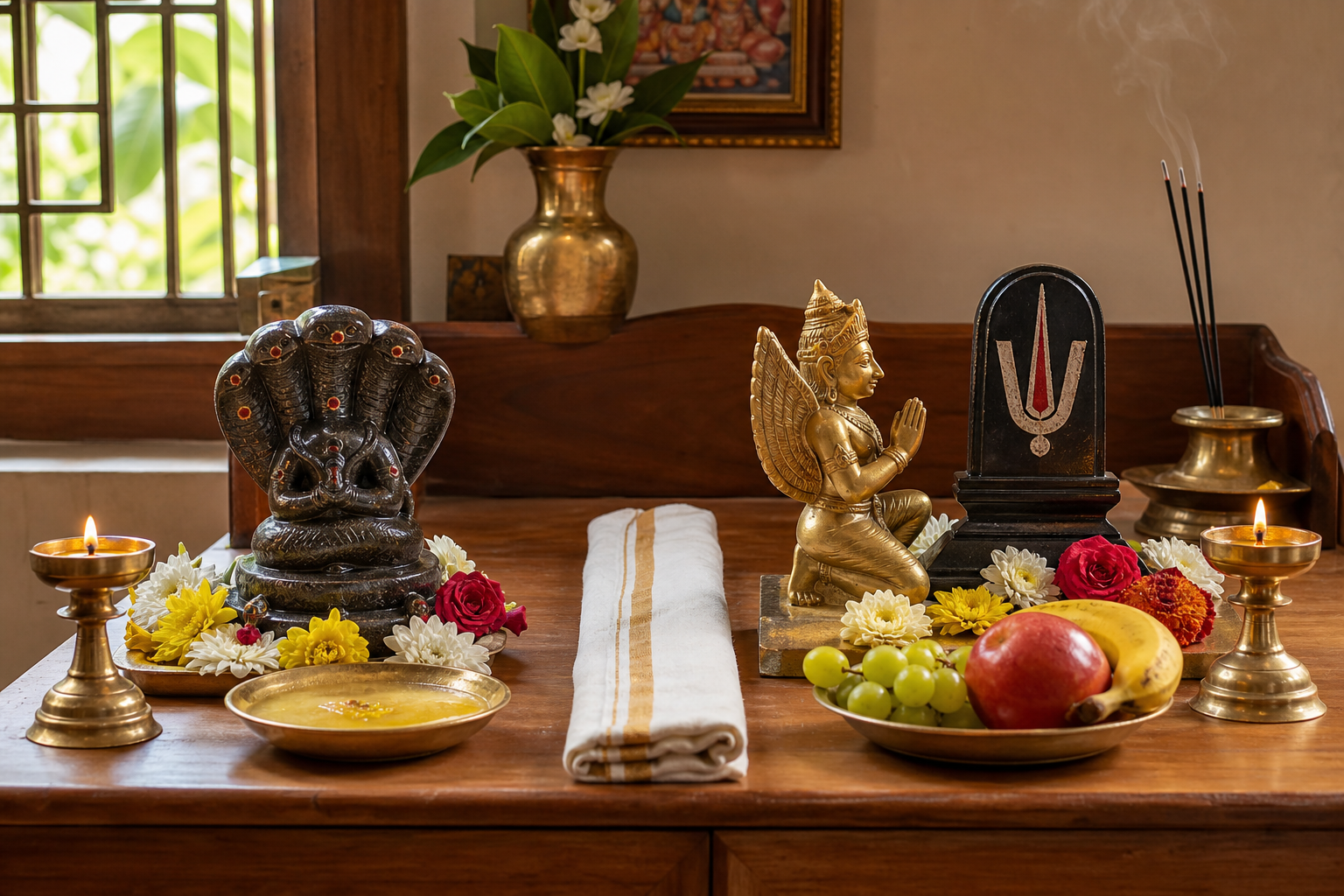
You want to mark Naga and Garuda Panchami at home, but you don’t want to improvise a ritual from disconnected customs. The cleanest approach is to decide whether your household is keeping a Naga vrata, performing Garuda puja, or observing both, and then give each practice its own clear purpose.
You don’t need an elaborate ceremony to begin well. You do need the correct tithi, a clean worship space, the few materials actually required by your chosen practice, and a trusted family or temple tradition for details that vary by community.
First decide what you are actually observing
Several related words can become blurred in casual festival instructions. Keeping them distinct prevents most of the confusion:
- Panchami identifies the fifth lunar tithi. It does not supply a universal civil-calendar date, so check the panchanga followed by your household or local temple.
- Vrata is a disciplined religious observance or vow. Its commitments may be inherited through family or sampradaya practice.
- Katha is the sacred narrative heard or recited as part of an observance. It gives the day meaning, but it is not automatically a complete puja procedure.
- Puja is the act of ritual worship, with its own preparation, focal image, offerings, prayers, and conclusion.
This distinction matters when instructions are incomplete. Hearing the Naga Panchami katha does not tell you every rule of a formal vrata. Similarly, arranging the opening elements of Garuda puja does not establish which mantras or offerings your lineage uses. If your family has an inherited procedure, follow it consistently. If it does not, choose a modest observance rather than inventing austerities or combining unrelated ritual fragments.
Let the Naga Panchami katha shape the observance
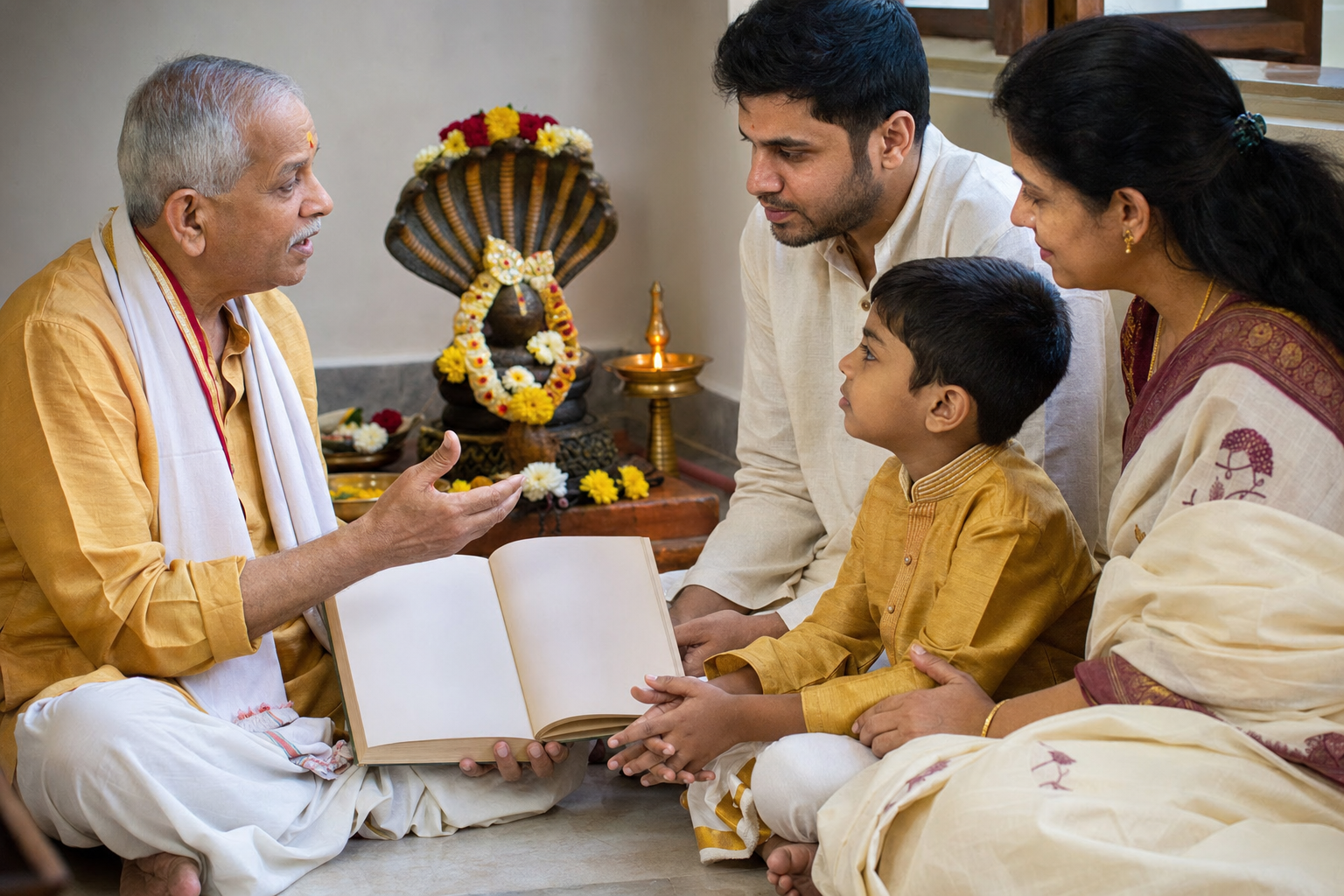
The Naga Panchami vrata-katha places the serpent clan in mortal danger during King Janamejaya’s Sarpayaga. Some of the surviving serpents approach Lord Brahma with their fear for the clan’s continued existence. Brahma consoles them and grants that serpents will receive worship.
One fruitful way to hear this narrative is as a lesson in restraint. Fear of a being does not justify limitless destruction, and the exercise of power still carries dharmic obligations. The movement from attempted annihilation to protected remembrance gives you a meaningful center for the day: reverence should transform fear into self-control, not into cruelty.
If you are leading the observance at home, read or recount the katha slowly enough for the family to notice that movement. Pause after the serpents seek Brahma’s protection. Ask children and adults what changes when a feared being is approached as part of creation rather than merely as an enemy. That short reflection will do more than a hurried recitation whose meaning no one hears.
The katha provides a theological center, but it does not establish one universal list of Naga Panchami materials. For formal images, offerings, mantras, fasting rules, or other vrata requirements, use the practice of your family, sampradaya, or temple. If none is available, a clean prayer space, attentive recitation of the katha, pranam, and a plainly spoken prayer for restraint and protection form a more honest beginning than an elaborate sequence assembled without authority.
Reverence for nagas never requires you to approach or handle a wild snake. Keep your distance, keep children and animals away, and contact an appropriate local wildlife or snake-rescue service if one enters a living area. A living creature is not a ritual prop.
Prepare the Garuda Panchami space precisely
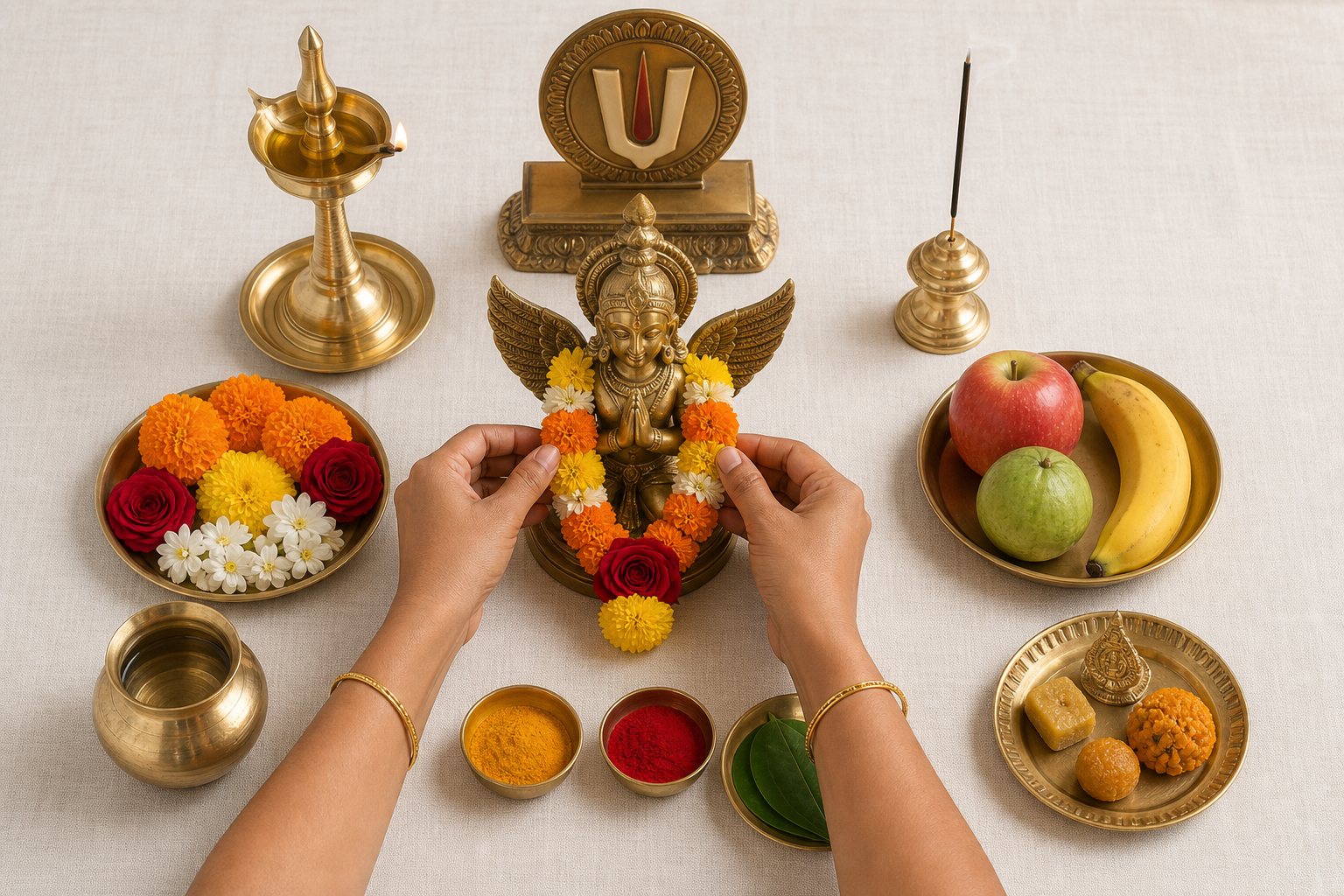
Garuda Panchami puja is dedicated to Garuda, also called Garuthmantha. Its initial home arrangement is simple enough to prepare without turning the puja into a decorating project. The important details are the focal image, the five designs, and what is placed over them.
- Sanctify the puja room. Clean and prepare the place before arranging the ritual materials.
- Place the Garuda image. A photograph or an idol may serve as the focal representation.
- Draw five designs in front of the image. Use five rangoli patterns or kolam designs, preserving the specified number rather than treating it as incidental decoration.
- Cover the prepared designs as directed. Place a banana leaf or a sanctified cloth on the kolams.
- Continue according to a trusted tradition. Use your family’s or temple’s instructions for the prayers, offerings, and conclusion that follow the setup.
These Garuda Panchami puja steps also answer two practical questions. You do not need a murti if you have an appropriate Garuda photograph, and the five kolams belong in front of the image rather than wherever there happens to be floor space. Set aside that area before the puja begins so people do not have to step around or over the arrangement.
Do not let the accessible setup create false confidence about the rest of the ceremony. If you have not received the required mantras or offering sequence, ask a temple or knowledgeable practitioner before adding them. A small puja conducted coherently is preferable to a long one built from mutually inconsistent instructions.
Observe both without collapsing their meanings
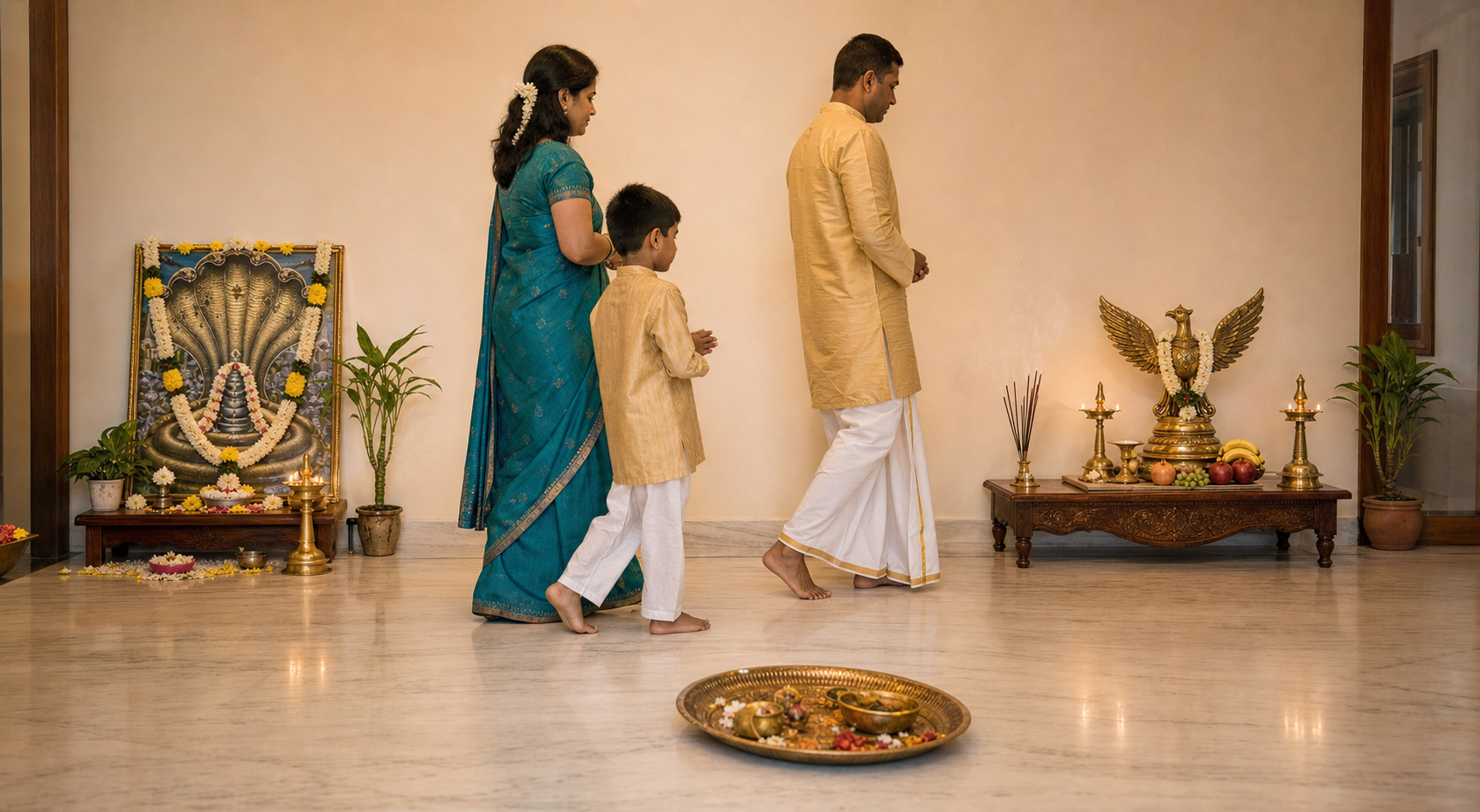
If your household calendar places both observances on the same tithi and you intend to keep both, you do not have to force them into a single undifferentiated ceremony. Garuda and the nagas retain distinct identities and ritual attention. The fact that sacred narratives can contain tension between beings does not require a devotee to turn worship into a choice of sides.
A workable home plan is to complete one observance before beginning the other:
- Confirm the Panchami tithi using the panchanga or temple calendar your household normally follows.
- Decide whether each observance will be a full inherited vrata or puja, or a simpler act of prayer and katha recitation.
- Gather the Garuda image, kolam materials, and banana leaf or sanctified cloth for the Garuda setup.
- Gather only the Naga Panchami materials required by your trusted tradition, together with the katha you will read or hear.
- Name the dedication of each observance clearly, complete it, and then rearrange the space if necessary before beginning the other.
- Write down the procedure your family actually followed, including any guidance received from your temple, so next year’s observance grows from continuity rather than memory.
This separation is especially helpful when children are present. They can see that honoring Garuda does not require contempt for nagas, and honoring nagas does not erase Garuda’s distinct place. The practical lesson is larger than ritual order: dharmic life can acknowledge powerful differences without reducing every relationship to hostility.
Key takeaways
- Check Panchami through the panchanga or temple calendar your household trusts; do not assume a civil date without verification.
- Keep vrata, katha, and puja distinct. Each describes a different part of religious observance.
- For Garuda Panchami, prepare a Garuda photograph or idol, five rangoli or kolam designs, and a banana leaf or sanctified cloth.
- Let the Naga Panchami katha direct attention toward restraint, protection, and reverence for life.
- Use family, sampradaya, or temple guidance for mantras, offerings, fasting rules, and other details that are not universal.
- Never approach or handle a wild snake as an act of devotion.
If you have no inherited procedure, begin with the smaller observance you can perform truthfully: verify the tithi, prepare a clean space, preserve the five-kolam arrangement for Garuda puja, and give the Naga katha the attention its moral movement deserves. Then seek local guidance before adding formal vows, mantras, or offerings. That gives your household a sound practice to carry forward.
References
- Hindu Pad – Nag Panchami Vrat Katha | Story of Naga Panchami Puja
- Hindu Pad – Garuda Panchami Puja | Puja procedure of Garuda Panchami Vrata