
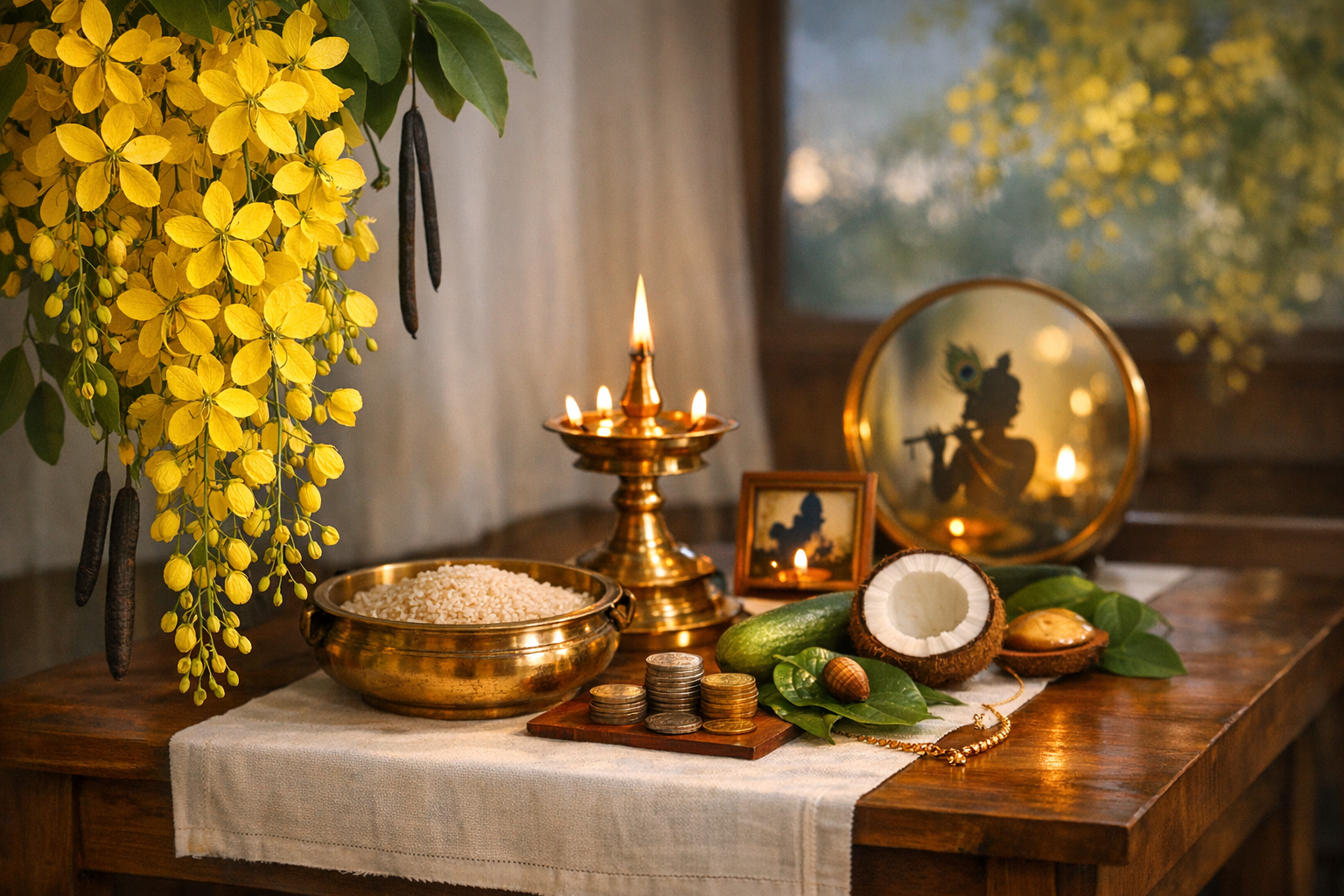
Among the most evocative sights of Vishu in Kerala is the luminous cascade of Konna poo, the golden racemes of Cassia fistula. Known worldwide as the golden shower tree and in Hindi as Amaltas, this species occupies a singular place where botany, seasonality, and sacred symbolism converge. Its flowering peak in April aligns almost uncannily with Vishu, making the tree a living calendar that signals the new agricultural and spiritual cycle.
Botanically, Cassia fistula L. belongs to the family Fabaceae (subfamily Caesalpinioideae). A medium-sized deciduous tree, it typically reaches 10–20 meters in height, with a broad crown and pendulous inflorescences that can extend several tens of centimeters. The blossoms form in long racemes of bright yellow, five-petaled flowers, creating a spectacular, gravity-drawn curtain of color. After flowering, cylindrical pods develop and gradually turn dark as they mature, an easily recognizable feature of the species.
Native to South Asia, Cassia fistula is found across the Indian subcontinent and parts of Southeast Asia, and it is widely cultivated in tropical and subtropical regions. In Kerala, where seasonal cues are finely observed, its leaf-shedding phase followed by synchronized flowering marks a transition from the dry season toward the early rainsan ecological rhythm the festival of Vishu mirrors in cultural form.
Phenologically, the tree’s flowering window in peninsular India runs from late March to May, with a pronounced peak around mid-April in Kerala. The timing aligns with rising temperatures, declining soil moisture, and increased daylightall factors known to cue floral initiation in seasonally deciduous trees. This environmental clockwork turns Konna poo into a reliable seasonal signpost for communities preparing for Vishu.
Vishu, celebrated on the day of Mesha Sankranti when the Sun enters sidereal Aries, inaugurates the new year in Kerala’s traditional reckoning. The heart of the festival is the Vishukkani Darshanan auspicious first sight at dawn arranged to embody prosperity, balance, and clarity for the year ahead. Konna poo is central to this arrangement, offering both chromatic brilliance and a textured reminder of nature’s cyclic renewal.
A typical Vishukkani features a nilavilakku (traditional lamp), an image or murti of Vishnu or Krishna, a mirror, an uruli with rice or grains, a fresh cucumber, coconut, betel leaves and arecanut, coins or jewelry, and the unmistakable golden sprays of Konna poo. The selection embodies a microcosm of life: illumination, divinity, self-reflection, sustenance, fertility, and wealth, with the Konna blossoms binding these elements in a radiant, unifying palette.
The yellow-gold hue of Konna poo carries layered symbolism in Sanatana Dharma. It evokes Surya’s life-giving light, the generative power of Sri (auspicious abundance), and the serene brilliance associated with sattva. In the context of Vishu, the blossoms are more than ornamental; they translate cosmic order and seasonal change into a tactile and visual theology that households experience together at dawn.
Kerala’s choice of Cassia fistula as its state flower underscores the tree’s cultural stature. Across Asia, the species carries parallel meanings. In Thailand, where the tree is known as Ratchaphruek, it is a national emblem associated with prosperity and communal harmony. These shared connotations speak to a broader South and Southeast Asian appreciation for seasonal flora as markers of auspicious time and social cohesion.
In traditional Ayurvedic literature, Cassia fistula is referred to as Aragvadha, a classical name that points to its reputation as a health-supporting plant. The pulp of the mature pods is described as a gentle laxative, and different parts of the plant have been used in formulations intended to support skin health and digestive balance. Such descriptions are a matter of historical record; any contemporary use should be guided by qualified practitioners.
Horticulturally, Cassia fistula thrives in full sun and well-drained soils, showing notable tolerance to heat and periodic drought once established. It is most easily propagated by seed; a brief warm-water soak can aid germination. Urban planners and householders value the species for its spectacular seasonal display and relatively modest maintenance requirements, although care should be taken to site trees where falling flowers and pods will not interfere with pathways or gutters.
Ecologically, Konna poo is more than ceremonial garnish. The tree’s blossoms attract pollinators, including bees and certain butterflies, enhancing local biodiversity at a time of year when nectar resources can be limited. Its leafy canopy offers shade and habitat, while the sequence from bloom to pod supports a dynamic micro-ecosystem through the pre-monsoon months.
Household memories in Kerala often converge on the hush before dawn on Vishu: lamps glowing steady, the fragrance of fresh leaves and rice, and the golden sheen of Konna poo completing the Vishukkani. Children and elders alike recall the quiet wonder of opening their eyes to a tableau that promises clarity and courage for the year. These shared experiences turn botany into living heritage, renewing intergenerational bonds through ritual practice.
Given the demand for blossoms around Vishu, sustainable sourcing is essential. Community planting drives, temple gardens, and school compounds can ensure an ample local supply of Konna poo, reducing the pressure on wild or solitary urban trees. Timing harvests to minimize stress on the trees and encouraging pruning schedules that support healthy canopies are pragmatic steps that align ecological care with ritual continuity.
The reverence for seasonal bloom cycles that Konna poo embodies resonates across the dharmic traditions of Hinduism, Buddhism, Jainism, and Sikhism. The shared appreciation of nature’s rhythmsseen in the mid-April new year observances across parts of South and Southeast Asia, the auspicious place of yellow in many spring rituals, and the ethic of environmental stewardship in community lifeoffers common ground for unity and mutual respect.
For the global Malayali diaspora, replicating the Vishukkani spirit sometimes means adapting to local ecologies. When Konna poo is unavailable, households may choose other seasonal yellow blossoms while recounting the role of Kanikonna in Kerala. This practice preserves meaning while honoring both place and memory, a flexible fidelity that has long characterized cultural traditions from the subcontinent.
Ultimately, the significance of Cassia fistula during Vishu is an elegant synthesis of science, season, and spirit. The tree’s precise bloom phenology, the aesthetic and theological logic of the Vishukkani, and the ethical imperative to cultivate and conserve living heritage converge in Konna poo. In celebrating this radiant blossom, communities in Keralaand those connected to it worldwideaffirm a shared commitment to prosperity, ecological harmony, and the enduring bonds of dharmic culture.
Note: Descriptions of traditional medicinal uses are historical and informational. They do not constitute medical advice; consultation with qualified practitioners is recommended for any therapeutic application.
Inspired by this post on Hindu Pad.
