
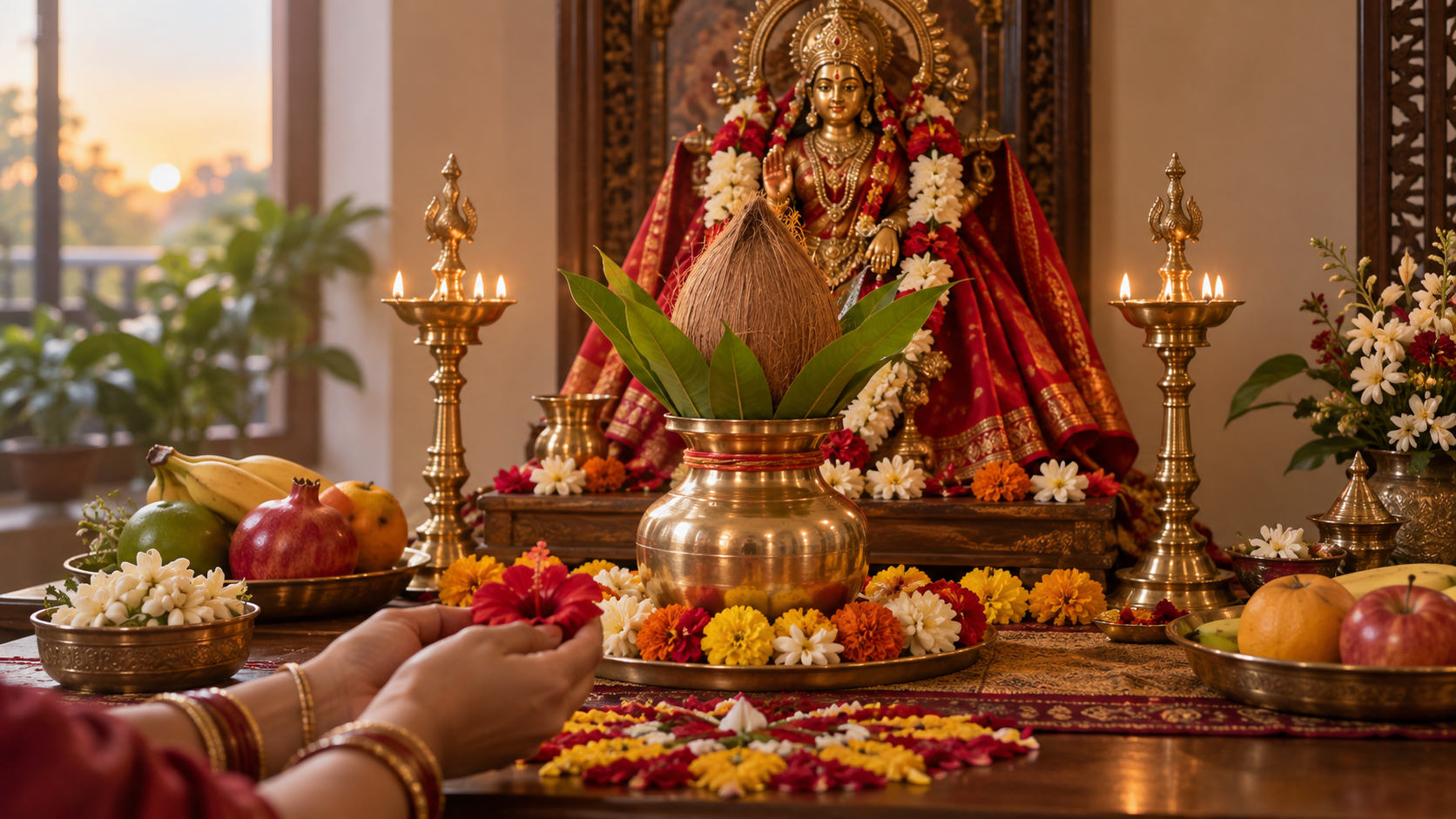
You have chosen a place for Devi, gathered a lamp and flowers, and then reached the difficult question: what does it mean to invite the Goddess rather than merely place her image on a shelf? For home worship, the answer is not greater complexity. It is a clear intention, a coherent sequence, and attention you can actually sustain.
Navaratri practice varies across regions, sampradayas, and families. You do not need to flatten those differences into a supposedly universal ritual. You need to know which tradition you are following, what you are promising to do, and how you will receive, worship, and respectfully conclude the presence you have invoked.
Invocation begins with a clear promise
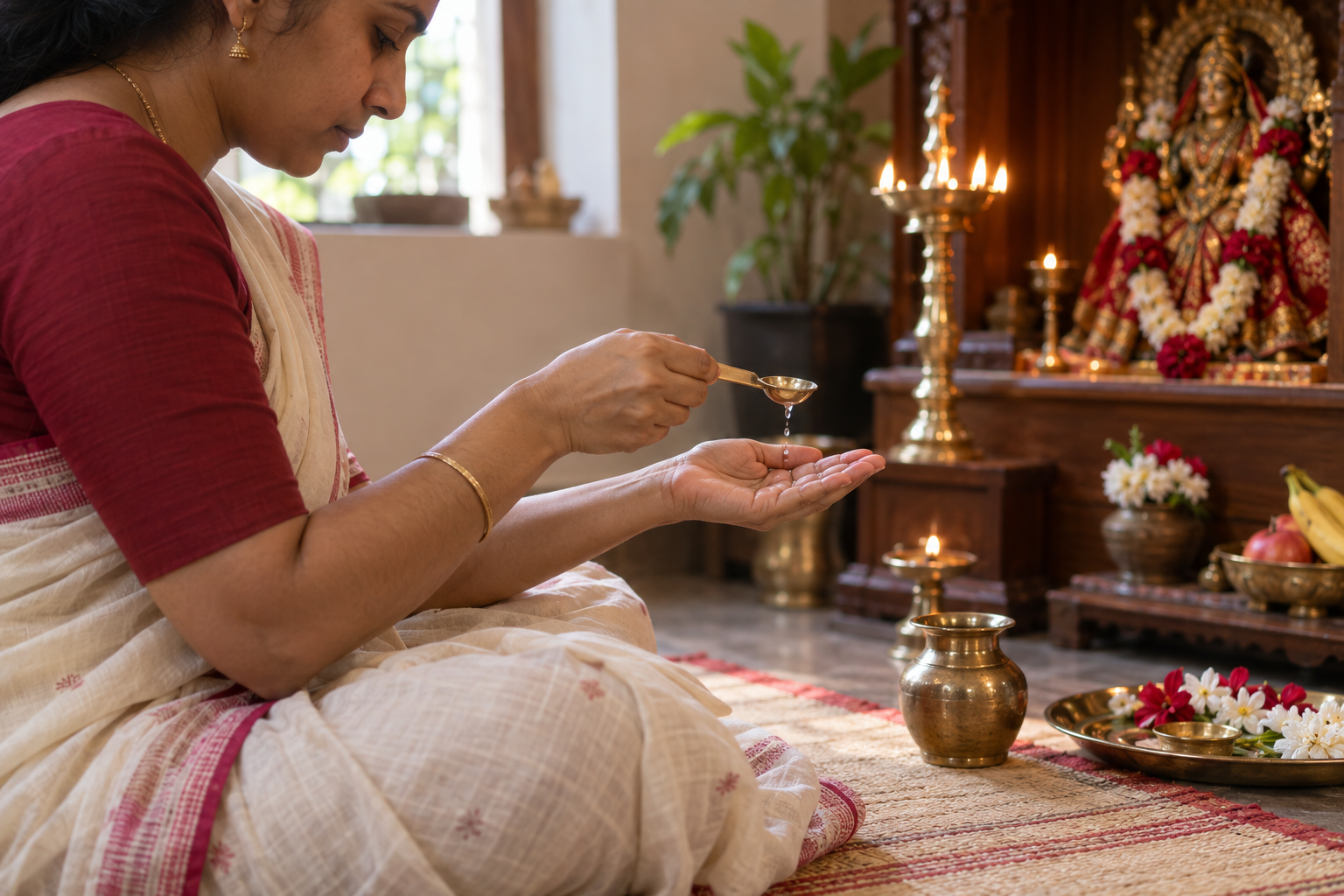
The Sanskrit word amantran means invitation or calling. In Durga Puja, it refers to inviting Durga and her divine family to reside in the festival image or murti for the observance. This is more than an opening announcement. It changes the worshipper’s posture from looking at a sacred representation to receiving an honored presence.
Before the first puja, settle four practical questions:
- Whom are you invoking? Decide whether your household will worship Durga in a familiar family form, a particular manifestation such as Katyayani, or Devi without adding a form your tradition does not use.
- Where will Devi be received? Prepare one clean, stable place for the image, murti, kalasha, or lamp recognized by your custom. Keep ordinary storage, loose papers, and unrelated objects away from it.
- What can you sustain? Choose a realistic daily time, a manageable set of offerings, and a recitation you already know or can learn properly. The invitation should be matched by your presence.
- Whose ritual order will you follow? If your family has an inherited paddhati, ask an elder or acharya about it before assembling instructions from unrelated traditions. If it does not, keep the worship explicitly simple and devotional.
This planning is part of the worship. A long sankalpa followed by hurried or abandoned observance is less coherent than a modest commitment you keep with care. Do not undertake formal temple-style or specialized Tantric procedures from fragments found online. Those disciplines depend on initiation, transmission, or detailed ritual guidance that a general home-puja outline cannot supply.
A simple sequence you can sustain at home
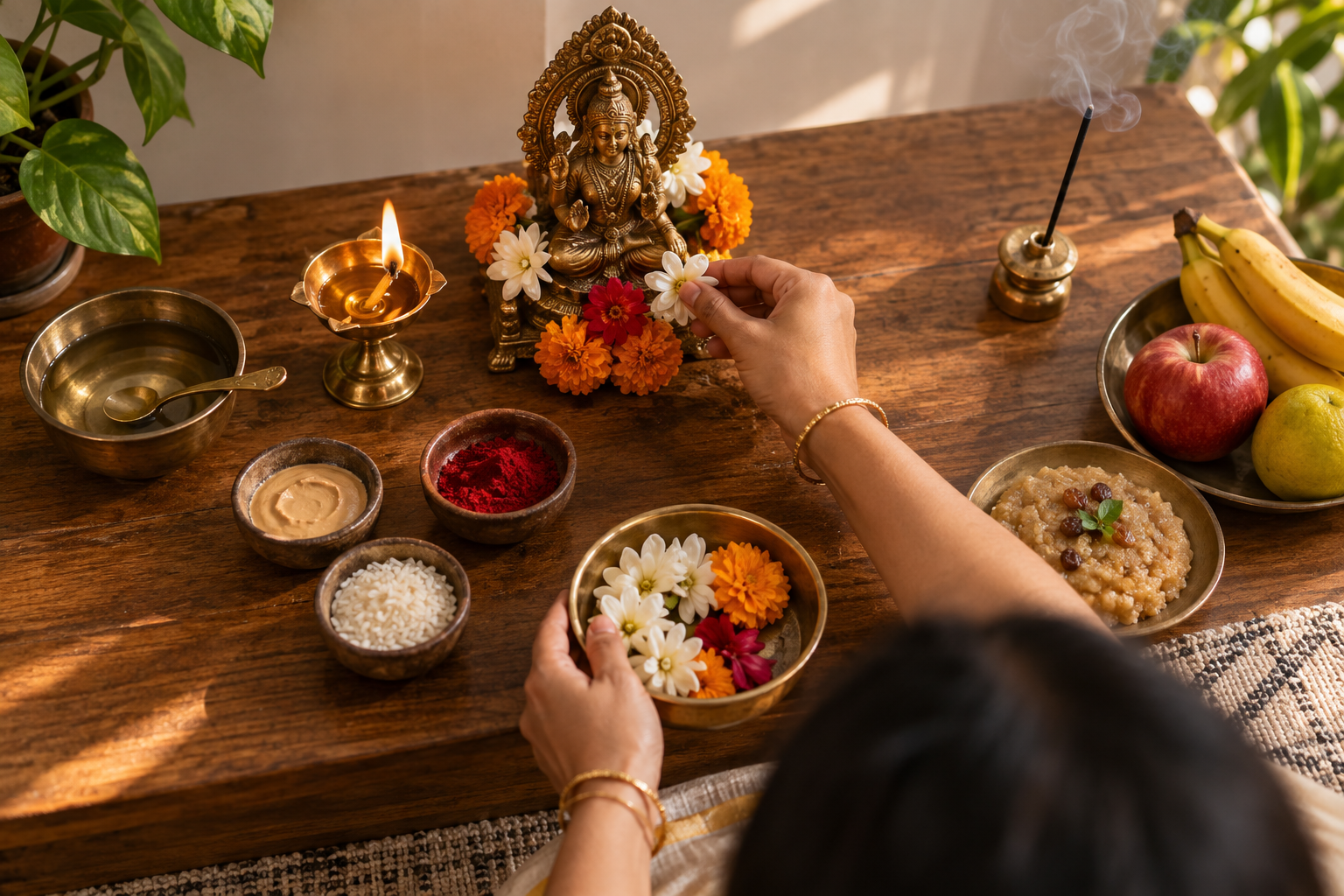
The following is a devotional framework, not a replacement for your family’s prescribed vidhi. Use it when you need a clear order for home worship and no inherited detail has been given to you.
- Prepare yourself and the space. Bathe or wash according to your household custom, wear clean clothes, and clean the worship surface. Arrange everything before lighting the lamp. Place any flame or incense on a stable, heat-resistant surface and do not leave it unattended.
- Establish Devi’s seat. Place the chosen image, murti, kalasha, or other recognized representation respectfully. Avoid crowding the altar with every form you encounter. A focused arrangement helps you remember whom you are receiving.
- State your sankalpa. Say plainly what you are undertaking and for how long. A simple personal resolve might be: During this Navaratri observance, I will worship Devi here each day with the offerings and recitation I have chosen. A formal lineage sankalpa should be learned from someone authorized to teach it.
- Offer the invitation. Fold your hands and invite Devi with attention. If you do not know a prescribed invocation, you can use ordinary devotional language: Mother Durga, with reverence I invite you to be present in this place and in my awareness. Please accept this worship and guide this home toward dharma, clarity, and courage. This is a personal prayer, not a scriptural mantra.
- Make the offerings. Offer only what is clean, suitable, and customary in your home. Water, a flower, light, fragrance where appropriate, and food prepared for offering form a clear devotional vocabulary. Do not turn a lack of elaborate materials into a reason to postpone worship.
- Recite what you can honor properly. Use a familiar mantra, name of Devi, stotra, or reading received through your family or teacher. If pronunciation or ritual use is uncertain, seek guidance rather than combining powerful seed mantras or specialized formulas from disconnected sources. An intelligible prayer offered with steadiness is an honest place to begin.
- Leave room for silence and conduct. Sit quietly after recitation. Identify one action through which the worship will enter your day: speaking without cruelty, completing a neglected duty, restraining anger, helping someone in the household, or correcting an avoidable disorder.
- Close the daily worship distinctly. Offer pranam, perform aarti if it belongs to your practice, and receive or distribute prasada. This daily close is not necessarily the final departure ritual. At the end of the full observance, thank Devi and follow your household’s procedure for conclusion, visarjana, and the respectful handling of the kalasha or other ritual materials.
The test of this sequence is not whether it looks impressive. Ask whether each action has a meaning you understand and whether you can repeat it without resentment or haste. Add a rite only when you know what it does and how it belongs within the whole.
Let Katyayani’s story change what you ask for

Katyayani is understood as a manifestation of Parvati. Her avatar narrative, commonly related with the Durga Saptashati, belongs to the crisis created by Mahishasura after prolonged tapas and the power he received. The story prevents worship from becoming decorative: spiritual effort and acquired power are not automatically dharmic when desire and domination govern their use.
If Katyayani is the form before you, do not rush from her name to a list of desired results. First identify the disorder you are asking Devi to help you confront. It may be an outward injustice, but it may also be a habit that has gained too much authority over your own conduct.
Give that reflection a practical edge:
- Name the problem without disguising it as someone else’s fault.
- Separate courage from anger. Decide what firm, dharmic action is actually available to you.
- Choose one action that can be completed before the next worship period.
- Bring the result back to the altar honestly, whether you succeeded or failed.
This keeps the invocation from ending when the lamp is extinguished. Katyayani worship then becomes a discipline of recognizing misused power, refusing helplessness, and aligning your own strength with dharma. It should not be presented as a guarantee that a particular recitation will produce a particular material outcome.
Approach Suvasini Puja as hospitality, not display
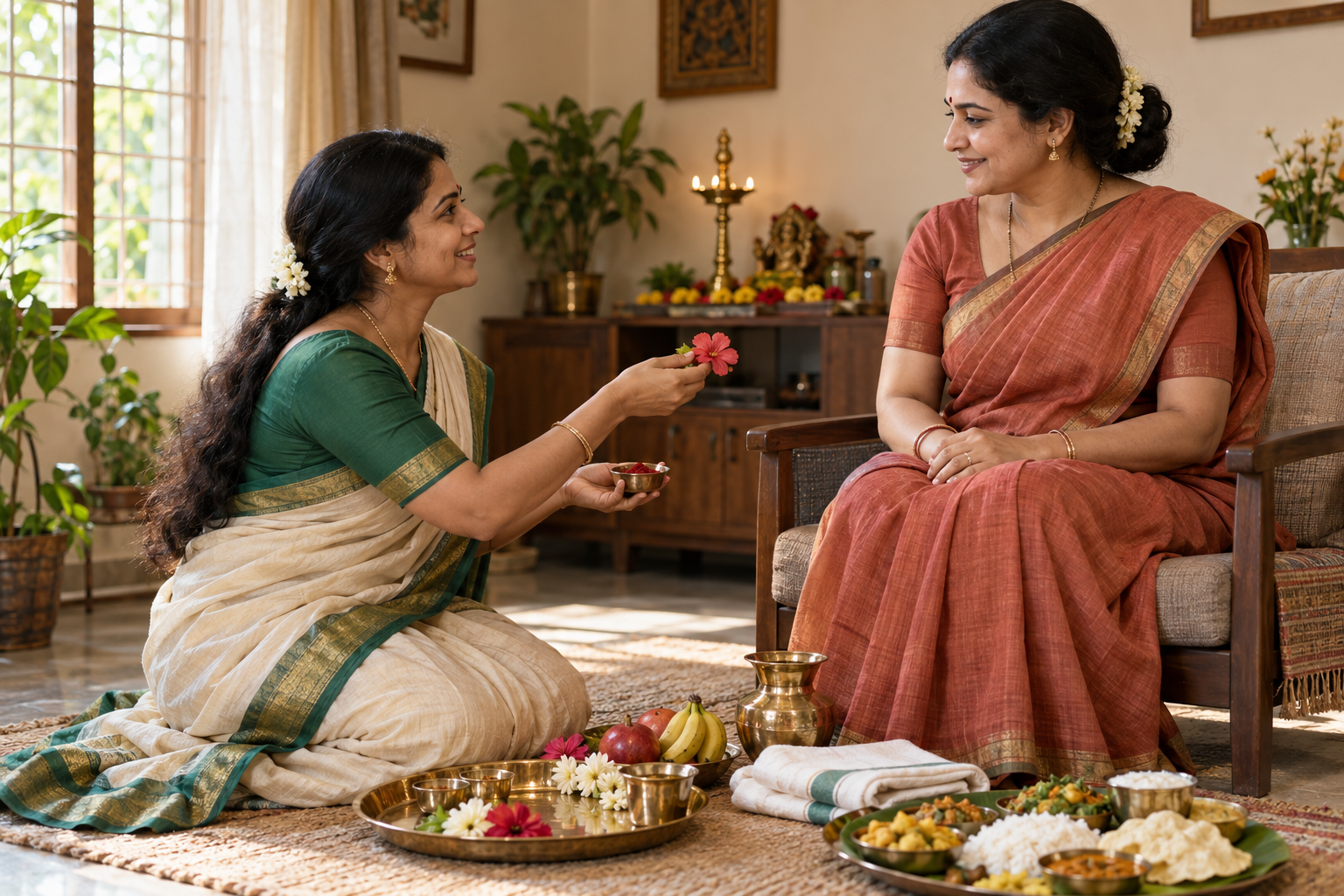
Suhasini Puja, also called Suvasini Puja, is observed in some communities during Sharad Navaratri. It does not have one universally fixed day. Some households associate it with Kalasha Sthapana or Durgashtami, while others perform it on Mahanavami.
That variation is a reason to locate yourself within a tradition, not to hunt for a single date that invalidates everyone else. Before inviting anyone, ask the elder, priest, or teacher who knows your family’s practice which day is followed, whom the custom asks you to invite, and which honors are offered. Resolve those questions before the guest arrives.
The invited person must never become a ritual prop. Make the invitation clear, obtain her willing agreement, explain the expected time, and ask privately about food or accessibility needs. Prepare the prescribed articles and hospitality in advance so that she is not left waiting while the household searches for instructions. Do not assume consent to photography or public posting simply because the occasion is religious.
If your household has not inherited Suvasini Puja and you cannot find reliable guidance within your tradition, you do not have to attach it to the festival to make your Navaratri complete. Honor the practices you have actually received. Everyday dignity toward women cannot be outsourced to a ceremonial moment, and ceremonial honor should never conceal discourtesy before or after the puja.
Key takeaways for a steady Navaratri practice
- Decide the form, ritual framework, daily time, and final conclusion before beginning.
- Treat amantran as a commitment to receive and attend to Devi, not as a decorative opening line.
- Prefer one coherent home practice over a collection of impressive but unrelated procedures.
- Let Katyayani’s story direct you toward a concrete dharmic response to misused power or disorder.
- Follow family and regional guidance for Suvasini Puja because its timing and procedure vary.
- Distinguish the close of each day’s worship from the formal conclusion of the full observance.
Before Navaratri begins, write a small worship plan you can keep beside the altar: the form of Devi, your daily time, the recitation, the offerings, one act of conduct, and the way the observance will conclude. Confirm any uncertain inherited detail with a knowledgeable elder or acharya. Then begin without anxiety and keep the invitation through steady attention.
References
- Hindu Pad – Story: Origin of Katyayani Mata
- Hindu Pad – Suhasini Puja | Suvasini Pooja during Sharad Navaratri
- Hindu Pad – Amantran | Inviting Ma Durga for Durga Puja

Leave a Reply
You must be logged in to post a comment.