
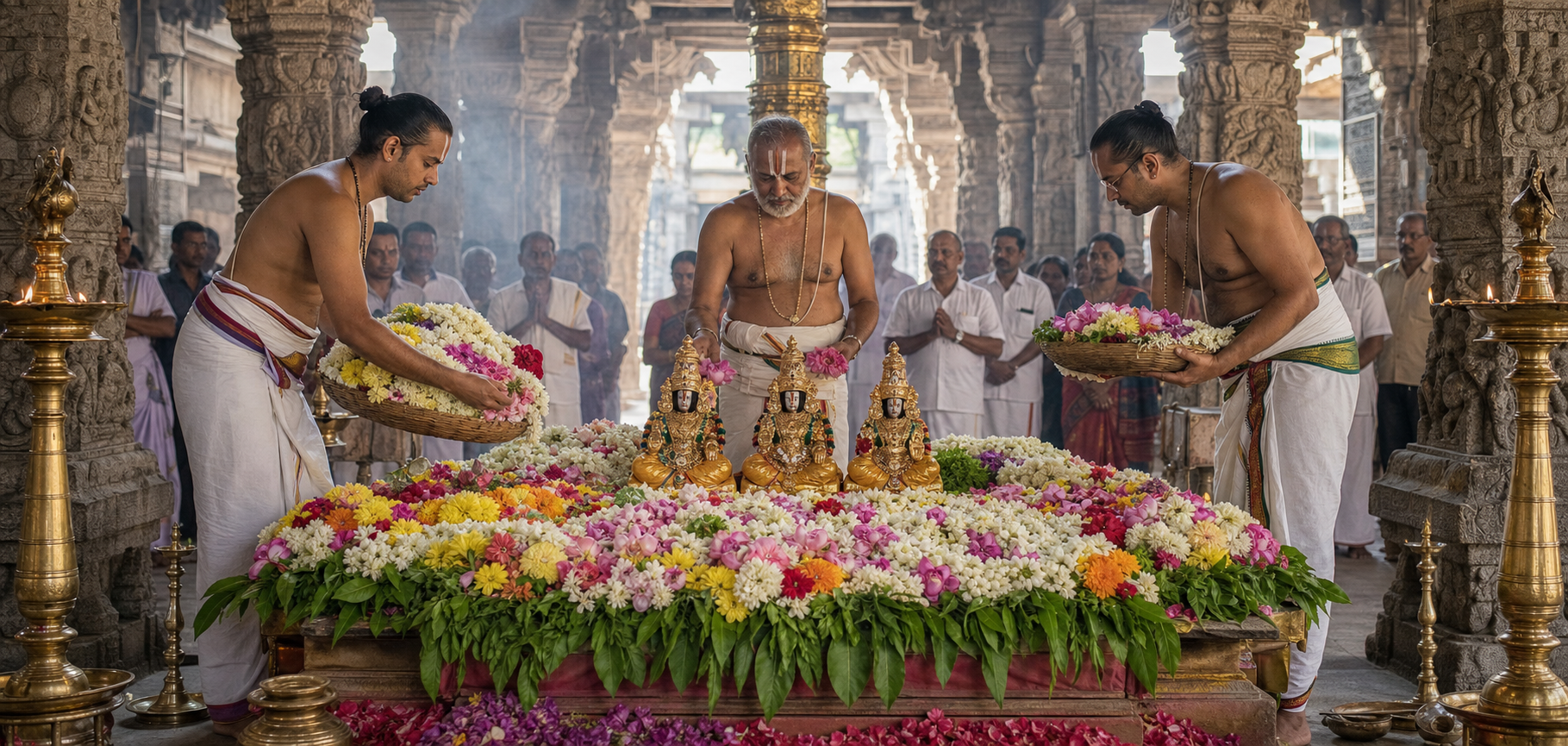
If you are consulting the 2026 Nagulapuram Pushpayagam calendar, the first distinction to keep clear is this: 5 June was the scheduled festival day, but the sacred sequence began on the evening of 4 June. The 11.00 am time announced for 5 June referred to Snapana Tirumanjanam, not to a separately timed start for the floral offering.
That distinction matters whether you are preserving the 2026 timetable, trying to understand the ceremony, or preparing for a future edition. Pushpayagam is not simply a moment when flowers cover the deity. It is the culmination of purification, protection, consecration, renewal, ritual bathing, and finally the offering of flowers to Sri Vedanarayana Swamy.
The 2026 schedule: what was fixed and what was not
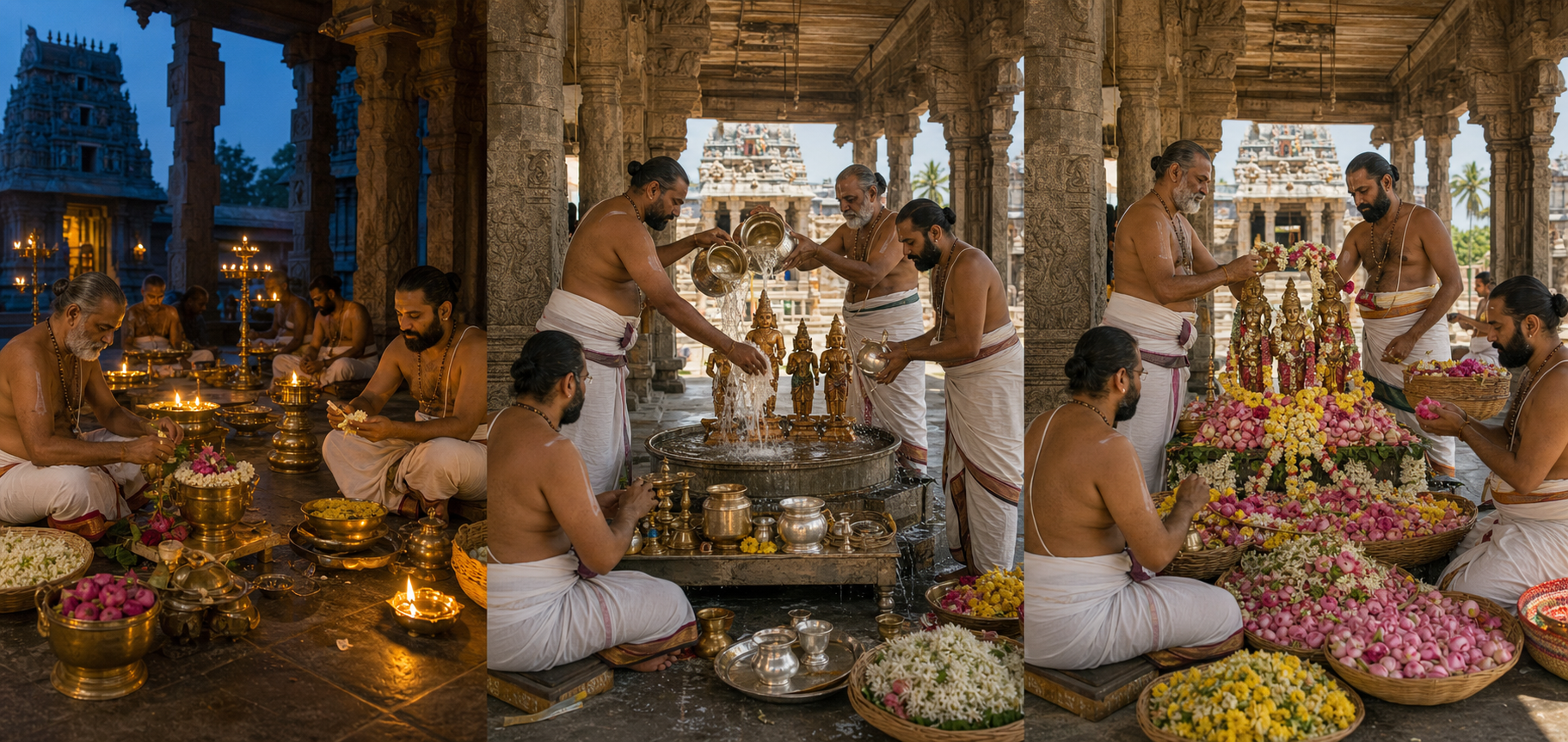
The 2026 observance was scheduled across 4 and 5 June at Sri Vedanarayana Swamy Temple in Nagulapuram, also written as Nagalapuram. All announced times were in Indian Standard Time.
| Date | Time | Scheduled rites | What the timing means |
|---|---|---|---|
| 4 June 2026 | 6.15 pm-7.45 pm IST | Punyahavachanam, Rakshabandhanam, Mrutsangrahanam, Senadhipati Utsavam, and Ankurarpanam | The ceremonial foundation was laid on the evening before the principal festival day. |
| 5 June 2026 | From 11.00 am IST | Snapana Tirumanjanam | The announced main-day time marked the beginning of the ritual bathing of the utsava murti. |
| 5 June 2026 | After Snapana Tirumanjanam | Pushpayagam | The flower offering followed the abhishekam, but no separate clock time was specified. |
Do not read 11.00 am as a guaranteed starting time for the showering of flowers. It was the start time for Snapana Tirumanjanam. Panchamrita, perfumed water, chanting, and the practical movement between ritual stages all belong to the preceding worship. Anyone trying to document the 2026 event accurately should therefore write that Pushpayagam followed the 11.00 am Snapana, not that Pushpayagam itself began at 11.00 am.
The timetable also does not establish special-entry arrangements, the length of queues, rules for bringing flowers, or the time at which a devotee needed to enter the temple. Timings alone cannot answer those questions. For a later observance, confirmation must come from current Tirumala Tirupati Devasthanams communications or a local temple notice close to the date.
Why the rites begin on the previous evening
The five preliminary rites are not ceremonial padding before the visually impressive part. They establish the conditions in which the flower offering can be made. Their order moves from purification to protection, from the sanctification of material nature to ritual order, and finally to the symbolism of new life.
- Punyahavachanam purifies the ceremonial space, materials, and participants. Consecrated water is sprinkled while mantras are recited, marking the passage from ordinary activity into sacred action. If you witness this rite, the water is not a decorative gesture; it establishes ritual readiness for everything that follows.
- Rakshabandhanam invokes protection through the tying of a sacred thread. In this temple setting, the name refers to a liturgical act safeguarding the ceremonial participants, objects, and proceedings. It should not be confused with the separate household and social celebration commonly known as Raksha Bandhan.
- Mrutsangrahanam is the ceremonial gathering and sanctification of earth. The rite acknowledges Bhumi as more than an inert supply of material: the Earth participates in the sacred work. Ordinary soil becomes consecrated dravya through mantra and ritual intention.
- Senadhipati Utsavam invokes Vishvaksena, the divine commander associated with order in Vaishnava worship. The purpose is the unobstructed and disciplined conduct of the Mahotsavam. It expresses a central Agamic principle: devotion is heartfelt, but it is not disorderly.
- Ankurarpanam is the auspicious sowing of seeds. It embodies fertility, renewal, the growth of merit, and hope for the continuity of dharma. The action is small, but its meaning extends from the life held within a seed to the welfare of the whole community.
Snapana Tirumanjanam began the next stage at 11.00 am on 5 June. During this abhishekam, the utsava murti was to be ritually bathed with panchamrita and fragrant waters while Vedic passages and stotras accompanied the worship. The bathing restores ritual freshness and prepares the murti to receive the profusion of flowers.
You can remember the entire ceremonial logic in seven movements: purify, protect, sanctify the earth, establish order, sow, bathe, and offer. That sequence is more useful than memorising unfamiliar names without their relationships. It also gives parents and elders a clear way to explain the Mahotsavam to children.
What the flowers mean at a temple of Matsya
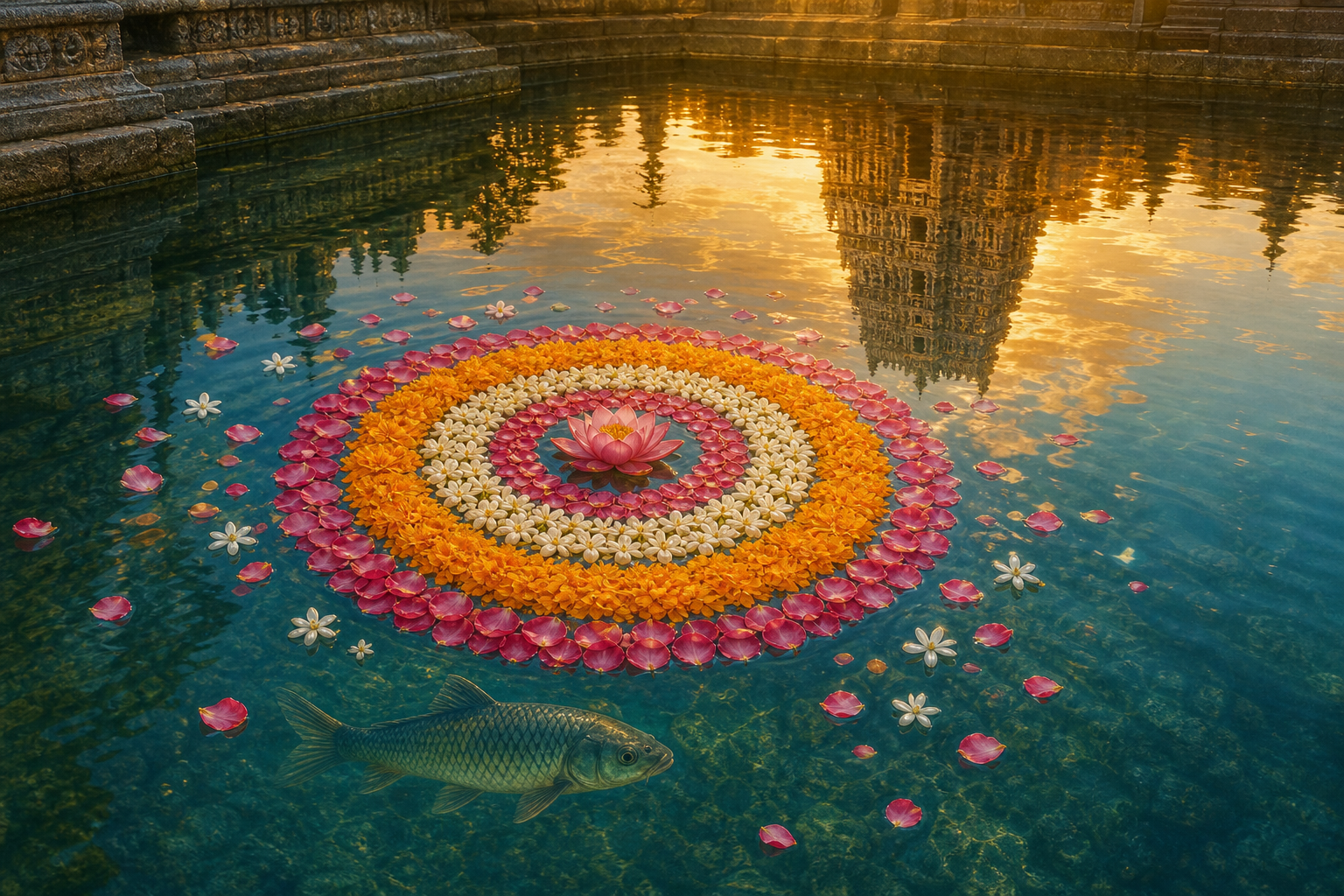
Sri Vedanarayana Swamy Temple is a Vaishnava kshetra in the Tirupati district of Andhra Pradesh. Administered by Tirumala Tirupati Devasthanams, it carries Vijayanagara-period architectural and cultural heritage within an active tradition of worship. Its significance is therefore not confined to an old structure. Architecture, iconography, priestly discipline, chanting, offerings, and congregational devotion remain parts of one living institution.
The presiding Lord is worshipped as Vedanarayana, the Matsya form of Vishnu. Matsya is revered as Vishnu’s first avatar, associated with the restoration of the Vedas. The name Vedanarayana thus directs attention to the Lord as guardian and restorer of sacred knowledge.
Against that theological background, Pushpayagam is more than floral decoration. Archakas offer abundant fresh blossoms while reciting mantras and hymns. Bhava, the devotee’s inward disposition, is joined to kriya, disciplined ritual action. Beauty becomes a form of worship because colour, scent, touch, mantra, and intention are all directed toward the deity.
Flowers carry several meanings at once. Their freshness points to purity of intention. Their fragrance suggests that virtue should spread beyond the person who cultivates it. Their beauty awakens gratitude, while their brief life checks pride and draws attention to impermanence. As gentle offerings, they also accord with ahimsa and a life-affirming mode of devotion.
The rite also turns the devotee’s attention outward. Pushpayagam is a thanksgiving for nature’s abundance and a collective prayer for timely rain, health, prosperity, and universal welfare. Mrutsangrahanam, Ankurarpanam, the water of Snapana, and the final blossoms place earth, seed, water, plant life, community, and deity within one sacred relationship.
This provides a careful point of connection across the wider dharmic family. The non-violent offering resonates with Jain emphasis on ahimsa; the fading blossom can prompt the Buddhist contemplation of impermanence; and disciplined communal participation recalls the place of seva and congregation in Sikh practice. These are shared ethical and contemplative resonances, not a claim that the traditions possess one identical liturgy. Pushpayagam remains specifically rooted in Vaishnava Agamic worship.
How to use the 2026 record when planning a future visit
A past festival timetable can help you understand the order of worship, but it cannot safely be reused as a future travel schedule. If you hope to attend a later Pushpayagam at Nagulapuram, make these checks before arranging your day:
- Search under both Nagulapuram and Nagalapuram. The two spellings refer to the same temple location, and notices may use either form.
- Confirm the current date and every time through TTD or a local temple notice. Do not assume that a later edition will repeat the 4-5 June dates or the 2026 hours.
- Ask separately for the Snapana Tirumanjanam time and the Pushpayagam time. A notice that says 11.00 am for Snapana does not necessarily tell you when the floral offering will begin.
- Check the current dress, access, queue, and decorum instructions. The temple uses codes and queue systems to protect sanctity and safety, but exact arrangements can change.
- Do not assume that flowers brought by individual visitors will be accepted as ritual offerings. Confirm the approved procedure before purchasing or carrying them to the temple.
- If you are taking children, explain three visual anchors beforehand: the seeds represent renewal, the bathing represents purification, and the flowers unite gratitude with humility. They will then be able to follow the worship rather than seeing only a crowded ceremonial scene.
During the ceremony, notice how the parts depend on one another. The flowers receive most of the visual attention, but the offering rests on the previous evening’s consecration and the morning’s abhishekam. Seeing that structure changes Pushpayagam from a spectacle into an intelligible act of worship.
Key takeaways
- The principal Nagulapuram Pushpayagam observance for 2026 was scheduled for 5 June, with preparatory rites on 4 June.
- Punyahavachanam, Rakshabandhanam, Mrutsangrahanam, Senadhipati Utsavam, and Ankurarpanam were scheduled from 6.15 pm to 7.45 pm IST on 4 June.
- Snapana Tirumanjanam was scheduled to begin at 11.00 am IST on 5 June. Pushpayagam followed it, but the announced timetable did not give the flower offering a separate start time.
- Sri Vedanarayana Swamy is worshipped as Matsya, the first avatar of Vishnu and the restorer of the Vedas.
- The flowers express purity, virtue, impermanence, ahimsa, gratitude for nature, and prayer for collective welfare.
- For any future visit, verify the current date, separate ritual timings, entry arrangements, dress expectations, and flower-offering procedure directly through TTD or the temple.
If your aim is future darshan, use the 2026 sequence to understand what you hope to witness, then build your journey only around a current temple notice. One timely confirmation can prevent the most common mistake: arriving for the flowers without knowing when the worship that prepares them actually begins.