
If you are planning puja, travel, a signing, or a new beginning for Friday, May 29, the useful question is not whether the entire date is simply good or bad. The Tithi changes during the morning, while Rahu Kalam and the day’s helpful Muhurtas must be placed according to your local sunrise and sunset.
For an India-based working plan, use approximately 9:38 AM IST as the Trayodashi-to-Chaturdashi boundary. Then replace every generic clock-time table with timings calculated for your city. That distinction will prevent the two most common mistakes: assigning one Tithi to the whole civil date and copying a 6:00 AM-to-6:00 PM Rahu Kalam chart without checking local daylight.
Key takeaways
- May 29 begins under Shukla Paksha Trayodashi and moves into Shukla Paksha Chaturdashi at about 9:38 AM IST in the India-based calculation.
- Before the change, Shiva abhishekam, mantra-japa, study, and a quiet sattvic routine fit the contemplative quality of Trayodashi. After it, Chaturdashi favors meditation, stotra patha, vrata, purification, and unobtrusive seva.
- Brahma Muhurta, Abhijit Muhurta, Vijay Muhurta, and Godhuli Bela are useful daily anchors, but their clock times depend on local sunrise, solar noon, and sunset.
- For Friday, Gulikai occupies the second eighth of daylight, Rahu Kalam the fourth, and Yamaganda the seventh. Avoid these periods when initiating an important or first-time action.
- Do not select a marriage, property transaction, sacred vow, or community ceremony from the Tithi and weekday alone. Confirm Nakshatra, Yoga, Karana, and any tradition-specific rules in a local Panchang.
The morning Tithi change determines which quality you are using
A Tithi is not another name for a calendar date. It measures each 12-degree increase in the angular separation of the Sun and Moon. Because the Moon does not move at a perfectly uniform apparent rate, a Tithi can begin or end at any civil-clock hour. The Tithi present when you begin an action is therefore more relevant than the Tithi printed beside the date in a monthly calendar.
On the standard IST reading, May 29 opens in Shukla Paksha Trayodashi. Activities begun before approximately 9:38 AM belong to Trayodashi; those begun after the boundary belong to Shukla Paksha Chaturdashi. Most of the daytime is consequently Chaturdashi, even though the date begins with Trayodashi.
This matters especially for Shiva worship. Trayodashi carries a well-established association with Shiva upasana, and an early-morning abhishekam or japa can be placed before the transition in India. Chaturdashi retains a strong Shiva orientation, but its emphasis is better suited to inward practice, vrata, meditation, stotra recitation, and purification than to treating the day as a universal opening for every material undertaking.
Pradosh requires more care. It is not enough to notice that Trayodashi appears somewhere on May 29. The observance is tied to Trayodashi in the sunset period. Because this Trayodashi ends in the morning, the relevant Pradosh will generally have fallen on the previous evening – Thursday, May 28 – in many Indian locations. Confirm that conclusion with the sunset-bound rule followed by your sampradaya and regional Panchang before undertaking the vrata or attending a temple observance.
If you live outside India, do not convert 9:38 AM IST and stop there. Consult a Panchang calculated for your location and local civil date. A time-zone conversion can tell you when the astronomical boundary occurs on your clock, but local sunrise conventions still determine how a religious calendar assigns and observes the day.
The same lunar rhythm appears across several Dharmic traditions, though their observance rules are not interchangeable. Hindu households use Tithi and Nakshatra for vrata and puja; Buddhists align Uposatha observances with lunar phases; Jains arrange fasting and pratikraman by Tithi; and some Sikh commemorative calendars retain a relationship with the Bikrami cadence. Use the calendar of your own tradition while recognizing the civilizational continuity expressed through this shared attention to lunar time.
Build the useful Muhurta windows from local solar times
A named Muhurta should not be copied as a universal clock time. Sunrise, solar noon, and sunset move with location and season. Start with those three values for your city, then place the following practical anchors.
| Window | How to locate it | Suitable practical use | Limit to remember |
|---|---|---|---|
| Brahma Muhurta | Roughly from 1 hour 36 minutes before sunrise until 48 minutes before sunrise | Meditation, mantra-japa, svadhyaya, and quiet preparation | Use your local sunrise, not a national or nearby-city time |
| Abhijit Muhurta | About 24 minutes before through 24 minutes after local solar noon | Beginning a necessary task when a more specific Muhurta is unavailable | Solar noon need not be 12:00 PM; also check for an avoidance-period overlap |
| Vijay Muhurta | In late afternoon, commonly positioned about 1.5 to 2.5 hours before local sunset | Work seeking success, resolution, or favorable completion | Obtain the exact interval from a city-based Panchang when the action is important |
| Godhuli Bela | Around local sunset | Light devotional activity and a calm transition into evening | It is not a substitute for verifying a sunset-bound vrata such as Pradosh |
Choose the window according to the action. Brahma Muhurta is the clearest choice for sadhana and study. Abhijit offers a practical fallback for an ordinary initiative that cannot wait for a highly tailored election. Vijay Muhurta is more naturally used for bringing purposeful work toward success or resolution. Godhuli is best kept gentle and devotional.
Do not stack labels mechanically. If an approximate Abhijit or Vijay interval overlaps Rahu Kalam, Yamaganda, or Gulikai in your local calculation, avoid using the overlap for a new important undertaking. Move to a clean portion of the favorable window or obtain a more complete Muhurta assessment.
Calculate Friday’s Rahu Kalam instead of copying fixed times
The familiar Friday chart showing Rahu Kalam from 10:30 AM to noon is based on a notional day with sunrise at 6:00 AM and sunset at 6:00 PM. It is a teaching example, not a location-independent answer. Your city’s daylight interval may be shorter or longer, shifting all three avoidance periods.
- Write down local sunrise and sunset for May 29, 2026.
- Find the total daylight duration by subtracting sunrise from sunset.
- Divide that duration into eight equal segments.
- For Friday, mark the second segment as Gulikai Kalam.
- Mark the fourth segment as Rahu Kalam.
- Mark the seventh segment as Yamaganda.
- Keep important beginnings outside those three intervals.
With the illustrative 6:00 AM sunrise and 6:00 PM sunset, daylight lasts 12 hours and each segment lasts 90 minutes. The resulting Friday periods are Gulikai from 7:30 AM to 9:00 AM, Rahu Kalam from 10:30 AM to noon, and Yamaganda from 3:00 PM to 4:30 PM. Change either sunrise or sunset, and those clock times must change as well.
These periods mainly guide beginnings. Starting a journey, signing an agreement, opening a venture, or performing a first-time action is traditionally deferred. Work already underway does not normally have to stop when Rahu Kalam begins. Routine worship, daily duties, and necessary continuation are different from electing the first moment of an important undertaking.
This distinction makes the Panchang usable rather than burdensome. You do not need to suspend ordinary life for several hours. You need to recognize that the opening moment carries special weight and place that moment with care.
Turn the Panchang into a plan for May 29
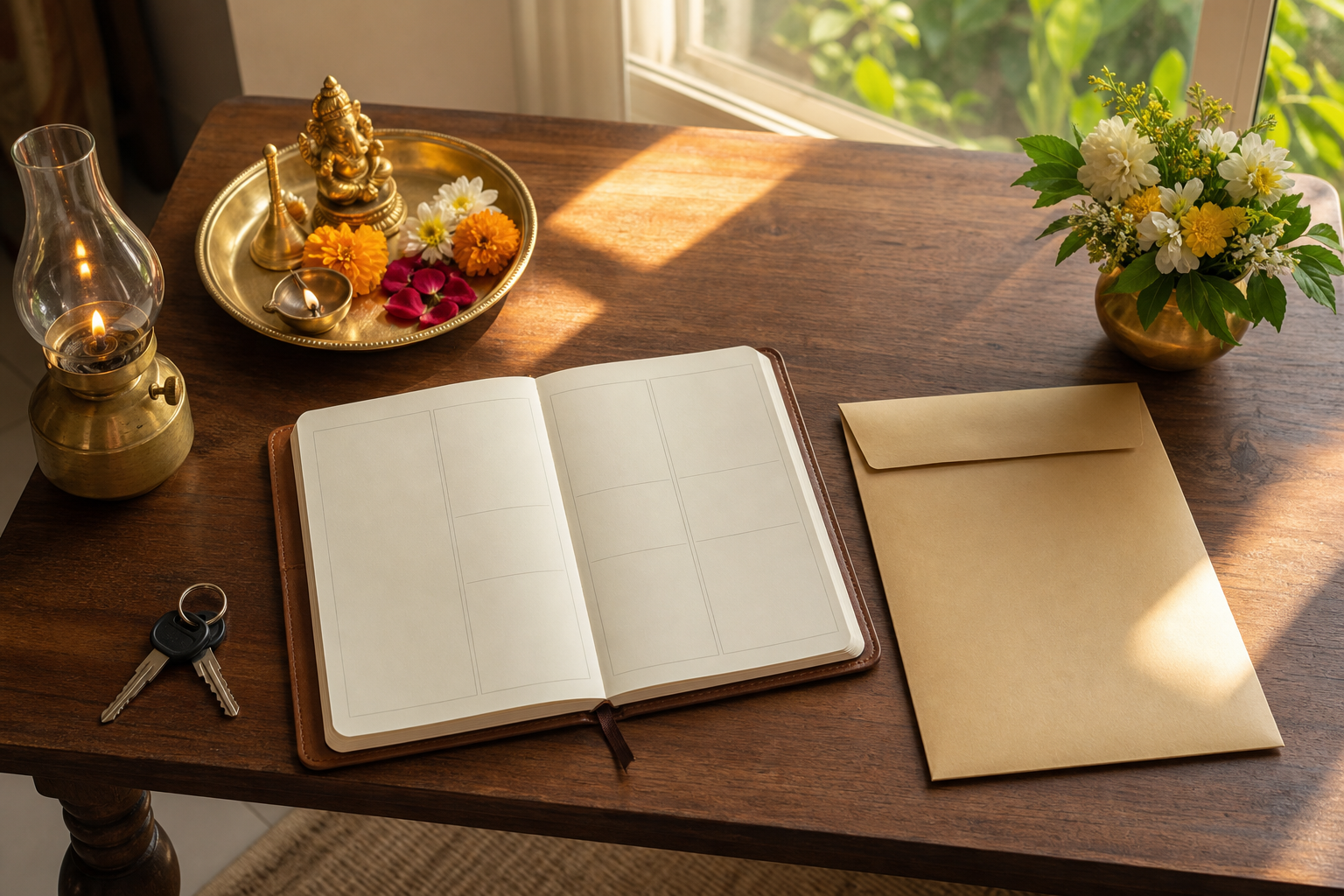
A practical schedule begins with the nature of your activity. Spiritual practice, routine work, travel, and a major samskara do not require the same level of electional detail.
- Fix the location. Record the city where the activity will actually begin, along with its local sunrise, solar noon, and sunset.
- Confirm the Tithi boundary. Use about 9:38 AM IST only as the India-based baseline. Replace it with the exact local Panchang result when outside India or when undertaking a formal observance.
- Choose the quality you need. Use Trayodashi for early Shiva-oriented worship and Chaturdashi for meditation, vrata, stotra, purification, and quiet seva.
- Place a favorable daily anchor. Select Brahma Muhurta for sadhana, Abhijit for a necessary ordinary beginning, Vijay for success-oriented work, or Godhuli for light devotion.
- Cross out Friday’s restricted segments. Calculate Gulikai, Rahu Kalam, and Yamaganda from the actual daylight span. Do not rely on the notional times unless your sunrise and sunset really are 6:00 AM and 6:00 PM.
- Add the remaining Panchang limbs when consequences are substantial. Tithi, Vara, Nakshatra, Yoga, and Karana form the complete five-limbed framework. A personal election may also require Tarabalam, Chandrabalam, and the Moon’s Rashi.
For a simple India-based devotional day, you might meditate or study in Brahma Muhurta, perform Shiva abhishekam or japa while Trayodashi remains, and continue with stotra patha, meditation, or seva after Chaturdashi begins. At sunset, keep Godhuli devotional, but do not call the evening Pradosh merely because the civil date once contained Trayodashi.
For an ordinary material task, identify a clean Abhijit or Vijay interval that does not collide with a calculated avoidance period. For marriage, a property transaction, a binding vow, or a community ceremony, stop at that point and verify the complete city-specific Panchang with someone competent in the rules of your tradition. Chaturdashi is not treated as a default marriage Tithi in many classical Muhurta traditions, and a broadly favorable daily interval cannot by itself override that concern.
Before May 29 arrives, save four items in your calendar: the local Tithi change, one suitable Muhurta, Friday’s three avoidance intervals, and the purpose of your chosen activity. That small preparation is enough to turn the Panchang from a collection of labels into a disciplined way of acting at the right time.