

If someone you love has died, the Garuda Purana’s descriptions of Yama, karmic judgment, and naraka can sound more frightening than consoling. If you are reading before a loss, you may be asking an equally personal question: what should you do now so that death does not find you spiritually unprepared?
Begin with the distinctions that hold the teaching together. The death of the body is not the destruction of the atman. The jiva continues under karma, relatives express care through rites, and liberation remains the final horizon. Once those parts are kept in their proper places, the journey becomes a call to responsible living rather than a catalogue of horrors.
First distinguish the atman from the travelling jiva

The most important question is not simply, “What happens to me?” It is, “Which meaning of me are we discussing?” Hindu thought does not treat the physical body, the changing personality, and the eternal Self as identical.
- Atman is the immutable Self. It is not created when the body is born or destroyed when the body dies.
- Jiva is the embodied, transmigrating being: the individual caught in the movement of birth, experience, death, and rebirth.
- Sukshma-sharira, the subtle body, carries the impressions and tendencies commonly called vasanas when the gross body can no longer function.
- Karma provides moral continuity. Actions matter, but so do the intentions and attitudes from which those actions arise.
This distinction between atman and jiva resolves an apparent contradiction. The Self can remain untouched while the jiva undergoes consequences, carries conditioning, and takes another birth. Experiences after death belong to the conditioned jiva, not to the eternal Self in its absolute nature.
It also prevents two common misreadings. Death is not annihilation, but neither does Hindu teaching promise that the present personality will continue forever without change. The jiva’s continuity is karmic and subtle. Moksha is freedom from that conditioned transit, not merely admission to a more pleasant destination within it.
The Garuda Purana is a Vaishnava Mahapurana framed as a dialogue between Narayana and Garuda. Its death-related teachings, commonly associated with the Pretakalpa, operate on several levels at once: metaphysical account, ritual instruction, ethical warning, and psychological mirror. Manuscripts and regional customs are not identical. You therefore do not have to force every image, rite, and philosophical claim into one flat kind of statement.
The journey after death is a map of continuity and accountability

The sequence begins with withdrawal. Prana recedes from the senses and limbs, and ordinary sensory engagement ceases. Yogic language associates the movement of consciousness with subtle channels and, in an auspicious departure, with the brahmarandhra at the crown. This is a spiritual anatomy, not a medical test. Bodily signs cannot be used to diagnose a person’s spiritual destination, and mantra must never replace necessary medical or palliative care.
The onward journey can be understood in four movements:
- The embodied condition ends. The gross body is left behind while karmic and subtle continuity remains with the jiva.
- A liminal preta condition follows. Preta here names a being in transition, not the caricature of a permanently wandering ghost. The departed has not yet been ritually assimilated among the pitrs, or ancestral beings.
- Karma becomes impossible to evade. Yama’s attendants, the crossing of Vaitarani, and Chitragupta’s reckoning give dramatic form to moral accountability. What was done, intended, encouraged, or neglected has consequences.
- The jiva encounters an appropriate outcome. Painful narakas, meritorious realms, rebirth, and the liberating refuge opened by knowledge, devotion, or grace belong to different possible trajectories.
This is not a picture of arbitrary divine anger. Yama’s realm represents order: the jiva encounters the moral shape of the life it has lived. The practical lesson is immediate. A harmful act does not become harmless because it was hidden from other people, socially rewarded, or rationalised afterward.
Names such as Tamisra, Andhatamisra, Raurava, Maharaurava, Kumbhipaka, Kalasutra, and Asipatravana give the naraka passages their unforgettable severity. You need not choose carelessly between “every image is a physical travel report” and “none of it means anything beyond metaphor.” Traditional believers may accept these as real post-mortem states. A moral and psychological reading notices at the same time that greed burns, deceit entangles, and cruelty returns as suffering. The two readings can reinforce the same demand for reform.
Within this karmic vision, naraka is corrective rather than the final purpose of existence. Its frightening imagery should therefore prompt repentance, restraint, and changed conduct. It should not be used to terrorise children, speculate gleefully about another person’s fate, or intensify the anguish of a grieving family. If a description makes you afraid, turn the fear into a precise ethical question: what cruelty, dishonesty, exploitation, or attachment in your own life now requires correction?
Why death can still resemble deep sleep
A serene description of death as a deep, restful transition does not cancel the karmic journey. Vedantic analysis distinguishes waking, dreaming, and deep sleep. In deep sleep, ordinary mental and sensory activity has subsided, yet causal potential has not been erased. The person wakes with continuity.
Death may resemble that cessation of surface activity while differing in its place within the longer cycle of embodiment. The peaceful image concerns the withdrawal of ordinary experience; the dramatic journey concerns the jiva’s unresolved karma. One describes stillness at the threshold. The other explains why the threshold is not yet moksha.
For you, the distinction has a practical consequence. Do not confuse a calm physical death with proof that every karmic issue has been resolved, and do not assume visible bodily struggle proves spiritual failure. Care for the dying person without passing judgment. The inner course of another jiva is not available for spectators to grade.
Death rites are duties of care, not decorative customs
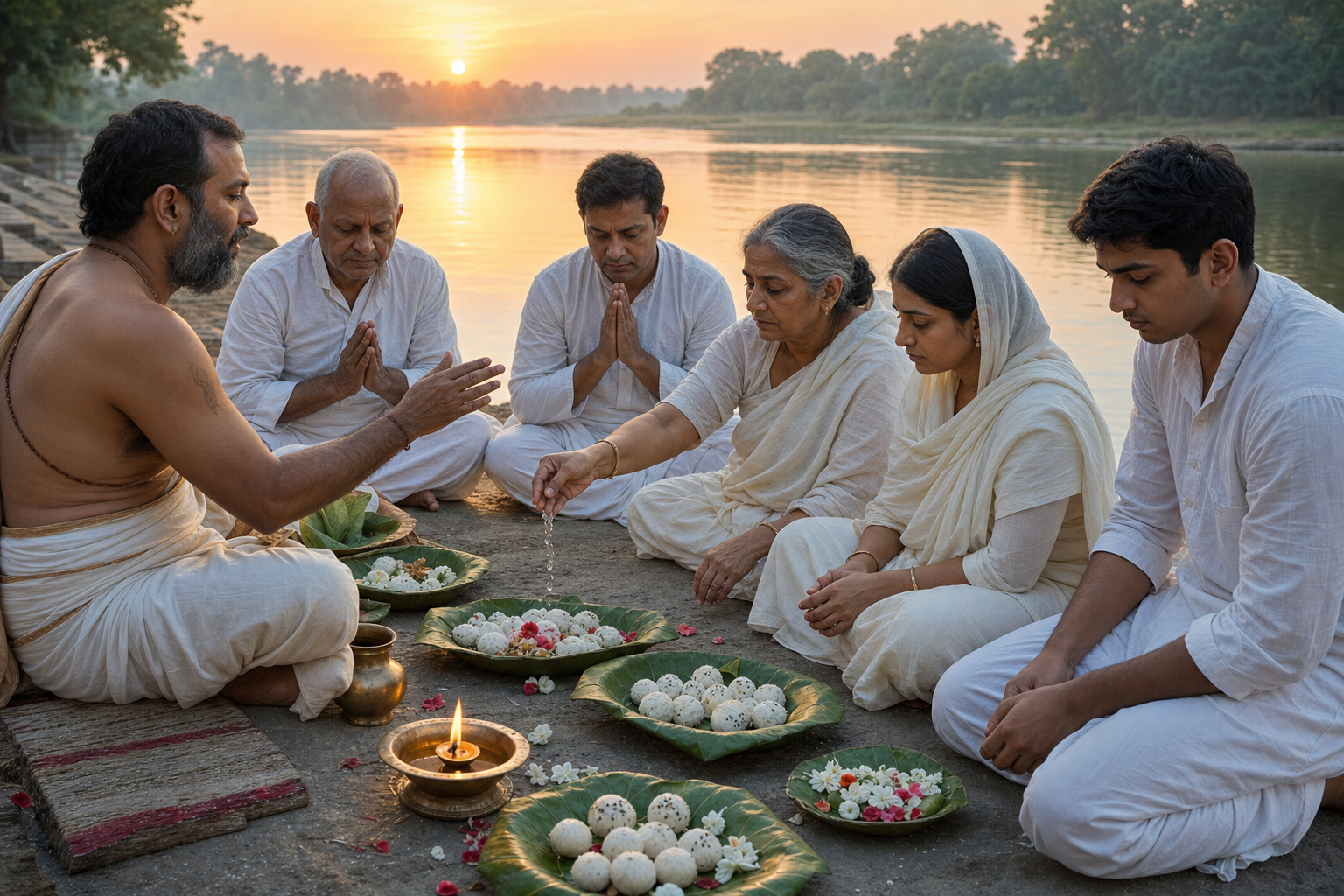
Antyeshti, pinda-dana, and shraddha put metaphysical conviction into action. In the Garuda Purana’s ritual worldview, offerings do not merely help survivors remember; they support the preta’s passage and eventual integration among the pitrs. At the human level, the same rites give grief a sequence, assign loving duties, and prevent loss from becoming an entirely private burden.
Many traditions arrange offerings across the first ten days, hold further ceremonies on the eleventh, and perform sapindikarana on the twelfth or thirteenth day. The exact sequence varies by region, community, family tradition, and sampradaya. Treat those timings as a map of the questions you need to ask, not as a universal do-it-yourself manual.
- If death is near: keep the space as calm as circumstances permit. Use a divine name, mantra, prayer, or recitation familiar to the person rather than turning the bedside into a theological debate. Continue appropriate medical and comfort care.
- If death has just occurred: complete the required medical and legal steps, then contact a trusted purohit, acharya, gurdwara, temple, or other authority appropriate to the family’s actual tradition.
- Before combining instructions: establish which regional and sectarian custom the family follows. Mixing unrelated internet checklists can create conflict at the very moment relatives need clarity.
- If a prescribed rite cannot immediately be arranged: continue respectful remembrance and seek competent local guidance. Dana offered in the departed person’s memory can express dharmic care, but it should not be presented as an invented universal replacement for lineage-specific rites.
- After the initial period: record the family’s practice for annual shraddha and Pitru Paksha so that remembrance does not depend on one person’s memory.
If relatives disagree, separate the essential duty from the disputed detail. The essentials are reverence for the deceased, sincere remembrance, disciplined conduct, and completion of the family’s recognised rites as well as circumstances allow. Questions about the proper officiant, sequence, or form belong with someone who actually knows that tradition.
Do not weaponise ritual precision against the bereaved. Distance, migration, family division, cost, and sudden death can make an ideal sequence difficult. Dharma calls for conscientious effort, not public humiliation. A rite intended to carry love across a threshold has been misunderstood when it becomes an occasion for vanity or cruelty.
Prepare for death by changing the life that produces karma

The most useful preparation begins long before the final bedside. No last-minute ceremony turns sustained adharma into an irrelevant detail. Likewise, the vivid warnings are not meant to leave you paralysed. They identify the leverage you still possess: present conduct, present attention, and present devotion.
The yamas provide a direct ethical audit. Ahimsa asks where you cause avoidable harm. Satya asks where your speech hides or distorts what is true. Asteya asks what you take without right, including credit and opportunity. Brahmacharya asks whether desire and energy are disciplined rather than allowed to rule you. Aparigraha asks what you grasp, hoard, or refuse to release.
The niyamas build the inner capacity needed to answer that audit: shaucha, or purity; santosha, or contentment; tapas, or disciplined effort; svadhyaya, or sacred self-study; and Ishvara-pranidhana, or surrender to the Divine. These are not ornamental Sanskrit terms. They are methods for weakening the habits that carry agitation forward.
A workable rule of life can remain simple:
- Repair known harm. Admit a lie, restore what was taken, stop participating in cruelty, and make amends where doing so will not create further harm.
- Practise nama consistently. Use the divine name or mantra received in your tradition. Familiar remembrance is easier to return to during illness and dying than a practice first encountered in crisis.
- Join devotion to conduct. Puja and recitation cannot serve as permission to exploit people. Bhakti should make accountability more honest, not less.
- Make seva and dana habitual. Service loosens the self-centred habits that make every loss feel like an attack on possession and control.
- Study with a purpose. Use svadhyaya to identify a tendency that must change. Accumulating descriptions of lokas without changing daily conduct misses the ethical force of the teaching.
- Leave clear family instructions. Record your sampradaya, the person or institution to contact for antyeshti, the prayers meaningful to you, and the ancestral observances your household maintains.
Vaishnava practice adds a decisive dimension: the jiva is not saved by moral bookkeeping alone. Nama, bhakti, seva, and sharanagati orient the person toward Bhagavan, while grace opens a horizon beyond transient pain and pleasure. Vaikuntha is therefore not simply a reward earned like wages. It expresses refuge in a loving relationship with the Divine. That grace does not make ethics unnecessary; sincere surrender changes how you live.
Other dharmic traditions arrange the post-mortem map differently without erasing this practical centre. Buddhist teachings on transitional states emphasise awareness and compassion. Jain teaching places the jiva’s movement through four gatis under karma and makes ahimsa and self-discipline indispensable. Sikh teaching joins karmic causality to naam-simran, truthful living, and the grace of Vahiguru. The traditions should not be collapsed into one system, but their shared counsel is usable: remember the Divine, reduce harm, master the mind, and do not postpone ethical repair.
Key takeaways for facing death without living in fear
- The body dies, but the atman is not destroyed. The conditioned jiva remains within karmic continuity until liberation.
- The preta condition is transitional. It should not be confused with either the eternal Self or a permanently damned ghost.
- Yama, Chitragupta, Vaitarani, and the narakas make accountability vivid. Their proper ethical use is self-correction, not speculation about someone else’s fate.
- Literal and psychological readings of naraka need not cancel one another. Both can expose how harmful conduct produces suffering.
- Antyeshti, pinda-dana, shraddha, and sapindikarana belong to living regional and sectarian traditions. Follow competent family or lineage guidance rather than assuming one schedule fits everyone.
- A calm death is supported by familiar remembrance, a compassionate environment, and a life already shaped by dharma. Outward appearances still do not reveal another person’s spiritual destination.
- The durable preparation is daily: practise ahimsa and satya, repair harm, remember Bhagavan, serve others, and leave your household clear ritual instructions.
You can act on this teaching now without pretending to know every detail of the unseen journey. Write down whom your family should contact when death occurs. Then identify one unresolved act of harm, deception, or grasping and begin repairing it. The point of learning about death is to make your next living choice more truthful.