
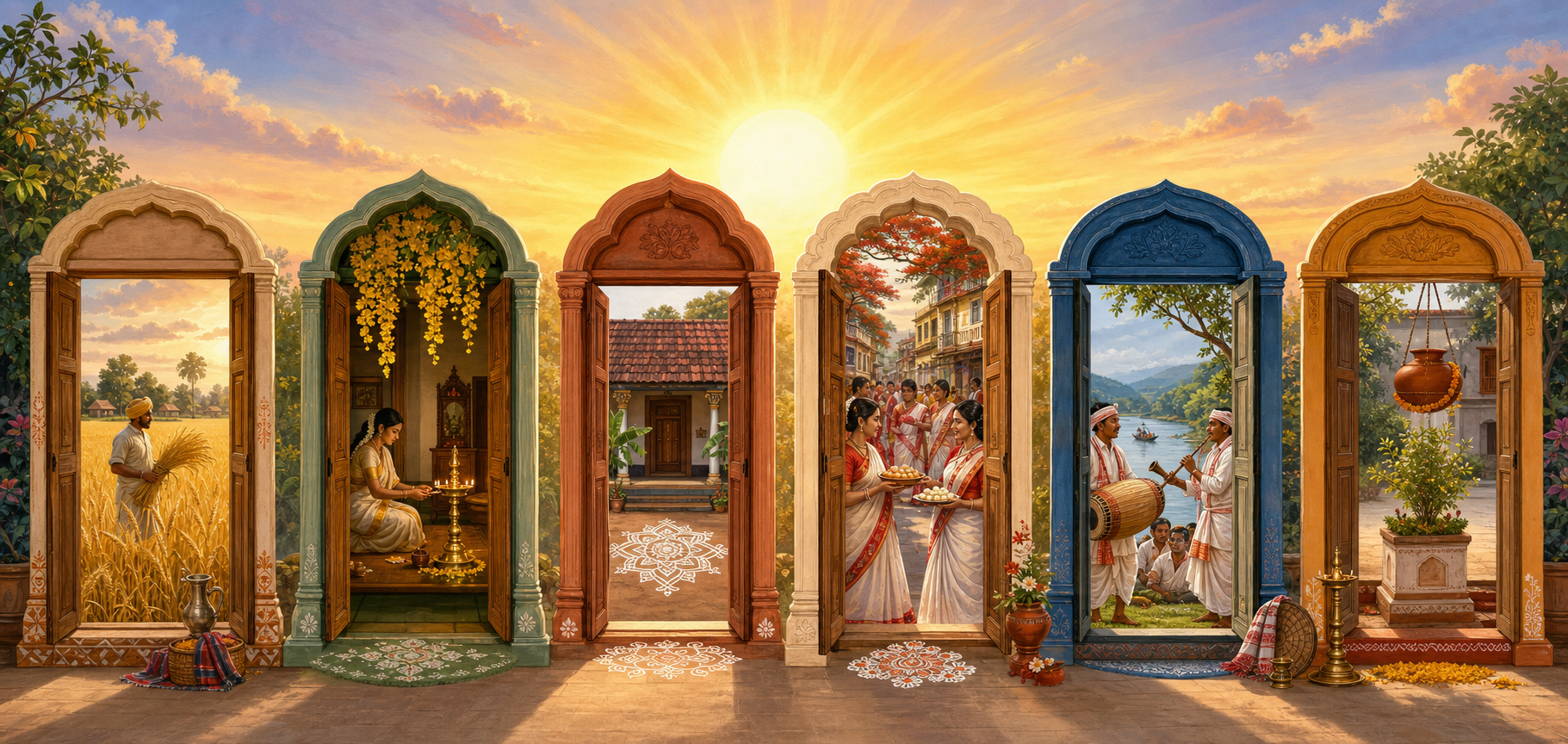
You see Vaisakhi, Vishu, Puthandu, Pohela Boishakh, Rongali Bihu and Pana Sankranti greetings arrive within the same few days. Are these different names for one festival, or separate festivals that happen to overlap?
Treat them as members of one calendrical family, not as synonyms. Their common hinge is Mesha Sankranti, while each community gives that hinge its own history, ritual language and duty. Once you understand that distinction, you can choose the right date, greet people accurately and participate without flattening living traditions into a generic pan-Indian New Year.
One solar threshold does not make one uniform festival

Mesha Sankranti is the moment when the Sun enters Mesha, or Aries, in the sidereal zodiac. A sankranti is a solar transition from one sidereal sign to another. Because Mesha begins a new solar cycle in several regional calendars, this ingress opens a month or year across much of Bharat.
The word sidereal matters. Indian jyotisha measures the Sun against a stellar framework, whereas the tropical zodiac is anchored to the seasons. Precession has separated the sidereal entry into Aries from the March equinox, so Mesha Sankranti now occurs around the middle of April. The older association between Vishuva and balance does not mean that the present observance falls on the astronomical equinox.
- The astronomical layer: the Sun crosses into sidereal Mesha.
- The calendrical layer: a regional solar month or year begins.
- The cultural and religious layer: each community interprets the turn through its own sacred memory, agricultural season and inherited practices.
The first layer is shared. The third is not interchangeable. That is why calling every mid-April observance simply Mesha Sankranti may be astronomically understandable but culturally incomplete.
In 2026, the principal observances center on Tuesday, April 14. A ritual time is more precise than a civil date, however. Longitude, the ayanamsha used by an almanac and the method of calculation can produce small differences in the stated ingress and Punya Kala. If you are only attending a cultural gathering, the announced festival date is sufficient. If you plan timed snana, arghya, japa or dana, consult a trusted panchang calculated for your location rather than copying a muhurta from another city.
Six regional traditions, six ways to begin again
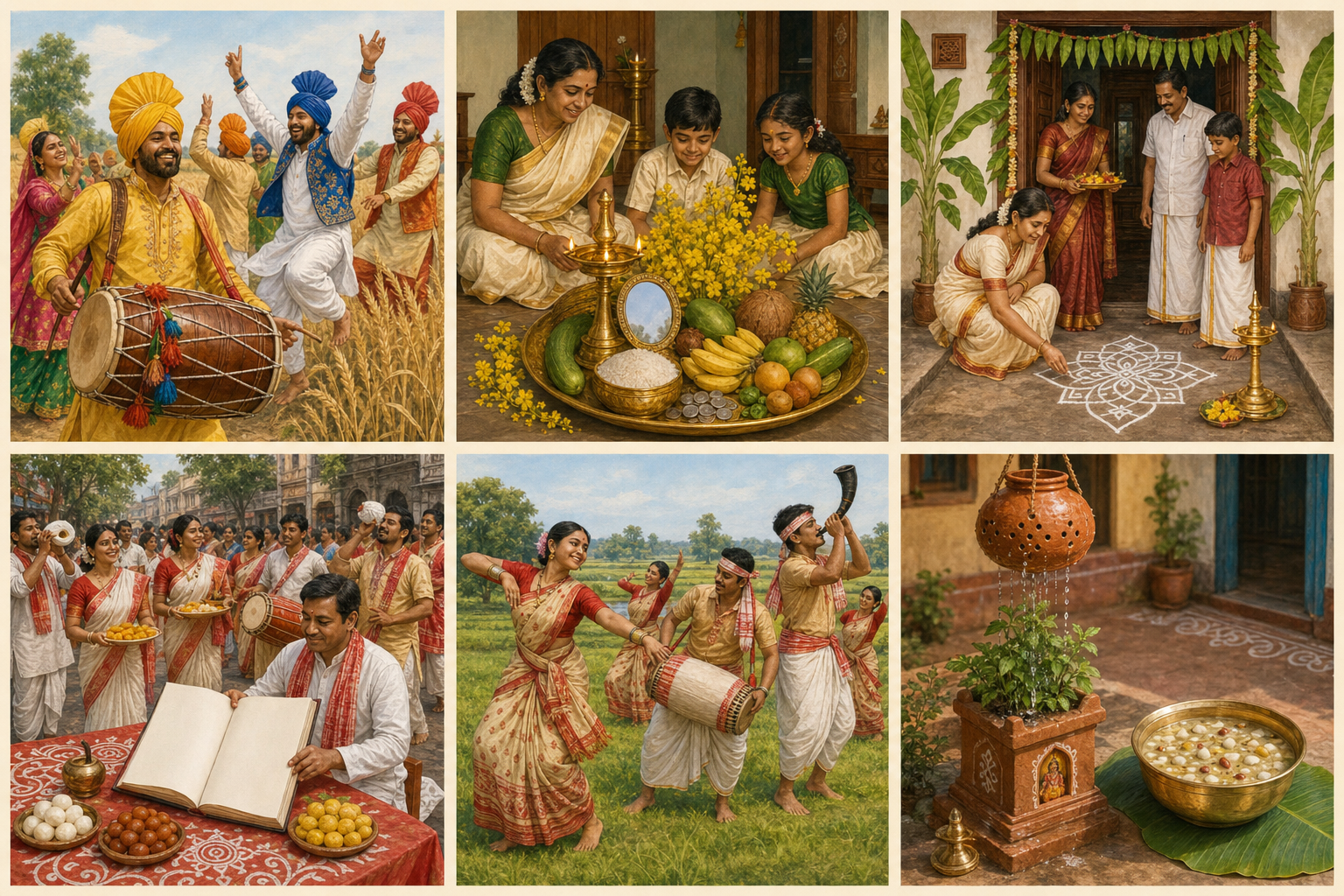
The regional names tell you more than the astronomy does. They reveal what a community remembers and what it places at the beginning of the year.
| Tradition and region | What the solar turn carries | A practice to recognize |
|---|---|---|
| Vaisakhi in Punjab and Sikh communities | Vaisakh 1, harvest gratitude and, within the Punjabi solar and revised Nanakshahi framework, the Sikh New Year; above all, remembrance of the Khalsa’s formation in 1699 | Shabad kirtan, Ardas, karah prasad, langar, Nagar Kirtan and processions led by the Panj Pyare |
| Vishu in Kerala | Auspicious renewal at the Mesha threshold | Preparing the Vishu kani so that the year’s opening sight directs the mind toward abundance and balance |
| Puthandu in Tamil Nadu | The Tamil New Year and the opening of Chithirai | Panchanga sravanam, or listening to the new almanac, followed by family observance and a festive meal |
| Pohela Boishakh in Bengal and Bangladesh | The opening of the Bengali year and renewal of social and commercial life | Welcoming customers and inaugurating new business ledgers |
| Rongali or Bohag Bihu in Assam | Agrarian renewal expressed through community joy | Dance, music and celebrations grounded in the agricultural season |
| Pana or Maha Vishuba Sankranti in Odisha | The Odia New Year under the regional solar calendar, together with the customary observance of Hanuman Jayanti | Bela pana, water donation, the Basudhara theki and acts of relief during the hot season |
This table is a map, not a script for combining everything into one ceremony. A Vishu kani is not a generic New Year decoration. Panchanga sravanam is not merely a forecast. Langar is not festival catering. Pana offered to a thirsty passerby is not just a seasonal drink. Each practice belongs to a moral and religious setting that gives it depth.
Use the name your host uses. A Sikh friend celebrating Vaisakhi may not describe the day as Mesha Sankranti, because its central Sikh meaning lies in the Guru’s discipline, the Khalsa and seva. An Odia family may place pana and water dana at the center. Shared timing becomes a bridge only when distinct identities remain visible.
The year’s first act reveals what renewal is for
Regional New Year customs are practical philosophies. They do not leave renewal as a mood. They give the household something concrete to see, hear, open, offer or serve.
- Vishu trains the gaze. The first sight is arranged deliberately, reminding you that attention shapes the world you inhabit.
- Puthandu trains your relationship with time. Hearing the panchang places personal plans inside a larger sacred and seasonal order.
- Pohela Boishakh trains economic memory. Opening a fresh ledger treats work, exchange and accountability as part of renewal rather than as matters outside culture.
- Vaisakhi and Rongali Bihu train gratitude for labor and land. Harvest joy acknowledges that food depends on cultivation, community and ecological conditions that no household controls alone.
- Pana Sankranti trains seasonal compassion. Sharing water and cooling drinks turns the discomfort of the hot season into a reason to serve someone else.
- Khalsa remembrance trains courage and equality. The initiation of the Panj Pyare through Amrit Sanchar in 1699 places disciplined conduct, dignity and protection of the vulnerable at the heart of Vaisakhi.
If you are making a New Year sankalpa, let this structure discipline it. Do not stop at a broad wish to be more spiritual or generous. Attach one action to a recurring time: daily japa, a regular reading from the Bhagavad Gita, a continuing langar shift, mindful speech at home or repeated help at a community water counter. A modest observance that enters your calendar is more faithful to the festival’s logic than an ambitious resolution that disappears after the feast.
How to observe or join without creating a festival mash-up
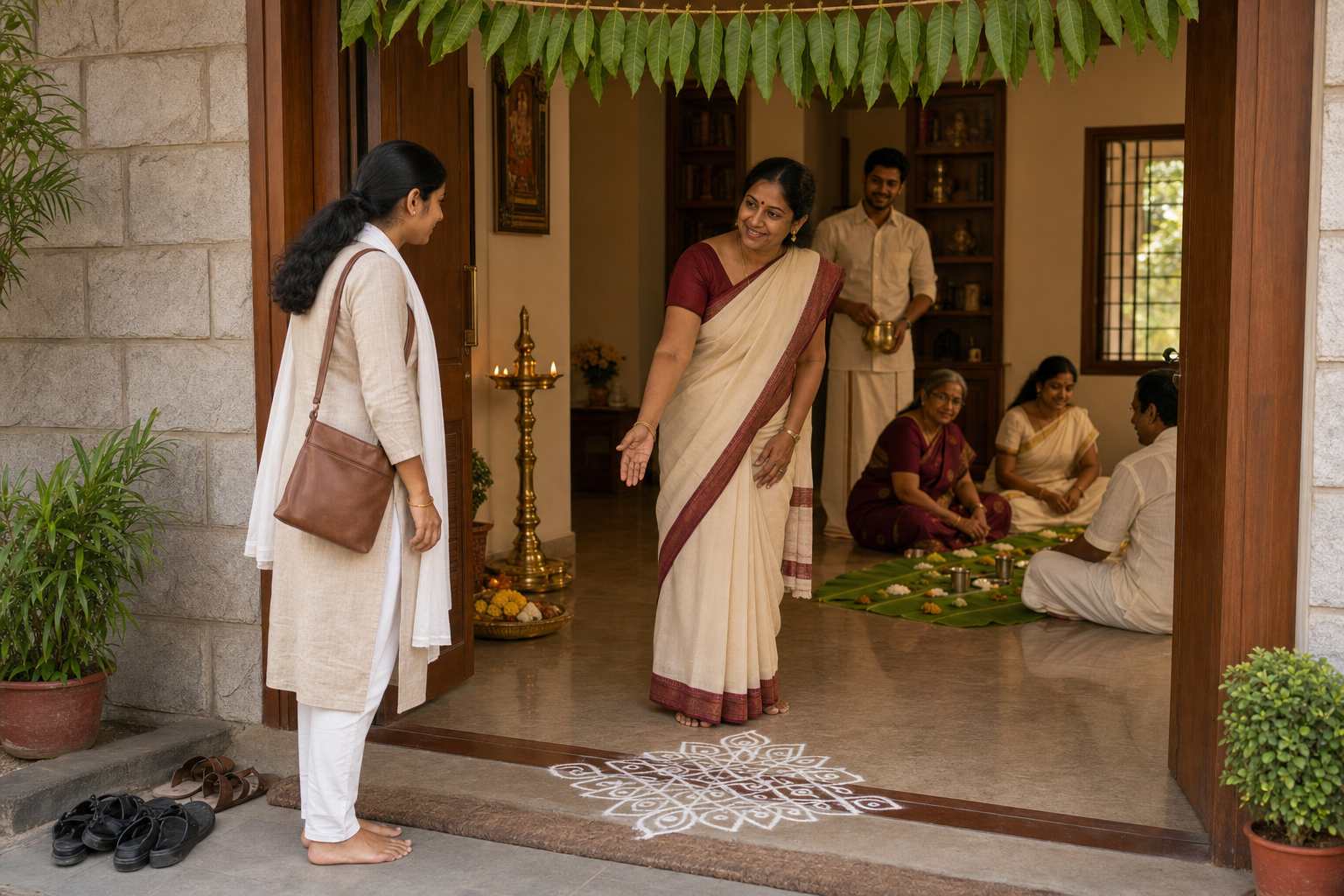
A simple Hindu Mesha Sankranti observance at home
If your household follows a Hindu Mesha Sankranti tradition but has no detailed inherited vidhi, keep the observance clear and restrained. You do not need to borrow every attractive custom from every region.
- Name your calendar anchor. Begin with your family’s regional panchang, panji, temple tradition or sampradaya. If elders preserve a household practice, ask for that before constructing a new one.
- Verify the local time. Note the Sankranti moment and the suitable Punya Kala for your city. Do not assume that midnight begins the ritual window merely because the civil date changes then.
- Prepare before the window. Clean the shrine, arrange the lamp and offerings, and obtain anything intended for dana in advance. This keeps the auspicious period focused on worship and service.
- Keep the core observance simple. Traditional Mesha Sankranti duties include snana, arghya to Surya, japa and dana during the appropriate daylight period.
- Add one authentic regional marker. An Odia household might prepare bela pana from bael pulp with water or milk, curd, jaggery, black pepper, banana and cardamom, following its own family proportions. A Tamil household might hear the panchang. A Kerala household might prepare the Vishu kani. Let one complete practice retain its meaning instead of turning several customs into decorative fragments.
- Give in a seasonally useful form. Water, buttermilk, jaggery, seasonal fruit or support for a community hydration counter fits the heat-conscious dana of Pana Sankranti. Where a public water stand is practical, clean reusable tumblers and avoidance of single-use plastic keep service aligned with stewardship.
- Write down one continuing vow. Give the sankalpa a frequency and a place in your routine before the day ends.
If Vaisakhi is your anchor
Use the Sikh grammar of the day rather than grafting a Hindu solar puja onto it. A gurdwara observance commonly includes Asa di Vaar or other shabad kirtan, Ardas, karah prasad and langar. Some communities arrange for an Akhand Path to conclude on Vaisakhi morning, conduct Amrit Sanchar or undertake Nishan Sahib seva. Listen, serve and follow the guidance of the local sangat.
Vaisakhi also belongs to agricultural Punjab, but reducing it to a harvest party loses its defining Sikh memory. Guru Gobind Singh’s inauguration of the Khalsa at Anandpur Sahib in 1699 made spiritual courage, discipline and caste-transcending fellowship central to the day. If you participate in langar, regard the shared meal as practiced equality, not simply hospitality.
If you are a guest or organizing a shared event
- Keep the names visible. Say Vaisakhi, Vishu, Puthandu, Pohela Boishakh, Rongali Bihu or Pana Sankranti as appropriate. A brief explanation of the shared solar threshold can follow; it should not replace the regional name.
- Follow the host’s ritual cues. At a gurdwara, wear modest clothing, cover your head, remove your shoes and enter barefoot where required. Remain respectful during prayer, and accept guidance about seating and langar.
- Participate through service. Helping in langar, assisting at a water counter or supporting anna-dana often brings you closer to the festival’s purpose than treating the celebration as a performance to watch.
- Give each community its own voice. At a diaspora gathering, place a shared-calendar introduction before clearly named regional segments. Let participants explain their own observance rather than presenting all customs as interchangeable folklore.
- Do not force festivity onto solemn memory. If your Vaisakhi visit includes Jallianwala Bagh in Amritsar, hold the remembrance of the 1919 massacre with the seriousness it requires.
Mixed regional families can use sequence instead of fusion. Keep the inherited household rite in its own form, join another community’s gathering later, and explain to children that the traditions share a sky without making the same vow. That is a more durable lesson in Dharmic unity than a ceremony in which no practice remains recognizable.
Questions people ask about the mid-April New Years
Are Mesha Sankranti and Vaisakhi the same festival?
No. They share a calendrical neighborhood. Mesha Sankranti names the Sun’s sidereal ingress into Aries. Vaisakhi carries Punjabi harvest meaning and singular Sikh significance, especially the formation of the Khalsa. Within the revised Nanakshahi framework, Vaisakh 1 is fixed on April 14 and is widely observed as the Sikh New Year.
Why is Mesha Sankranti in mid-April rather than at the March equinox?
The traditional calculation is sidereal, using a zodiac aligned to the stellar framework. The equinox belongs to a season-anchored tropical reference. Precession has separated those two zero points, and an ayanamsha is used in relating the frameworks.
Do all the regional New Years always fall on exactly the same day?
They cluster around the same mid-April solar turn, but regional calendars and calculation methods should be respected. In 2026, April 14 is the central date for Vaisakhi and Maha Vishuba or Pana Sankranti, alongside the wider family of solar New Year observances. Check the local calendar used by the community you are joining, especially when a timed rite matters.
What is the simplest respectful way to mark the day?
Use the correct regional name, check a local panchang if you are performing a timed Hindu observance, keep one authentic practice intact and turn renewal into service. That could mean arghya and dana, a Vishu kani, panchanga sravanam, a new ledger, bela pana and water distribution, or kirtan and langar.
Before April 14, choose where renewal will become conduct. Put the temple or gurdwara visit, almanac reading, ledger opening, water service or seva commitment on your calendar now. The solar turn becomes a New Year when your first deliberate act begins shaping the days that follow.
References
- DharmaRenaissance Blog — Baisakhi 2026 (April 14): Definitive Guide to Khalsa Day, Sikh New Year, and Mesha Sankranti
- DharmaRenaissance Blog — Maha Vishuba Sankranti 2026: Odia New Year Date, Timeless Rituals, and Shared Dharma