
If your main question is what you should do for Matsya Jayanti in 2026, begin by separating the festival date from the local worship time. Keep March 21 as your working date, but confirm that Chaitra Shukla Tritiya prevails in your location before fixing the sankalpa, temple visit, or vrata.
You do not need an elaborate ceremony to observe the day meaningfully. A clean altar, a clear sankalpa, a manageable form of fasting, Vishnu japa, the Matsya katha, and one act that protects knowledge or water can form a complete household observance.
First, confirm March 21 against your local Panchang
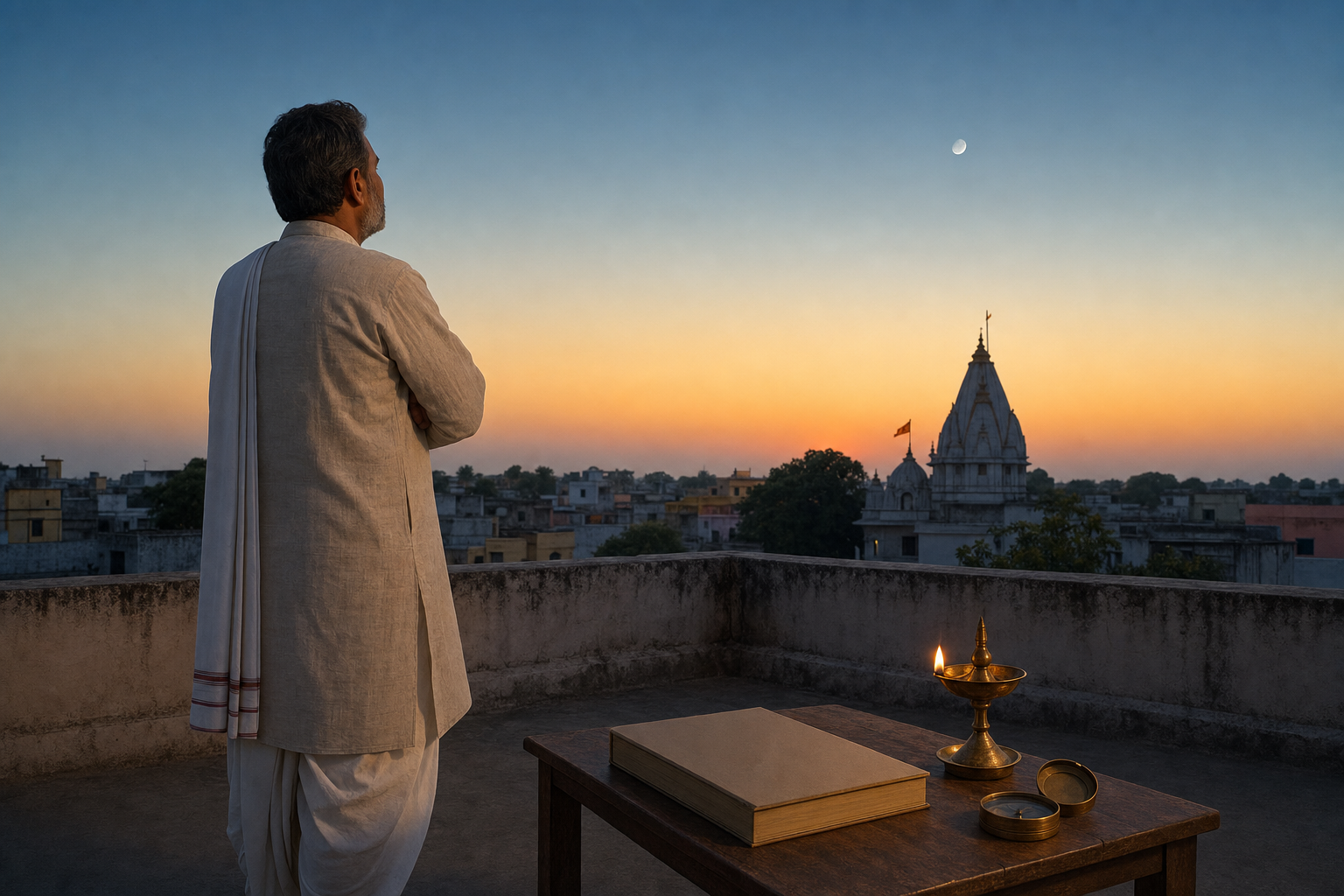
Matsya Jayanti is observed on Chaitra Shukla Tritiya, the third tithi of Chaitra’s bright fortnight. In 2026, March 21 corresponds to that tithi across a broad range of regional calendars. It should nevertheless be treated as the principal civil date, not as a universal substitute for a local calculation.
A tithi is determined by the relative motion of the sun and moon. It can begin or end between two civil midnights, and the same boundary can fall at a different local time in another time zone. Most regional almanac traditions give particular weight to the tithi present at sunrise. That is why a date copied from an almanac prepared for another city may not settle the observance where you live.
Check a reliable Panchang configured for your city or region. Look for three pieces of information: when Tritiya begins and ends, which tithi prevails at local sunrise, and whether separate instructions are given for vrata parana. If your family follows a particular sampradaya or your temple announces a different schedule, follow that established parampara rather than combining incompatible timings from several online calendars.
Month labels can also look different without representing a real disagreement. North Indian Purnimanta calendars treat Chaitra as the first month, while Amanta systems used in several other regions move from Phalguna to Chaitra after the new moon. When labels appear to conflict, compare the tithi and local sunrise rather than relying only on the printed month name.
Do not automatically move Matsya Jayanti to a Matsya-related Dwadashi. Chaitra Shukla Tritiya is the widely followed date for the jayanti, while some communities conduct additional Matsya worship on particular Dwadashi observances. These practices can coexist, but one should not be silently substituted for the other. Your inherited family or temple custom is the proper tie-breaker.
A complete home puja without unnecessary complexity
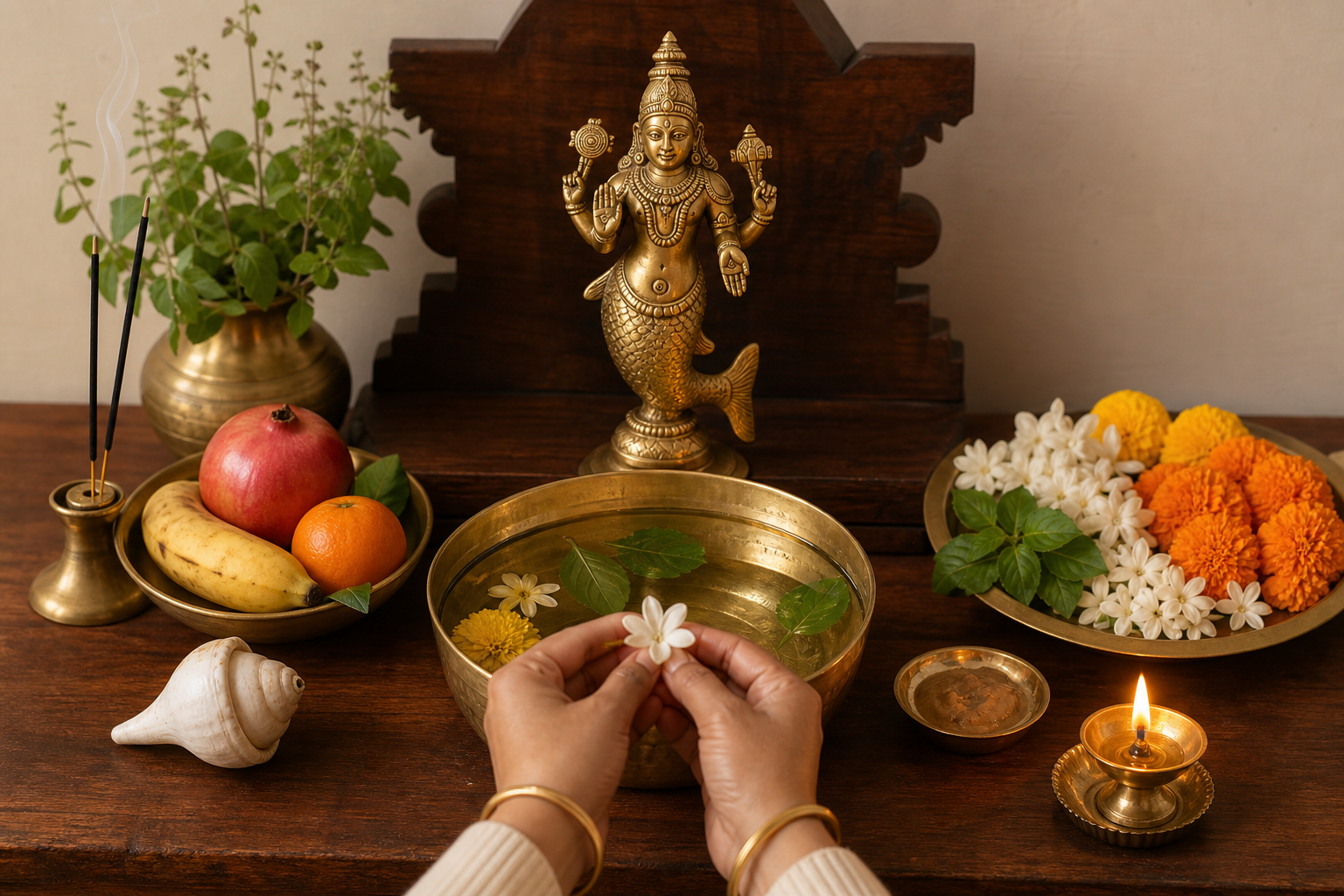
Prepare before the tithi begins so that the observance does not become a search for supplies. A practical altar can include an image or yantra of Matsya Narayana, a lamp, incense, clean water, sandal paste, flowers, a clean cloth for vastra, and a sattvik naivedya consistent with your vrata. Keep a separate vessel and water ready if abhisheka belongs to your household practice.
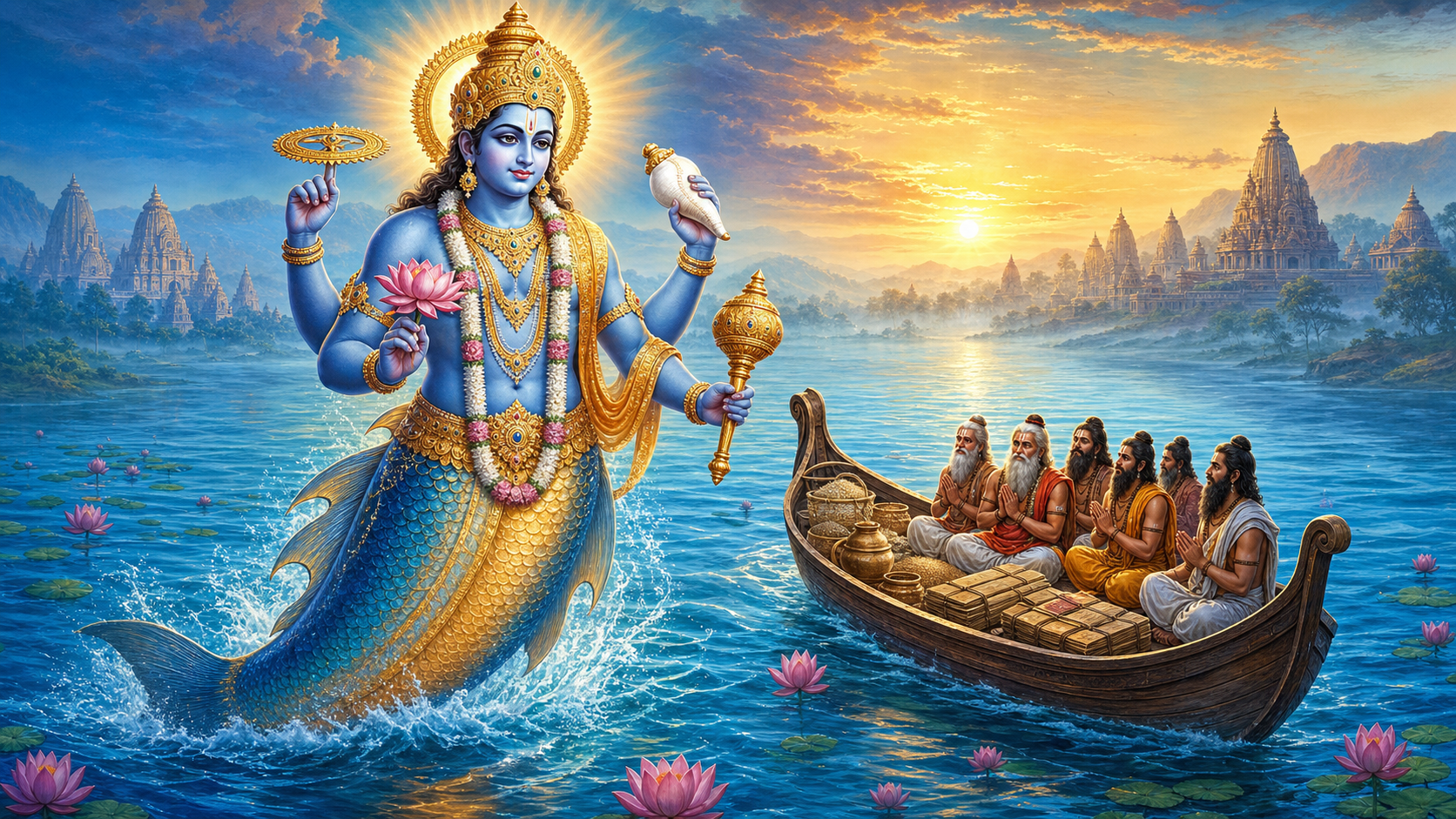
Matsya iconography is not entirely uniform. You may see Vishnu represented as a complete fish or as a deity with a human upper body and a fish below, sometimes bearing the shankha, chakra, gada, and padma. A horn and the boat of Manu may also appear in the image. These differences express the same rescue narrative; you do not need to locate one supposedly definitive form before worshipping.
A full Shodashopachara sequence is appropriate where it is understood and regularly practised. A shorter Panchopachara worship is equally workable for a household with limited time or materials. Completeness comes from offering what you have with attention, not from hurriedly imitating a ceremony you have not learned.
- Bathe, wear clean clothes, clean the shrine, and arrange the offerings before sitting down.
- Take the sankalpa for Chaitra Shukla Tritiya and name Matsya Avatar Jayanti as the occasion. Include your customary place, family, and purpose formulas if you know them.
- Contemplate Matsya Narayana and perform avahana. Offer an asana and arghya according to your household method.
- Perform abhisheka if it is part of your practice. Otherwise proceed with vastra, sandal paste, flowers, incense, lamp, water, and naivedya.
- Recite either “Om Matsyaya Namah” or “Om Namo Bhagavate Vasudevaya.” Choose a count you can complete steadily without turning japa into a race.
- Read or listen to the Matsya narrative. If time permits, add one established Vishnu recitation rather than beginning several texts and finishing none.
- Conclude with arati, pranam, and distribution of prasad. Follow your local Panchang if the vrata has a prescribed parana time.
For a longer recitation, appropriate choices include Vishnu Sahasranama, Purusha Sukta, Gajendra Moksha stotra, or the Dashavatara stotra associated with the Gita Govinda. The Matsya Purana and the Matsya episode of the Bhagavata Purana bring the avatara-katha directly into the worship. You do not need to perform every option. Select one mantra practice and one reading that you can approach attentively.
If you are observing with children, let them identify Manu, the boat, the divine fish, and the knowledge or life carried through the deluge. Then ask what deserves protection in your own family. That short conversation makes the katha more durable than treating it as a story heard once a year.
Choose a vrata that strengthens restraint rather than pride
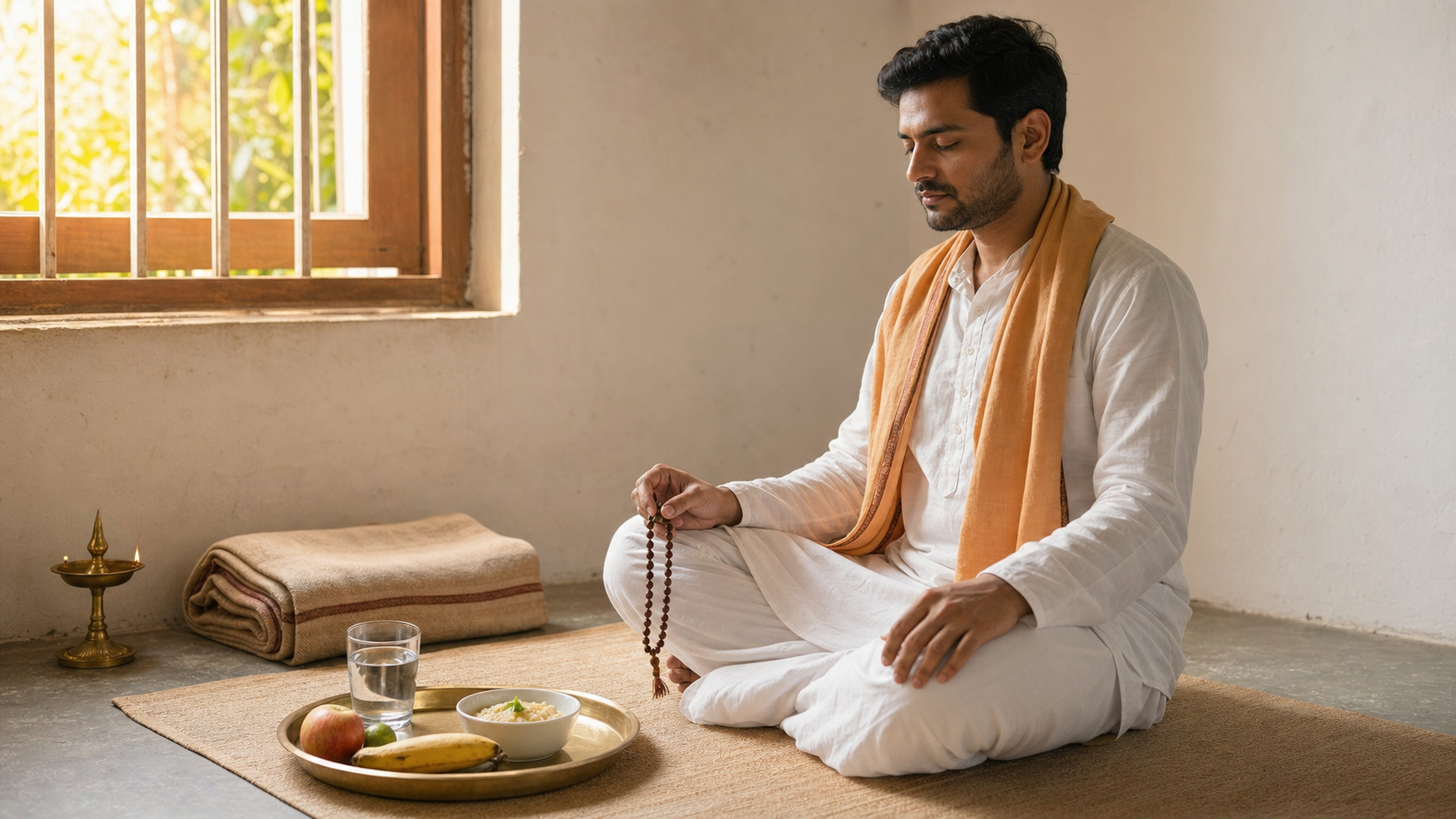
Matsya Jayanti vrata is commonly kept with sattvik discipline, but its severity varies. Phalahara may consist of fruits and milk. An anukalpa meal can be light and free from grains. Some devotees undertake nirjala fasting, but abstaining from water should never be treated as the measure of devotion.
If fasting or avoiding water could harm your health or conflict with medical guidance, do not undertake a severe vrata. Select a safer form of dietary restraint, or centre the observance on puja, japa, dana, and disciplined conduct. Religious sincerity does not require preventable injury. When health circumstances are uncertain, obtain appropriate clinical advice rather than relying on a general festival schedule.
Keep the food simple and avoid onions, garlic, and excessively pungent or tamasic preparations if that is consistent with your tradition. Decide what you will eat before the vrata begins. This prevents a nominal fast from turning into constant planning, elaborate substitute dishes, or irritation with everyone around you.
The internal vrata matters just as much. Restrain harsh speech, unnecessary argument, compulsive consumption, and distracted use of the day. If hunger makes you impatient, reduce the dietary austerity and recover the ethical one. A lighter fast accompanied by gentleness is closer to the day’s purpose than a severe fast used to excuse anger.
Plan parana with the same care as the sankalpa. Because Tritiya boundaries differ by locality, do not copy a break-fast clock time calculated for another region. Follow your regional Panchang or the instructions of the temple or acharya guiding your observance.
Let the Matsya katha determine what you do after puja

The Matsya narrative is not merely decoration around the ritual. Its earliest literary form appears in the Satapatha Brahmana, where a fish warns Manu of a coming deluge and leads him to safety. Later Puranic accounts develop the fish as Vishnu’s Matsya Avatar, who protects Vaivasvata Manu, the Saptarishis, and the seeds of life through pralaya. The boat is fastened to the divine fish, with Vasuki serving as the connecting rope in prominent tellings.
Details differ across textual recensions. In several accounts, a daitya takes the Vedas during the upheaval and Matsya restores them for the new cycle. You do not have to force every version into one literal sequence. Their common centre is clear: life, rightful order, and sacred knowledge must be carried through periods of dissolution rather than abandoned to them.
This is why Matsya stands first in the familiar Dashavatara sequence. Modern interpreters sometimes compare that aquatic beginning with a progression from simpler to more complex forms of life. The comparison may be suggestive, but it should not displace the theological meaning of avatara. Matsya is Vishnu’s preserving intervention when the continuity of dharma is at risk.
Turn that meaning into one definite action. Donate useful books or learning materials. Support a library, school, or dharma institution that preserves and transmits knowledge. Read a sacred text with a younger family member. Catalogue the scriptures or recordings already held in your home so that the next generation can actually find and use them. The amount spent matters less than whether the act genuinely helps knowledge survive and circulate.
The fish form also places water stewardship directly before the worshipper. Conserve water during bathing and altar preparation. Avoid chemical or non-biodegradable offerings that can enter drains or waterways. Use materials that can be handled responsibly after puja. If a trusted local group is caring for a pond, riverbank, or other water body, Matsya Jayanti is a fitting occasion to support that work.
Where Chaitra Shukla Tritiya coincides with regional Chaitra Teej or Gangaur-related customs, a household may honour Vishnu and Devi within the same seasonal period. There is no need to manufacture a conflict between devata traditions. Preserve the sequence and details received through your family while giving each observance its proper attention.
Key takeaways for Matsya Jayanti 2026
- Use March 21, 2026, as the principal date, but verify Chaitra Shukla Tritiya and sunrise conditions in a Panchang set for your location.
- Follow your family sampradaya or local temple when its observance timing differs from a generalized calendar.
- A workable home puja consists of sankalpa, Matsya Narayana worship, japa, katha, arati, and prasad; elaborate materials are not essential.
- Choose phalahara, anukalpa, or another safe level of restraint. Do not attempt nirjala fasting when it could compromise your health.
- Use “Om Matsyaya Namah” or “Om Namo Bhagavate Vasudevaya” for accessible japa, and select one substantial Vishnu hymn or Matsya reading if time allows.
- Give the observance a visible result by protecting knowledge, supporting education, or caring for water without creating chemical or non-biodegradable waste.
Before March 21 arrives, make four decisions: which local Panchang you will follow, what form of puja you can complete calmly, what level of vrata is safe, and what knowledge- or water-preserving act will accompany the worship. Once those are settled, Matsya Jayanti becomes more than a date on the calendar. It becomes a disciplined answer to the question at the heart of the avatara: what will you help carry safely through change?