

You may be reading the Bhagavad Gita, reciting verses, and trying to act without attachment, yet still find yourself pulled by lethargy one day, restless ambition the next, and subtle spiritual pride after a period of calm. This does not mean your practice has failed. It means the real test is no longer whether you can produce a peaceful hour, but whether you can recognize what is moving through the mind without calling it your deepest self.
The Gita gives you a practical way to meet that test. Learn to identify tamas, rajas, and sattva as movements of Prakriti; cultivate the clarity needed for right action; and then release your identification even with clarity. Recitation, inquiry, devotion, and duty become one discipline whose fruit is not a better spiritual personality, but increasing freedom from compulsion.
Do not turn the three gunas into personality labels

The first correction is simple: you are not a guna. Tamas, rajas, and sattva describe changing qualities of Prakriti, including the body, senses, mind, and intellect. Tamas conceals and weighs down. Rajas agitates, projects, craves, and pursues. Sattva illuminates, balances, and makes discernment possible. All three can appear in the same person, sometimes within the same hour.
Bondage has two movements. A guna first colors experience; identification then converts that passing condition into a claim about who you are. Heaviness becomes “I am incapable.” Restless desire becomes “I need this result in order to be complete.” Clarity becomes “I am purer or wiser than others.” The second movement is where a condition hardens into a self-story.
The usual progression from tamas through rajas toward sattva remains valuable. You often need energy to rise out of inertia and clarity to govern energy. But even sattva binds when harmony, knowledge, virtue, or spiritual pleasure is possessed as an egoic achievement. Sattva is the clean window through which discernment becomes possible; it is not the one who sees.
This is why guna-atita does not mean permanently feeling calm. Calm is a condition and therefore changes. Going beyond the gunas means that pleasure and pain, clarity and confusion, energy and fatigue are known as movements within experience rather than final definitions of the knower. You remain responsible for how you respond, but you stop deriving your identity from the state that requires a response.
Different Hindu darshanas explain that freedom through distinct metaphysical accounts. Sankhya-Yoga distinguishes Purusha, the witnessing consciousness, from Prakriti and its gunas. Advaita Vedanta uses discrimination, including the method of neti neti, to recognize that changing objects cannot be the changeless Atman and that Atman is Brahman. Vishishtadvaita and Dvaita place decisive emphasis on devotion, surrender, and divine grace while preserving their own accounts of the soul’s relation to Narayana or Ishvara. These positions should not be flattened into one doctrine. Their shared practical warning is enough to begin: the mind’s present condition is not entitled to speak as your ultimate identity.
Change your inner language accordingly. Say, “Tamas is present; what duty is already clear?” Say, “Rajas is present; what result am I trying to possess?” Say, “Sattva is present; how can this clarity serve without becoming mine?” This is not an excuse to avoid responsibility. It is a more accurate starting point for responsible action.
Make recitation a complete practice, not a reading quota
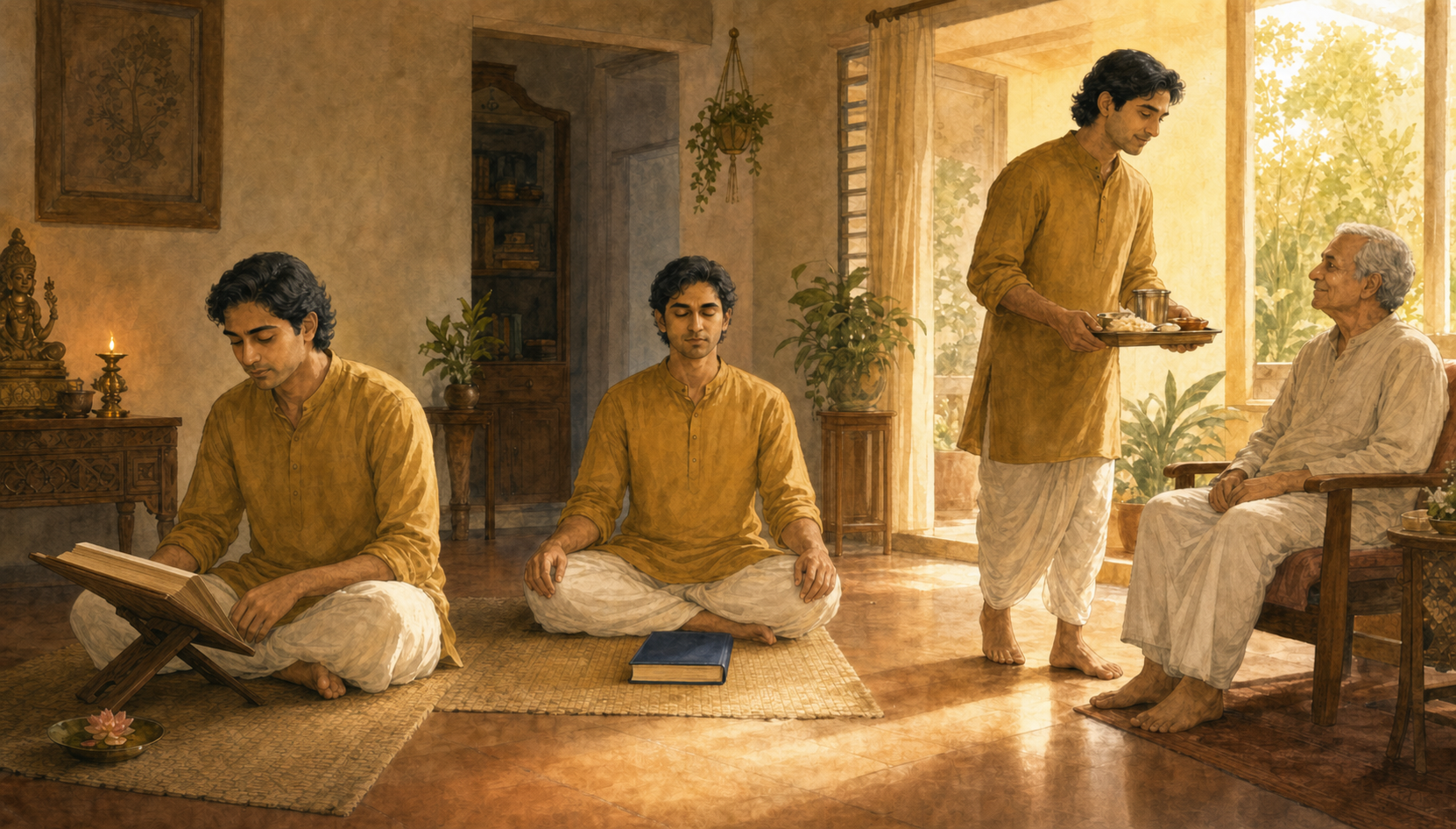
Gita parayana works best when sound, meaning, and conduct remain connected. Regular recitation, hearing, recollection, and self-study can form beneficial samskaras that gradually reshape attention and action. But completing a chapter is not a substitute for being corrected by it. If the recitation never reaches your speech, duty, consumption, resentment, or treatment of other beings, the mouth has moved farther than the life.
A sustainable session can fit within 20-40 minutes. Keep the form steady enough that you can notice changes in yourself rather than continually redesigning the practice.
- State a sankalpa. Use a plain intention such as: “May this study clarify my duty, loosen grasping, and make my actions fit for offering.” The purpose is direction, not a bargain for a particular spiritual reward.
- Settle the breath and attention. A few unforced rounds of pranayama can mark the transition from scattered activity to svadhyaya. Do not turn breath control into a contest. Its role here is to gather attention for recitation.
- Recite on a cadence you can keep. One chapter each day completes the Gita in an 18-day cycle. An established practitioner with more time may recite three chapters daily and complete a cycle in six days. A full recitation can be reserved for Ekadashi or Gita Jayanti, but an occasional intense observance should not displace the ordinary discipline that actually meets your habits.
- Remain with the meaning. After recitation, ask: Which guna was most visible in my mind? What duty has become clearer? What fruit, image, comfort, or grievance am I trying to possess?
- Select one embodied response. Complete a postponed duty, withdraw a harmful word, offer work without seeking recognition, tell the truth you have been evading, or perform a concrete act of seva. Keep the action small enough to complete before the next session.
- Close by releasing the session itself. Sit briefly in silence, use a traditional peace invocation, or repeat a devotional mantra such as “Om Namo Bhagavate Vasudevaya.” Do not carry the practice away as evidence of being more spiritual than someone else.
If Sanskrit pronunciation demands all your attention, pair careful recitation with a translation and a commentary trusted in your sampradaya. Shankara is especially useful for nondual discrimination, Ramanuja for surrender and grace, Madhva for theistic devotion and duty, and the Jnaneshvari for a luminous devotional exposition. Choose one interpretive current long enough to understand its reasoning. Sampling many traditions can broaden awareness, but mixing their conclusions before you understand their differences usually produces slogans rather than discernment.
The four familiar yogas can remain present in the same session. Recitation and inquiry sharpen jnana. The action chosen afterward becomes karma-yoga. Offering the practice and its fruit becomes bhakti. The collection and steadying of attention draws on raja-yoga. You do not need to manufacture an artificial choice among them every morning; you need to prevent any one dimension from becoming an escape from the others.
Respond to tamas, rajas, and sattva differently

Calling every inner difficulty “attachment” is too vague to guide action. Each guna requires a different immediate correction. The guna that predominates can also misuse a good practice: tamas can turn contemplation into avoidance, rajas can turn discipline into competition, and sattva can turn knowledge into superiority.
| Predominant movement | What to notice | Your next move | The spiritual trap |
|---|---|---|---|
| Tamas | Heaviness, confusion, concealment, procrastination, resentment, or aversion to a duty you already understand | Stop demanding perfect insight. Name one known duty and begin it. Recite audibly if silent reading is dissolving into passivity. | Calling withdrawal detachment or calling neglect surrender |
| Rajas | Craving, anxiety, mental bargaining, comparison, agitation, or fixation on recognition and results | Name the fruit being clutched. Perform the right action as an offering while refusing to make inner peace conditional on the outcome. | Using sadhana to become more accomplished, admired, or invulnerable |
| Sattva | Clarity, balance, delight in study, ethical steadiness, and a refined sense of spiritual order | Use the clear interval for inquiry and service. Then release the claim that purity, insight, or harmony belongs to you. | Mistaking a luminous condition for moksha |
The order matters. When tamas predominates, more analysis can become another hiding place; act on the dharma you already know. When rajas predominates, adding more vows and measurements can feed the same achievement machinery that needs to be relinquished; simplify, offer, and continue. When sattva predominates, study deeply and serve well, but notice the almost invisible “mine” that tries to settle around goodness.
Do not attempt to destroy the gunas. The embodied mind continues to function through Prakriti. The practical movement is regulation followed by disidentification: reduce tamasic obstruction, redirect rajasic force toward dharmic action, cultivate sattvic clarity, and recognize that the witness or the soul, understood according to your darshana, is not another product in that sequence.
This also prevents spiritual suppression. A guna-atita person is not someone who refuses to acknowledge fatigue, desire, grief, or pleasure. Denied emotion can still dictate conduct from concealment. Witnessing begins with an honest recognition of what has arisen, continues through a dharmic response, and ends without converting the event into a permanent identity.
Let ordinary friction test whether freedom is becoming real

No checklist can certify moksha. Ordinary life can, however, expose the difference between cultivated appearance and reduced bondage. The useful question is not, “Did I feel spiritual during recitation?” It is, “What governed me when conditions opposed my preferences?”
- Pleasure and pain: Can you receive either without reorganizing your whole identity around obtaining or escaping it?
- Praise and blame: Can you examine criticism for truth without collapsing under it, and receive appreciation without becoming dependent on it?
- Visible and invisible duty: Do you still perform necessary work when no status, gratitude, or immediate result is available?
- Clarity and confusion: When the mind is clear, do you use clarity well without claiming superiority? When it is clouded, can you avoid making permanent decisions from a passing condition?
- Practice and service: Is your sadhana making you more truthful, less harmful, and more available for seva, or merely more absorbed in your own spiritual condition?
The Gita’s vision of loka-sangraha keeps transcendence from collapsing into private escape. Freedom from the gunas supports wise participation in the world because action is less distorted by craving, fear, inertia, and self-display. The gunas may still move through the body-mind, but they lose some power to command speech and action.
At the end of each 18-day cycle, review your journal without turning it into a spiritual scorecard. Look for the recurring point of capture. Which duty did tamas repeatedly postpone? Which result made rajas bargain with dharma? Where did sattva become pride? Who received less harm, more truth, or more practical help because you studied the Gita? The answers tell you where the next cycle should place its attention.
This ethical test also permits a careful Dharmic-unity perspective without erasing differences. Buddhist nirvana, Jain kevalajnana, and Sikh mukti through Naam and alignment with Hukam do not rest on one interchangeable metaphysics. Yet Buddhism’s freedom from greed, hatred, and delusion, Jainism’s release from karmic coloring, Sikh transcendence of trai guna, and Hindu freedom from Prakriti’s compulsions all refuse to equate liberation with the satisfaction of egoic appetite. Compassion, ahimsa, truthfulness, and seva are not decorative consequences. They reveal whether inner discipline is loosening the forces that produce harm.
Be especially suspicious when “beyond the gunas” becomes a reason to abandon family obligations, ignore ethical limits, dismiss another person’s suffering, or claim immunity from correction. That is not transcendence. It is more likely tamas hiding as detachment, rajas defending an exalted identity, or sattva being appropriated as spiritual rank. Genuine freedom makes conduct steadier and service less self-referential.
Key takeaways for your next Gita cycle
- The gunas are changing conditions of Prakriti, not permanent personality types and not your deepest identity.
- Cultivate sattva because clarity supports discernment, but do not confuse a peaceful or virtuous state with liberation.
- Use one chapter a day for an 18-day Gita cycle, joining recitation to reflection and one concrete dharmic action.
- Meet tamas with a known duty, rajas with action offered without possession of the fruit, and sattva with inquiry, service, and release of spiritual ownership.
- Measure practical movement by reduced compulsion amid pleasure and pain, praise and blame, success and frustration, not by the intensity of experiences during sadhana.
- Keep bhakti, jnana, karma, and meditative steadiness connected so that one path does not become an excuse to neglect the others.
Begin the next session before trying to redesign your whole life. Write one sankalpa, recite the first chapter, name the guna that most clearly colored your attention, and choose one action to complete before the following session. Keep the same journal through the 18th chapter.
When the cycle ends, look for a duty performed without bargaining, a reaction recognized without being obeyed, and an act of service completed without being converted into self-praise. Then begin again, placing the next cycle at the weakest link you found. Liberation is not manufactured by repetition, but steady repetition can expose and loosen everything you have been mistaking for yourself.
References
- DharmaRenaissance Blog — Batu (Vatu) in the Padma Purana: The Transformative Power of Bhagavad Gita Even After Death
- DharmaRenaissance Blog — Moksha Beyond the Gunas: A Definitive, Scholarly Guide to Liberation and Dharmic Unity