
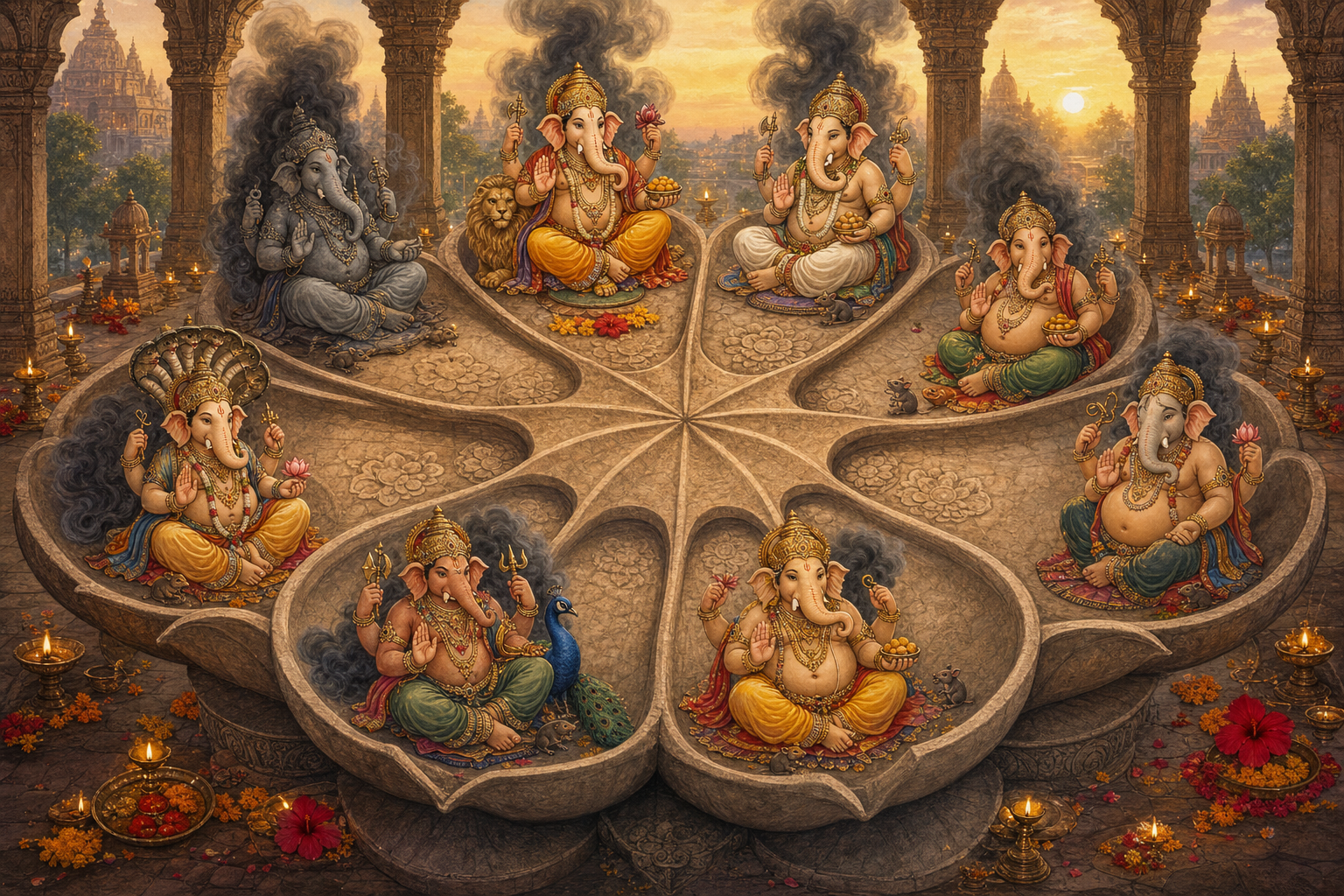
You probably arrived with two practical questions: Who are Ganesha’s eight avatars, and what are you meant to do with the list? The names matter, but memorising them is only the beginning. Their deeper value lies in recognising the obstruction that is active in you before it governs your next decision.
Within the Mudgala Purana, the eight forms are Vakratunda, Ekadanta, Mahodara, Gajavaktra, Lambodara, Vikata, Vighnaraja, and Dhumravarna. Their victories bring jealousy, pride, delusion, greed, anger, uncontrolled desire, possessiveness, and self-importance into view. Read this way, Ganesha does more than clear the road ahead. He reveals how we help create our own vighnas.
Key takeaways
- The eight-avatar cycle links each form of Ganesha with a distinct inner obstruction.
- The sequence is best used as a mirror for conduct, not merely as a list of divine names to memorise.
- An inward interpretation does not reduce sacred narrative to psychology; it asks where the asuric tendency has gained a foothold in the practitioner.
- Mudgala is remembered through more than one traditional profile, so the Rajarshi, the Mahabharata ascetic, and the Purana’s seer-narrator should not be compressed into an unsupported single biography.
- A simple practice can join mantra, offering, honest self-examination, and a corrective action in daily life.
The eight avatars and the obstacles they expose
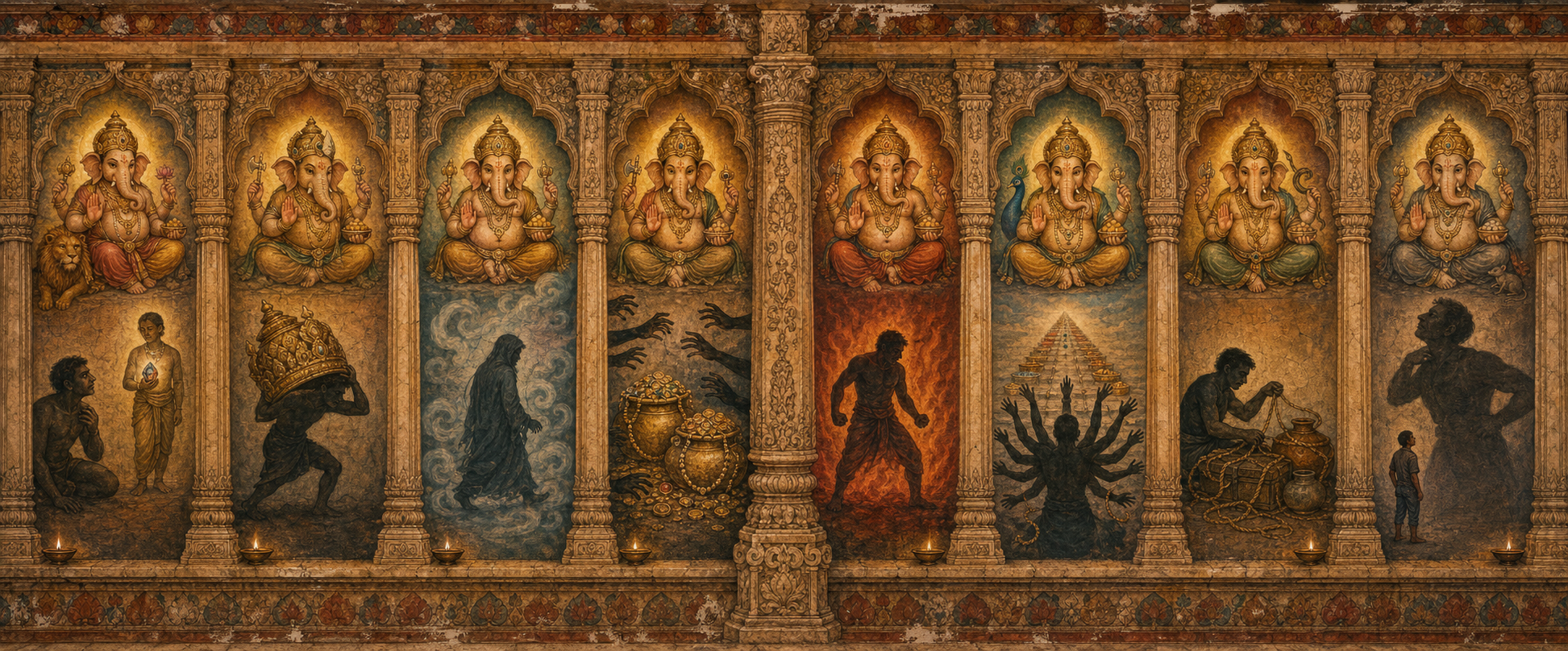
The following table gives you a practical first reading of the cycle. The question in the final column is not a replacement for traditional worship. It is a way to carry the avatar’s meaning from the shrine into conduct.
| Avatar | Inner obstacle | Question for self-examination |
|---|---|---|
| Vakratunda | Jealousy | Where has comparison made me resent another person’s good? |
| Ekadanta | Pride | What correction am I refusing because it threatens my image? |
| Mahodara | Delusion | What fact am I replacing with the story I prefer? |
| Gajavaktra, often called Gajanana | Greed | What would be enough before I reach for more? |
| Lambodara | Anger | What response should wait until my speech is governed again? |
| Vikata | Uncontrolled desire | What appetite is choosing my conduct for me? |
| Vighnaraja | Possessiveness | What do I call mine when I am actually its temporary steward? |
| Dhumravarna | Self-importance | What duty would I still perform if nobody praised me for it? |
Gajavaktra may appear as Gajanana in some tellings. That variation should not distract you from the central movement: every form of Ganapati confronts a force that distorts perception and then corrupts action.
These avatars are not personality labels to place on other people. Calling a colleague greedy or a relative proud is easier than seeing the same tendency at work in your own decisions. Begin with observable conduct. Repeatedly checking another person’s status may reveal jealousy. Rejecting sound advice merely because it came from a junior may reveal pride. Continuing to acquire after your real need has been met may reveal greed. The useful question is not which avatar describes somebody else, but which form you need to remember now.
How to use the sequence without reducing it to self-help
The asuras belong to sacred narrative; they are not merely clinical names for difficult emotions. An inward reading therefore need not deny divine agency, cosmic order, or the reality of dharmic struggle. It asks a more demanding devotional question: Where does the defeated force try to reappear through me?
Read in sequence, the cycle moves from comparison to pride, from pride to confused perception, and from confusion to grasping. Grasping then hardens into anger when frustrated, desire when continually stimulated, possessiveness when an object becomes part of identity, and self-importance when the ego places itself at the centre. This is a progressive map, but not a claim that every person passes through eight permanent stages. The same vighna can return in a subtler form after you thought it had been overcome.
Start by naming behaviour rather than declaring yourself to be a fixed kind of person. I am jealous easily becomes shame or defensiveness. I withheld praise because another person’s success made me feel smaller identifies an action that can be corrected. The distinction matters because dharmic self-examination aims at responsible change, not a new identity built around a fault.
Next, separate the external obstacle from your inner participation in it. A delayed undertaking, hostile person, or material shortage may be real. Ganapati worship does not require you to pretend otherwise. Yet pride may stop you from asking for help, anger may worsen the conflict, or delusion may keep you committed to a plan whose assumptions have already failed. Removing the inner contribution can reveal what must actually be done about the outer problem.
Finally, join insight to a counter-action. Jealousy calls for sincere appreciation rather than secret comparison. Pride calls for receiving correction. Greed calls for deciding what is enough. Anger calls for restraint before speech becomes injury. Possessiveness calls for stewardship, and self-importance calls for service that does not depend on recognition. Without such action, the avatar remains an image admired from a distance.
The intended fruits are buddhi and shraddha. Buddhi lets you discriminate between fact, appetite, habit, and duty. Shraddha keeps you aligned with dharma when the corrective action is uncomfortable. One without the other is unstable: discernment without trust can become clever rationalisation, while trust without discernment can become mechanical observance.
Place the teaching correctly: scripture, narrator, and Mudgala
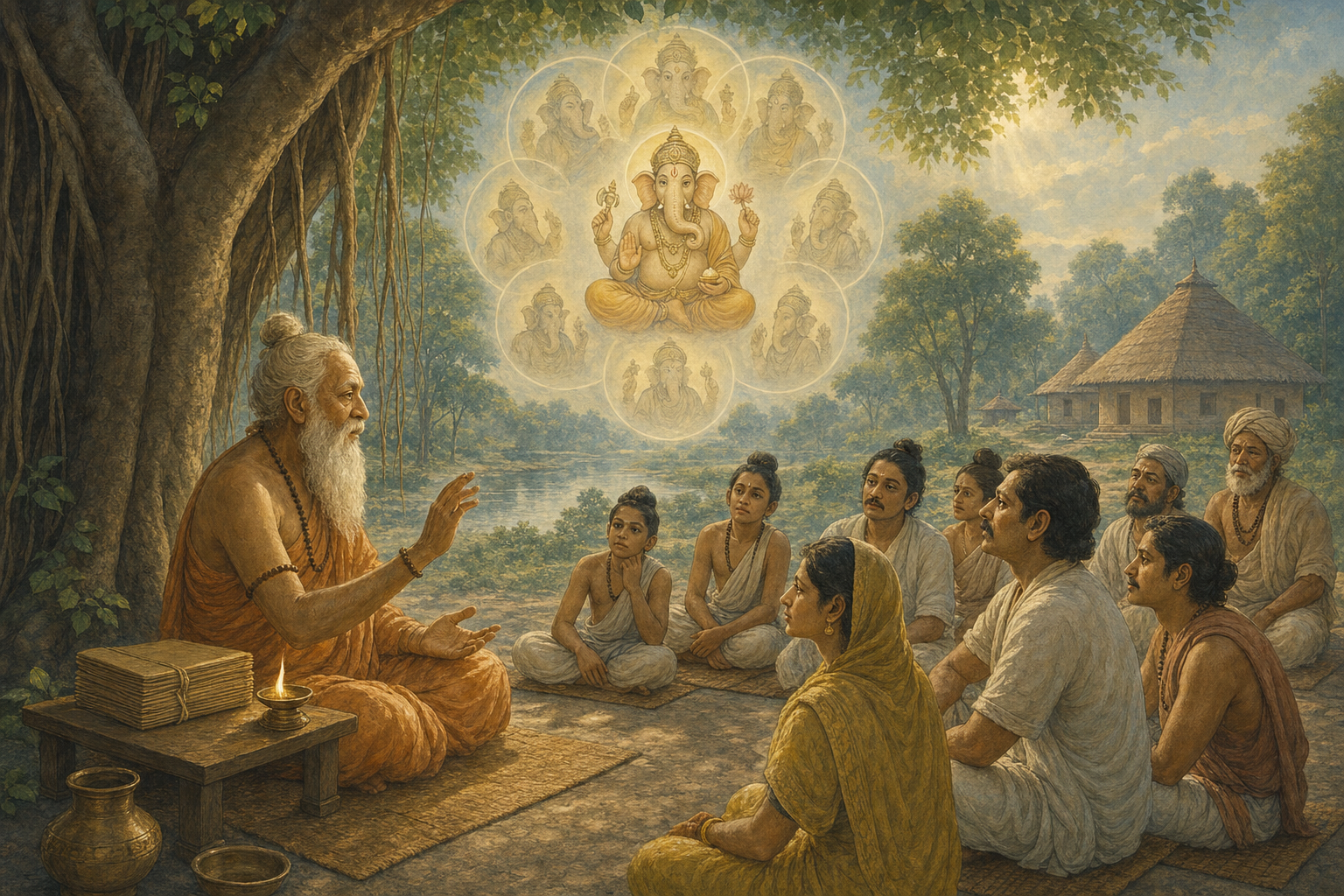
You are dealing with a Ganesha-centred Upapurana from the medieval body of Ganapati literature, alongside the Ganesha Purana. Compilation is generally placed between roughly the 10th and 14th centuries CE, with later redactional layers considered likely. That dating is approximate, not a claim that the entire work appeared at one moment or from one hand.
The emphasis falls on theology and practice rather than a dynastic or regional chronicle. Mythic narration stands beside vrata guidance, mantra-vidhi, worship, and homa outlines because the goal is formation of the devotee. Multiple recensions and regional variations also explain why you may encounter differences in spelling or ritual detail. A variation should be identified and situated, not automatically treated as proof that one living tradition is defective.
The name Mudgala requires similar care. At least three traditional memories meet around it:
- A Rajarshi of royal lineage moves from sovereign responsibility toward rishihood through tapas, joining kshatra with brahmavidya.
- A Brahmin ascetic in the Mahabharata’s didactic tradition lives on gleaned grain, accumulates extraordinary merit, and refuses celestial pleasure rather than abandon his establishment in dharma.
- A seer-narrator named Mudgala carries the traditional association with the Ganesha-centred Purana.
These profiles converge around restraint, forbearance, equipoise, devotion, and goodwill. Their ethical harmony is meaningful, but it does not by itself establish one continuous historical biography. If your question concerns authorship, traditional association with a seer-narrator is more careful than claiming that one identifiable individual composed every layer now transmitted under the title Mudgala Purana.
The Rajarshi memory remains especially valuable for a householder. It refuses the assumption that spiritual seriousness begins only after responsibility ends. Authority can be disciplined by self-scrutiny; strength can mature through kshama; worldly duty can become a field for contemplative depth. The relevant test is whether power serves dharma or recruits dharma to protect the ego.
The theological range is equally important. Ganapati can be approached as saguna, the Lord with name, form, qualities, and a welcoming presence in worship. At the contemplative horizon, the same divine reality is understood as nirguna, beyond attributes and realised as the nondual ground. You do not have to choose between loving the form and seeking the formless. Ritual gives attention a sacred centre; contemplation keeps ritual from becoming empty mechanics.
A grounded household practice for the avatar you need
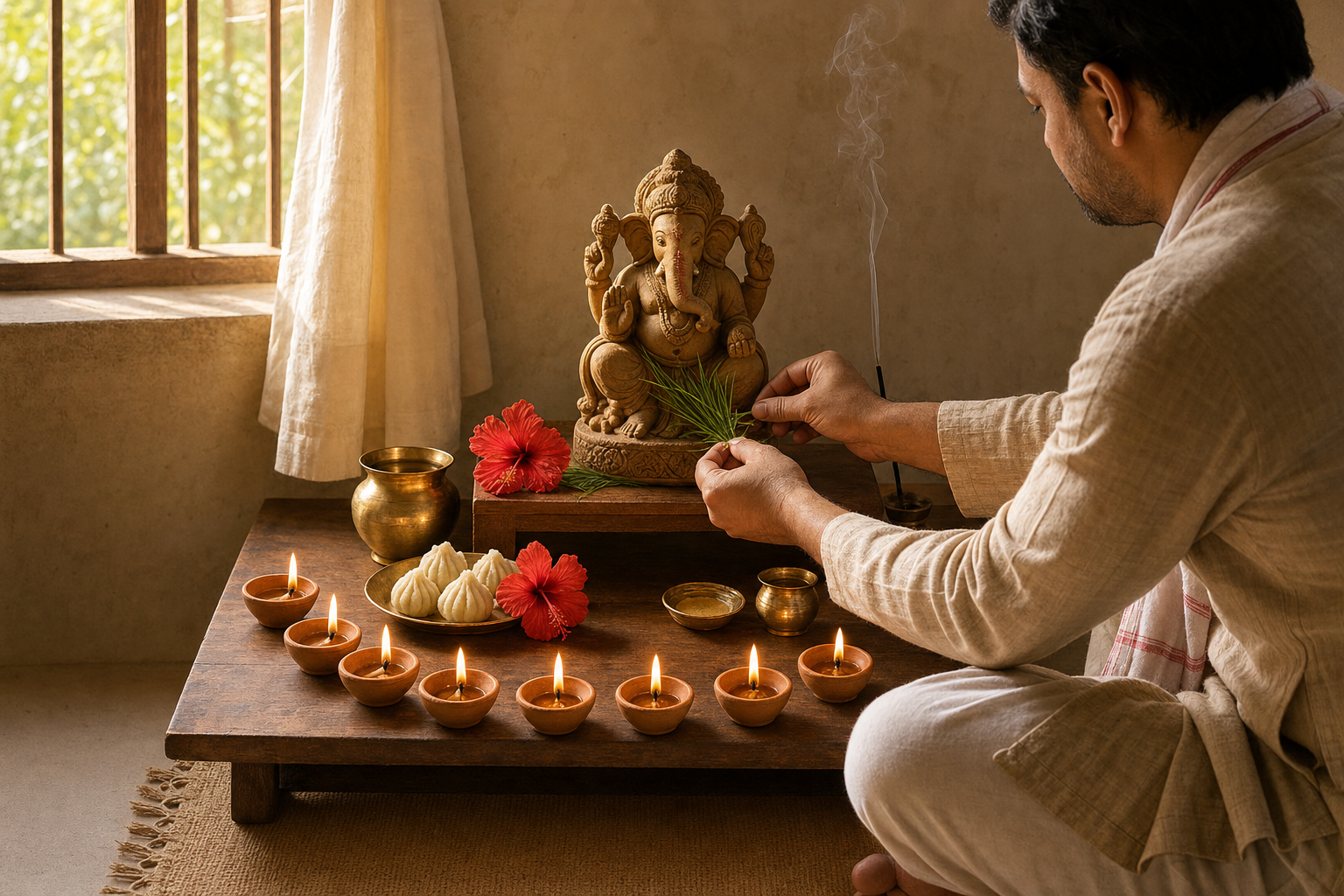
You do not need to work with all eight avatars at once. Choose the obstruction that is visibly affecting your conduct, then bring that one concern into a regular Ganapati practice. Chaturthi is a traditional occasion, while steady household worship can maintain the discipline between observances.
- Form a precise sankalpa. Name the tendency and the conduct you intend to change. Replace a vague wish such as remove every obstacle with an ethical intention such as before I answer criticism, I will examine whether pride is speaking.
- Prepare a simple offering. A household observance may include a lamp, fragrance, water, and naivedya. Durva grass, red flowers, and modaka hold a recognised place in Ganapati worship. Follow your inherited household or lineage practice where its details differ.
- Recite with attention. Use Om Gam Ganapataye Namaha without allowing repetition to outrun awareness. Let each recitation bring the sankalpa back into focus.
- Remember the relevant avatar. Speak the avatar’s name and return to the corresponding question in the table. Bring one actual decision, conversation, purchase, resentment, or attachment before your buddhi.
- Choose a corrective act. Offer deserved praise, accept a correction, postpone an angry reply, define enough before acquiring more, release control that is not yours, or perform a duty without seeking credit. Select the action that directly opposes the obstruction you named.
- Close beyond self-interest. End with gratitude and an intention toward loka-sangraha, the welfare and cohesion of the larger world. An auspicious beginning should not make your private success somebody else’s burden.
This sequence is a contemporary reflection framework built from the eight-avatar symbolism, not a scripturally fixed multi-day vrata. Keep that distinction clear. You can adapt a reflective method, but you should not present your adaptation as a universally prescribed ritual.
Sankalpa is not simply a request for the outcome you prefer. It establishes the moral direction of the act. That is why procedural care, purity of means, ethical livelihood, and concern for others belong together. A technically polished rite cannot make greed, deception, or harm auspicious.
Formal Ganapati homam belongs in a more specific ritual setting. Agni receives offerings joined to names and protective invocations, but regional paddhatis differ in procedure. Follow a recognised paddhati with knowledgeable guidance rather than extrapolating a complete fire rite from a compact household outline. The fire consecrates a beginning most truthfully when the undertaking itself is dharmic.
At your next beginning, do not ask only whether Ganesha will remove the obstacle. Ask which part of your conduct is feeding it. Name that obstruction, remember the corresponding form of Ganapati, and carry a corrective act out of the shrine. That is where a list of eight names begins to become sadhana.