
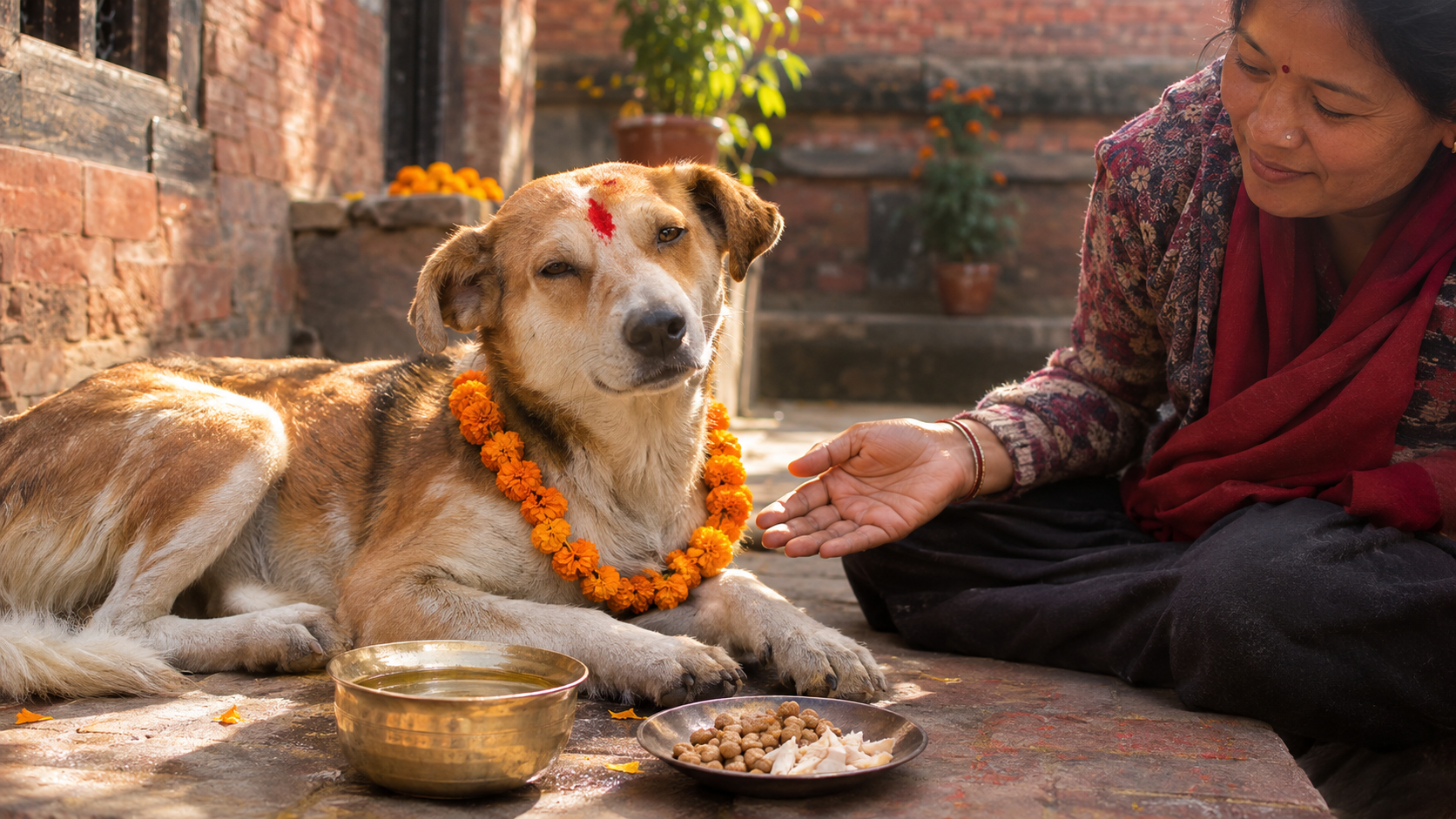
You may have seen a dog wearing a marigold garland and tika and wondered what is actually happening. Is Kukur Tihar a Nepali pet festival, a Hindu ritual, or simply a charming moment made for social media?
The first two descriptions reach the heart of it. Kukur Tihar asks you to see dogs as bearers of loyalty, protection, companionship and service. Once you understand that, the way to observe the day becomes clearer: the dog cannot be treated as a prop, and visible honour must be matched by practical care.
The garland is not the whole observance
Kukur Tihar is celebrated mainly in Nepal alongside the Diwali period. Dogs are honoured with flowers, garlands, tika and food or treats. The photographs are memorable, but the outward gestures make sense only when you know what they express.
The ceremony interrupts an ordinary human habit: we readily accept an animal’s vigilance, labour and affection while treating the animal itself as part of the background. Kukur Tihar brings the dog to the ceremonial centre. The guardian at the gate, the companion at home, the animal in a shelter and the trained service dog are all made visible.
This is why describing the festival merely as “a day when Hindus worship dogs” is inadequate. Veneration here is a disciplined act of recognition. It acknowledges that a being does not need human speech, status or wealth to occupy a meaningful place in the moral order.
If you are explaining Kukur Tihar to a child, guest or colleague, keep the explanation concrete: “Today we thank dogs for guarding, guiding, serving and accompanying us.” That sentence communicates more than an exotic label ever could.
Yamraj and Yudhishthira give the day its deeper frame
The loyal messengers of Yamraj
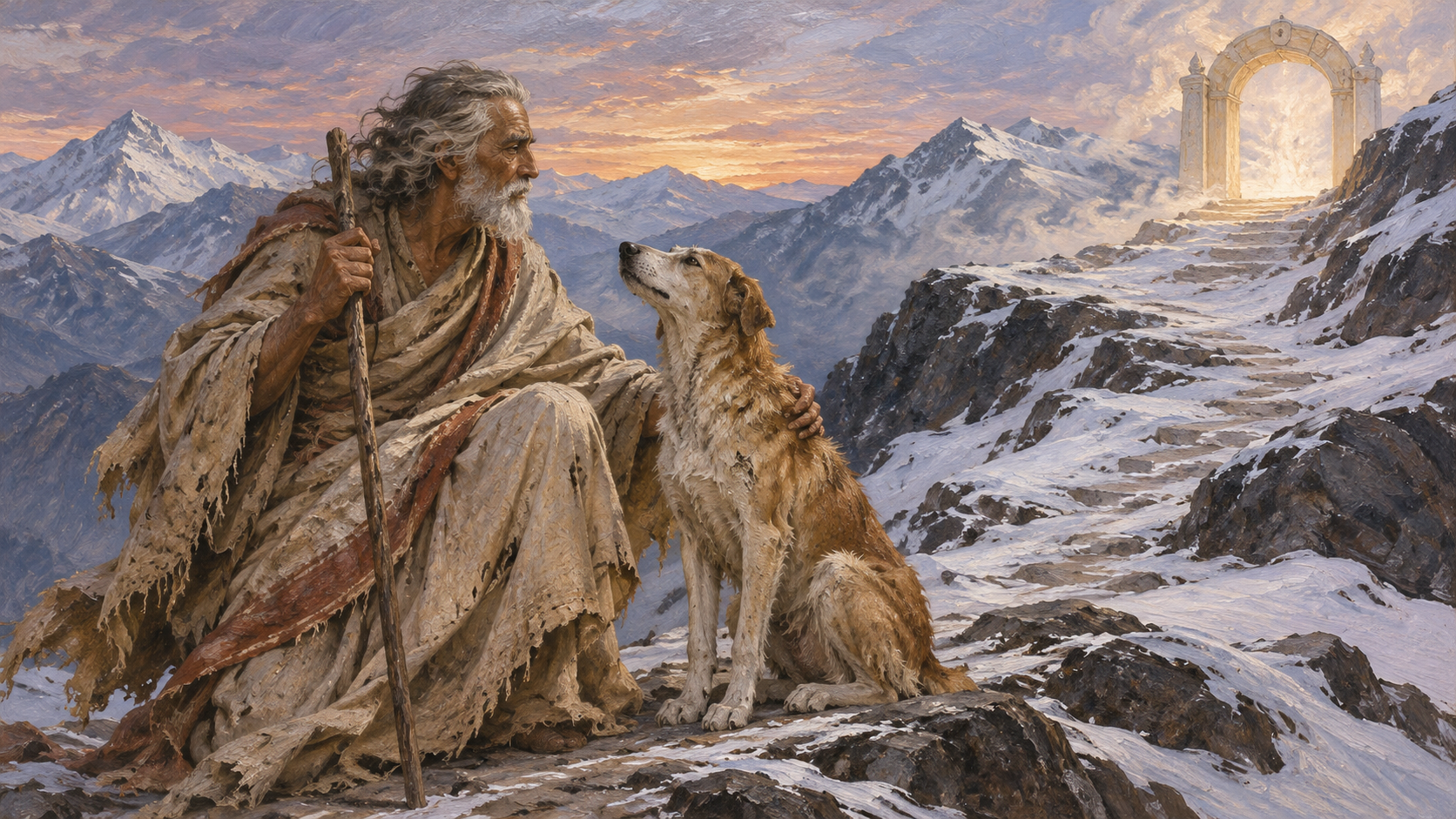
In one Hindu understanding, dogs are regarded as loyal messengers of Yamraj, the deity of death. Honouring them is traditionally associated with appeasing Yamraj and seeking protection and safe passage after death.
That association carries the festival beyond ordinary affection for pets. The familiar dog stands in relation to life’s most unavoidable boundary. A creature known for watching doors, roads and human companions also becomes a religious reminder that no threshold should be approached carelessly or arrogantly.
It would be too thin to reduce this to a transaction in which a treat purchases a favourable afterlife. The more demanding lesson is that reverence begins before a person asks for protection. You honour the messenger because loyalty itself deserves recognition, not merely because you want something from the power the messenger serves.
Yudhishthira refuses to abandon his dog
The Mahabharata supplies the festival with an equally important ethical lens. King Yudhishthira refused to enter heaven without the faithful dog that remained with him. At the very point where personal reward appeared to be within reach, he would not accept advancement at the cost of abandoning a loyal companion.
That choice turns loyalty into a reciprocal duty. A dog may guard, follow and trust a human, but dharma asks what the human does when keeping faith becomes inconvenient. Spiritual attainment emptied of fidelity would be a contradiction.
The two frames should remain distinct but connected. The association with Yamraj gives dogs a sacred role within the passage between life and death. Yudhishthira’s decision gives you a moral test for the present: do you return the loyalty you praise?
How to observe Kukur Tihar without making a dog perform
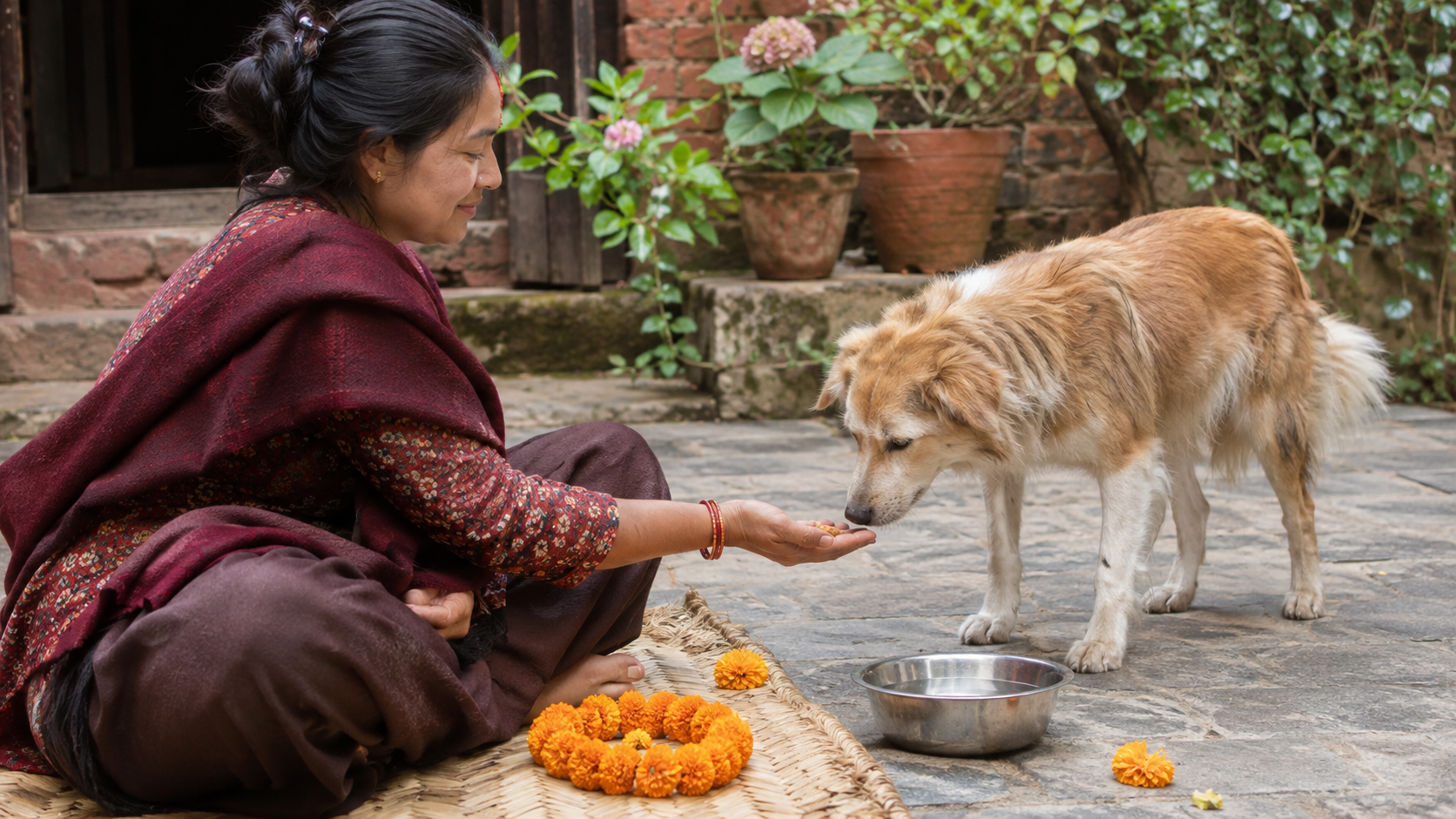
If you plan to observe Kukur Tihar at home or in your community, put the animal’s welfare before the visual result. A beautiful garland does not honour a dog that is frightened, restrained or surrounded by an overwhelming crowd.
- Decide whom your observance will include. You can honour a family dog, a familiar community dog or dogs cared for by a shelter. If you want to recognise police or military dogs, contact the responsible unit instead of approaching a working animal independently.
- Ask the caregiver before doing anything. The person who knows the dog should decide whether it is comfortable with visitors, garlands, tika and food. A sacred intention does not cancel an animal’s need for space.
- Keep the ritual calm and animal-led. Allow the dog to approach and withdraw. If it pulls away, freezes, hides or tries to remove the garland, stop. Do not restrain it for a photograph. A tika mark or garland is meaningful only when it can be offered without causing distress.
- Use food as care, not decoration. Do not assume that ceremonial sweets, household leftovers or unfamiliar treats are suitable for every dog. Ask the dog’s caregiver, shelter or handler what can be offered safely, and provide clean water where appropriate.
- Add an act that lasts beyond the ceremony. Support a shelter, provide supplies requested by local caregivers, volunteer through an established animal-welfare group or contribute to the continuing care of community dogs. The exact action matters less than making sure it answers a real need.
- Explain what the symbols mean. Tell participants that the day honours loyalty, protection and service and recalls the human obligation to return that loyalty. This prevents the observance from collapsing into costumes and photographs.
Families may have their own ritual order, inherited practice or guidance from elders. Follow that living tradition where it exists. There is no need to invent an elaborate procedure merely to make the observance appear more authentic.
A pet-only celebration misses the ethical centre
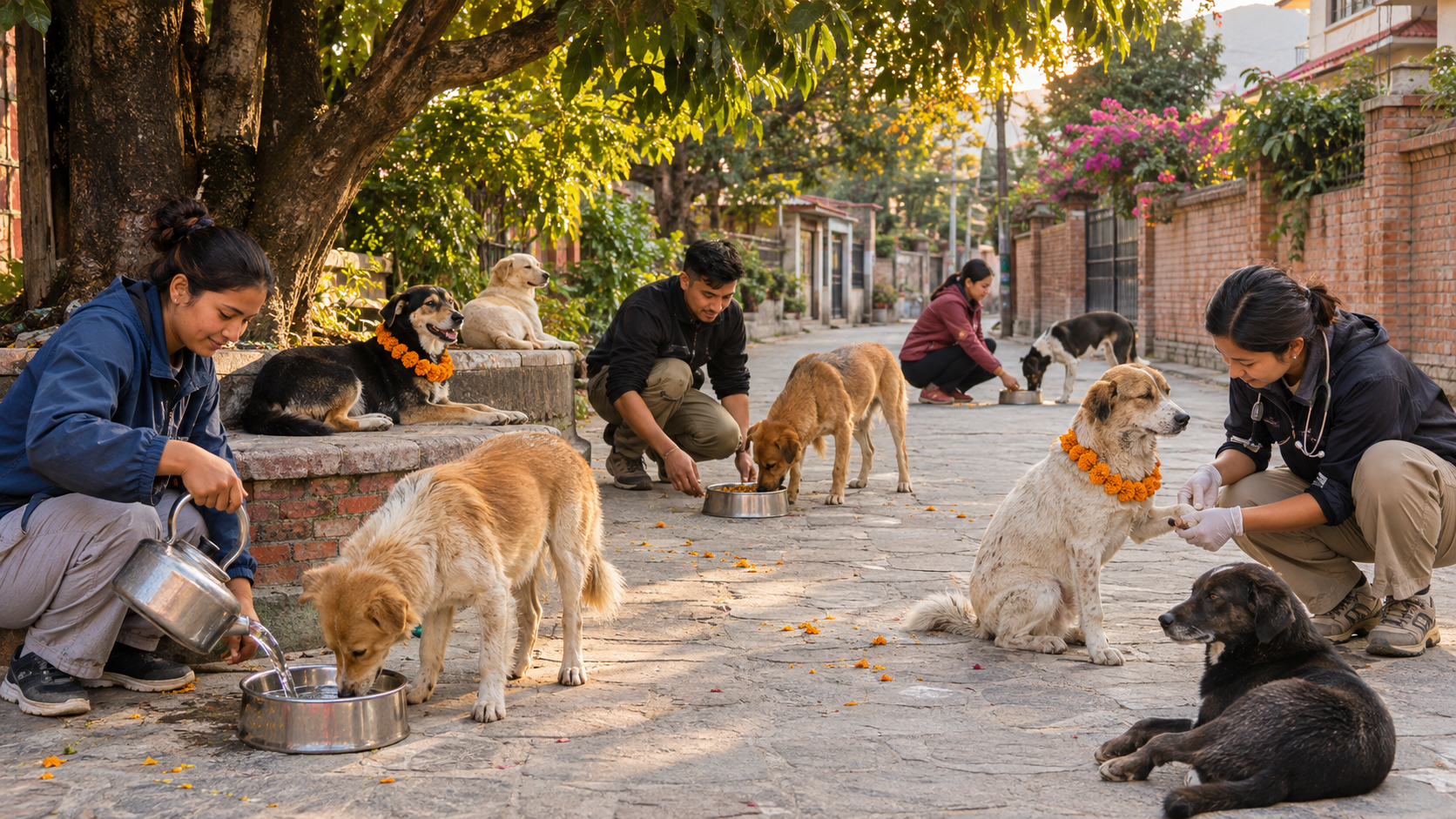
Kukur Tihar is not limited to well-groomed household pets. Its circle of regard includes street dogs, shelter animals and working military and police dogs. That breadth is not an optional modern addition. It reveals the ethical force of the celebration.
A street dog should not become a convenient festival ornament for a crowd of strangers. Work through people who already feed or care for local animals. A shelter may need particular supplies or scheduled assistance more than an unexpected group of visitors. A working dog may have duties and handling rules that must take precedence over the ceremony. In every case, respect begins by learning what care requires rather than assuming access.
Nepal’s Armed Police Force has shown how recognition of working dogs can join ceremony with respect for skill. At its Kathmandu headquarters, personnel adorned service dogs with marigold garlands and tika while presenting their operational abilities, including obstacle work and synchronised drills. The point was not simply that the dogs were lovable. Their discipline, training and contribution were being acknowledged.
The practice can also travel without losing its roots. Celebrations at the Nepal Embassy in India and in the United Kingdom show how communities outside Nepal can participate. If you organise such an event, preserve three anchors: name its Nepali setting, explain its Dharmic meanings, and make canine welfare part of the programme rather than an afterthought. Inviting Nepali community members into the planning is better than presenting the day as a generic dog festival with its origin mentioned only in small print.
Key takeaways for a respectful Kukur Tihar
- When explaining the festival, begin with gratitude for loyalty, protection, companionship and service, not with the novelty of dogs wearing garlands.
- When discussing its Hindu meaning, distinguish the dogs’ association with Yamraj from the ethical lesson of Yudhishthira’s refusal to abandon a faithful companion.
- When performing the visible ritual, let the dog withdraw and let its caregiver decide what contact, decoration and food are appropriate.
- When helping dogs beyond your home, coordinate with shelters, community caregivers or service-dog units instead of arriving unannounced.
- When organising a public celebration, retain its Nepali cultural context and connect ceremony to a concrete animal-welfare action.
Before your next observance, choose one dog, shelter, service unit or community caregiver to support. Decide what honour would mean in that particular setting: a calm ritual, an approved offering, needed supplies, money or time. Then let the garland point beyond itself. The clearest way to venerate loyalty is to become more loyal in return.
References

Leave a Reply
You must be logged in to post a comment.