
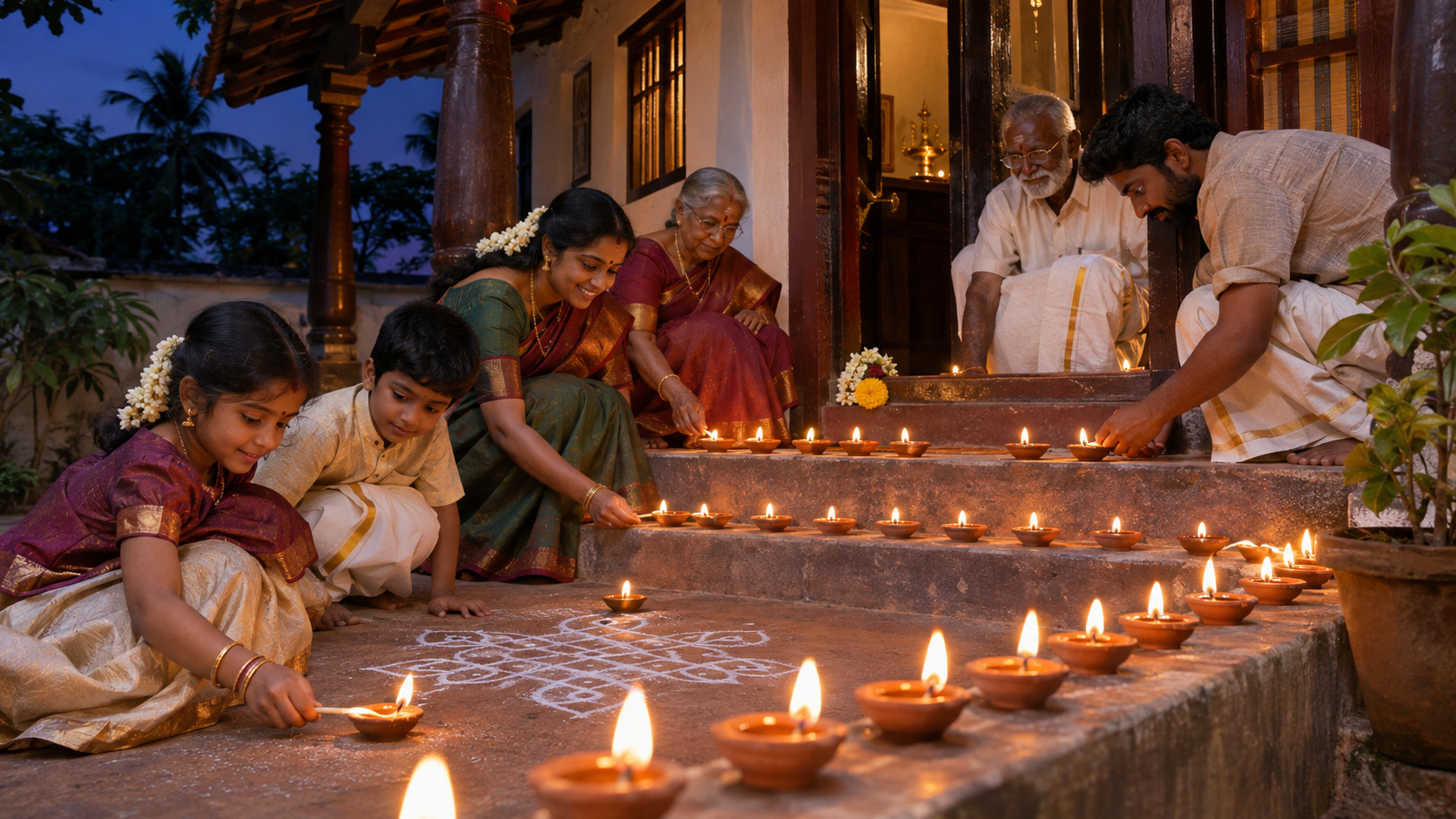
If you want to celebrate Karthigai Deepam but aren’t sure what belongs at the centre, don’t begin by collecting decorations. First identify the correct lunar-stellar day. Then build your observance around lamps, shared worship and the sacred narratives that give those flames their meaning.
This approach gives you something recognisably traditional even if you live far from Tamil Nadu or have not inherited a detailed family procedure. Karthigai Deepam may be described as another festival of lights, but that description is incomplete. Its identity comes from the meeting of Krittika and Pournami, Shiva’s limitless pillar of fire, Murugan’s six divine sparks and the great flame kindled upon Arunachala.
Find the festival by its star and lunar phase
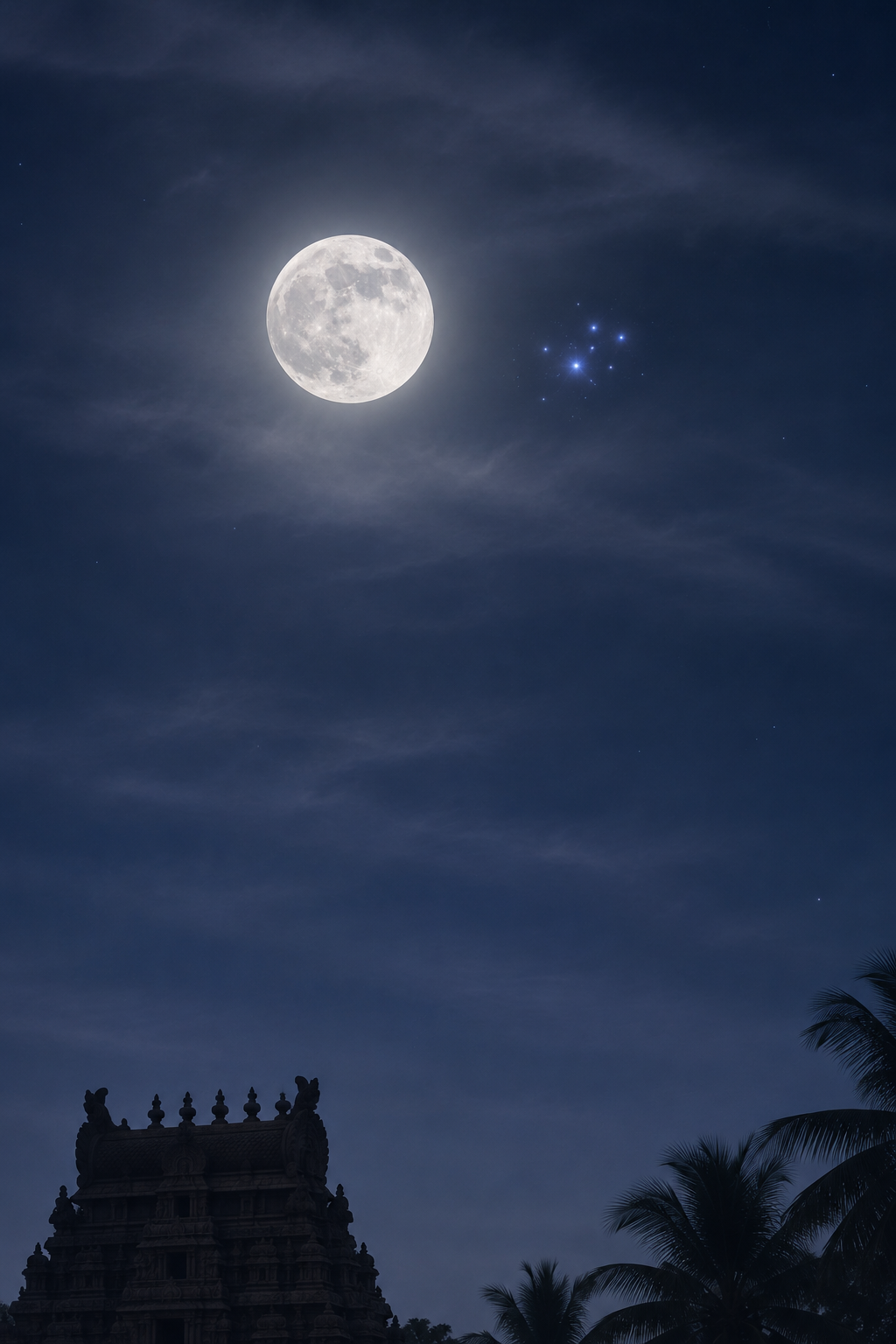
Karthigai Deepam falls in the Tamil month of Karthigai when the Krittika star coincides with Pournami, the full moon. Because the observance is defined by a Tamil month, a nakshatra and a lunar phase, you should not treat it as a fixed Gregorian anniversary. Check the calendar followed by your household or local Tamil temple for the Krittika-Pournami conjunction in Karthigai rather than copying the previous year’s civil date.
The festival comes a few weeks after Deepavali, but it should not be reduced to a second Deepavali. Both observances use light to express the overcoming of darkness. Karthigai Deepam, however, has its own celestial timing, Tamil cultural setting and particular association with earthen lamps illuminating homes, streets and temples.
If someone in your family asks what makes the day distinct, give a precise answer: it is Karthigai’s full-moon observance under Krittika, associated especially with Shiva as infinite fire and with the manifestation of Murugan. That answer preserves much more than the generic label “festival of lights.”
Two sacred narratives give the lamps their meaning
Karthigai Deepam holds together two narratives. One directs the mind towards what cannot be measured. The other directs the heart towards divine care, unity and compassion. You can tell either story during a household observance, but understanding both reveals why the lamp signifies more than victory or celebration.
Shiva as the limitless pillar of fire
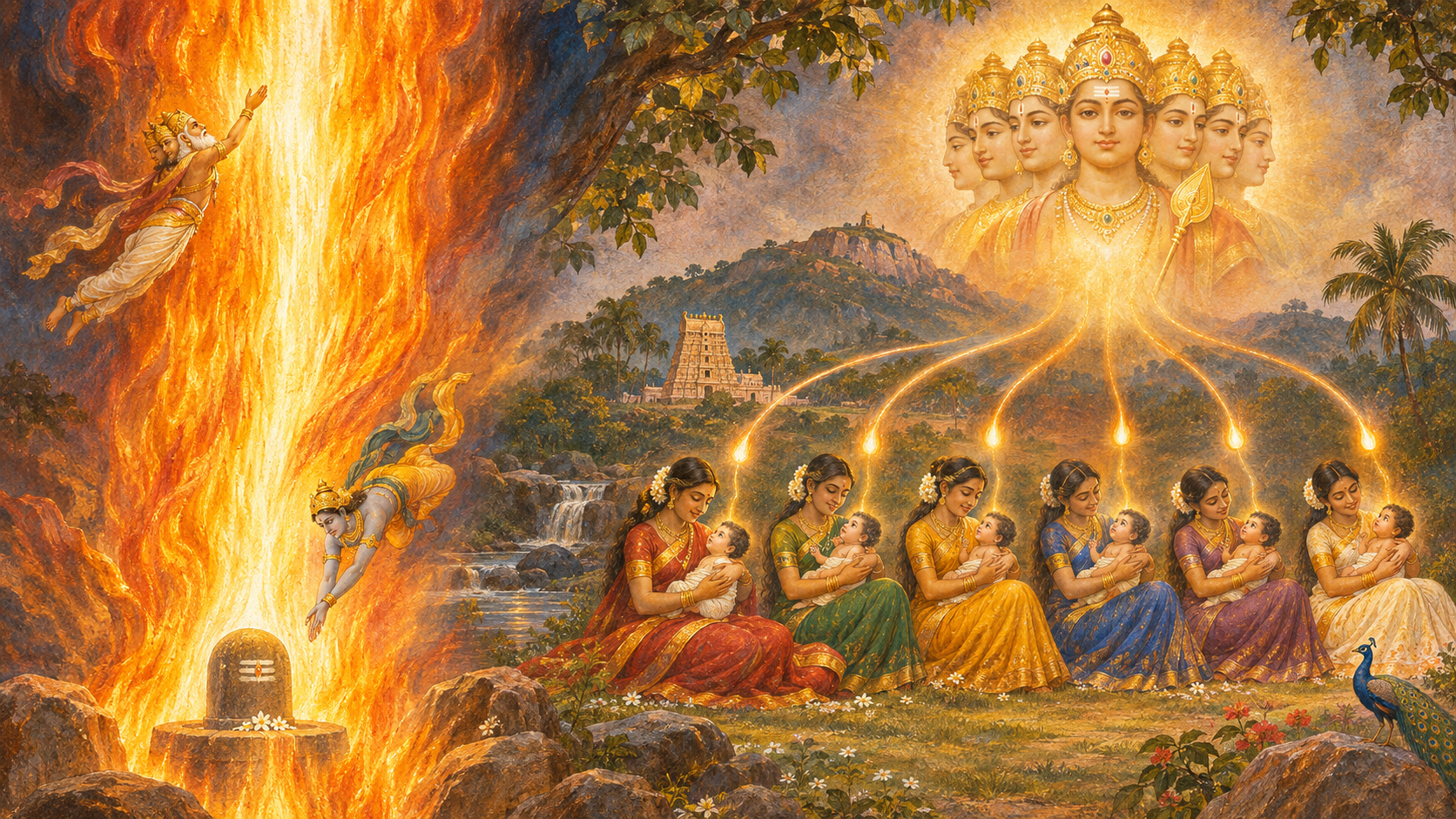
In the best-known Shaiva tradition, Brahma and Vishnu dispute which of them is greater. Shiva appears before them as Lingodbhava, an immeasurable pillar of fire, and challenges them to find its limits. Vishnu takes the form of a boar and descends in search of the base. Brahma becomes a swan and flies upwards in search of the summit. Neither succeeds.
Their failure is the point. The divine ground of existence cannot be enclosed by status, argument or measurement. The two deities must relinquish the contest that began the search. In a popular continuation of the narrative, the fiery manifestation becomes the sacred hill of Arunachala, worshipped as Shiva himself. The name Arunachala evokes a mountain of red-dawn fire, and the Maha Deepam on its summit makes the cosmic image visible upon the landscape.
When you light a lamp with this narrative in mind, use it as an occasion for humility. Ask what pride, rivalry or need for control you should place before a reality greater than yourself. This is not an additional ritual requirement. It is a practical way to prevent the lamp from becoming a decorative object emptied of the story it represents.
Murugan and the care of the Krittika stars
The second tradition begins with six sparks issuing from Shiva’s third eye. Agni and Vayu carry them to the celestial lake Saravana Poigai, where six infants appear. The six stars of the Krittika cluster nurture the children. Parvati then embraces them in an act of divine motherhood, uniting them as the six-faced Arumugan, or Murugan.
This manifestation of Murugan under the Krittika stars brings warmth to the festival’s theology of fire. The flame is not only overwhelming and limitless. It also gives life, gathers what appears divided and recalls the care through which divine potential is nurtured.
The two traditions do not need to compete for space. Shiva’s pillar teaches that the divine exceeds the ego’s measure. Murugan’s manifestation teaches that divine power can also be intimate, compassionate and unifying. If children are present, tell the sequence clearly: six sparks, six infants, six nurturing stars and Parvati’s embrace. The memorable structure allows them to carry the story long after the lamps have gone out.
Build a simple home observance around lamps and memory
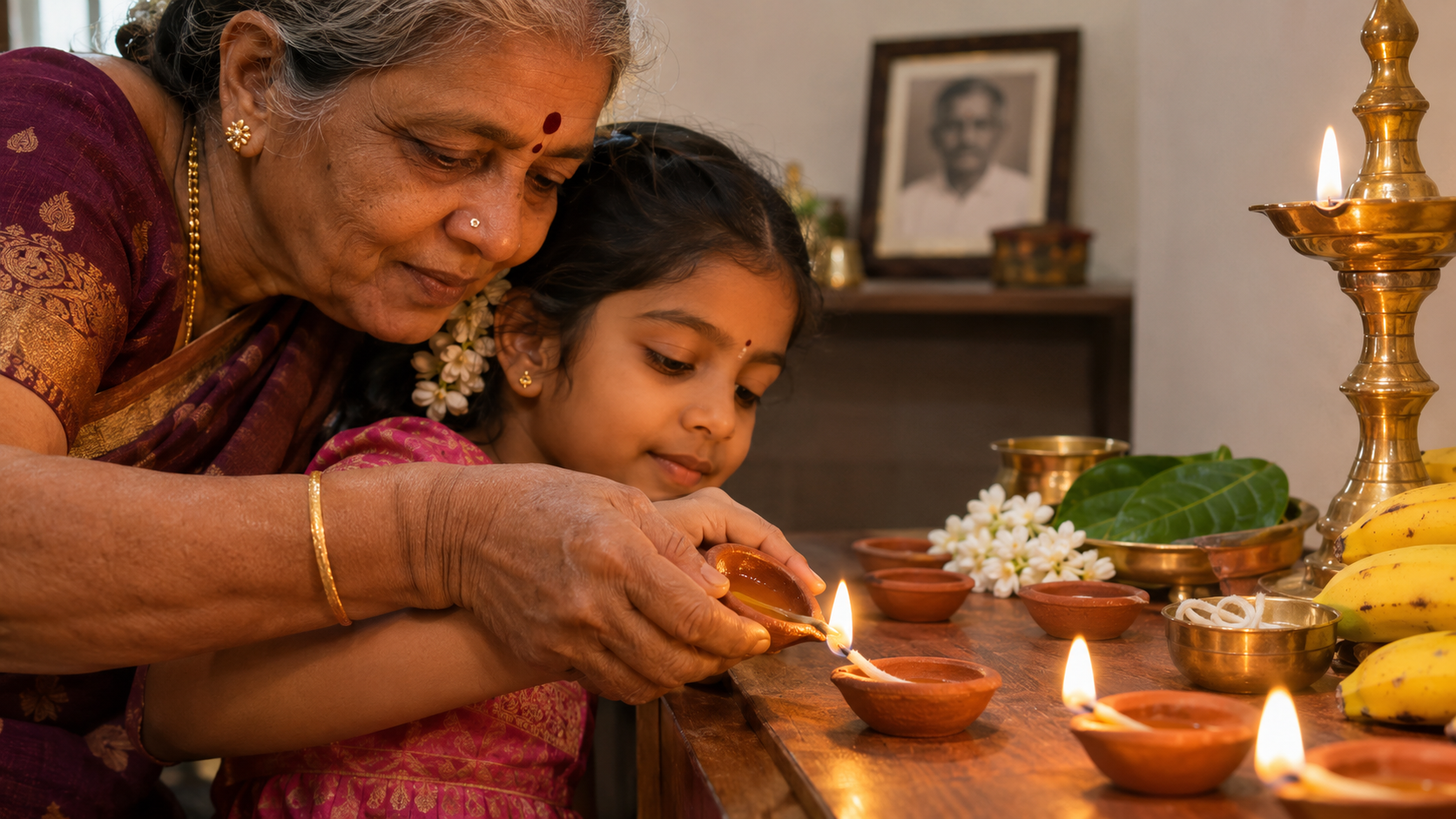
Family customs differ, and an inherited household practice should not be discarded merely to imitate something seen elsewhere. If you do not have such a custom, the following sequence keeps the observance close to Karthigai Deepam’s well-attested elements without pretending that a temple rite and a home rite are identical.
- Confirm the Karthigai-Pournami day under Krittika using the calendar observed by your household or temple.
- Prepare the earthen lamps your family can supervise safely. Place every flame on a stable, non-flammable surface, away from curtains, loose clothing and busy walkways. Do not leave a burning lamp unattended.
- Gather the household before lighting. Explain in one or two sentences whether you are remembering Shiva as infinite light, Murugan’s manifestation or both.
- Light as many lamps as you can tend responsibly. A modest row of attended lamps is more faithful than an unsafe display created merely for scale.
- Carry the observance beyond private decoration. Join a temple celebration or a safe community lighting where that is available, while respecting local rules around open flames.
Why the communal dimension matters
Communal lamp-lighting is not a recent addition. Verses 141 and 185 of the Akananuru, one of the Eight Anthologies of Sangam literature, describe lamps being lit collectively during Karthigai. Later references appear in works associated with Avvaiyar and the Jain poet Thiruthakka Thevar. This literary continuity places the custom deep within roughly two millennia of Tamil cultural memory.
That history should change how you see a row of lamps. It is not merely an attractive arrangement for one household. It belongs to a repeated public act through which generations made streets, homes and sacred places participate in the same light. Joining others, where practical, restores that social dimension. If you must observe privately, telling the history within your household still prevents the practice from becoming detached from its community.
Avoid the shortcuts that flatten the festival
- Do not guess the date solely from last year’s calendar. The lunar phase and nakshatra define the observance.
- Do not present Karthigai Deepam simply as Deepavali repeated. Light is shared symbolism, but the celestial timing and sacred narratives are distinct.
- Do not let spectacle replace explanation. A child who knows why one lamp is being lit has received more than a child shown many lamps without their story.
- Do not reproduce Tiruvannamalai’s temple-specific sequence at home as though it were a universal domestic requirement. Learn from its symbolism while preserving the difference between pilgrimage, temple liturgy and household worship.
- Do not compromise fire safety to create a larger display. The number of lamps is never a reason to leave flames unguarded.
Read Tiruvannamalai as a movement from one flame to many
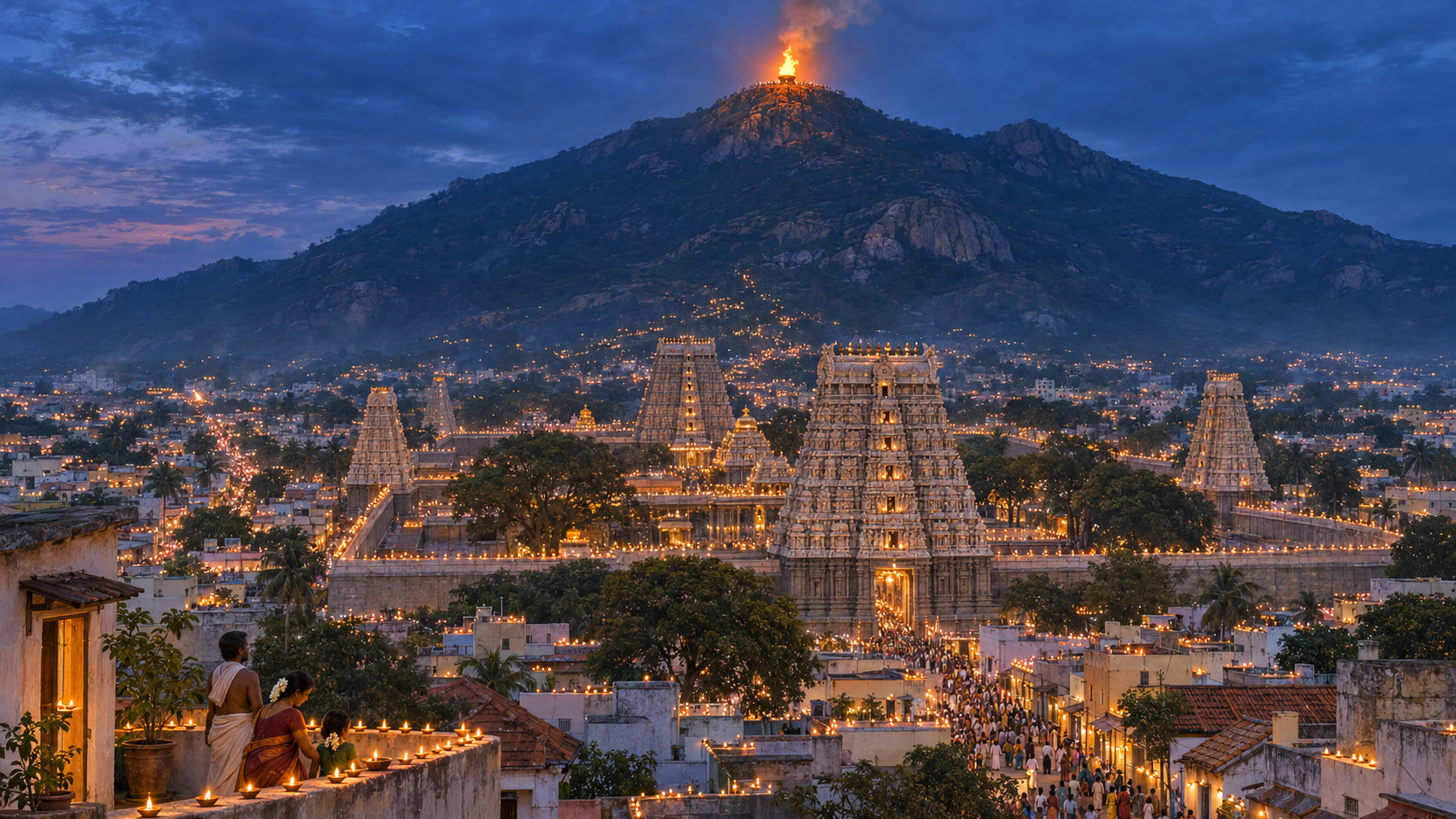
Tiruvannamalai gives Karthigai Deepam its grandest public form. Arunachala Hill is revered as the embodiment of Shiva, while the Arunachaleshwarar temple stands at its foot. Here the festival is not confined to one day. A ten-day Brahmotsavam precedes its climax, with temple deities carried through the surrounding streets on their vahanas and large gatherings assembling for darshan.
Before dawn on the principal day, a single Bharani Deepam is kindled inside the temple sanctum while the moon is still associated with Bharani, the nakshatra preceding Krittika. Five lamps are then lit from that flame and carried through the temple precincts. Devotees associate them with the five elements, the Panchabhutas. The connection is especially apt because Tiruvannamalai is honoured as the Agni Sthalam, the fire shrine among the Panchabhuta sacred places.
The Bharani flame is preserved through the day and is connected with the Maha Deepam lit upon Arunachala’s summit. The sequence invites contemplation: one flame gives rise to five without becoming diminished, and the sacred fire that begins within the temple is finally proclaimed across the mountain.
If you intend to visit Tiruvannamalai for Karthigai Deepam, decide which part of the observance you want to encounter. The processions and darshan unfold across the Brahmotsavam; the Bharani and Maha Deepams belong to the climactic day. Treating the celebration as a multi-day sacred cycle will help you understand what you are seeing rather than focusing only on the summit flame. Major gatherings are integral to the occasion, so follow temple directions and local arrangements when planning your participation.
Key takeaways for a faithful observance
- Find the right day: look for Pournami under Krittika in the Tamil month of Karthigai.
- Keep lamps central: earthen lamps in homes, temples and shared spaces are the festival’s characteristic practice.
- Tell the sacred narrative: remember Shiva’s limitless pillar of fire, Murugan’s six sparks and nurturing by the Krittika stars, or both.
- Preserve the communal element: participate with family or temple community rather than treating the lamps as private decoration alone.
- Distinguish home and temple rites: Tiruvannamalai’s Bharani Deepam, five lamps and summit Maha Deepam express a place-specific sacred sequence.
- Choose safety over scale: use stable placements, keep flames away from combustible material and supervise every burning lamp.
For your next observance, make three decisions early: where you will confirm the date, which lamps you can tend safely and which sacred narrative your household will hear. The celebration can remain simple. What matters is that its light is correctly timed, consciously understood and shared with others.
References

Leave a Reply
You must be logged in to post a comment.