
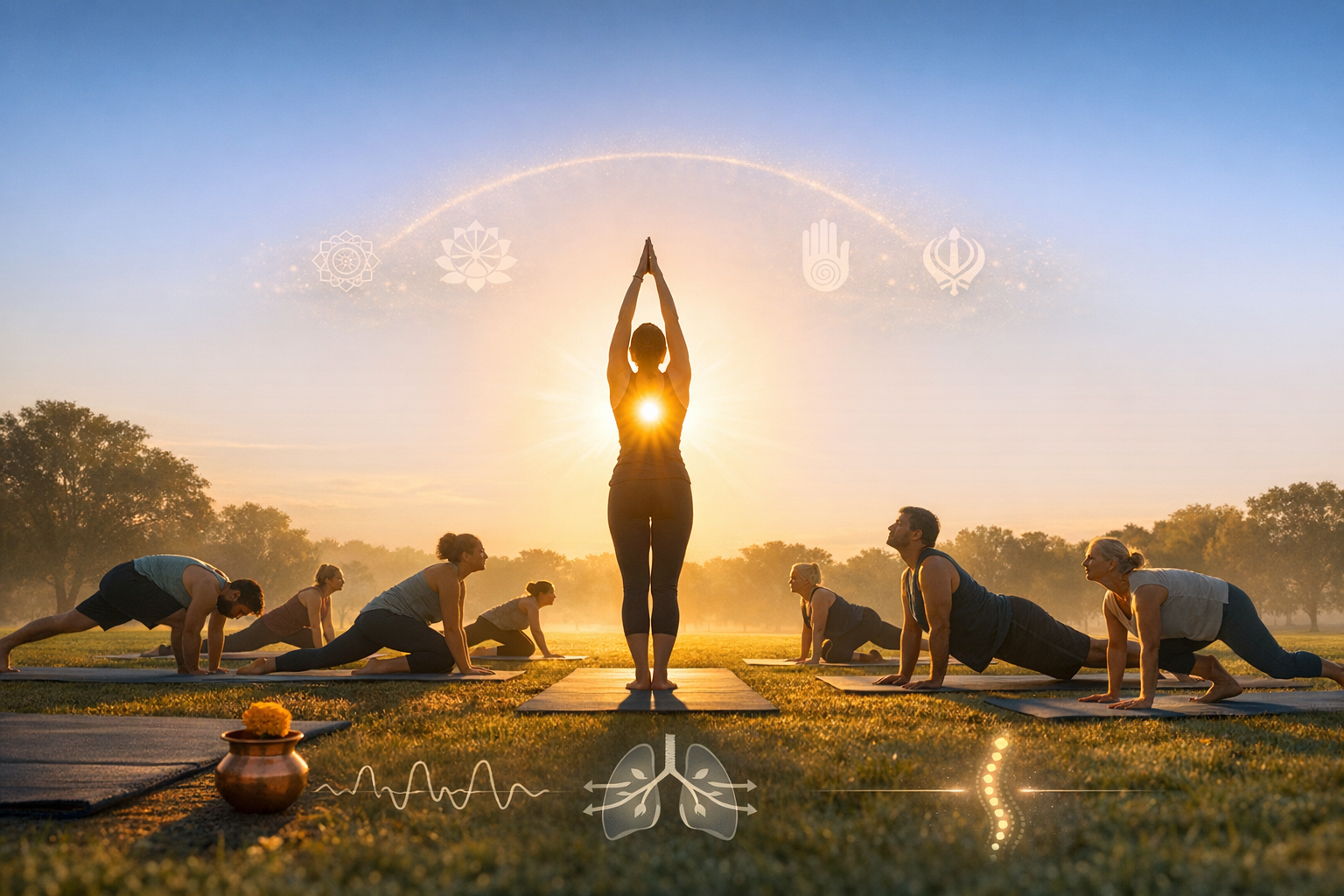
On 21 June 2026, the world observes International Yoga Day, established by United Nations General Assembly resolution 69/131 on 11 December 2014 to recognize yoga’s universal appeal. Timed with the Northern Hemisphere’s summer solstice, the day foregrounds a time-tested discipline that integrates body, breath, and mind, while also honoring a shared contemplative inheritance across Hindu, Buddhist, Jain, and Sikh traditions. The observance aligns with the spirit of Vasudhaiva Kutumbakam, emphasizing a global family bound by well-being and ethical living.
Historically, yoga is a living, plural tradition. Within Hinduism it spans Patanjali’s Ashtanga Yoga (the eight-limbed path) and diverse Hatha Yoga lineages; Buddhism offers deep meditative disciplines such as mindfulness and breath awareness; Jainism cultivates equanimity through Samayik and ethical rigor via the Mahavratas; Sikh practice centers on simran and seva. International Yoga Day highlights this dharmic continuum by inviting communities to engage with practices that foster clarity, compassion, and resilience without insisting on a single doctrinal pathway.
The choice of 21 June is symbolically apt. As the longest day in much of the world, it evokes light, rhythm, and renewalmotifs long associated with Surya (the Sun). In many communities, morning Surya Namaskara (sun salutations) and offering Arghya to the Sun (Surya Arghya) are integrated into practice, connecting circadian biology with contemplative ritual. The timing also encourages outdoor movement and breathwork, aligning somatic practice with natural cycles.
Contemporary research supports the public-health relevance of yoga. According to the US National Institutes of Health (including the National Center for Complementary and Integrative Health), yoga-based programs are associated with increased relaxation, improved flexibility, better posture, enhanced breath control, and benefits for mental well-being. Across trials, yoga interventions commonly report small-to-moderate improvements in stress, anxiety, depressive symptoms, functional mobility, and quality of life, with favorable safety profiles when appropriately adapted.
From a physiological standpoint, breathing practices (Pranayama) are a key differentiator. Slow, diaphragmatic breathing at comfortable cadences tends to increase vagal activity and heart-rate variability, modulate baroreflex function, and ease sympathetic arousal. Training attention on nasal breathing, extended exhalation, and gentle breath holds within one’s comfort range promotes CO₂ tolerance, steadier respiratory mechanics, and calmer interoceptive signalingmechanisms often linked to reductions in perceived stress and enhanced cognitive focus.
Musculoskeletal benefits accumulate through systematic, pain-free range-of-motion work. Asanas pair isometric and dynamic loads with mindful alignment, encouraging balanced strength around major joints, lengthening of chronically shortened tissues, and improved scapulothoracic and lumbopelvic coordination. Over time, these adaptations often translate into better gait, postural endurance, and daily-movement confidence for both sedentary and athletic populations.
Cardiometabolic effects are increasingly studied. Gentle-to-moderate intensity sequences and relaxation techniques can support healthy blood pressure, glucose regulation, lipid profiles, and body composition when combined with dietary prudence and adequate sleep. Evidence consistently frames yoga as a complementnot a substituteto medical care, with particular promise for individuals managing hypertension, prediabetes, or metabolic syndrome under professional guidance.
Mental-health outcomes have been a major focus. Yoga, meditation, and breath-led relaxation commonly reduce perceived stress, worry, and ruminative thinking, while improving mood and emotion regulation. Mechanistically, these effects are consistent with modulation of autonomic tone and attentional networks, as well as with skill-building in non-reactivity and cognitive reappraisal. For many, a combined regimen of asana, Pranayama, and seated meditation offers synergistic benefits.
Sleep quality frequently improves with regular practice. Evening breathwork, gentle forward folds, and guided relaxation (yoga nidra or systematic body scans) can help downshift hyperarousal and restore pre-sleep parasympathetic dominance. Consistent bedtime routines that integrate brief meditation or slow breathing often translate into easier sleep onset and fewer nocturnal awakenings.
Pain management is another established application. Guidelines and reviews identify yoga as a nonpharmacologic option for chronic low back pain and other persistent musculoskeletal complaints, where movement confidence, graded exposure, and central pain modulation matter. Carefully titrated, person-centered progressions tend to be most effective, particularly when informed by clinical input for complex conditions.
Philosophically, the Ashtanga model clarifies yoga’s breadth: yama (ethical restraints), niyama (observances), asana (postures), Pranayama (breath regulation), pratyahara (sensory regulation), dharana (focused attention), dhyana (meditation), and samadhi (absorption). The ethical pillarsahimsa (non-harm), satya (truthfulness), asteya (non-stealing), brahmacharya (wise energy use), and aparigraha (non-hoarding)resonate with Buddhist śīla, Jain Mahavratas, and the Sikh ethos of seva. In practice, these convergences nurture inter-community trust and shared civic virtue.
Traditional yogic anatomy provides a functional map for practice. Concepts such as prana (vital energy), nadis (ida, pingala, sushumna), and chakras serve as experiential frameworks guiding attention, posture, and breath. While distinct from biomedical models, these lenses help practitioners organize inner experience, align intention with action, and cultivate steadiness. Many modern programs integrate both perspectivestracking tangible outcomes (e.g., mobility, sleep, mood) while honoring subtle phenomenology.
Surya Namaskara remains a widely practiced, adaptable sequence. A classic twelve-position cycle coordinates spinal flexion and extension, lunging, plank variations, and gentle backbends with synchronized breathing. Primary considerations include even weight distribution through hands and feet, neutral neck alignment, engaged core during transitions, and unforced ranges of motion. Practitioners with wrist, shoulder, knee, or lumbar sensitivities can modify with blocks, shorter stances, or supported variations to preserve joint comfort.
Safety governs intelligent progression. Individuals who are pregnant, recovering from injury or surgery, or managing cardiovascular, ocular (e.g., glaucoma), or blood-pressure concerns should avoid extreme postures, prolonged inversions, or breath retentions and should consult qualified professionals. A sustainable path emphasizes steady, pain-free increments, adequate rest between sessions, and close attention to signals such as breath strain, dizziness, or joint pain.
A concise 20-minute protocol for beginners can be effective: two minutes of quiet sitting with natural breathing; three to five gentle rounds of Surya Namaskara at a comfortable pace; five to seven minutes of foundational standing and supine poses (e.g., Tadasana, Bhujangasana, Setu Bandha Sarvangasana); three to five minutes of slow Pranayama (e.g., equal inhalation–exhalation); and two to three minutes of guided relaxation. Consistency across weeks generally matters more than intensity within any single session.
Micro-practices support demanding workdays. Two to five minutes of box breathing (equal counts inhalation, retention, exhalation, retention), brief thoracic mobility drills, or seated spinal waves can refresh attention without changing attire or location. Evening transitionsdimming lights, unhurried nasal breathing, and gentle forward foldssignal the nervous system to downshift, protecting sleep and recovery.
Community observances amplify the spirit of International Yoga Day 2026. Inclusive events might combine a Common Yoga Protocol session (as widely used in India), Surya Namaskara demonstrations, multilingual guided meditation, and inter-tradition reflections on ahimsa and seva. Such gatherings foreground that yoga is a shared civilizational resource, inviting participation from all dharmic paths and from people of every age and ability.
For children and older adults, tailored formats work best. Playful balance and animal-themed movements keep younger practitioners engaged while building coordination. Chair-supported sequences, slower transitions, and breath-led pacing aid seniors in improving mobility and confidence. Intergenerational sessions nurture empathy and transmit cultural wisdom through embodied learning.
Progress can be observed through both subjective and objective markers: calmer stress responses in daily conflicts, fewer aches on waking, steadier energy through afternoon hours, gentler self-talk, improved sleep continuity, and mindful food choices. Simple logs tracking frequency, duration, perceived exertion, and mood before/after practice help consolidate gains and guide adjustments.
In integrative health contexts, yoga and Ayurveda often complement one another. Seasonal routines, nutrition aligned with individual constitution, and restorative breathwork cultivate digestive comfort, steady circadian rhythms, and resilience. While approaches differ across schools, the shared aim is coherent: to reduce unnecessary suffering and enhance clarity, vitality, and ethical engagement in society.
International Yoga Day 2026 thus serves as both celebration and invitation. It recognizes a unifying heritage across Hinduism, Buddhism, Jainism, and Sikhism, honors the scientific evidence for mind–body benefits, and encourages safe, inclusive practice. Whether through Surya Namaskara at dawn, a quiet midday breath break, or an evening meditation circle, the discipline offers a practical path toward steadiness and shared flourishing.
Inspired by this post on Hindu Pad.
