
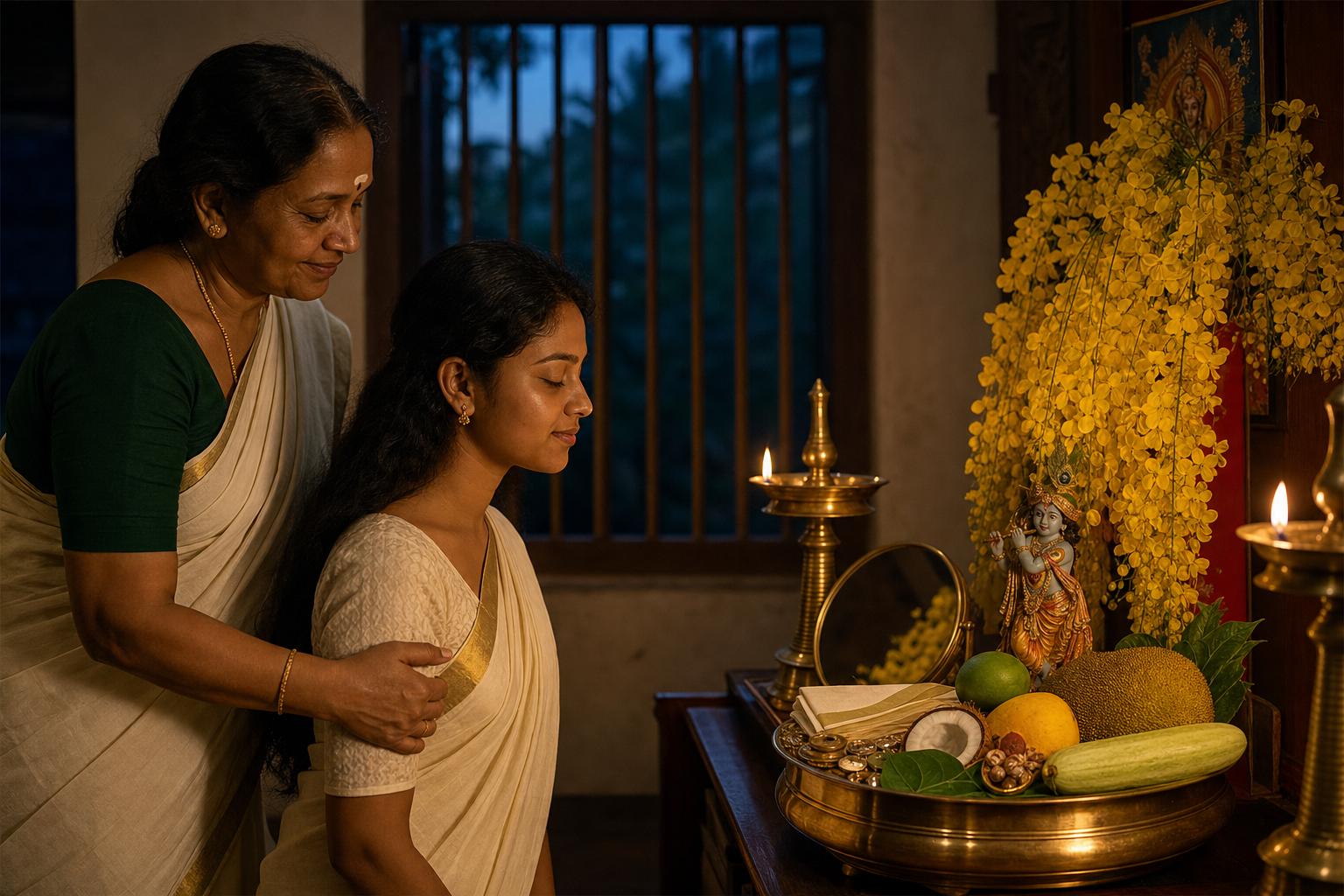
If you are trying to observe Vishu properly, the most useful distinction is between meaning and inventory. You do not preserve the festival by turning the Vishukkani into a shopping test. You preserve it by keeping the relationships among light, divinity, self-reflection, seasonal abundance, generosity, and shared food.
That makes Vishu portable without making it vague. Whether you are preparing for a large family in Kerala or a small household far from home, you can know what should remain central, what may be adapted, and how to keep the morning calm enough for the ritual to do its work.
Give Vishu a clear sequence from eve to meal
Begin by fixing the correct day. Vishu is observed on the first day of Medam, at the solar threshold marked by Mesha Sankramana, when the Sun enters sidereal Aries. This usually falls on April 14 or 15 in India, but the precise Sankramana is determined through the relevant panchangam. Check the calendar followed by your family or temple rather than assuming that one Gregorian date applies every year.
The ritual is oriented toward dawn, not a midnight countdown. Its order matters because each act prepares the ground for the next:
- On the previous evening, clean the prayer space, prepare the lamp, polish the vessel or bowl, and assemble the Vishukkani.
- At dawn, light the nilavilakku and approach the kani before allowing the rest of the morning to become busy.
- Let each person receive darshan without rushing. A prayer, familiar verse, or a few moments of silence is enough.
- Offer Vishu Kaineettam after darshan, beginning the year with generosity rather than possession.
- Serve Vishu Kanji or Vishu Katta as the morning meal, according to household custom.
- Continue the day with a temple visit, calls to relatives, an act of service, and the Vishu Sadya as circumstances permit.
Vishu Kaineettam is often remembered by children as festive money, but its ritual meaning is wider. The elder circulates auspicious wealth and accepts responsibility for the wellbeing of the next generation. The custom may also extend to household staff, neighbors, or people in need, expressing dana and interdependence through a concrete gift. Decide the recipients and prepare the money on the previous evening. The amount should fit your means; dignity and intention matter more than display.
Build the Vishukkani as one complete field of meaning
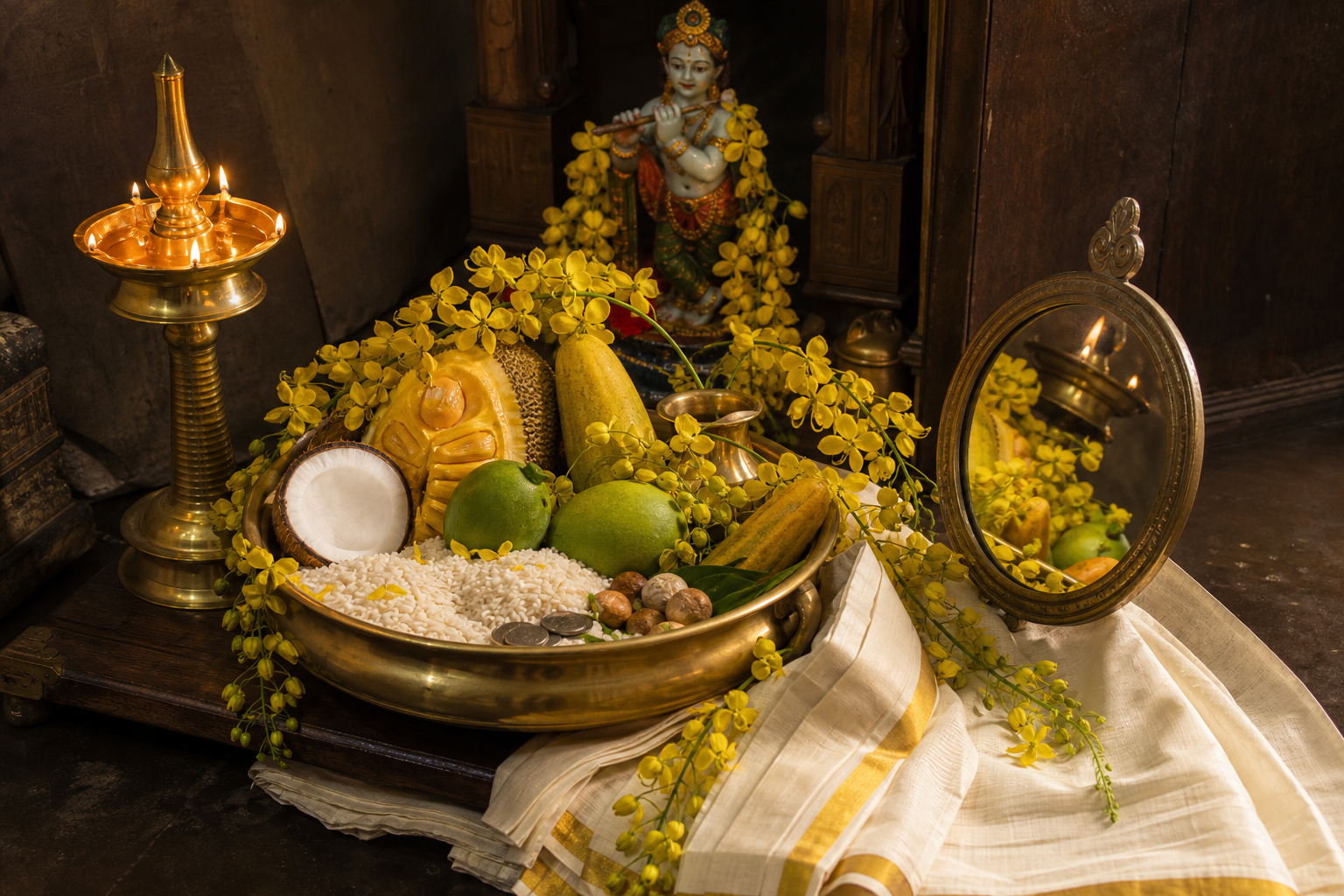
A Vishukkani is not a collection of independent lucky objects. It is a composed first sight. The lamp, mirror, deity, grain, produce, wealth, scripture, and flowers should be visible together so the eye encounters a whole vision of life rather than a crowded shelf.
A practical arrangement begins with a clean cloth and a stable surface in the prayer space. Place an uruli or another clean, beautiful bowl near the center and fill or line it with raw rice. Arrange kani-vellari, coconut, bananas, mango, jackfruit, lemons, gourds, betel leaves, and arecanut according to availability. Set an image or murti of Vishnu or Krishna nearby, add a revered text such as the Bhagavad Gita or Ramayana, and place coins, currency, or gold modestly. A traditional kani brings these elements together with a mirror, nilavilakku, and konna blossoms.
| Element | What it places before your attention | How to arrange it |
|---|---|---|
| Vishnu or Krishna | The divine order around which the year is oriented | Give the image a clear, dignified position rather than burying it among produce. |
| Nilavilakku | Light, knowledge, and the removal of tamas | Place it where its light reaches the arrangement. Keep petals and cloth away from the flame, and supervise it around children. |
| Mirror | Self-knowledge within the presence of the divine | Angle it so the viewer can see a reflection alongside the lamp or deity. |
| Uruli and raw rice | Sustenance, agricultural continuity, and abundance earned through right effort | Use the grain as the visual base or central anchor. |
| Seasonal produce | The generosity of land, climate, and cultivation | Prefer fresh, locally available fruit and vegetables over decorative excess. |
| Coins, currency, or gold | Artha governed by dharma | Keep wealth visible but secondary to the lamp, food, and sacred image. |
| Scripture | Wisdom directing prosperity and action | Place the text reverentially where it remains clean and can be seen. |
| Konna poo | Solar radiance, auspicious abundance, sattva, and the Kerala season | Use the golden clusters to frame and unify the arrangement. |
The lamp and mirror deserve particular attention. When the mirror catches the flame, deity, and your own face in one field, the arrangement makes a precise demand: do not separate the life you hope to receive from the person you must become. Prosperity is present, but so are self-examination, knowledge, and dharma.
Do not let the absence of an heirloom object stop the observance. If you do not own a bell-metal uruli, use a clean and attractive bowl. If an Aranmula-style valkannadi is unavailable, use a polished household mirror. Diaspora households commonly preserve the ritual through such measured adaptations. The substitution should perform the same symbolic function, not merely resemble the missing object.
Let the season guide what you place before the deity
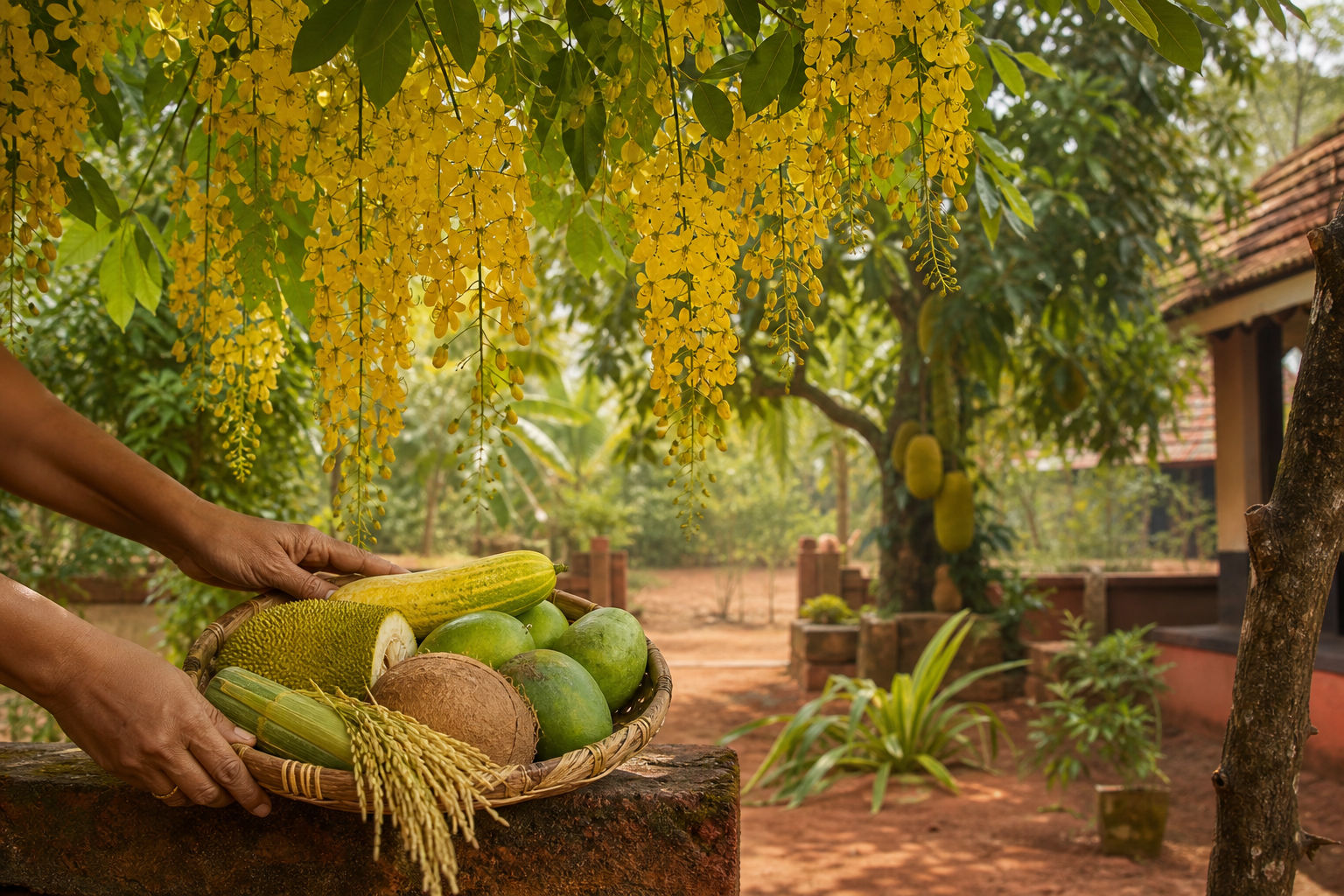
Konna poo is central because it joins ecological time to sacred time. Cassia fistula, the golden shower tree, sheds leaves and then produces long yellow flower clusters. In peninsular India its flowering season generally runs from late March to May, with a pronounced mid-April peak in Kerala. The bloom therefore arrives as a living sign of the transition from the dry season toward the early rains.
This is why the flowers mean more than yellow decoration. Their gold evokes the life-giving light of Surya, the auspicious abundance associated with Sri, and the calm luminosity of sattva. The Vishukkani translates those ideas into something you can see at dawn: radiance growing from a tree that has moved through dryness, leaf fall, and renewal.
The other foods in the kani carry the same seasonal discipline. Rice represents cultivated sustenance. Mangoes, jackfruit, bananas, cucumber, coconut, and gourds bring Kerala’s early-summer ecology indoors. When you choose produce, look first for freshness and recognizability. A smaller arrangement made from sound seasonal food expresses abundance more convincingly than an oversized display of tired or purely ornamental items.
If you live where konna does not grow, use seasonal yellow flowers and explain what they are standing in for. Preserve three things: the golden visual field, the connection to what is blooming where you live, and the memory of Kanikonna in Kerala. This is stronger than importing flowers without regard for condition or ecological cost. It allows a child to learn both the inherited symbol and the landscape outside the present home.
Where konna is available, source it gently. Vishu demand should not become a reason to strip a solitary tree. The blossoms also serve bees and butterflies when other nectar may be limited. Community planting in temple grounds, schools, and neighborhood gardens can increase the future supply, while the tree’s preference for full sun and well-drained soil makes long-term cultivation practical in suitable climates. Ritual continuity is better served by growing the tree than by exhausting it once a year.
Choose breakfast first, then decide how large the sadya should be
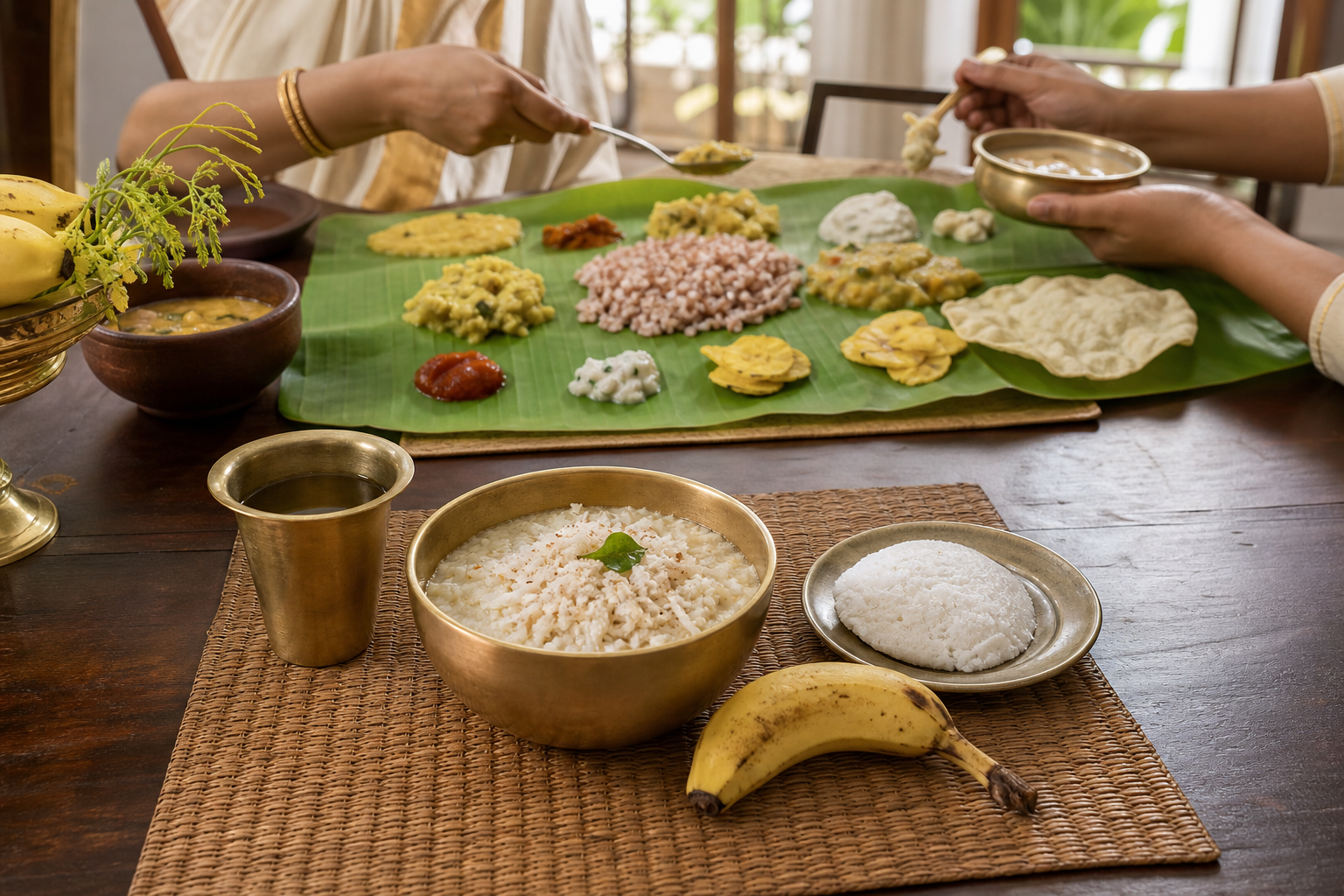
The food plan becomes manageable once you separate the ceremonial breakfast from the later feast. Vishu Kanji and Vishu Katta use nearly the same flavor language – rice, coconut, cumin, and restrained seasoning – but their liquid ratios and serving times are different. Choose one before doing the rest of the menu.
Vishu Kanji for a soft, immediately served breakfast
Vishu Kanji is a lightly salted rice gruel enriched with coconut milk and a small amount of cumin. A traditional-scale formula uses 2 1/2 cups of unakkalari or pacha ari, approximately five cups of grated coconut, 1/2 teaspoon cumin seeds, salt, and about 8-9 cups of total liquid from coconut milk and water. Household measures vary, but the important technical point is the generous liquid ratio that keeps the finished kanji pourable.
- Rinse the rice. An optional 20-30 minute soak helps it hydrate evenly.
- Extract coconut milk in three strengths: thin, medium, and thick. Keep the thickest milk for the end.
- Simmer the rice gently in the thin coconut milk with the cumin and a small amount of salt.
- When the grain is tender and releasing starch, add the medium coconut milk. Continue over controlled heat until the mixture becomes glossy and spoon-coating.
- Lower the heat before adding the thick coconut milk. Warm it through without an aggressive boil, then serve the kanji promptly.
The full preparation commonly takes about an hour, depending on the grain, vessel, and flame. A heavy-bottomed pot reduces scorching. If the coconut milk looks close to separating, lower the heat rather than trying to finish faster. If the kanji thickens while it waits, stir in warm thin coconut milk until it flows again. Uppumanga, mango pickle, pappadam, or a cherupayar preparation can provide the acid, crunch, or protein that the mild gruel needs. These proportions, texture cues, and remedies are detailed in the traditional Vishu Kanji and Vishu Katta method.
Vishu Katta when you want a sliceable preparation
Vishu Katta uses less liquid and requires cooling time. For the same 2 1/2 cups of rice, the total liquid is approximately 5-6 cups. The rice may be used whole or ground coarsely. Cook it first in thin coconut milk with 1/2 teaspoon cumin and salt, add the richer milk gradually, and stir until the mixture becomes a dense, cohesive mass.
Spread the hot mixture in a tray lightly greased with coconut oil, level the surface, and let it cool to room temperature. The rice starch firms as it rests, allowing the Katta to be cut into diamonds. Serve it with warm jaggery syrup for sweetness or a raw-mango accompaniment for acidity. If it does not set, the mixture retained too much water: return it to low heat and stir out more moisture, or allow it a longer rest before cutting.
Choose Katta only if your morning allows for both active stirring and cooling. Choose Kanji if you want to serve breakfast as soon as cooking is complete. This one decision prevents the common problem of trying to finish a set dish, a porridge, and a full sadya at the same time.
Build a sadya around balance, not dish count
The Vishu Sadya is a festive vegetarian meal shaped by family custom and seasonal availability. A fuller spread may include parippu with ghee, sambar, avial, kalan, olan, kootu curry, thoran, pachadi, puli inji, pickles, pappadam, banana chips, sharkara varatti, and payasam. These dishes bring contrasting tastes and textures into a meal informed by the principle of shad rasa, or the six tastes. The aim is balance, not an endurance test for the cook.
For a smaller household, use a deliberate structure: rice with parippu and ghee; one substantial gravy such as sambar; avial; one thoran; one sharp or sweet-sour accompaniment such as puli inji, pachadi, or mango pickle; pappadam or chips; and one payasam. Add kalan, olan, kootu curry, or other family essentials when you have the people and time to prepare them well. The recognizable Vishu Sadya repertoire is broad enough to accommodate household variation.
Do the quiet work on the previous evening. Sort and rinse-ready the rice, grate the coconut, identify which milk extraction you need, assemble spices, and set out the breakfast vessel. Keep the menu visible so two people do not unknowingly prepare competing dishes. On Vishu morning, protect the darshan from kitchen urgency by having the ingredients ready before sleep. The food should continue the clarity of the kani, not erase it with avoidable haste.
Key takeaways
- Confirm the first day of Medam and the relevant Mesha Sankramana through the panchangam followed by your family or temple; prepare the kani on the previous evening for dawn darshan.
- Arrange the lamp, mirror, deity, grain, produce, wealth, scripture, and flowers as a connected field. Their relationship matters more than owning every traditional object.
- When konna is unavailable, use seasonal yellow flowers but preserve the story of Kanikonna and its connection to Kerala’s April ecology.
- Treat Vishu Kaineettam as dana and intergenerational responsibility, not as a display of spending.
- Choose either Kanji or Katta before planning the sadya. Kanji needs more liquid and immediate service; Katta needs less liquid, active stirring, and time to set.
- Size the sadya to your household. A balanced, carefully cooked meal carries the tradition better than a long menu prepared in distress.
The test on Vishu morning is not whether your arrangement matches a photograph. Ask whether the people before it can see light, nourishment, their own reflection, the guidance of dharma, and a reason to share what they have. If those relationships are clear, the ritual has retained its grammar.
Start tonight with four decisions: confirm the day, choose Kanji or Katta, set out the lamp and mirror, and name one person beyond your immediate household whom your generosity will reach. That is enough to turn festival preparation into a meaningful beginning.
References
- DharmaRenaissance Blog — Radiant Konna Poo in Vishu: Botany, Bloom Cycles, and Sacred Symbolism in Kerala
- DharmaRenaissance Blog — Vishukkani Darshan: Timeless Ritual Science, Solar New Year, and Kerala’s Sacred Abundance
- DharmaRenaissance Blog — Vishu Kanji & Vishu Katta: Authentic Kerala Vishu Breakfast, Ritual Meaning, and Recipe Guide
- DharmaRenaissance Blog — Vishu Festival Unveiled: Astronomical New Year of Kerala, Sacred Kani, Kaineettam & Sadya