

You see Shiva covered in ash, accompanied by beings polite society would avoid, and at home where funeral fires expose the end of every worldly distinction. If you have wondered whether this imagery rejects purity, glorifies disorder, or gives religious cover to shocking conduct, your hesitation is useful. Shiva’s symbols demand discernment.
Read carefully, Shiva’s marginality is neither a fascination with misery nor a license to break rules. It is a disciplined revelation: no place, person, emotion, or stage of existence lies outside sacred reality. The practical question for you is not whether the frightening can be made fashionable. It is whether fear, impermanence, and exclusion can be faced without denial, indulgence, or cruelty.
Read the boundary before judging the image
Shiva repeatedly occupies a threshold: life and death, form and formlessness, household order and ascetic freedom, the honored center and the neglected edge. A threshold is not merely a place between two settled worlds. It is where the apparent opposition between them becomes unstable.
The cremation ground is the clearest example. Ordinary life lets you postpone the knowledge of death. Status, possessions, appearance, and social approval can feel permanent because daily routines reinforce them. The funeral fire interrupts that illusion. Ash does not preserve rank. By dwelling there, Shiva does not declare life worthless; he reveals which claims cannot survive mortality.
This helps distinguish marginality from social defeat. Shiva is not driven to the edge because the center has rejected him. He goes freely, and his presence changes what the edge means. The feared location becomes a place of instruction. The forgotten being becomes a member of a divine retinue. The category called impure can no longer be treated as if it were beyond the reach of consciousness.
The Vedic background sharpens the point. Rudra carries a double valence: his power is feared, yet healing is sought from that same power. Sri Rudram does not solve the tension by dividing terror and grace between separate realities. The Mahamrityunjaya mantra asks for release from mortality’s binding force while keeping death close enough to be confronted. Shiva develops this theological pattern into a comprehensive vision in which creation, preservation, dissolution, concealment, and grace belong to one divine movement.
Use three questions when a Shaiva image unsettles you
- Which boundary is being crossed? Look for a division such as life and death, pure and impure, accepted and rejected, or visible and unseen.
- Which attachment is being exposed? The target may be pride in status, avoidance of mortality, fear of the unfamiliar, or dependence on respectable appearances.
- What becomes possible after the crossing? In a sound reading, fear becomes steadiness, neglected beings recover dignity, and unruly forces are brought into an intelligible order.
If your interpretation ends at shock, it is incomplete. Shiva crosses a boundary to disclose a deeper unity, not merely to prove that a boundary can be violated.
Key takeaways
- Shiva’s marginality reveals the limits of status and conventional security; it does not romanticize deprivation.
- The cremation ground teaches impermanence by removing the distinctions on which social pride depends.
- The fearsome is included within sacred reality, but inclusion is not the same as approval of every impulse or action.
- A transgressive symbol should produce greater clarity, restraint, and compassion. Shock without transformation is spiritual theatre.
- The social test of the symbolism is whether you can preserve discipline without denying another person’s dignity.
Let each frightening symbol perform its own work

It is tempting to turn all of Shiva’s unsettling features into one vague message about rebellion. That erases their precision. Ash, the bhuta-ganas, Bhairava, Nataraja, and the linga do different work. Read separately, they form a disciplined progression from impermanence to integration and from integration to freedom.
Ash removes false permanence
Vibhuti or bhasma is what remains after form has been consumed. Worn on Shiva’s body and applied by devotees, it makes mortality tactile. The gesture does not require contempt for the body. It asks you to stop demanding that the body, reputation, possessions, or present circumstances provide permanence they cannot provide.
When you apply vibhuti, give the act a definite object. Name one identity or possession you are treating as permanent: a role, an achievement, a grievance, an image of yourself, or another person’s approval. The ash then becomes more than a sectarian marker. It becomes a test of whether remembrance of death is loosening attachment while leaving responsibility intact.
Nihilism says that passing things have no value. Shiva’s ash teaches something more demanding: passing things matter, but they cannot bear the weight of ultimacy. You can care for them without worshipping them.
The bhuta-ganas model integration without surrender
Bhuta can refer to subtle beings as well as the elemental constituents of existence, while gana indicates a company or retinue. Shiva’s sovereignty over the bhuta-ganas therefore conveys more than companionship with ghosts. Forces that appear fragmented, disturbing, or socially unassimilable are gathered around a center.
They are neither expelled nor enthroned. This is the crucial balance. Exclusion would pretend that disturbing forces do not exist. Indulgence would let them rule. Shiva’s retinue presents a third possibility: acknowledge what is present, place it in relationship to a higher center, and redirect its energy.
You can use this pattern when anger, envy, grief, shame, or fear appears. First name the state without turning it into your identity. Then refuse the immediate action it demands. Ask what wound, attachment, or threatened value it reveals. Finally, choose a response consistent with dharma. The emotion is admitted into awareness but does not seize sovereignty.
This contemplative use of the ganas can support self-inquiry, but it is not a substitute for psychological care. If an inner state is overwhelming, persistent, or linked to danger, qualified help and spiritual practice serve different purposes and should not be confused.
Aghora and Bhairava train steadiness before time
Aghora means not terrible or non-terrifying. It does not claim that painful realities feel pleasant. It points to a way of seeing in which the fearsome no longer has the power to destroy discernment. Bhairava concentrates this teaching through the imagery of time, transience, guardianship, and uncompromising awareness. As Kaal Bhairav, the guardian of Kashi, he confronts the instinct to treat time as an enemy that might be escaped.
Fearlessness in this register does not mean an absence of fear. It means that fear no longer chooses your ethics for you. When frightened, ask what the fear is trying to make you abandon: truthfulness, patience, reverence, duty, or another person’s humanity. Remaining faithful to dharma while fear is present is closer to Bhairava’s lesson than cultivating a dramatic appearance.
Nataraja and the linga keep dissolution inside wholeness
Nataraja prevents cremation-ground symbolism from collapsing into a cult of destruction. The dance holds five cosmic functions together: creation, preservation, dissolution, concealment, and grace. The surrounding fire is therefore not an image of ending alone. It belongs to a continuous movement in which endings make transformation possible.
Under Nataraja’s foot lies apasmara, forgetfulness or ignorance. The point is easy to miss in a culture that celebrates conquest: the dance subdues ignorance, not a class of human beings. If your devotion makes you eager to crush people rather than illuminate confusion, the symbolism has been inverted.
The linga supplies another correction. Its aniconic form allows devotion to approach the divine without confining it to a human likeness. In the linga-yoni ensemble, apparently opposed principles appear as complementarity rather than conflict. Form and formlessness, stillness and generativity, are not forced into rival camps. When an image at the margin seems to destroy a binary, look for the more inclusive reality it is making visible.
Sacred transgression is not a license to indulge

Sacred transgression crosses a conventional limit in order to expose attachment and recover a deeper obedience to dharma. Mere transgression crosses a limit because appetite, vanity, resentment, or the desire to shock wants freedom from accountability. The outward gesture can look similar while the inner direction is opposite.
Historical Shaiva movements such as the Pashupatas and Kapalikas, followed by varied Agamic and Tantric schools, worked deliberately with liminal symbols and disciplines. Their existence does not turn unusual practices into open-source techniques. Such disciplines were understood within demanding structures of initiation, ethical restraint, and guidance. The point was transmutation, not spectacle.
Use the following tests before treating any unconventional act as spiritually serious:
- Examine the aim. Does the act reduce attachment, fear, and self-importance, or does it give the practitioner a more exotic identity?
- Examine the authority. Is the practice situated in a living discipline with a competent guru, or assembled from fragments because they appear powerful?
- Examine the ethical frame. Yama, niyama, non-harm, truthfulness, and responsibility do not become irrelevant because a practice is esoteric.
- Examine the effect. Does the practitioner become steadier, less possessive, more truthful, and more capable of service? Increased impulsiveness, contempt, or dependency points in the other direction.
- Examine who bears the cost. A practice cannot claim liberation while coercing, humiliating, exploiting, or endangering another person.
The last test matters because religious language can disguise ordinary domination. Secrecy may protect a legitimate initiatory boundary, but it must never be used to make abuse immune from moral scrutiny. A guru’s authority and a lineage’s discipline are reasons for greater accountability, not less.
Nor should you imitate cremation-ground or other esoteric disciplines on your own. Ritual, legal, physical, and community boundaries remain real. Household worship, mantra, abhishekam, scriptural reflection, and service provide demanding ways to encounter Shiva’s teaching without staging extremity.
The avadhuta standing outside ordinary social markers is not a costume available to anyone tired of obligation. Renunciation has meaning when attachment has actually been relinquished. Abandoning duties while preserving appetite is not transcendence; it is appetite with sacred vocabulary.
This is why aghora must be read precisely. Not terrible does not mean that nothing is forbidden. It means that reality can be faced without panic, hatred, or denial. The person who sees clearly becomes more capable of restraint because aversion no longer dictates the response.
Carry Shiva’s marginality into social conduct
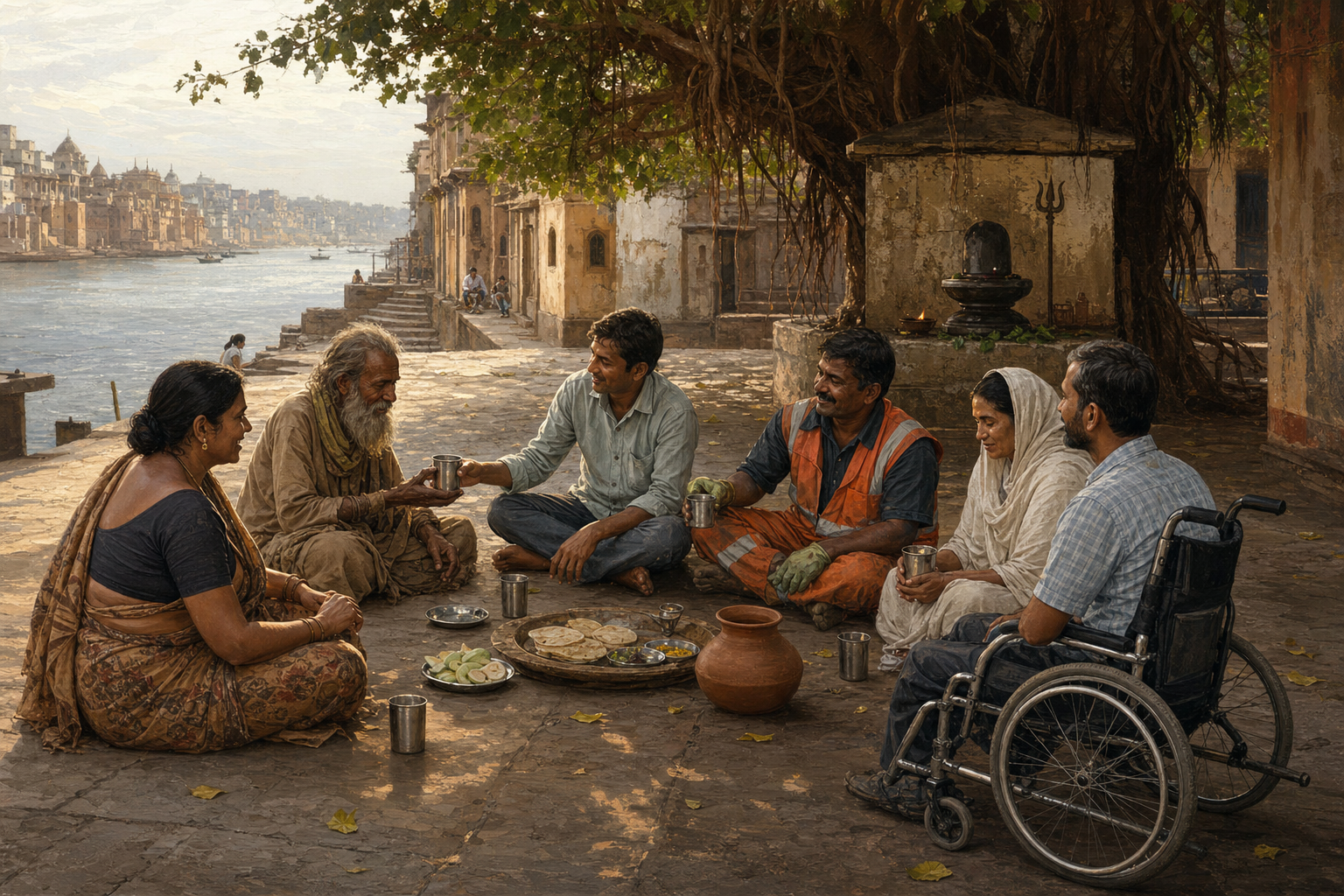
It is possible to admire Shiva’s ghosts, ash, and ascetics while remaining harsh toward actual people at the social edge. That is not a minor inconsistency. It fails the theological claim expressed by the imagery.
The cremation ground makes pedigree temporarily useless. Shiva’s welcome of beings marked as unsettling or impure therefore challenges any system that turns relative distinctions into denials of inherent worth. A ritual tradition may recognize different roles, disciplines, stages, and qualifications. None of those distinctions requires humiliation. The decisive line runs between ordered difference and the claim that some human beings possess less dignity.
In a temple, satsang, festival committee, or community association, translate that principle into questions that can be answered:
- Who performs the least visible work, and are they addressed with the same courtesy as donors and office-holders?
- Do rules protect the sanctity of worship, or are they being applied selectively to preserve someone’s status?
- Who is allowed to speak about a decision that directly affects them?
- Is food, seva, or assistance offered in a way that preserves the recipient’s agency rather than displaying the giver’s virtue?
- When someone is socially awkward, poor, grieving, stigmatized, or unfamiliar with custom, does the community guide them without making them a spectacle?
You do not have to erase ritual form to answer these questions well. Shiva does not make every member of the gana identical. He gives the diverse company a center. A healthy community can likewise retain form, authority, and responsibility while refusing contempt.
There is also a warning against romanticizing marginality. People pushed to an edge are not symbols placed there for someone else’s spiritual education. Dignity requires listening to their concrete needs, respecting their choices, and changing conduct where exclusion is being reproduced. Invoking Shiva while using vulnerable people as scenery merely turns inclusion into another performance.
Recognize Dharmic resonances without erasing differences
Other Dharmic traditions also place disciplined fearlessness near the path of liberation. Vajrayana Buddhist practice uses charnel-ground imagery to confront decay and cultivate compassion; Mahakala carries a transforming association with time that can remind a Shaiva reader of Bhairava. Jain aparigraha and tapas pursue detachment through a distinct discipline governed by ahimsa. Sikh teaching joins fearlessness and freedom from enmity in the expression nirbhau, nirvair.
These are resonances, not interchangeable doctrines. You understand the Dharmic family more honestly when you notice a shared problem – fear, attachment, enmity, or denial of mortality – and then let each tradition disclose its own method and vocabulary. Similarity can open a conversation; it should not erase difference.
Within Hindu Dharma, the principle of Ishta already makes room for temperamental difference. One seeker may meet the divine through Shiva’s austerity, another through Rama’s ordered virtue, Krishna’s intimacy, or another consecrated form. Shiva’s capacious center does not demand the disappearance of other paths. It shows how difference can be held without fear.
Bring the margin into sadhana without theatrics

You do not need an extreme setting to work with Shiva’s teaching. You need a practice that brings what you avoid into awareness, subjects it to dharma, and produces a concrete change in conduct.
- Begin with impermanence. Apply vibhuti according to your tradition, or sit before a linga or image of Shiva. Name one condition you cannot keep forever. Do not force detachment; simply stop pretending permanence is available.
- Bring one gana into awareness. Choose a troubling emotion, memory, or impulse. Name it accurately without condemning yourself and without granting it permission to act.
- Place it under a sacred center. Recite the Mahamrityunjaya mantra as prayerful remembrance, or undertake the japa prescribed in your tradition. Let the mantra interrupt the claim that fear must control your next decision.
- Choose one restrained response. Decide what dharma requires in the situation: a truthful conversation, an apology, a boundary, patient action, or refusal to retaliate.
- Restore dignity outside yourself. Perform one act that corrects neglect without seeking display. Listen to someone usually ignored, share responsibility for unglamorous work, or question a humiliating custom through the proper community channel.
The sequence matters. Awareness without a sacred center can become rumination. Mantra without honest awareness can become avoidance. Inner work without changed conduct can become self-absorption. Shiva’s symbolism holds the three together: look directly, order what you find, and act differently.
Maha Shivaratri concentrates the same movement through vigil, japa, fasting, abhishekam, and offerings such as water, milk, and bilva leaves. If you observe the night, resist turning austerity into competition. Follow the discipline of your household, temple, or guru, and respect your physical capacity. The purpose of wakefulness is clearer seeing, not a public display of endurance.
During abhishekam, notice the contrast between repeated offering and the linga’s stillness. Each substance passes. The act of surrender is renewed. During japa, notice which fear keeps returning. Repetition does not mean the practice is failing; it shows where the mind remains bound. Bring that same point into your conduct the next day.
You can judge the practice by ordinary evidence. Are you less eager to defend status? Can you acknowledge a disturbing emotion without obeying it? Do people with less power receive more dignity in your presence? Are you becoming more accountable rather than more impressed with your spiritual identity? These are quieter signs than ash, skulls, or dramatic renunciation, but they are harder to counterfeit.
The next time Shiva’s unsettling imagery confronts you, do not stop at asking why a god would inhabit darkness. Ask which fear is losing its command, which neglected being is being restored to the sacred whole, and which discipline keeps courage from becoming license. Then make one verifiable change: a more truthful prayer, a restrained response to an inner gana, or an act of dignity toward someone overlooked. That is how the margin becomes a threshold.