
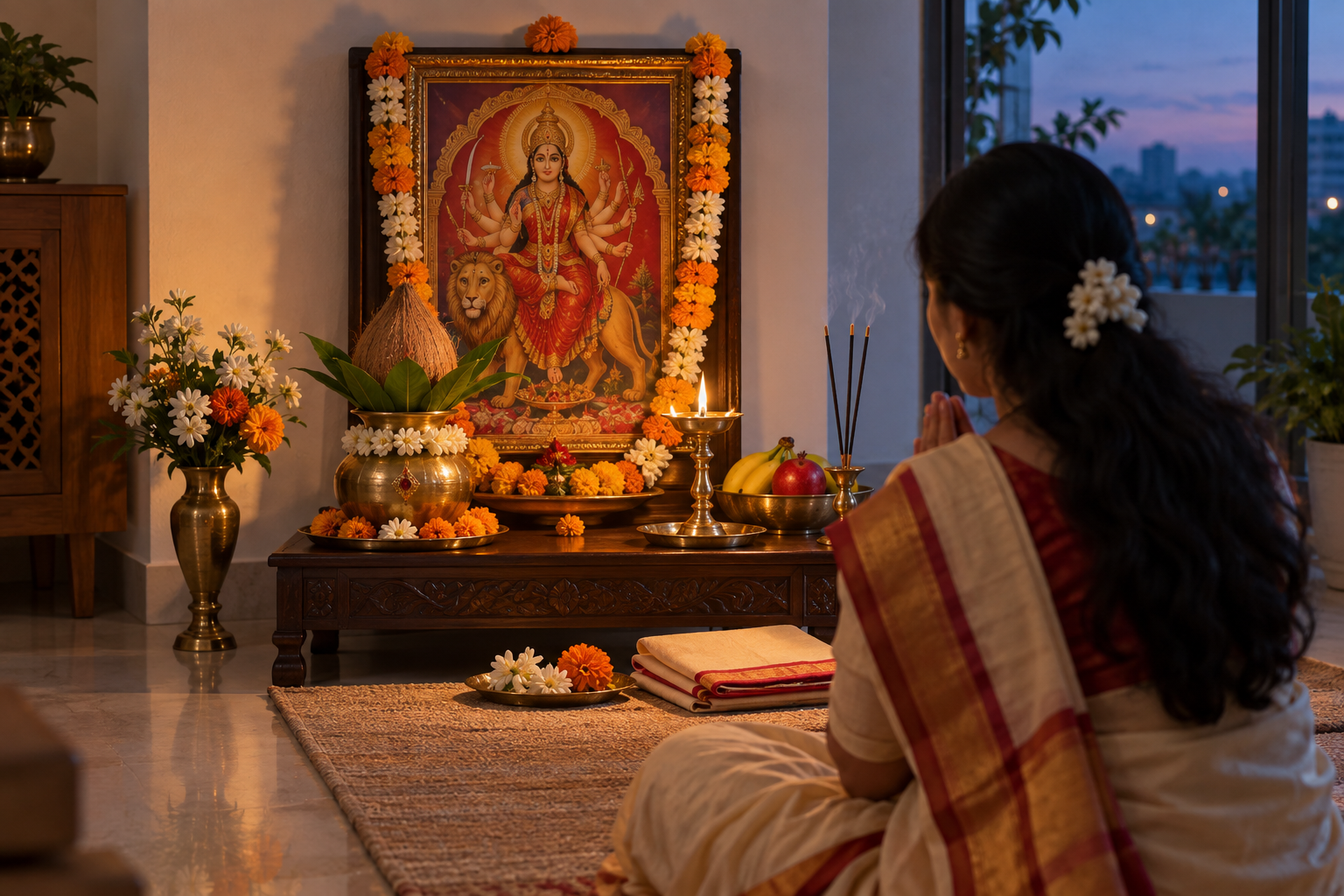
You want to observe Navaratri at home, but every relative, temple, and festival calendar seems to prescribe something different. One household establishes a kalasha, another emphasizes recitation, and a community Durga Puja follows formal rites that cannot simply be copied into a living room.
You do not need to collect every custom. You need a coherent observance: one calendar, one guiding tradition, a daily discipline you can sustain, and clear plans for any special ritual you undertake.
Choose the tradition before choosing the rituals
Navaratri is a shared festival of Devi, not a single uniform ceremony. Family customs, regional traditions, sampradayas, temple practices, and public Durga Puja observances can differ without cancelling one another. The first question is therefore not, “Which online checklist contains the most rituals?” It is, “Which living tradition is guiding this observance?”
- Identify your primary authority. Begin with your inherited household practice. If that is unavailable, ask the temple or priest whose calendar and worship you ordinarily follow.
- Confirm the calendar. Use a panchanga appropriate to your location or the schedule published by your chosen temple. A lunar tithi and a civil date are not the same kind of marker, so do not combine dates from unrelated calendars.
- Separate daily worship from special rites. A lamp, prayer, recitation, and offering can form your daily practice. Kalasha Sthapana, Amantran, Suvasini Puja, and other formal observances may require additional preparation or guidance.
- Decide where each practice belongs. You may worship daily at home while joining a temple or community for rituals that your household does not traditionally perform.
If you do not have an inherited procedure, adopt a modest plan instead of assembling fragments from several lineages. Choose one form or image of Devi, one regular time of worship, one familiar prayer or recitation, and one trusted person to consult when a formal question arises.
Build a daily rhythm that can survive all nine nights
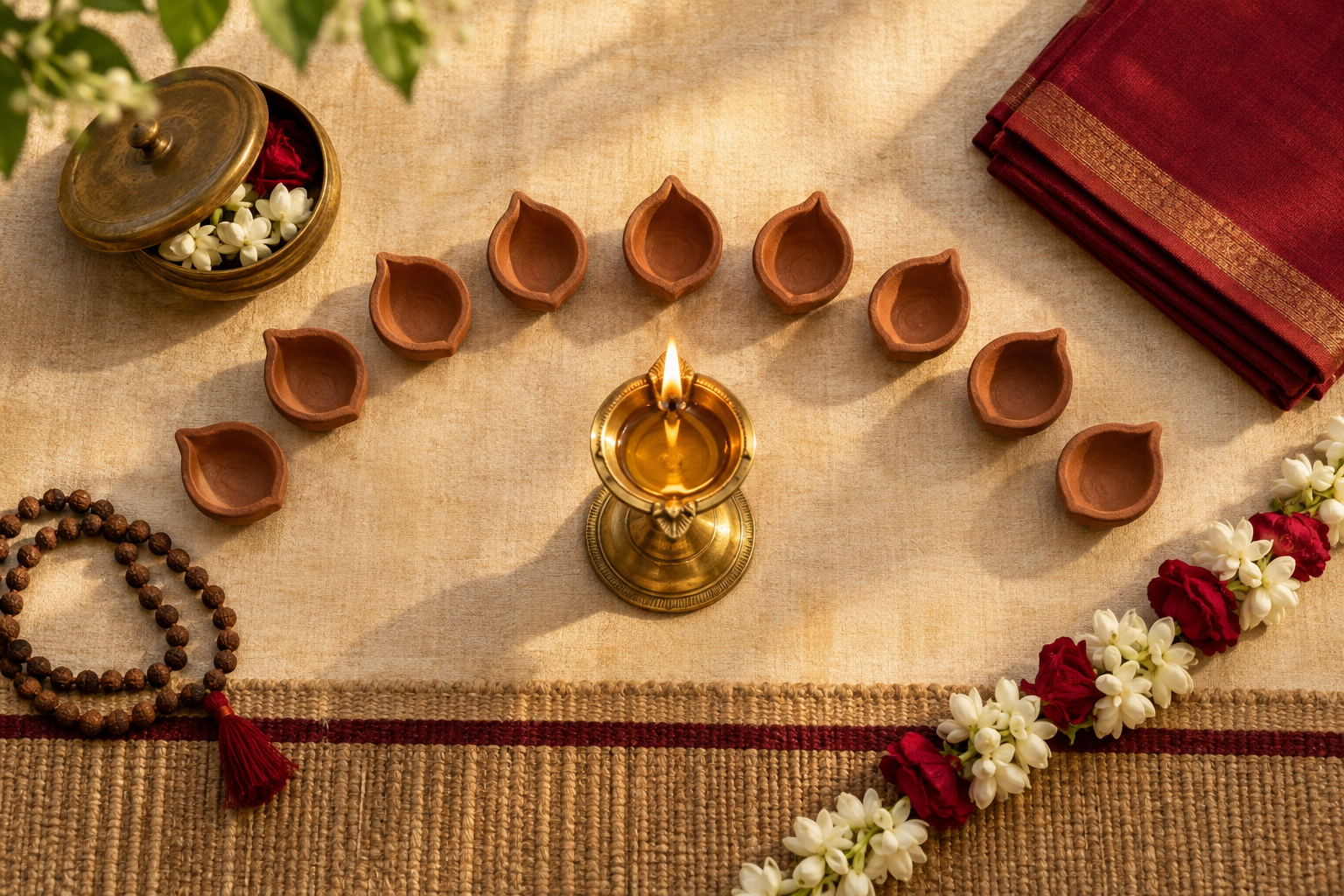
A useful home observance is repeatable. If your plan works only on a quiet holiday, it will probably collapse on an ordinary workday. Fix the minimum practice before adding optional elements.
- Prepare one clean worship space. Use a stable altar with the image or murti honored in your tradition. Keep unrelated household objects away from it.
- Choose a dependable time. Morning or evening can work; consistency matters more than selecting an impressive schedule that you cannot maintain.
- State your sankalpa plainly. Name the purpose of the observance: worship of Devi, cultivation of discipline, protection of dharma, or the welfare of family and community. Use the wording taught in your tradition if you have it.
- Make simple, appropriate offerings. Water, flowers, food, a lamp, or incense may be used according to household custom. Prepare only what you can offer and handle respectfully.
- Recite what you genuinely know. Continue a mantra you have received or a familiar stotra, nama, or prayer. Do not imitate specialized mantras, nyasa, mudras, or fire rites from an isolated checklist when your tradition expects instruction.
- Close deliberately. Offer pranam, perform aarti if that is your practice, distribute prasada appropriately, and leave the altar orderly for the next worship period.
A diya or incense should stand on a stable, non-flammable surface and should never be left unattended. If children or animals share the space, arrange the altar so that reverence does not become a fire or burn hazard.
If fasting forms part of your vrata, decide its form before Navaratri begins. Dietary rules vary, and a demanding fast is not a universal test of devotion. Pregnancy, childhood, older age, illness, and medication can change what is safe; follow appropriate medical advice rather than treating avoidable physical harm as tapas. If you have made a specific religious vow and cannot complete it, ask the person who guided the vow instead of inventing a harsher substitute.
Understand what Amantran and Katyayani add to worship
Amantran makes welcome into a responsibility
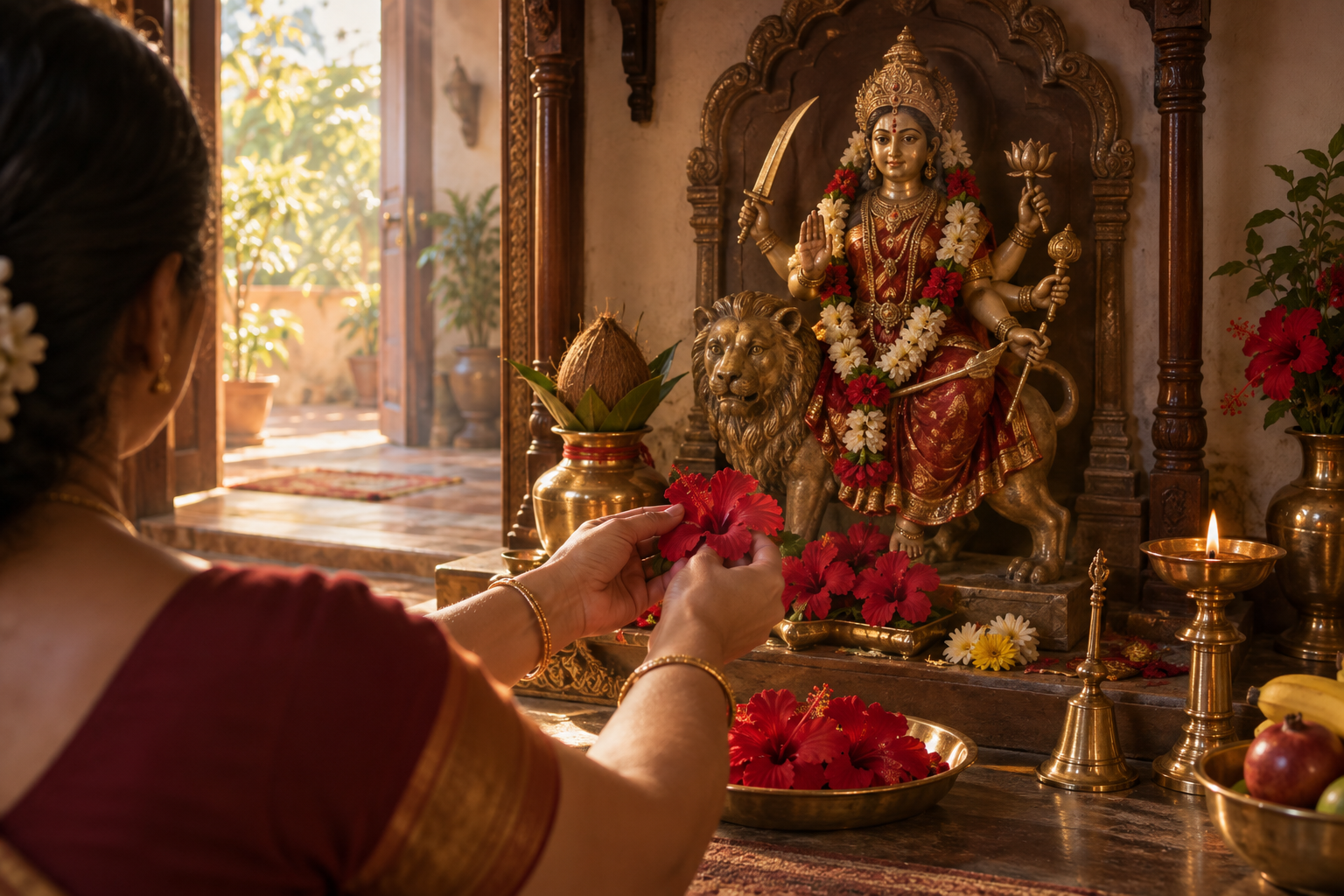
Amantran means invitation or calling. In formal Durga Puja, it is the ritual invitation for Goddess Durga and her divine family to reside in the specially prepared murti or image for the festival. This is more than an ornamental opening. An invitation creates a relationship of presence, worship, and hospitality for the duration of the observance.
Before undertaking Amantran, settle three practical questions: Is the worship space fully prepared? Who will maintain the prescribed daily service? How will the observance be brought to its proper conclusion? A community Durga Puja should follow its officiant and established paddhati. At home, if you have not inherited the formal procedure, you can offer a sincere prayer of welcome without claiming to reproduce the complete rite.
Katyayani reveals unity within Devi’s many forms
Within this tradition, Katyayani is a manifestation of Parvati, and her emergence is narrated in connection with the threat posed by Mahishasura. Her distinct name does not require you to imagine a deity disconnected from the greater reality of Devi. The form brings a particular dimension of Shakti into devotional focus.
When your household worships Katyayani, let the name shape attention rather than merely decorate the day. Ask where courage must be governed by dharma, where complacency has allowed disorder to grow, and what disciplined action is now required from you. The point is not aggression. It is strength directed toward protection, right order, and the defeat of adharma.
If your family or temple assigns Katyayani a particular day, mantra, offering, or recitation, follow that established sequence. If it does not, you need not manufacture a separate ceremony. You can contemplate her significance within your existing worship of Devi.
Plan Suvasini Puja through custom and considerate hospitality
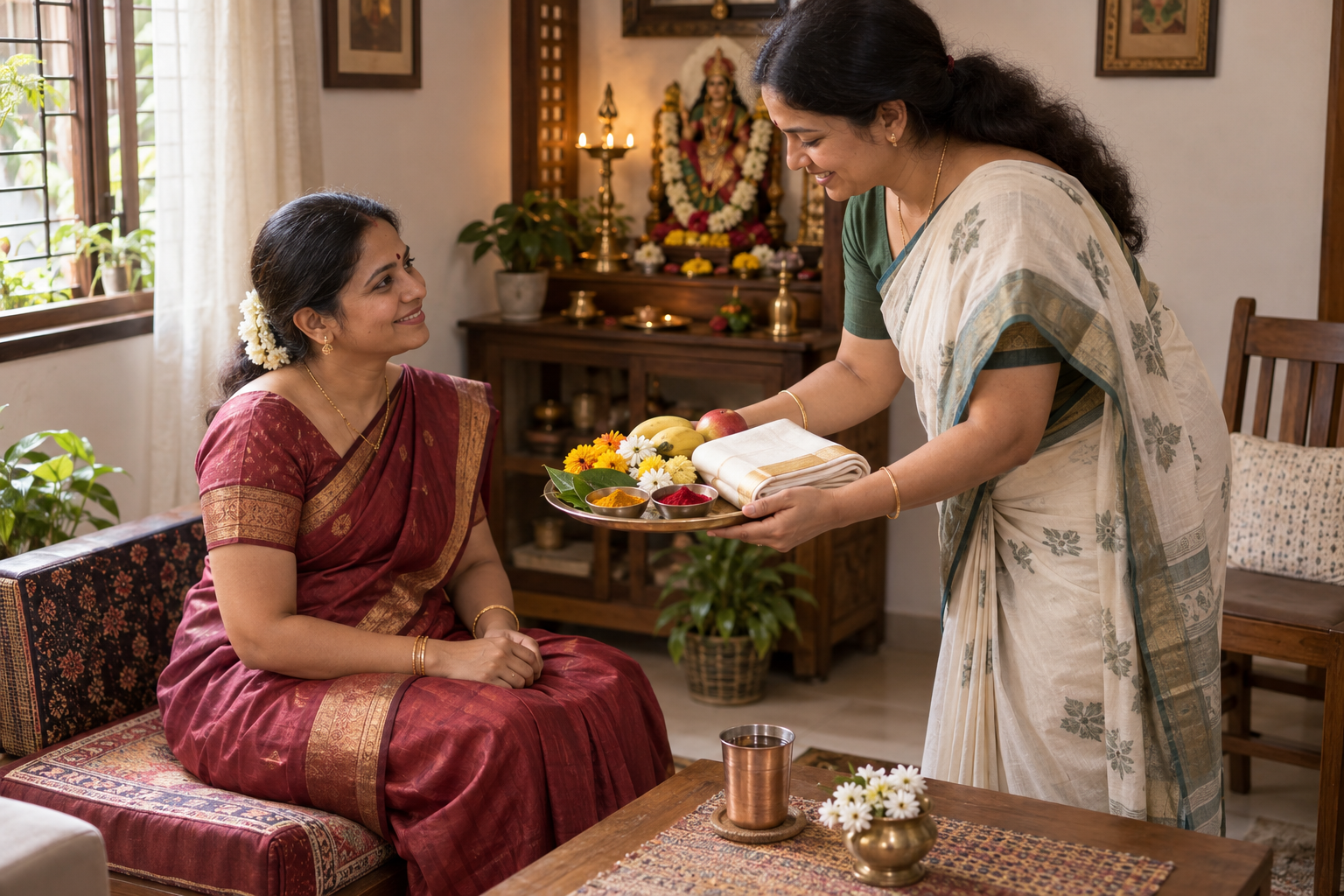
Suhasini Puja, also called Suvasini Puja, is observed during Sharad Navaratri, but it does not have one universally fixed day. Depending on local or household practice, it may accompany Kalasha Sthapana, Durgashtami, or Mahanavami. That variation is a reason to consult your tradition, not a reason to select whichever date happens to be convenient and present it as universal.
If Suvasini Puja belongs to your household observance, prepare it as both worship and hospitality:
- Confirm the day and ritual sequence with the elder, priest, or temple that preserves the custom.
- Invite participants personally and explain the timing and nature of the observance, rather than assuming their participation.
- Prepare the seating, offerings, food, and dakshina specified by your custom before anyone arrives.
- Ask about dietary restrictions, mobility needs, and practical comfort. A person being honored should not be made uncomfortable for the convenience of the ritual.
- Keep customary ritual eligibility distinct from judgments about human dignity. A defined ritual role is not a licence to rank or shame women whose lives fall outside that role.
If your family has no living connection to the practice, learn through a temple or knowledgeable practitioner before hosting it yourself. The respectful first step may be participation and observation, not immediate reconstruction.
Key takeaways for a coherent Navaratri
- Let one family, temple, or sampradaya tradition govern your calendar and ritual sequence.
- Keep a small daily discipline that you can repeat; add special observances only when you can prepare and complete them properly.
- Treat Amantran as a commitment to receive and serve Devi, not as a ceremonial flourish.
- Approach Katyayani as a form of Parvati whose strength directs you toward courageous, dharmic action.
- Schedule Suvasini Puja according to living custom, since its Navaratri day varies among traditions.
- Use fasting, lamps, mantras, and formal rites within the limits of safety, health, and competent guidance.
Before Navaratri begins, put your plan on one page: the calendar you will follow, the minimum daily practice, the special rites you will attend or perform, the person you will consult, and the procedure for concluding the observance. Once those decisions are made, you can stop chasing competing lists and give your attention to Devi.
References
- Hindu Pad – Story: Origin of Katyayani Mata
- Hindu Pad – Suhasini Puja | Suvasini Pooja during Sharad Navaratri
- Hindu Pad – Amantran | Inviting Ma Durga for Durga Puja

Leave a Reply
You must be logged in to post a comment.