

If you are planning to observe Guru Dwadashi in 2026, begin with the distinction that gives the day its meaning: this is not simply another general celebration of teachers. For devotees of the Datta tradition, it is closely bound to Shripad Shri Vallabha and the remembrance of his antardhan, or withdrawal from visible presence.
You do not need an elaborate ceremony to honour that connection. You need the correct day, a clear devotional focus, and a practice that turns reverence for the guru into something concrete.
When Guru Dwadashi falls in 2026

Guru Dwadashi falls on Friday, 6 November 2026. The observance belongs to Krishna Paksha Dwadashi in the month of Ashwin, also called Ashwayuja in some regional calendar usage. Krishna Paksha is the waning half of the lunar month, and Dwadashi is its twelfth tithi.
This lunar description matters more than the civil date alone. A tithi is determined through the relationship of the Sun and Moon, so its beginning and end do not have to coincide with midnight. Temple programmes may therefore be scheduled according to the tithi at a locally significant time rather than simply running for the whole calendar day.
Use 6 November as your planning date, but check the panchanga used by your temple, family or sampradaya before deciding the exact time for a vrata or formal puja. This is especially useful if you live outside Bharat, where local tithi timings may differ from timings printed for an Indian city.
Guru Dwadashi should also not be confused with Guru Purnima. Purnima is the full-moon tithi; Dwadashi is the twelfth tithi of a fortnight. The shared word “guru” does not make the two observances interchangeable.
Why Shripad Shri Vallabha is central to the day

Shripad Shri Vallabha is revered as an incarnation of Lord Dattatreya. His Antardhan Din is observed on Ashwin Krishna Dwadashi, which is why Guru Dwadashi carries a particular significance for his devotees.
In devotional language, antardhan is better understood as disappearance or withdrawal from visible presence than as a merely biographical anniversary. That distinction changes how you approach the day. The emphasis is not only on looking backward at the end of an embodied life. It is on recognising that the guru’s guidance is not exhausted by physical visibility.
The observance therefore holds three devotional relationships together. You honour Dattatreya as the divine source, Shripad Shri Vallabha as the revered incarnation, and the guru principle as guidance that must be received, remembered and lived. If one of these is missing, the day can become either an abstract theological occasion or a routine ritual without personal application.
This also explains why remembrance and conduct belong together. Remembering the guru is not complete if it ends when the lamp is extinguished. A teaching you obey, a harmful habit you restrain, or a neglected duty you resume can be a more serious offering than adding ceremonial complexity you do not understand.
A simple way to observe Guru Dwadashi at home
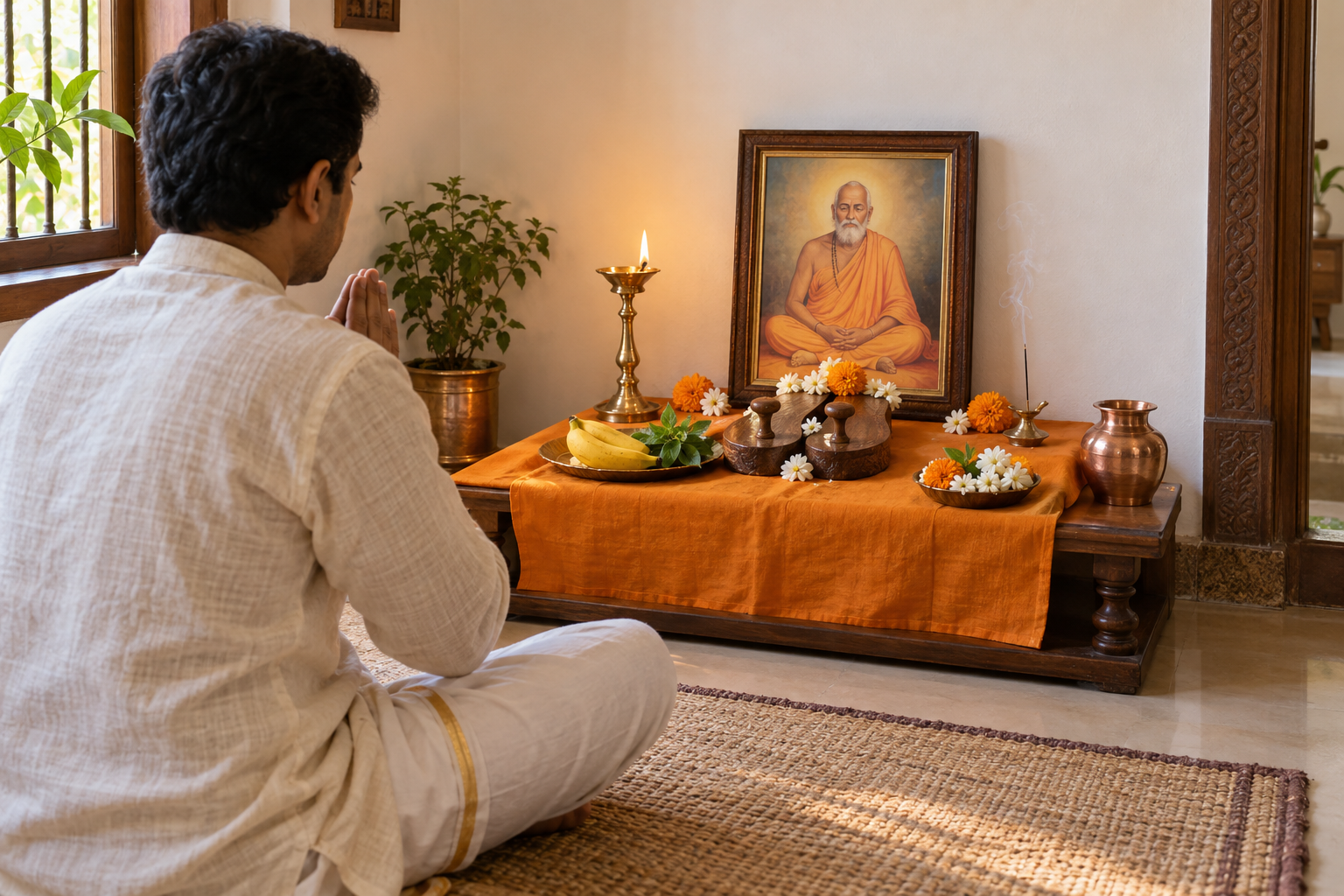
Practices differ among families, temples and Datta lineages. If you have received a specific method from your guru or household tradition, follow that method. If you have not, the following sequence gives you a modest home observance without pretending that one universal ritual is compulsory.
- Confirm the local observance time. Check your temple announcement or local panchanga before 6 November. If they differ, use the authority you ordinarily follow rather than combining several calendars and choosing whichever time is most convenient.
- Prepare one clean devotional place. Place the image or symbol of Dattatreya or Shripad Shri Vallabha that your household normally uses. A lamp, water and flowers may be offered where these are part of your practice. Simplicity is not a defect.
- State the purpose of the worship. Before recitation, quietly remember that the day marks Shripad Shri Vallabha’s antardhan and is being observed in gratitude for guru-kripa and guidance. This keeps the ritual anchored to the occasion.
- Use a prayer you actually know. Recite the Datta prayer, stotra, nama or mantra received in your tradition. If you have not received a formal mantra, do not imitate an initiation from an online fragment. A sincere repetition of the familiar invocation “Shri Gurudev Datta” keeps the practice clear and accessible.
- Read a short account from your own tradition. Choose a trusted passage concerning Shripad Shri Vallabha or Dattatreya. Read slowly enough to identify one instruction or quality that applies to your present conduct.
- Make one act of guru-seva measurable. Decide what you will do after the puja: complete a neglected duty, serve someone without seeking recognition, support a dharmic institution, study a teaching regularly, or correct conduct that contradicts what you profess.
- Close with gratitude. Offer namaskara, conclude according to household custom, and share any offered food as prasada. Write down the commitment you made so that it survives the emotion of the observance.
If your family keeps a vrata or follows dietary rules on this day, preserve those received instructions. The name of the festival by itself does not establish one compulsory fast for every devotee. Do not turn another household’s custom into a test of your own devotion.
Keep the observance centred on the guru relationship
The easiest mistake is to spend more effort arranging the puja than preparing the mind. Before beginning, identify the teaching you most need to hear but are most inclined to avoid. That may concern anger, speech, discipline, service, study or responsibility. Carrying that question into prayer gives the observance moral weight.
A second mistake is treating antardhan only as an occasion for sorrow. Reverence may naturally include longing, but the devotional point is continuing presence through remembrance, teaching and practice. Let the day strengthen fidelity rather than leave you with sentiment alone.
A third mistake is measuring the day through quantity: more recitations, more offerings or a longer ceremony. These can be valuable when rooted in an established practice. They become distractions when counting replaces attention. If time is limited, choose one prayer, one passage and one act of service, then perform all three carefully.
If you are visiting a Datta temple, ask in advance whether the programme is organised as a collective puja, recitation, bhajan or another lineage-specific observance. Arrive prepared to follow the temple’s discipline. Home improvisations should not be imposed on a shared sacred space.
Key takeaways
- Guru Dwadashi falls on 6 November in 2026.
- Its calendrical basis is Ashwin or Ashwayuja Krishna Paksha Dwadashi, the twelfth tithi of the waning fortnight.
- The day is observed as the Antardhan Din of Shripad Shri Vallabha, revered as an incarnation of Lord Dattatreya.
- Check local tithi timing and your temple’s programme rather than assuming the observance begins at midnight.
- If you have no inherited ritual, use a simple sequence of prayer, trusted reading, reflection and a definite act of guru-seva.
- Do not confuse Guru Dwadashi with Guru Purnima or present one family’s vrata as a universal requirement.
Before 6 November arrives, choose the prayer or reading you will use and decide which teaching you will put into practice. Then Guru Dwadashi will be more than a date you remembered: it will become a day on which remembrance changed how you lived.
References

Leave a Reply
You must be logged in to post a comment.