
You may have encountered the name Vedanti Chikkalinganna and found little more than a reverential mention. The practical questions remain: Who was he, what did he actually do, and why should a student of Dharma remember him?
Chikkalinganna matters because he shows how Vedanta becomes a lived public tradition. He did not depend on celebrity, institutional office or a claim to have invented a new philosophy. He learned through a Guru, worked carefully with established texts, taught in Kannada week after week, and made philosophical inquiry accessible without treating tradition casually. Once you see the shape of that work, his apparent obscurity becomes a lesson in how much of Bharata’s intellectual life has been sustained by local teachers whose influence was carried in people rather than publicity.
The shortest reliable answer: teacher, translator and practitioner
Chikkalinganna was born in 1864 in the old Agrahara of Krishnaraja Mohalla in Mysore. His father, Kapinipatayya, belonged to the Gangadikara Okkaliga community. Chikkalinganna was adopted by his father’s elder brother, Daroga Linganna, who was also known as Bank Linganna.
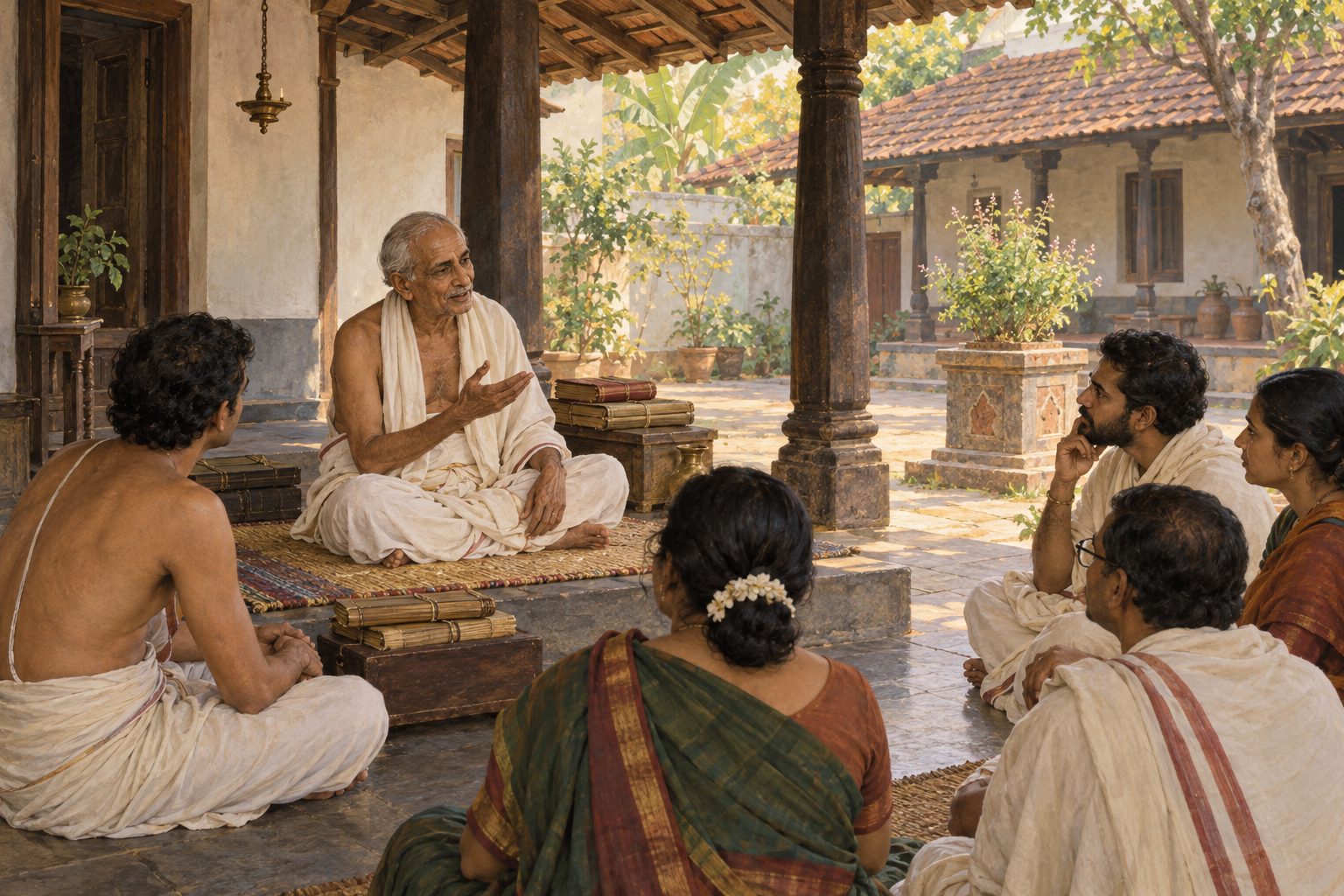
He received a solid Kannada education and some training in Sanskrit. His early strength was not merely memorising sacred narratives. He could recite the Ramayana, Bharata and Bhagavata in Kannada while making their meaning clear to an audience. That combination matters: command of a text, command of the listener’s language, and the ability to turn recitation into understanding.
A decisive encounter occurred while he was visiting his father-in-law’s home. A saintly man gave him a copy of the Yogavasistha-Ramayana, awakening an intense desire to understand Vedanta. The book opened the question, but it did not make him a teacher. That required a Guru and disciplined preparation.
In 1906, Sahajananda Bharati Swami came from Bangalore to Mysore to print his Kannada translation of the Pancadasi. Chikkalinganna served him and learned under him. Within about a year and a half, he had become known as Vedanti Linganna. Before returning to Bangalore, Sahajananda Bharati entrusted him, with the assent of those concerned, to continue the Vedantic expositions that the Swami had been conducting.
The sequence is worth noticing. A powerful text aroused the longing to know; Guru-seva converted longing into disciplined learning; the Guru then authorised public teaching. If you want to understand Chikkalinganna’s standing, this is more important than attaching an impressive label to him. His authority was presented as received, tested and exercised in service.
His lasting institution was a weekly practice of listening
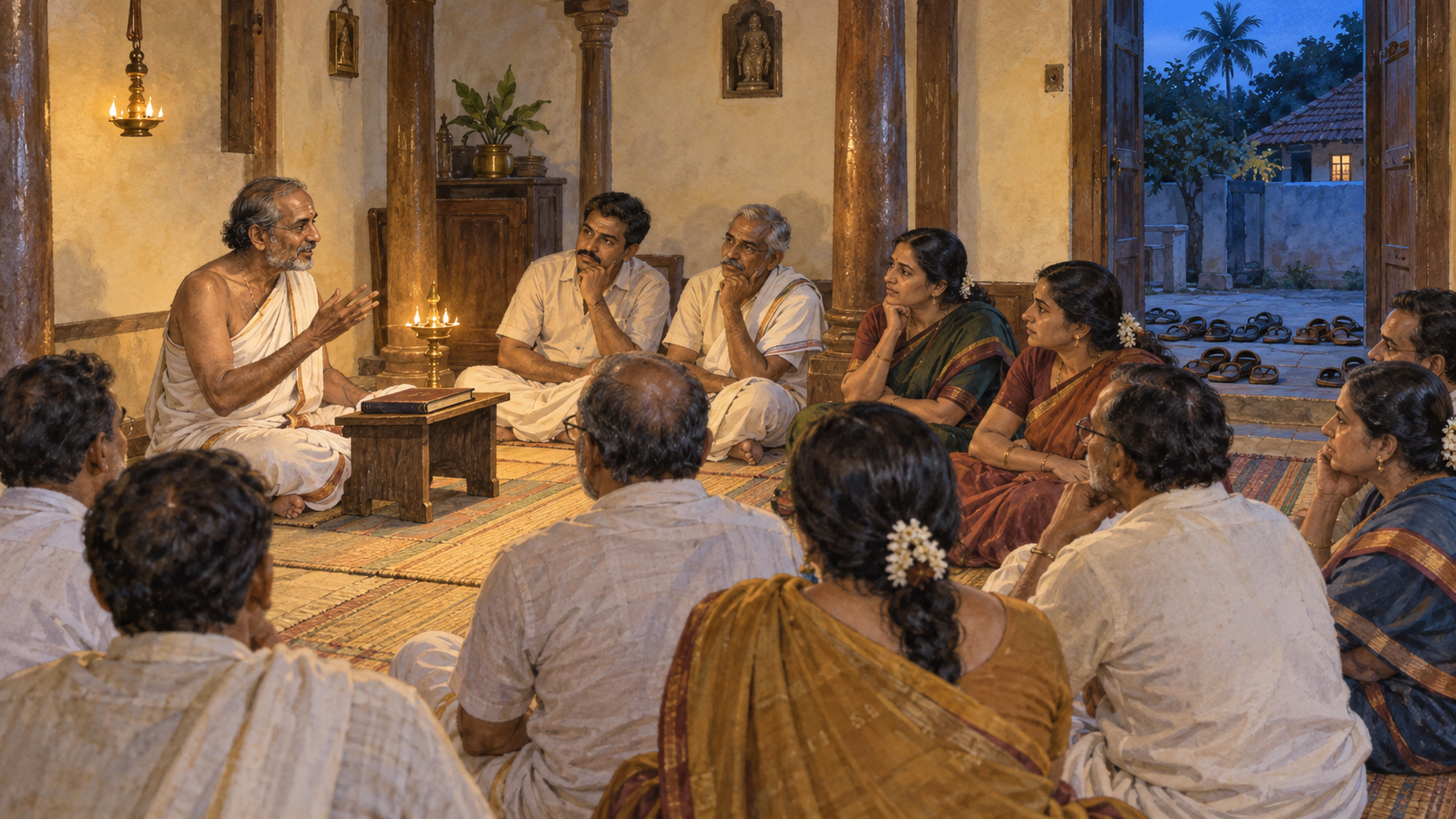
Chikkalinganna’s central achievement was sustained Vedantic sravana: the disciplined hearing and consideration of teaching. He maintained a regular weekly circuit across Mysore, speaking at Kamalamma’s Matha in Santhepete, Kashappa’s Matha, his own house in Sunnakere, Govindappa’s house in Mandi Mohalla and a house on Benki Nawab Street.
On special occasions, the scale expanded. He addressed audiences numbering in the thousands at Mysore Town Hall, Jaggulal Chhatra, the Okkaliga Hostel and other venues. He also organised Vedantic listening and related gatherings at Sahajananda Matha in Bangalore after his Guru’s passing.
That geography reveals the method. Teaching took place in homes and local mathas, where a recurring group could develop continuity. Larger halls allowed the same tradition to reach a wider public. Kannada made the meaning available to people who could not be expected to follow a technical Sanskrit exposition unaided. Regularity did the work that an occasional inspiring lecture cannot do: listeners could return, question, absorb and connect one week’s teaching with the next.
If you are judging his historical importance, do not ask only whether he left behind an original philosophical treatise. Ask how long he taught, which texts he transmitted, whether listeners returned, whether other learned people trusted him, and whether he could explain difficult material without severing it from its tradition. For an oral teacher, those are not secondary measures. They are much of the achievement.
Keep his distinct roles straight when reading his bibliography
Chikkalinganna’s relationship to books is easily blurred because he served as expositor, translator, reviser and publisher at different times. These are all substantial forms of intellectual labour, but they are not interchangeable. The following map keeps the attributions precise.
| Text | Chikkalinganna’s role | What the role tells you |
|---|---|---|
| Yogavasistha-Ramayana | He received and read a copy that intensified his desire to know Vedanta. | This text marks an awakening in his life, not a work he authored or translated. |
| Pancadasi | His Guru came to Mysore to print a Kannada translation; Chikkalinganna later expounded the text repeatedly. | It connects his Guru-seva with his subsequent public teaching. |
| Vrttiprabhakara | He revised and printed the translation composed by his Guru, then taught it week after week. | His contribution included textual stewardship as well as oral exposition. |
| Vicarasagara | He gave sustained weekly expositions to large audiences. | Here his documented role is that of a teacher, not the author. |
| Tattvanusandhana by Chidvanananda | He translated the Hindi work into Kannada. | This is direct evidence of his service to Kannada Vedantic literature. |
| Ramayana, Bharata and Bhagavata in Kannada | He recited and explained them so that their meaning reached his listeners. | His range joined Puranic and epic exposition to more technical Vedantic instruction. |
This distinction protects his memory from two opposite errors. Calling him merely a popular speaker understates his work with texts. Calling him the author of works that he actually translated, revised, printed or expounded overstates one role while concealing his real contribution.
When you catalogue a text, write a commemorative note or share his name online, preserve the verbs: authored, translated, revised, printed and expounded. Exact attribution is part of dharmic intellectual discipline. It honours the original writer, the Guru, the translator and the teacher at the same time.
Caste, tradition and the mistake of forcing modern labels
Chikkalinganna’s social position deserves attention because it helps explain the breadth of his reception. He came from the Gangadikara Okkaliga community, while his Vedantic gatherings were attended with devotion by both Brahmins and non-Brahmins. Scholars, Vedantins, heads of mathas and followers of different sects reportedly placed unusual trust in him. There was even an attempt to install him as the head of Chunchanagiri Matha.
It would nevertheless be inaccurate to recast him as a modern campaigner against every inherited social form. He upheld the traditional conduct associated with varnasrama-dharma and placed strong emphasis on reverence for Gurus and elders. His openness in teaching did not arise from contempt for tradition.
Both facts belong in an honest portrait. His teaching crossed community lines, and his personal conduct remained consciously traditional. Removing either fact turns a historical teacher into a convenient mascot for a present-day argument.
The more useful lesson lies in the character attributed to his inquiry. He was fearless when examining the meaning of truth, yet humility was treated as the proper ornament of knowledge. That combination offers you a practical test for spiritual learning: serious questions need not produce contempt, and fidelity to a Guru need not require intellectual timidity. A person may examine a proposition rigorously while refusing to turn disagreement into personal hostility.
How to keep Chikkalinganna’s legacy accurate and alive
Begin by recognising his recorded names. He appears as Vedanti Chikkalinganna, Vedanti Linganna and, among disciples, Rajayogi Chikkalinganna Swami. A search under only one form can miss catalogue entries, memorial references or oral histories connected with another.
His historic teaching places also provide leads for local inquiry: Santhepete, Sunnakere, Mandi Mohalla, Benki Nawab Street, Mysore Town Hall, Jaggulal Chhatra and the Okkaliga Hostel. Treat these as historical coordinates, not proof that the same buildings, names or institutions survive unchanged. Any claim about their present status needs present-day local verification.
Hirode Mallappa built a Vicara Mandira, or Temple of Inquiry, in Chikkalinganna’s memory. His disciples also marked the anniversary of his passing with padukabhisheka, lectures, Anna-Daana and worship. These details identify promising lines of investigation, but they should not be converted into a claim that every observance continues today without checking locally.
Key takeaways
- Search all three recorded names: Vedanti Chikkalinganna, Vedanti Linganna and Rajayogi Chikkalinganna Swami.
- Attribute each contribution precisely. He translated Tattvanusandhana, revised and printed his Guru’s Vrttiprabhakara translation, and expounded works including Pancadasi and Vicarasagara.
- Measure his importance through sustained teaching, vernacular clarity, textual care and the trust he earned across communities, not through fame alone.
- Keep his social openness and traditional observance together; neither should be erased to fit a modern political category.
- Verify the present condition of memorials, institutions and anniversary observances before describing them as active.
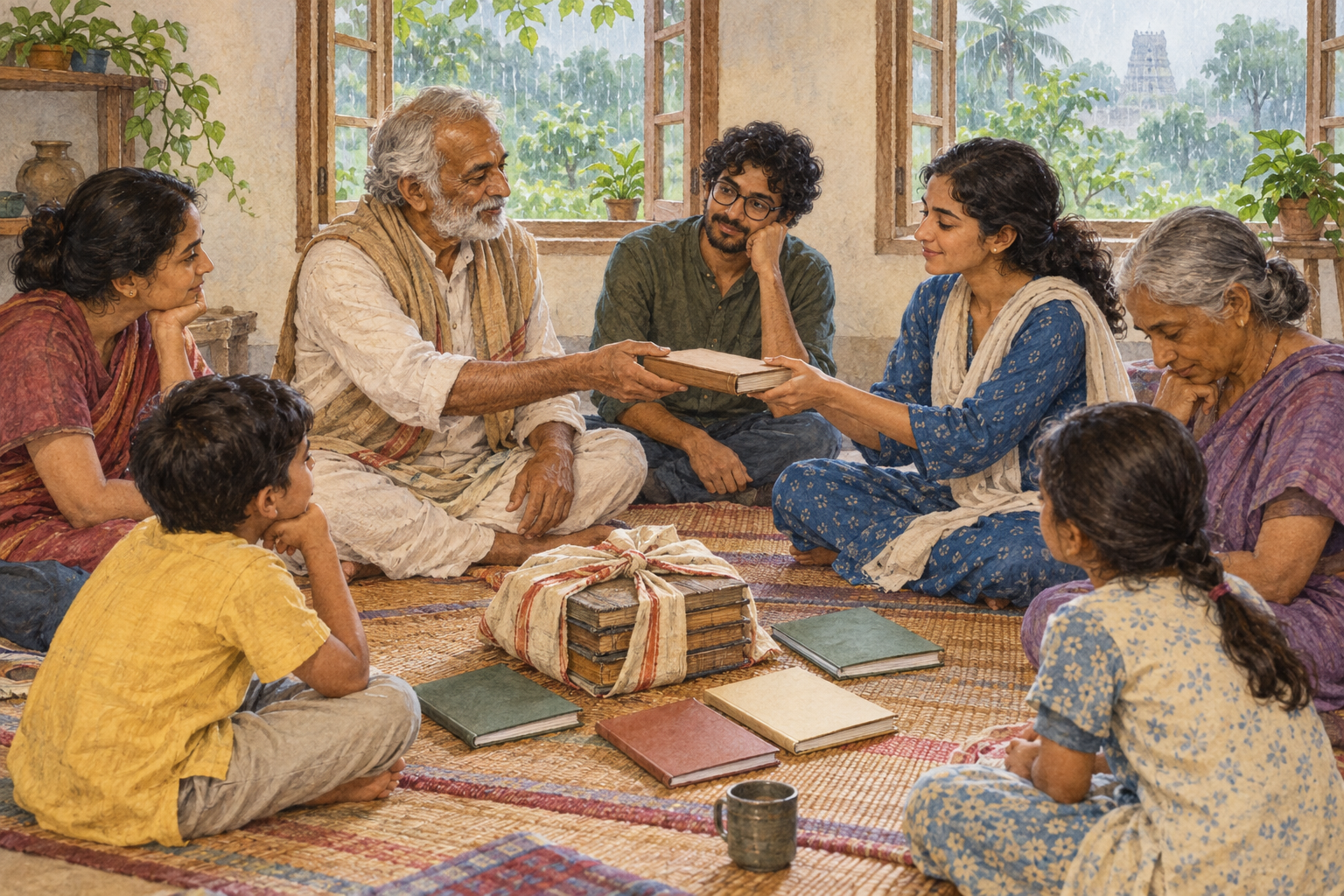
If you want to do more than praise him, recover his method in a modest form. Set a fixed weekly time, read a short passage from a clearly identified edition, state whose translation or commentary you are using, explain it in the language your circle actually understands, and leave room for questions. That discipline of regular listening, exact attribution and humble inquiry is closer to Chikkalinganna’s legacy than adding another honorific to his name.
References

Leave a Reply
You must be logged in to post a comment.