
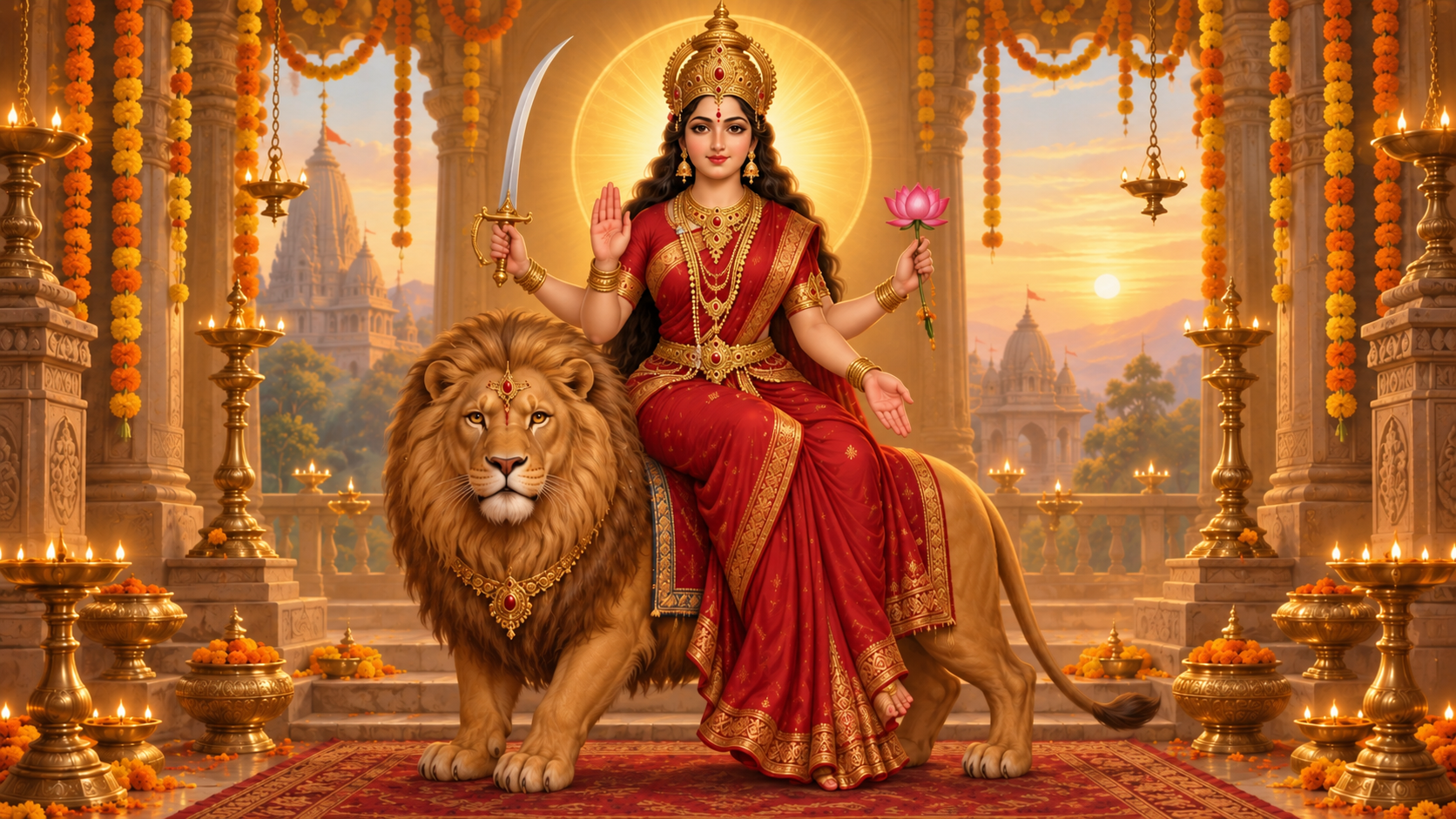
If you have reached the sixth day of Navratri and are unsure whether to worship Katyayani, Saraswati, or the form of Devi followed by your family, begin with a simple rule: continue the tradition in which you started the vrata. In the Navadurga sequence, the sixth day belongs to Maa Katyayani, the sixth Navadurga. Regional celebrations and temple alankarams may honor another manifestation of Devi on the same day.
You do not need an elaborate arrangement to observe Shashti sincerely. You need a clear sankalpa, a respectful offering, and the willingness to carry Katyayani’s courage into one real decision after the puja.
First identify the Shashti you are observing
Navratri occurs in more than one seasonal cycle. In 2026, the sixth day falls on March 24 during Chaitra Navratri and October 16 during Sharad Navratri. The day is also known as Devi Shashti, Durga Shashti, or Maha Shashti.
Those names do not always describe an identical public observance. They locate the day within different devotional and regional frameworks:
- Navadurga worship: The sixth form is Maa Katyayani. This is the pattern most relevant when you are worshipping one Navadurga on each of the nine days.
- Bengal and Assam: Maha Shashti commonly marks the beginning of Durga Puja observances.
- Kanaka Durga Temple in Vijayawada: The sixth-day alankaram for the 2026 Dasara Navaratri is Sri Saraswati Devi.
A temple-specific Saraswati alankaram does not displace Katyayani from the Navadurga sequence. Alankaram calendars express the living tradition of a particular temple; the Navadurga order governs a different mode of worship. If you are visiting a temple, follow its announced form and procedure. If you are performing Navadurga puja at home, worship Katyayani. If your family follows a hereditary paddhati, let that paddhati take precedence over a generic online checklist.
For an exact local puja period, consult the calendar or temple schedule used in your city. The day is clearly identified as Maha Shashti with Katyayani worship in the Navadurga sampradaya, but a timing copied from another location may not match your local observance.
Choose a sankalpa worthy of Katyayani
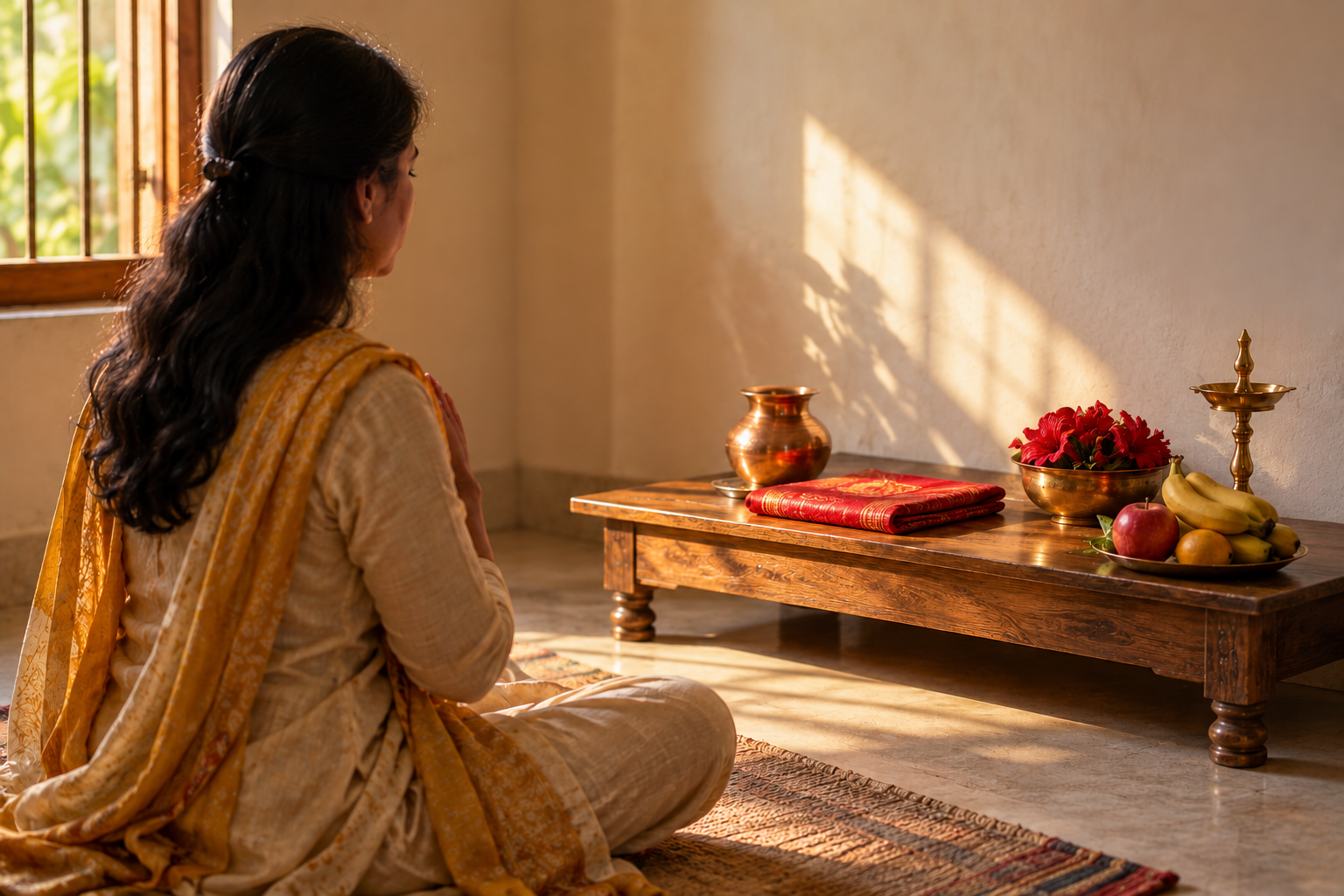
Maa Katyayani embodies the warrior dimension of Durga. She is invoked for strength, courage, and the removal of obstacles, with a special devotional association with marriage and relationships. Her worship should therefore be more precise than a vague request for good fortune.
Before beginning, name the obstacle honestly. Is it fear of making a decision? Family pressure surrounding marriage? Attachment to an unsuitable relationship? Avoidance of a difficult conversation? A sankalpa becomes useful when it identifies what must be transformed in you as well as what you hope will change around you.
- If you need courage, pray for the steadiness to do what dharma requires even when the easier choice is avoidance.
- If you face an external obstruction, ask for a clear path and the discernment to recognise it.
- If you are seeking marriage, ask for a compatible, dharmic partnership and freedom from confusion, haste, or coercion.
- If you are already in a relationship, ask for truthful speech, mutual respect, and the strength to confront what is not healthy or honest.
This framing matters. Katyayani worship is not a technique for controlling another person’s mind, compelling a particular match, or guaranteeing a result. The warrior quality of Devi includes the courage to release an attachment that conflicts with dignity, consent, or dharma.
A simple Katyayani puja you can perform at home
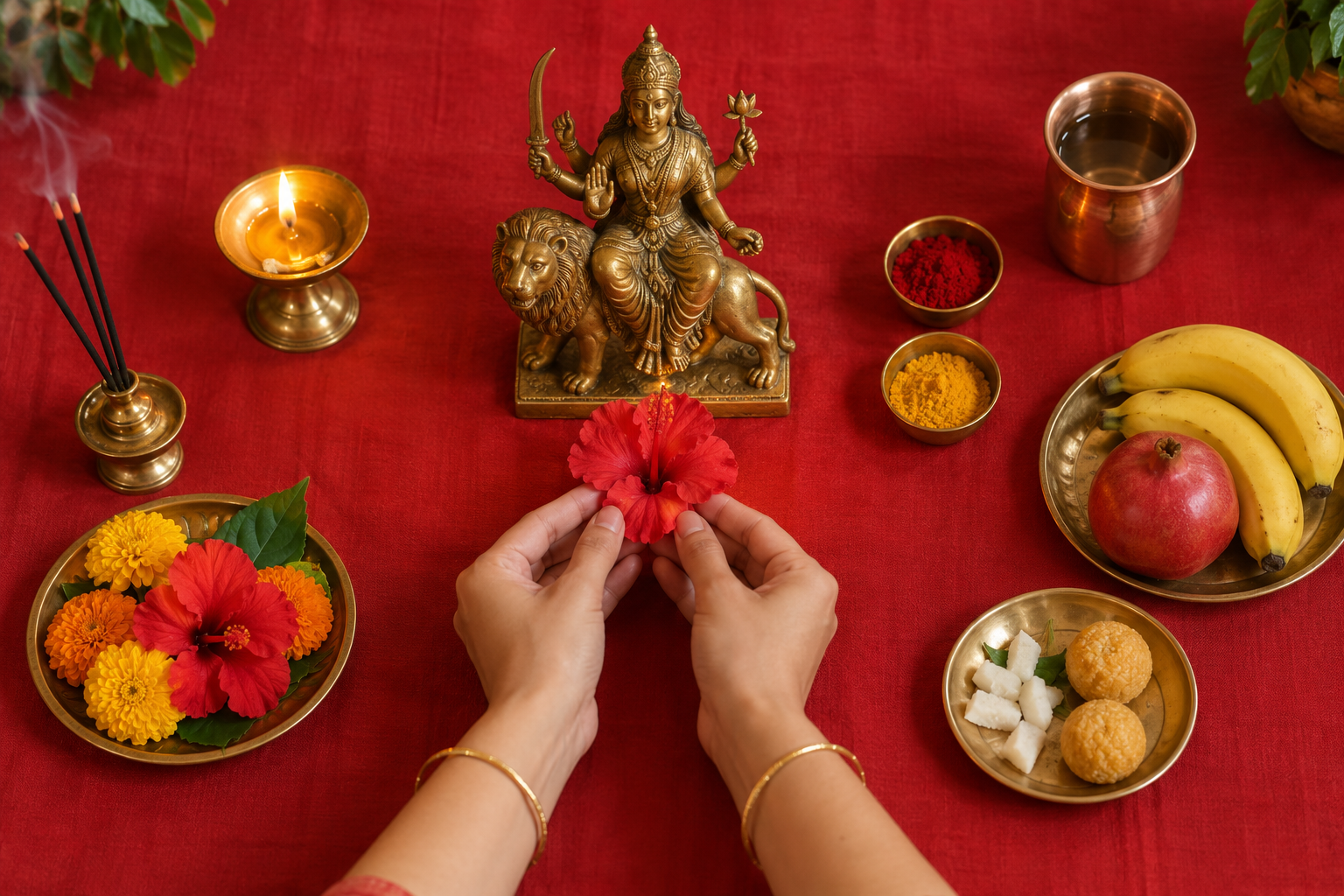
A complete ritual may include the mantras, nyasas, offerings, and concluding rites prescribed by a family’s or temple’s paddhati. If you have received such a method, follow it. If you have not, a shorter home observance can remain reverent without pretending to be a specialist ritual.
Prepare a clean surface with an image or murti of Devi. Customary Katyayani-puja materials include water, rice, turmeric, kumkum, camphor, and a kalash, alongside the ordinary materials used in your household puja. Use what belongs naturally to your practice; devotion is not measured by the length of a shopping list.
- Prepare yourself and the space. Bathe or wash, wear clean clothing, quiet the worship area, and place the items where you will not need to interrupt the puja to find them.
- Become still. Sit before Devi, regulate your breathing, and let the rush of preparation subside. Puja begins with attention, not with hurried movement.
- State your sankalpa. Identify the vrata, the sixth-day worship of Maa Katyayani, and the quality or obstacle on which you are seeking her grace. Keep the request brief enough that you can mean every word.
- Invoke and honor Devi. Offer water and the customary substances used in your home, such as rice, turmeric, and kumkum. Make each offering deliberately rather than moving through the sequence mechanically.
- Recite what you actually know. Katyayani worship may include a moola mantra, dhyana sloka, or stotra. Use the version taught by your family, guru, or temple. If you have not learned a longer text accurately, repeat Maa Katyayani’s name with concentration instead of improvising Sanskrit.
- Sit in silence after the recitation. Bring the obstacle named in your sankalpa before Devi. Ask what fear, attachment, or avoidance is preventing right action on your part.
- Conclude with aarti and pranam. Use the aarti customary in your home, offer gratitude, and bow. If you use a lamp or camphor, keep the flame attended and away from loose cloth, children, pets, and flammable decorations.
The pause after recitation is especially important on Katyayani’s day. Her symbolism is active rather than evasive. The question is not only, “Will this obstacle disappear?” It is also, “What courageous and dharmic action is now mine to take?”
If your prayer concerns marriage or a relationship
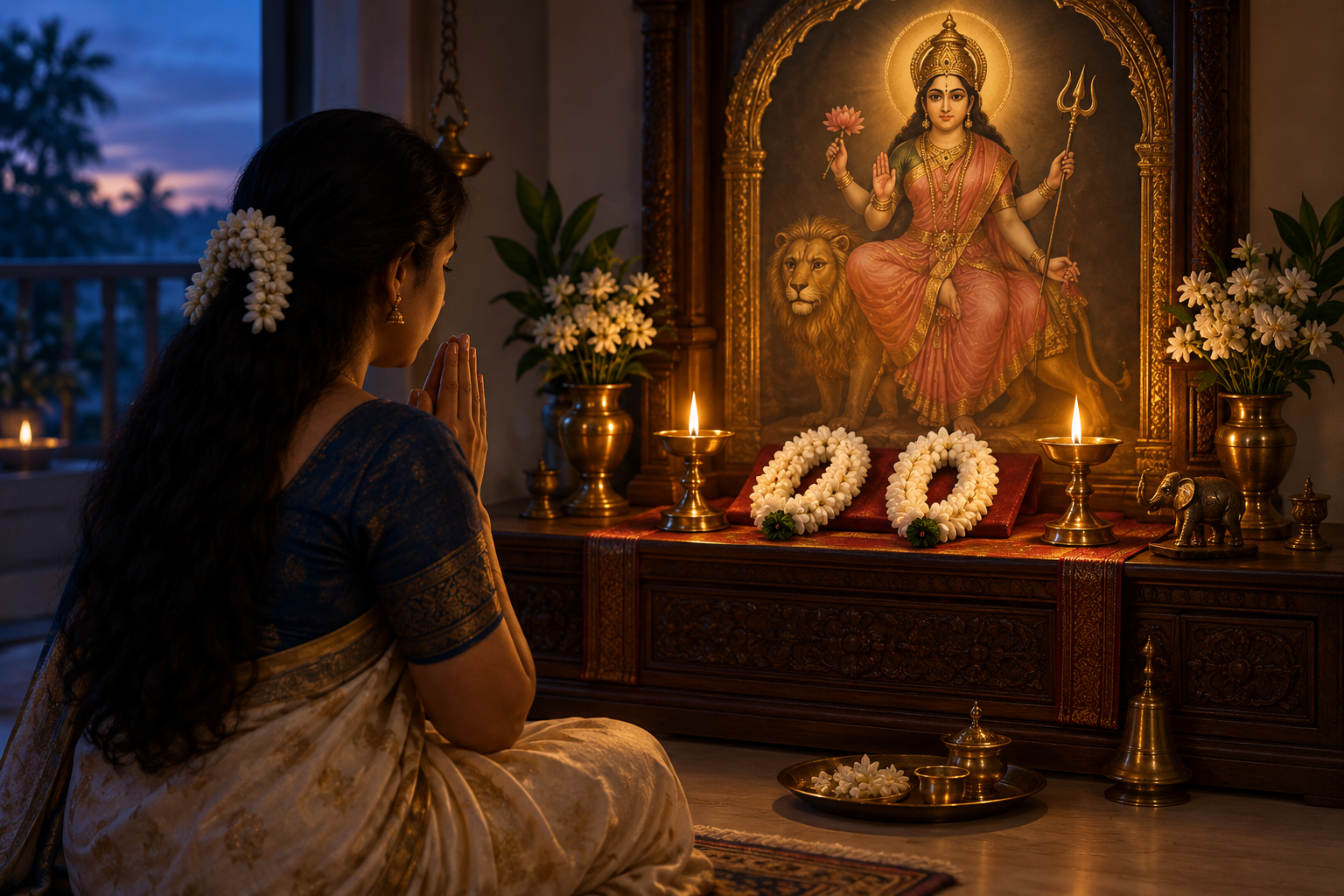
Many devotees approach Katyayani with a marriage-related wish. That is a recognised purpose of sixth-day worship, but the most useful prayer is not simply a demand for marriage as quickly as possible. Speed is not the same as suitability, and social pressure is not the same as dharma.
Pray for qualities that protect the future relationship: discernment before commitment, courage to ask difficult questions, freedom from deception, mutual respect, and the ability to distinguish loneliness from compatibility. If a particular match is being considered, include the willingness to accept clarity even when clarity does not produce the answer you initially wanted.
Then connect the puja to one worldly act. You might clarify a non-negotiable value, speak honestly with your family, decline a proposal that violates your boundaries, seek counsel from a trusted elder, or stop postponing a necessary conversation. The puja gives the action a sacred centre; it does not remove your responsibility to act.
Parents and relatives can use the day for self-examination as well. A prayer for someone’s marriage is not permission to override that person’s consent. Ask Devi to remove fear and ego from the family’s decision-making, not to make another human being surrender to pressure.
Key takeaways for Navratri’s sixth day
- In 2026, Shashti falls on March 24 in Chaitra Navratri and October 16 in Sharad Navratri.
- Follow Maa Katyayani when you are observing the Navadurga sequence; follow the announced alankaram when worshipping at a particular temple.
- Do not treat Katyayani only as a marriage-granting deity. Her central devotional qualities are courage, strength, and the removal of obstacles.
- A simple home puja can include a clean altar, sankalpa, customary offerings, a learned mantra or sincere name-recitation, silent reflection, aarti, and pranam.
- Frame relationship prayers around dharma, compatibility, truth, dignity, and consent rather than control over a desired person.
- Complete the observance by taking one concrete action that expresses the courage for which you prayed.
Before the sixth day ends, write down the obstacle you placed before Katyayani and the next dharmic action available to you. Carry out that action at the first suitable opportunity. That is how Shashti moves from an altar observance into lived sadhana.
References
- Hindu Pad – 6th day Alankaram in Vijayawada Dasara Navaratri 2026 – 16 October | Saraswati Devi Alankarana
- Hindu Pad – Katyayani Mantras – Moola Mantra, Dhyana Sloka, Stotra
- Hindu Pad – 6th day of Navratri 2026, October 16
- Hindu Pad – 10 Important Things to do on 6th day of Navratri Vrat, 16 October 2026
- Hindu Pad – Katyayani Puja Vidhi | Procedure of Maa Katyayani Pooja
- Hindu Pad – 6th day Navratri Puja Timings, 16 October 2026

Leave a Reply
You must be logged in to post a comment.