
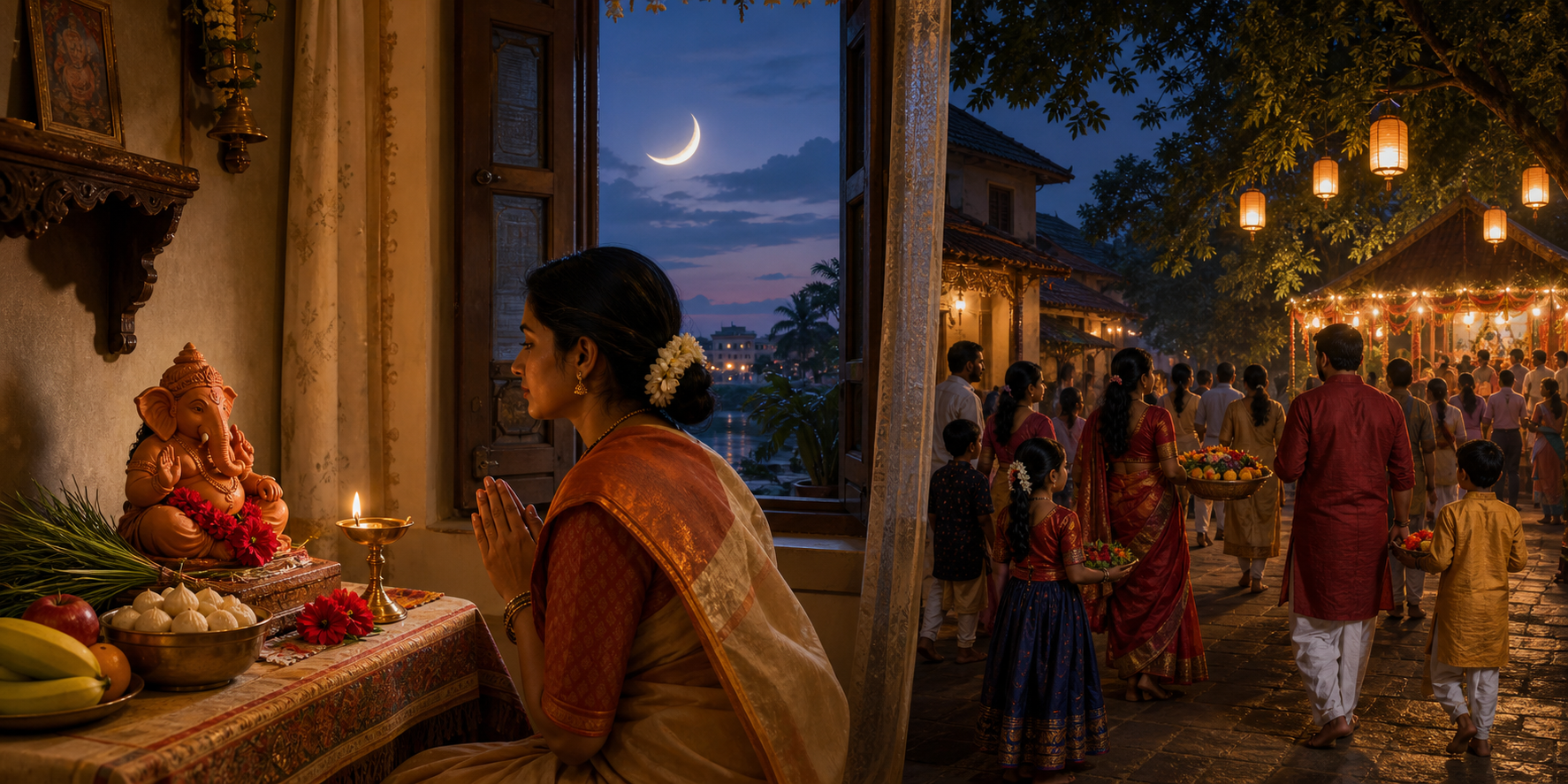
If you want Ganesha worship to become a stable part of life, do not begin by collecting more rituals. Decide what belongs in your ordinary day, what requires a lunar-calendar check, and what deserves the wider scope of a festival.
That distinction prevents two common problems: making daily puja too elaborate to sustain, and treating every Ganesha observance as though it followed the same timing and procedure. A clear rhythm lets you be simple on busy mornings, exact when a vrata depends on moonrise, and expansive when devotion calls you into family reconciliation, charity, or service.
Your Ganesha practice runs on three different clocks
Daily, monthly, and festival observances are not larger and smaller versions of one ceremony. Each has a different job. Daily worship maintains relationship and attention. The monthly Chaturthis create recurring occasions for sankalpa and discipline. A festival allows worship to move beyond the shrine into family, work, culture, and community.
| Cycle | Timing | Primary purpose | What you must verify |
|---|---|---|---|
| Daily | A consistent point in your day | Remembrance, steadiness, and a practical sankalpa | No lunar calculation is needed for a basic personal puja |
| Vinayaka Chaturthi | Shukla Paksha Chaturthi | Clarity, learning, beginnings, and orderly action | When Chaturthi prevails in your location |
| Sankashti Chaturthi | Krishna Paksha Chaturthi after Purnima | Vrata, restraint, prayer amid difficulty, and work on inner obstacles | Local tithi and moonrise, especially when completing a fast |
| Festival cycle | The dates prescribed for that observance | Intensified puja joined to ethical, familial, or community action | The calendar and customs of your family, sampradaya, or temple |
Key takeaways
- Keep daily worship repeatable. Consistency matters more than continually adding items to the altar or lengthening the ritual.
- Use Shukla Paksha Chaturthi for a clear sankalpa and a concrete beginning, but do not assume that every moment of the civil date is automatically a suitable muhurta.
- Treat Sankashti as a time-sensitive vrata. Confirm the tithi and moonrise for your own city before deciding when to perform the evening worship or conclude a fast.
- Let festival worship change conduct as well as atmosphere. Reconciliation, fair dealing, dana, cultural participation, and spiritual study give the celebration practical substance.
Keep daily worship small enough to remain daily
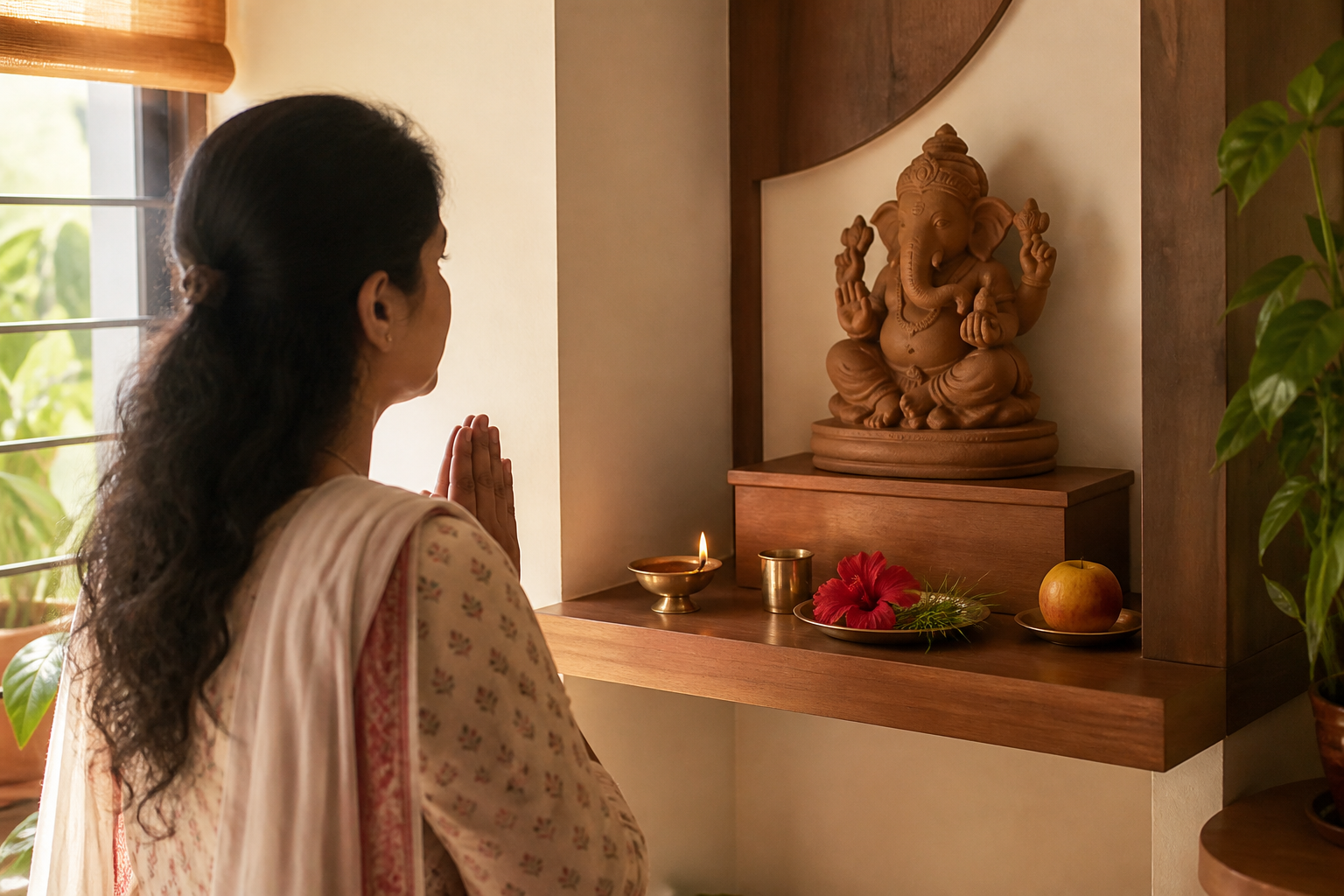
Your daily practice does not need to reproduce a temple ceremony. It needs a recognizable beginning, a devotional center, and a deliberate return to dharma. If the routine becomes impossible whenever you travel, work early, care for children, or lack a particular offering, it is too dependent on ideal conditions.
A compact sequence can retain the logic of puja without becoming burdensome:
- Wash your hands and face, straighten the shrine, and put away whatever is likely to distract you.
- Light a lamp or incense where it is safe to do so. If neither is practical, begin with folded hands and undivided attention.
- Invoke Sri Ganesha before an murti or image, or through a simple mental remembrance when you are away from home.
- Offer what is honestly available: a flower, fruit, durva, or clean water. An unavailable ingredient should not become an excuse to abandon worship.
- Recite Om Gam Ganapataye Namah according to your capacity. Keep the pace calm enough that the mantra does not become background noise.
- Name one obstacle without disguising your own responsibility for it. Pair the prayer with one action: begin the delayed lesson, answer the necessary message, settle the pending obligation, or apologize where pride has blocked you.
- Conclude with pranam, aarti if it is part of your routine, and the respectful sharing of prasada.
The sequence reflects the familiar movement from cleansing and sankalpa through invocation, offering, mantra, aarti, and pranam. A fuller form may include the five offerings of gandha, pushpa, dhupa, dipa, and naivedya, while a brief form can preserve the same devotional direction. Simple, sincere, repeated worship remains accessible across generations precisely because its center is attention rather than display.
Choose one existing event as the cue for your puja: after bathing, before breakfast, before opening your study materials, or when lighting the evening lamp. A cue is more reliable than the vague intention to worship whenever the day becomes quiet. On a constrained day, perform the essential form: pranam, mantra, one offering if available, and one truthful sankalpa. Resume the fuller routine when capacity returns; do not create a backlog of devotional guilt.
Read the two monthly Chaturthis correctly
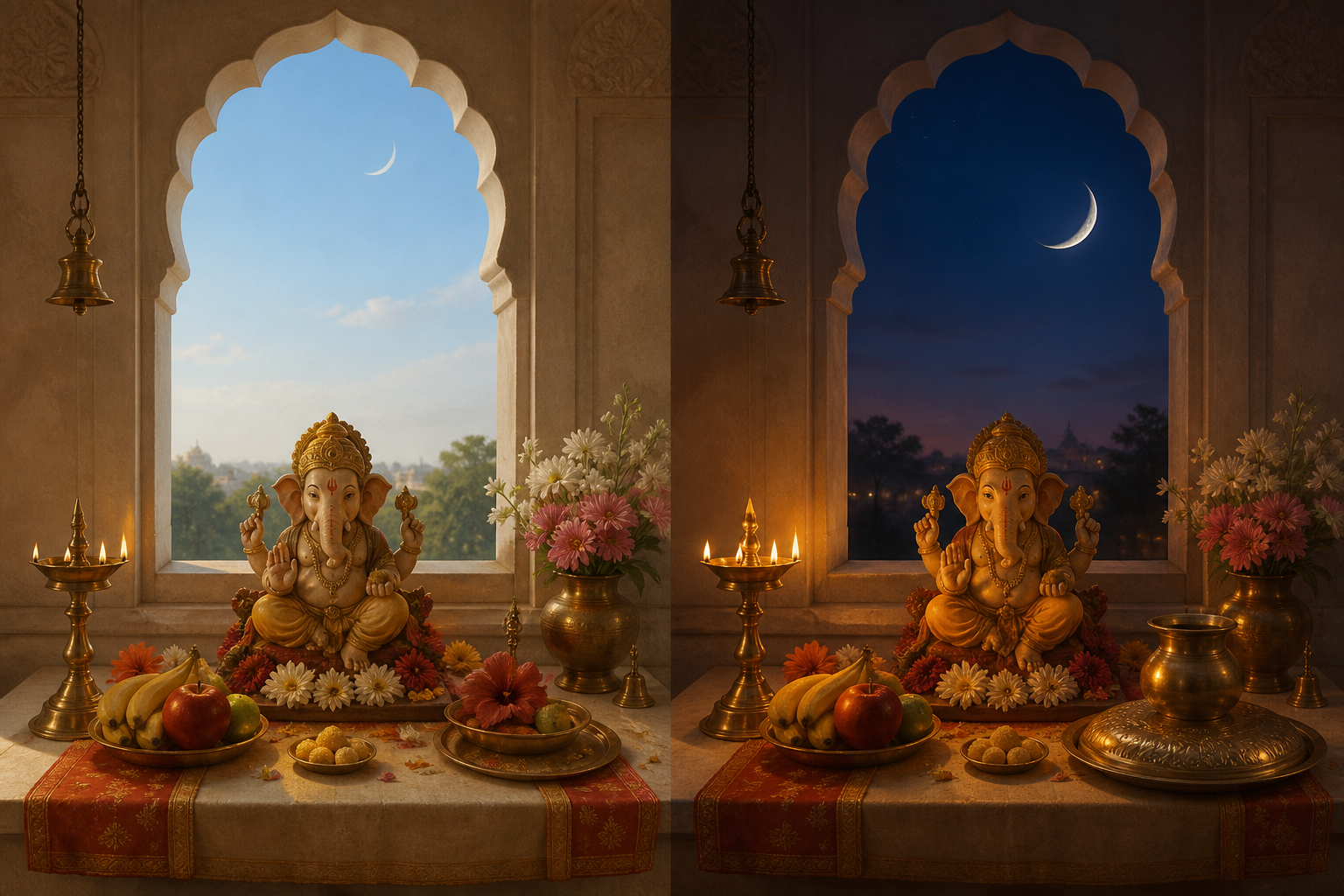
The lunar month gives you two distinct Ganesha observances. Their shared tithi name can cause confusion, especially when a calendar labels both simply as Chaturthi. The practical distinction is paksha: Vinayaka Chaturthi belongs to Shukla Paksha, while Sankashti Chaturthi belongs to Krishna Paksha.
Vinayaka Chaturthi: make the beginning concrete
Monthly Vinayaka Chaturthi falls on Shukla Paksha Chaturthi and carries associations with clarity, learning, obstacle removal, and fresh beginnings. You can use it to begin a course of study, restart neglected sadhana, organize a difficult piece of work, or make a commitment whose first step has been repeatedly postponed.
Do not leave the sankalpa at the level of aspiration. Write down the first visible act. “May my studies proceed without obstruction” becomes “I will prepare the reading space and complete the first assigned section.” “May this household become more harmonious” becomes “I will initiate the conversation I have avoided.” Ganesha worship asks you to seek grace without turning grace into a substitute for effort.
A tithi does not necessarily begin and end at midnight. If Chaturthi gives way to Panchami during the civil day, the observance should follow the period in which Chaturthi actually prevails locally. This is why a calendar date alone is incomplete.
Keep ritual timing and project timing conceptually separate. The presence of Chaturthi does not make every minute suitable for every undertaking. When you need a formal muhurta for a consequential beginning, local practice may also consider Abhijit Muhurat, an auspicious lagna, and the avoidance of Rahu Kalam, Yamaganda, or Gulika. Panchang calculations can differ with location, time zone, daylight-saving rules, and Drik or Vakya methods, so use a reliable city-based Panchang or a temple notice instead of copying a time published for another place.
Sankashti Chaturthi: let discipline address the obstacle
Sankashti, also called Sankatahara Chaturthi in parts of southern Bharat, is observed on every Krishna Paksha Chaturthi. Its recurring structure joins fasting, Ganesha puja, recitation, and the completion of the vrata after Chandra Darshan. Moonrise is therefore not a decorative calendar detail; it determines the closing phase of the observance.
Use this preparation sequence so that the evening does not become a hurried search for timings and offerings:
- Before the observance, verify Krishna Paksha Chaturthi and the moonrise time for your city. Do not transfer Indian timings to a diaspora location or use one city’s moonrise for another.
- Decide how you will undertake the vrata within your tradition and actual capacity. Prepare before the fast begins rather than improvising when tired.
- Arrange the Ganesha image or murti, lamp, flowers, durva, fruit, and naivedya such as modaka if these form part of your household practice.
- Set aside the text you intend to recite. The Sankashti Vrata Katha and Ganesha Atharvashirsha are established parts of the observance described in many homes and communities.
- Perform the evening puja and mantra japa without rushing toward the end of the fast.
- After moonrise, follow your tradition for Chandra Darshan and offering arghya to the moon, then receive prasada and conclude the vrata.
- Record the inner obstacle you are working on and one behavior that feeds it. Restlessness, indecision, and distraction do not disappear merely because they have been named; the monthly cadence lets you work on them repeatedly.
Fasting is a discipline, not a test of how much physical distress you can ignore. If food restriction could be unsafe because of a medical condition, medication, pregnancy, age, or another individual circumstance, seek appropriate clinical advice and ask a trusted family elder or temple how the observance may be adapted. Devotion does not require you to disregard a genuine health risk.
A useful working distinction is this: let Vinayaka Chaturthi organize a beginning, and let Sankashti examine what keeps obstructing right action. The first directs energy toward initiation; the second develops restraint and persistence. This does not replace the liturgical meaning preserved by your sampradaya, but it gives you a practical way to stop the two monthly observances from collapsing into an identical routine.
Let festival worship reach beyond the shrine
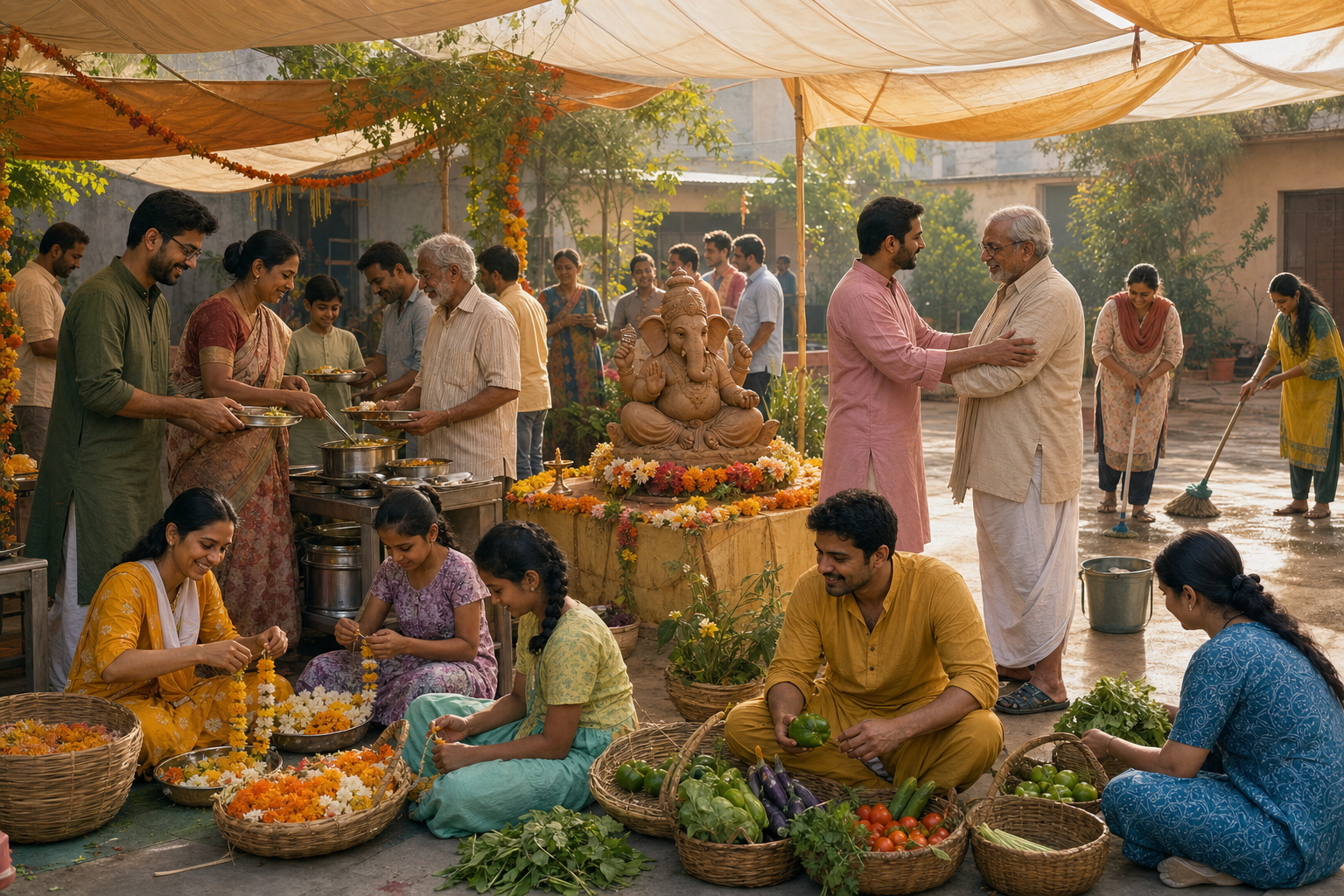
A festival cycle should do more than multiply the length of daily puja. It creates enough space for devotion to reach a wider circle of duties. Pancha Ganapati offers a clear model: the modern five-day observance runs on the fixed dates of December 21 through 25 and honors Panchamukha Ganapati. Each day joins a color and devotional theme to a different sphere of life.
- Golden yellow – family harmony: Perform puja, then make one sincere repair within the household. Listen without preparing a rebuttal, acknowledge an overlooked contribution, or begin a needed reconciliation.
- Royal blue – relatives, neighbors, and friends: Extend goodwill beyond the home. Thank someone whose support has gone unrecognized, revive a worthy relationship, or address a misunderstanding without reopening it merely to prove who was right.
- Ruby red – work and ethical exchange: Examine professional conduct. Settle a due amount, correct an unfair exchange, complete a neglected responsibility, or make your next commitment more honest about time and capacity.
- Emerald green – culture and charity: Support cultural memory through music, literature, sacred learning, or the arts, and turn dana or seva into a definite act rather than a seasonal sentiment.
- Brilliant orange – dharma and renewal: Study a sacred text, state a realistic sankalpa, perform aarti, and open the gifts that have been kept at the shrine through the observance.
The colors are aids to recollection, not a reason to create unnecessary expense. A cloth, flower, paper decoration, or another simple accent can mark the theme. What matters is that the ethical action does not disappear beneath the decoration. A beautifully arranged altar cannot reconcile a relationship, settle a debt, or perform seva on your behalf.
This festival structure also reveals why ahimsa, dana, seva, and maitri matter across the broader dharmic family. Hindus, Buddhists, Jains, and Sikhs preserve distinct theologies and disciplines, yet restraint, generosity, service, and goodwill offer genuine ground for mutual respect. You do not need to blur traditions to recognize a shared civilizational concern with transforming conduct.
Build a calendar your household can actually keep
The strongest calendar is not the one with the greatest number of entries. It is the one that tells you what preparation each entry requires. Put these three layers into your calendar now:
- Daily anchor: Attach a brief Ganesha puja to an event that already occurs every day. Define an essential form for constrained days and a fuller form for ordinary days.
- Monthly verification: Enter provisional reminders for both Shukla and Krishna Paksha Chaturthi, then verify the local tithi before each observance. Add the city-specific moonrise to the Sankashti entry instead of relying on memory.
- Festival preparation: Before Pancha Ganapati or another festival observed by your household, list the offerings, readings, relational actions, dana, and community commitments separately. This keeps ethical work from being crowded out by shopping and decoration.
If several family members participate, divide responsibility by function rather than expecting one person to carry the entire observance. One person can check the Panchang, another can prepare the shrine, a child can select a flower or lead a short mantra, and another family member can arrange prasada or the day’s act of service. Shared participation is more durable when each task is clear.
After each monthly observance, keep a three-line record: the obstacle you named, the action you promised, and whether you completed it. Review the previous entry before making the next sankalpa. That small act protects Ganesha worship from becoming a cycle of repeated requests with no corresponding change in conduct.
Before the next Chaturthi, choose your daily minimum, locate a trustworthy local Panchang, and place both monthly observances on your calendar. Then begin with the practice you can perform faithfully. A living rhythm grows from the next sincere act, not from waiting for a perfectly arranged future.
References
- DharmaRenaissance Blog – December 24, 2025 Panchang: Shukla Chaturthi to Panchami, Auspicious Timings and Guidance
- DharmaRenaissance Blog – Sankashti Chaturthi 2026: Complete Guide to Dates, Rituals, and Devotional Insights
- DharmaRenaissance Blog – Pancha Ganapati (Dec 21-25): Five Days of Ganesha Puja for Harmony, Prosperity, and Peace
