
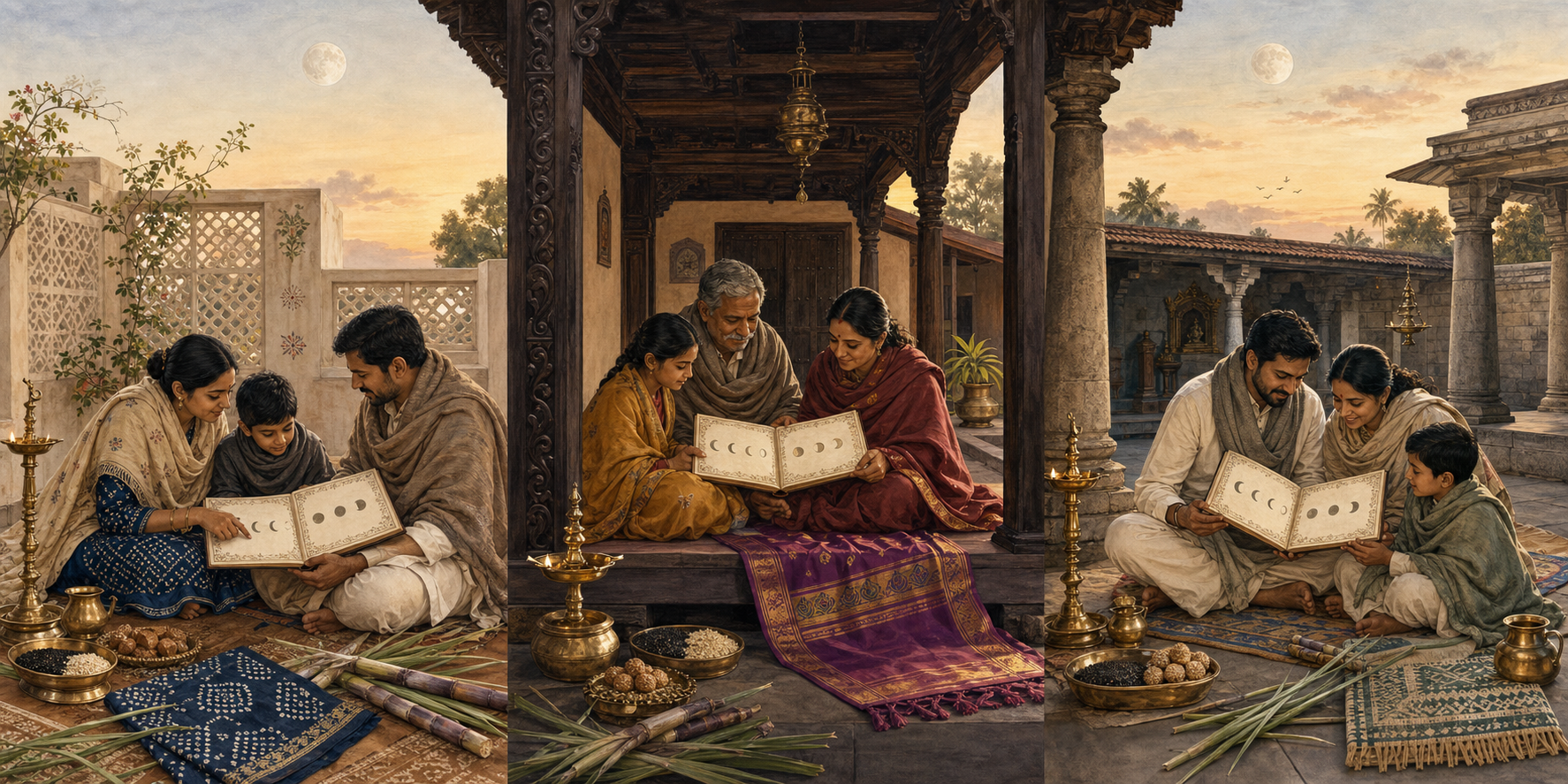
Your Gujarati relatives call it Posh, your Marathi calendar says Poush, and a Kannada Panchang lists Pushya. One calendar numbers it as the third month while another calls it the tenth. If you are coordinating a vrata, family ceremony, temple visit, or Makara Sankranti gathering, this can look like a contradiction.
For the 2025-2026 cycle, the practical answer is simpler than the names suggest: these regional calendars point to the same winter interval, from 21 December 2025 through 18 January 2026. What you should not assume is that every festival, fast, or muhurta therefore falls on the same civil date in every location.
One winter month, three regional names

The clearest way to read Paush across these calendars is to separate three pieces of information: the regional name, its position within that region’s year, and its Gregorian date span for the cycle you are planning.
| Regional calendar | Local name | Position in the year | 2025-2026 date span |
|---|---|---|---|
| Gujarati Vikram Samvat | Posh Maas | Third month | 21 December 2025 to 18 January 2026 |
| Marathi calendar in Maharashtra and Goa | Poush Mahina | Tenth month | 21 December 2025 to 18 January 2026 |
| Kannada calendar in Karnataka | Pushya Maasa | Tenth month | 21 December 2025 to 18 January 2026 |
Comparable Amanta-style reckoning is also followed in Telangana and Andhra Pradesh, as well as across much of western and southern Bharat. Amanta means that the lunar month concludes at the new moon. This common framework creates a recognizable regional rhythm without erasing differences in language, temple usage, or household practice.
Why can the same month be third and tenth?
A month number describes its place within a particular regional year’s sequence. It does not independently identify the season. Because regional calendars organize and name their annual cycle differently, the winter month can be third in the Gujarati count and tenth in the Marathi and Kannada counts without any calendar being mistaken.
Treat Posh, Poush, Paush, and Pushya as regional calendar labels rather than competing spellings that must be forced into one form. When communicating across regions, write both the local name and the Gregorian range: for example, “Pushya Maasa, 21 December 2025 to 18 January 2026.” That single line prevents most family and community planning errors.
Do not use one date to answer three different questions

The shared monthly span is useful, but it cannot answer every ritual question. Before adding anything to your calendar, identify which of the following you are actually trying to determine.
- What civil dates contain the month? For the Gujarati, Marathi, and Kannada conventions above, use 21 December 2025 through 18 January 2026.
- On which day should a vrata or lunar observance be kept? Ekadashi, Amavasya, and Purnima depend on tithi timing and the rules used by your tradition. Confirm them in a Panchang calculated for your location.
- Is a chosen time suitable for a wedding, housewarming, or another samskara? A monthly label is not a muhurta. The answer may depend on sunrise, the tithi transition, nakshatra calculations, regional custom, and family or sampradaya practice.
This distinction matters because some communities defer select weddings, housewarmings, or other new undertakings during Pushya. That is not a license to declare the entire month universally inauspicious. Nor should you cancel a ceremony merely because someone in a different region applies a different custom. Ask the temple, purohit, or lineage authority who will conduct the rite, and give them the ceremony’s actual location.
If you live outside Bharat, use a Panchang configured for your present city rather than copying a date from relatives back home. A tithi can begin or end between two sunrises, and the date assigned to an observance may therefore differ by location. For a destination wedding or griha pravesh, calculate for the destination, not the city from which the family is travelling.
Makara Sankranti belongs on a separate line
Makara Sankranti is a solar observance marking the Sun’s movement into Makara, whereas Paush, Posh, and Pushya are lunar-month designations. The two systems overlap during this winter interval, but one does not define the other.
For 2026, Makara Sankranti is anticipated around 14 January. Gujarat celebrates it prominently as Uttarayan, with community gatherings, kite-flying, and seasonal foods. Record that date provisionally, then confirm the applicable observance day in your regional Panchang. Do not treat 14 January as either the automatic beginning or the automatic end of Paush; in this cycle it falls within the stated monthly window.
A practical Paush plan: discipline, observance, and service
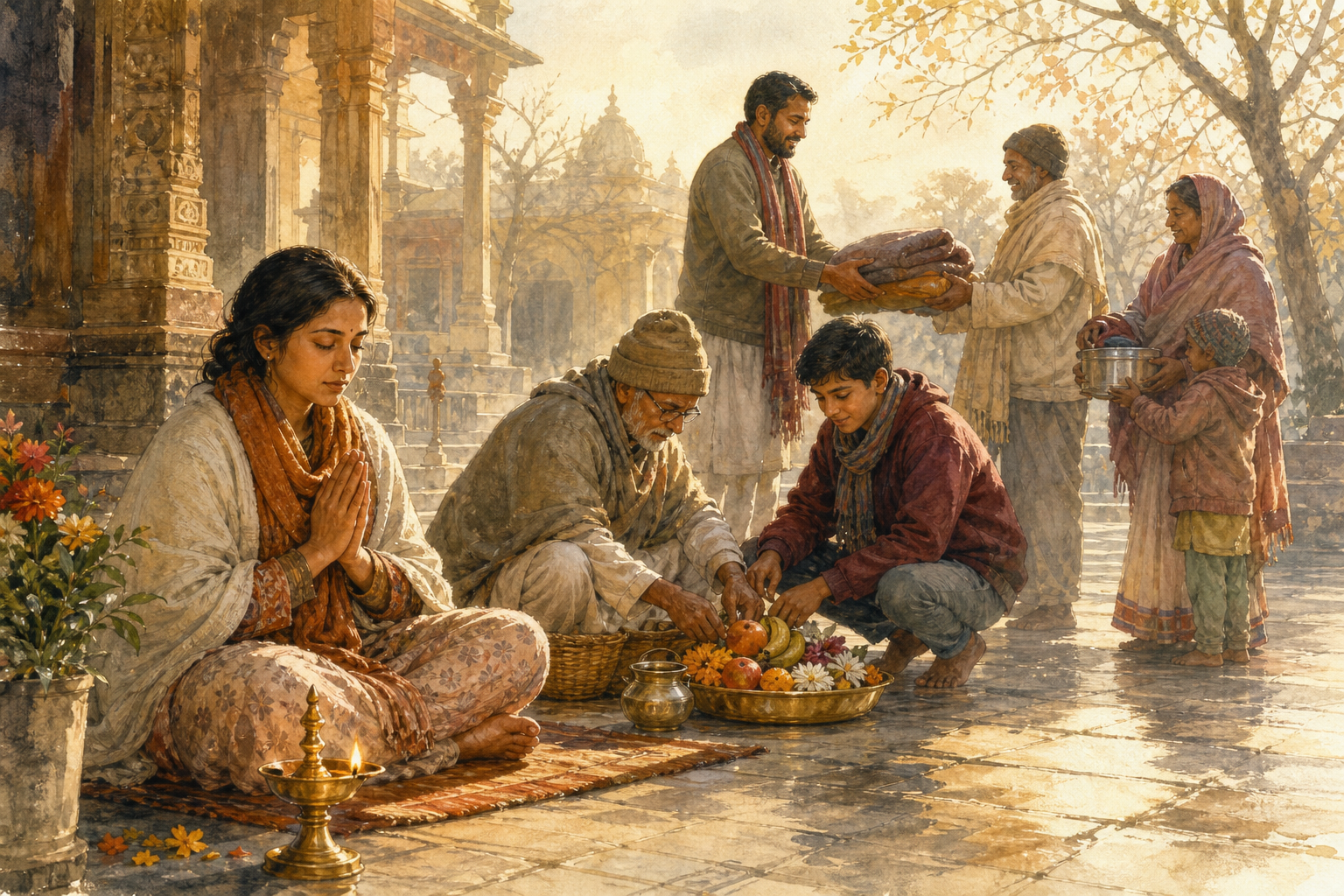
A month in which some households postpone major beginnings is not an empty month. Its quieter character creates room for practices that do not require an elaborate muhurta. Paush is commonly associated with japa, vrata, scriptural or devotional study, dana, temple seva, meditation, and steady daily worship. Karnataka traditions also emphasize annadanam, while some families use the interval for pilgrimage or the completion of existing vows.
You do not need to adopt every practice associated with every region. A manageable household plan has four parts:
- Choose one daily discipline. Fix a sustainable time for japa, meditation, worship, or study instead of building an ambitious routine that disappears after several days.
- Confirm one or more tithi observances. If your family keeps Ekadashi, Amavasya tarpanam, or Purnima worship, copy the timings from the same trusted, location-specific Panchang rather than mixing dates from several calendars.
- Pair inward practice with outward service. Decide in advance what dana, annadanam, temple assistance, or community seva you will undertake. A specific commitment is more useful than a vague intention to be charitable.
- Plan Sankranti separately. Put Uttarayan or Makara Sankranti gatherings, food preparation, and travel on the family calendar, but keep the solar festival distinct from your lunar vrata schedule.
This approach also gives substance to the wider Dharmic values often visible during the cool season: self-restraint, study, generosity, meditation, and service. Hindu, Buddhist, Jain, and Sikh communities can recognize those ethical affinities without pretending that they all follow an identical ritual calendar. Unity becomes more credible when shared values are honoured alongside real differences in doctrine and observance.
Four quick answers for family calendar planning
Are Posh, Poush, Paush, and Pushya the same month?
In the Gujarati, Marathi, and Kannada calendars discussed here, they are regional names for the same broad 2025-2026 lunar window. The name and month number change with the calendar tradition.
Is the whole month unsuitable for auspicious work?
No universal rule can be inferred from the month name alone. Some communities defer select life-cycle ceremonies or new undertakings, while the same interval is valued for sadhana, vrata, study, dana, and seva. Follow the custom of the family and tradition conducting the rite.
Can one regional Panchang supply every exact date?
Use it for the tradition and location for which it was calculated. For a precise vrata, festival day, or muhurta elsewhere, check a Panchang set to that city and confirm the observance rule followed by the relevant temple or lineage.
Should Makara Sankranti be treated as a Paush boundary?
No. Sankranti follows a solar transition; the lunar month follows its own boundaries. In 2026 the festival is expected around 14 January, within the 21 December to 18 January window, but it does not determine that window.
Put the monthly range in your calendar now, but leave each vrata, samskara, and Sankranti observance open until you have checked the correct city and tradition. If relatives use different calendars, record both regional names beside the event. That small habit preserves local usage while keeping the whole family on the same date.
References
- DharmaRenaissance Blog – Posh Maas 2025-2026 (Gujarati Calendar): Exact Dates, Ritual Guidance, and Uttarayan Insights
- DharmaRenaissance Blog – Poush Mahina 2025-2026: Exact Marathi Calendar Dates, Regional Traditions, and Key Insights
- DharmaRenaissance Blog – Pushya Maasa 2025-2026: Kannada Calendar Dates, Ritual Highlights, and Regional Unity
