
You can know what dharma requires and still remain stuck. Sometimes fear and inertia stand in front of the necessary action like a guard at a gate. At other times, no single barrier stops you; your attention is quietly consumed by small appetites, distractions, and repeated habits.
The stories of Dhenukasura and Mushikasura help you distinguish these conditions. Balarama shows how to remove an obstruction that must no longer be allowed to rule. Ganesha shows how unruly energy can be mastered and, in one prominent telling, made to serve as his vahana. The practical question is not simply how to defeat an inner enemy. It is whether this particular force must be stopped, restrained, or redirected.
The same feeling of stuckness can hide two different problems
Dhenukasura controls access. Mushikasura creates disorder. That distinction gives you a useful diagnostic before you reach for discipline, renunciation, confrontation, or compassion.
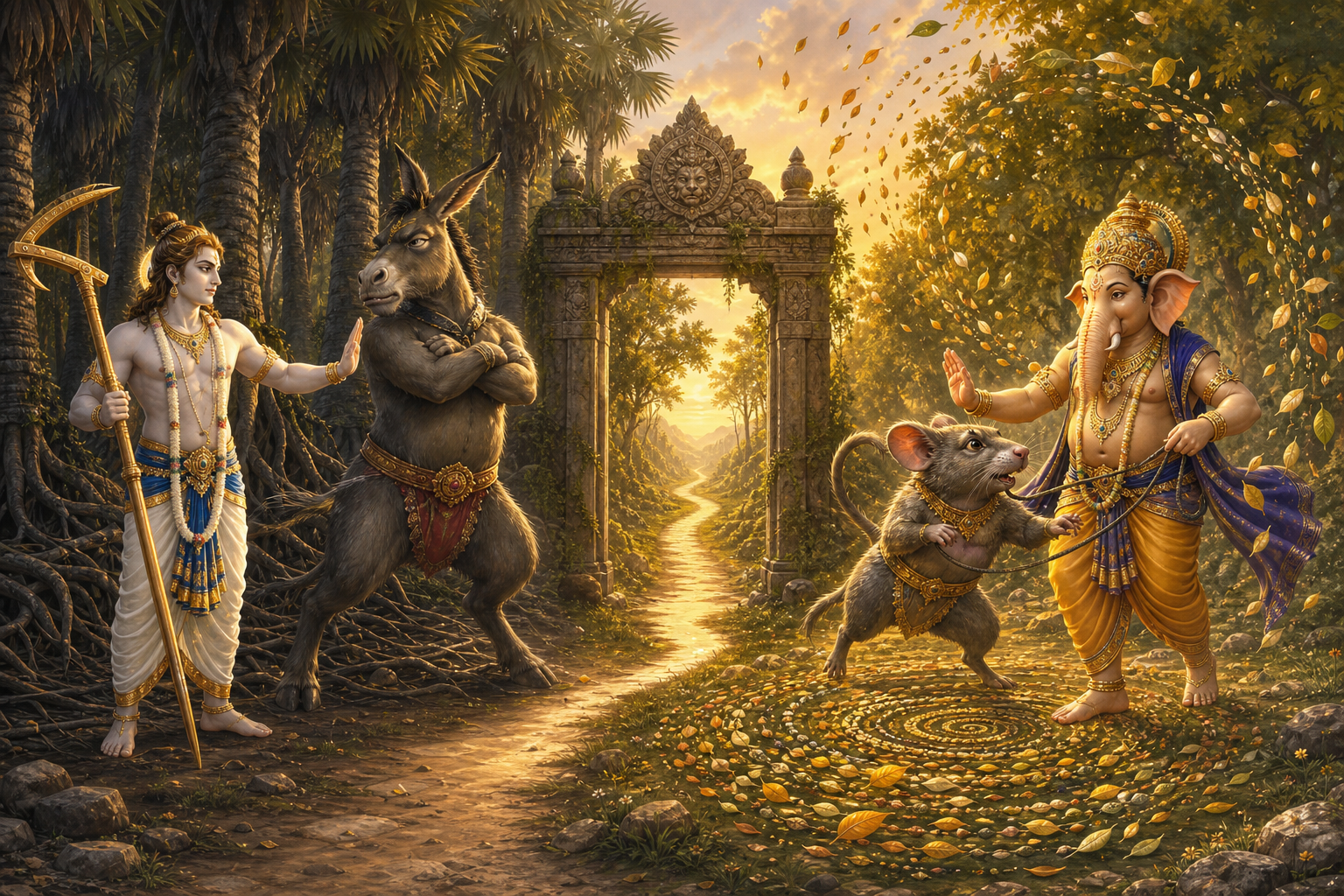
In the Talavana narrative, Dhenuka prevents the cowherds from enjoying the forest’s abundant fruit and keeps the community afraid. The good is present, but an obstructing force makes it inaccessible. Balarama does not negotiate indefinitely with that obstruction. He remains composed, acts decisively, and restores safety.
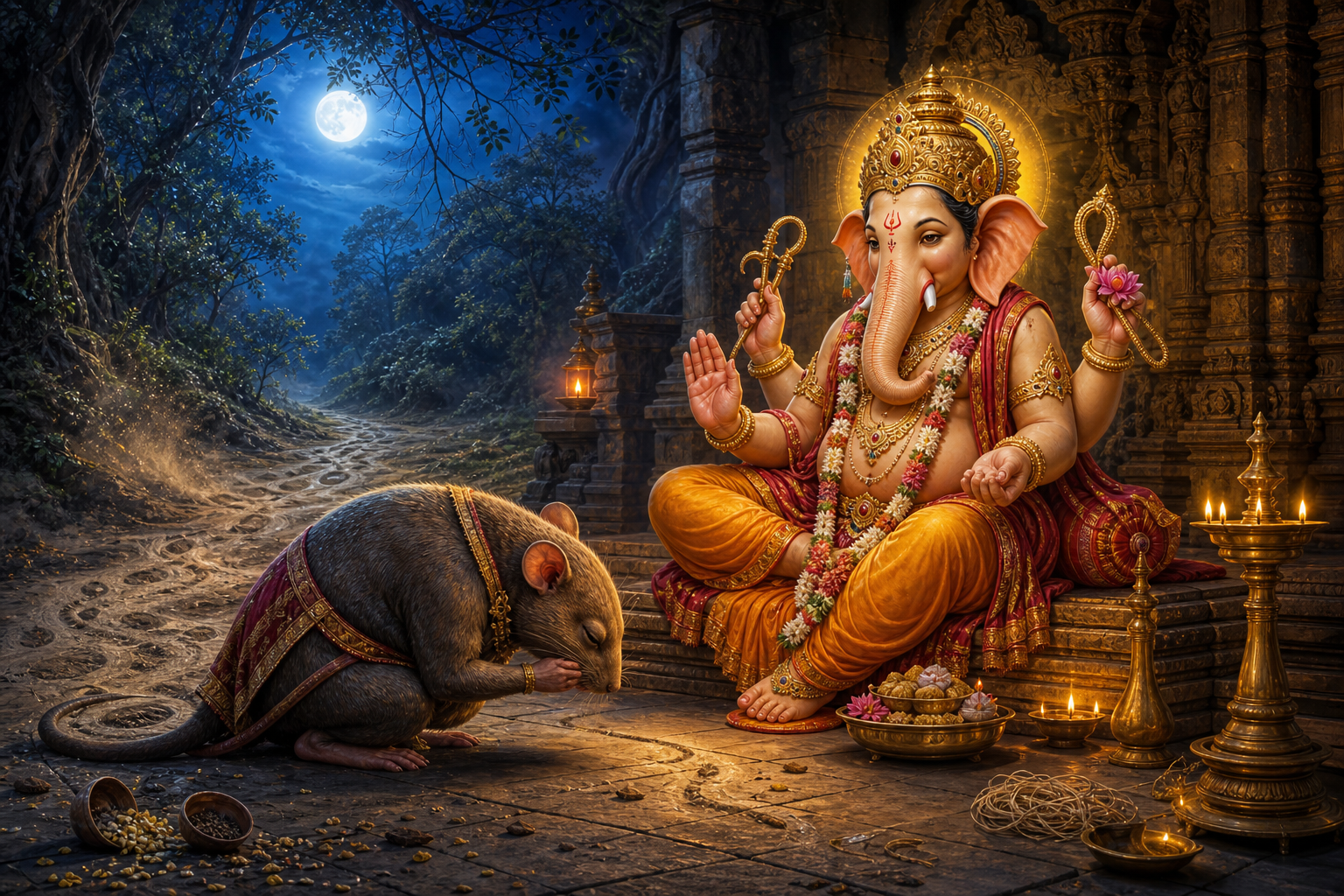
Mushika works differently. The rat image evokes activity below the surface: gnawing, tunnelling, multiplying disorder, and reaching into places that have been left unguarded. Some tellings end with Ganesha destroying the menace, while others end with Mushika subdued and consecrated as Ganesha’s mouse vahana. In the transformative ending, the troublesome energy remains, but its place and purpose change completely.
Ask yourself which pattern is operating:
- Is something blocking a worthy action you already understand? You may be facing a Dhenukasura pattern: fear, confusion, intimidation, or inertia has occupied the entrance.
- Are many small impulses consuming your attention? You may be facing a Mushikasura pattern: the mind is active, but it is not under wise direction.
- Would redirecting the energy produce something useful? If yes, govern it like a vahana. If the force only sustains harm or adharma, a firm boundary may be necessary.
Key takeaways
- The Dhenukasura pattern calls for proportionate, decisive action against an obstruction that keeps a genuine good out of reach.
- The Mushikasura pattern calls for early attention, firm governance, and the redirection of restless energy toward a defined purpose.
- Compassion does not require you to preserve every habit. Strength does not permit anger to act without discrimination.
- The shortest practical test is: What must stop, and what can be taught to serve?
Dhenukasura: remove what has occupied the gate

The fruit of Talavana matters. The episode is not about combat for its own sake. A nourishing resource has been withheld from a community, fear has become normal, and the people who should be able to enter have learned to stay away. Balarama’s strength is dharmic because it restores access and protects others.
That sequence keeps an inner reading from becoming vague. In contemplation, the fruit can represent a worthy result: honest work completed, a neglected duty resumed, a difficult truth spoken without cruelty, or a capacity placed in service. Dhenukasura represents the recurring force that blocks access to it. Balarama represents disciplined strength that no longer lets the obstruction dictate the terms.
Use the narrative when you keep circling a duty whose ethical direction is already clear. Do not begin with a judgment about your entire character. Identify the occupied gate.
- Name the fruit. Complete this sentence: The good I am responsible for bringing within reach is… If you cannot name the good, you are not ready to decide what the obstacle is.
- Name the obstruction as a repeated action. Replace a label such as laziness with a verb: postponing the conversation, hiding the unfinished work, surrendering to intimidation, or waiting for certainty that cannot arrive.
- Separate fear from information. Fear may be warning you about a real consequence, or it may be preserving an old pattern. Write down what the fear actually predicts. A prediction can be examined; a cloud of dread cannot.
- Choose the smallest decisive boundary that changes access. Send the necessary message, begin the duty before entertainment, remove the recurring distraction, ask for help, or refuse the demand that makes right action impossible.
- Judge the action by what it restores. After the boundary is set, does truth become easier to speak, does duty become possible, or does a shared good become more available? If the result is merely personal domination, the action has not followed Balarama’s example.
The emphasis on composure is essential. Decisiveness is not the same as rage. Balarama’s force is directed at the menace and followed by restored calm. If you are still trying to humiliate someone, win admiration, or discharge resentment, pause. You may have borrowed the language of dharma for an impulse that has not yet come under discipline.
There is also a communal test. Dhenukasura does not merely frustrate one individual’s preference; his obstruction frightens the cowherds and denies them the forest’s fruit. When you apply this story to a family, temple, organisation, or community, ask who has been kept away from a legitimate good. That question turns courage outward. It prevents inner transformation from becoming a private project detached from protection and responsibility.
Mushikasura: make restless energy carry wisdom
The Mushikasura pattern often looks less dramatic. You sit down for one duty and reach for another stimulus. You resolve to speak carefully and begin rehearsing an old grievance. You seek knowledge but keep collecting material instead of understanding it. Each movement is small, yet the accumulated disorder can govern the day.
The mouse at Ganesha’s feet offers a precise image of mastery. The appetite has not become the lord. It has been placed beneath discernment and given a function. A vahana carries; it does not choose the destination. This makes the transformative ending especially useful when the energy itself is not evil but its present rule is disorderly.
Desire for novelty, for example, can fragment attention. Under guidance, that same movement can support inquiry. Sensitivity to risk can become chronic hesitation, or it can be assigned the useful work of checking a plan before action. Ambition can seek status without limit, or it can be yoked to disciplined service. Transformation does not flatter the impulse. It changes who commands it.
Try this sequence when the problem is scattered energy rather than a closed gate:
- Catch the movement at the threshold. Notice the hand reaching, the tab opening, the subject changing, or the excuse forming. The earlier you see the movement, the less authority it has acquired.
- Name the appetite without turning it into an identity. Say, The mind wants stimulation, rather than, I am incapable of discipline. The first statement identifies something governable. The second makes a passing force sound permanent.
- Ask what legitimate energy is trapped inside it. Restlessness may contain curiosity. Anger may contain recognition that a boundary was crossed. The wish to be seen may contain a capacity that genuinely needs expression. This does not make every action acceptable; it helps you find what can be redirected.
- Give the energy a narrow assignment. Let curiosity investigate the question required by your present work. Let caution perform one review and then release the decision. Let physical agitation support a useful task before you return to study or prayer.
- Keep authority with the higher purpose. If the impulse repeatedly changes the destination, it has not become a vahana. It is still choosing the route.
This is where Ganesha’s role as Vighneshwara, the remover of obstacles, becomes practical. An obstacle is not always removed by erasing the energy behind it. Sometimes wisdom removes the obstacle by establishing order: this desire has a place, this fear has a limited duty, and this habit no longer controls the threshold.
Do not romanticise every impulse as hidden potential. Some habits repeatedly injure you or other people and need a clear stop. The Mushikasura traditions themselves preserve both destruction and subjugation. The point is not that transformation is always gentler or therefore always better. The point is that discernment must decide what the situation permits.
A daily discipline built around two questions
You do not need to wait for a crisis to work with these narratives. Place them at the ordinary thresholds of your day, where decisions are still small enough to govern.
At the beginning of the day
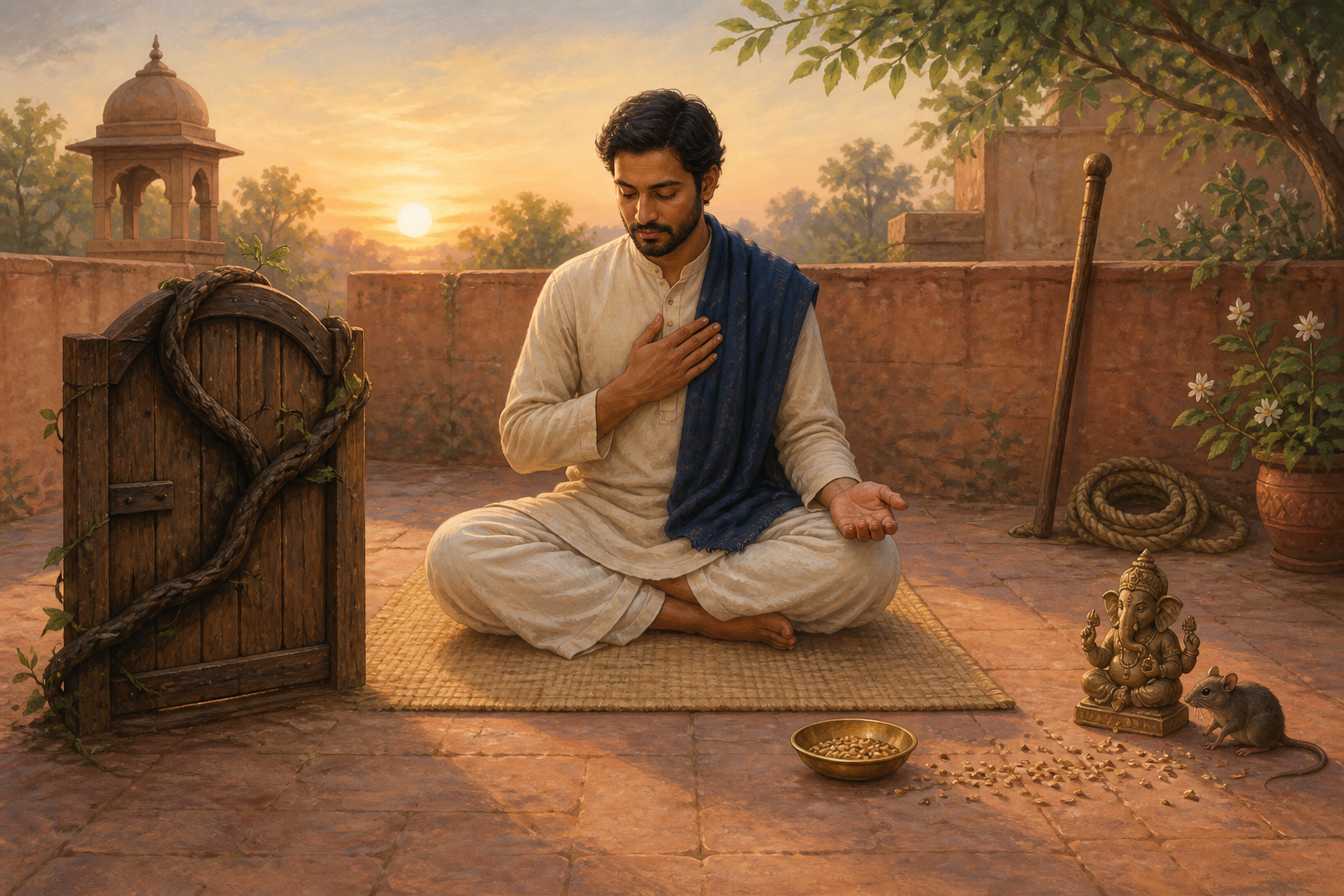
If beginning with Sri Ganeshaya Namah is part of your practice, let the invocation do more than announce an auspicious start. Name the Mushika that is most likely to enter unnoticed. It may be needless checking, scattered study, resentment, excess consumption, or avoidance disguised as preparation. Then give that energy a boundary or a useful assignment before it begins to tunnel.
Next, identify one Talavana: a worthy good that fear or inertia has made inaccessible. Write the concrete action that reopens the gate. Keep it visible. A broad intention such as becoming disciplined gives the obstruction room to hide. A defined act exposes whether you will move.
At the moment of resistance
Ask two questions in order:
- Is this a gate problem? If a known duty is being blocked, use Balarama’s clarity: establish the necessary boundary and act.
- Is this a direction problem? If energy is moving everywhere except toward its purpose, use Ganesha’s governance: catch it, narrow it, and assign it.
This prevents two common mistakes. The first is trying to negotiate endlessly with an obstruction that survives through delay. The second is attacking an energy that could have become useful under discipline.
At the end of the day
Review consequences rather than intentions. Did a worthy good become more accessible? Did restless energy carry a chosen purpose, or did it quietly choose the destination? Did your firmness protect anyone, or did it become harshness? Did your compassion establish order, or did it excuse repetition?
This review turns the stories into abhyasa, repeated practice. You are not trying to declare yourself victorious after one decision. You are learning to recognise the form an obstacle takes before it becomes powerful.
Keep the inner reading accountable to dharma
Dhenukasura and Mushikasura are not merely names for unpleasant moods. They belong to sacred narratives of divine protection, restored order, and the governance of power. A psychological interpretation can support sadhana, but it should not shrink Balarama and Ganesha into motivational symbols.
That theological humility also protects the practice from misuse. Calling another person your Dhenukasura can turn self-examination into accusation. The safer starting point is the obstruction within your own field of responsibility: the fear you obey, the confusion you preserve, the habit you refuse to govern, or the power you exercise without restraint. An external wrong may require firm action, but the story does not relieve you of proportion, truthfulness, or concern for the vulnerable.
The two narratives also resonate with ethical disciplines across the Dharmic family without making the traditions interchangeable. Buddhist mindfulness attends to kleshas that obscure clarity. Jain vows and ahimsa place conduct under disciplined restraint. Sikh teachings honour inner discipline expressed through courageous seva. Hindu devotion to Balarama and Ganesha has its own theological forms and relationships. The shared insight is practical: freedom does not mean permitting every inner movement to rule.
You can honour that kinship by asking an ethical question, not by erasing differences. Does this practice make you less governed by fear, appetite, and confusion? Does it make your conduct more truthful, restrained, courageous, and available for service? If not, the symbolism has remained an attractive idea instead of becoming transformation.
At your next point of resistance, do not begin with the sweeping judgment that something is wrong with you. Ask which narrative you are living. If an obstruction has occupied the gate, recover Balarama’s composed strength and reopen access to the good. If restless energy is tunnelling through your attention, place it under Ganesha’s discernment and give it a worthy direction. Then take the concrete action your answer requires.
References
- DharmaRenaissance Blog – DHENUKASURA SAMHARA MOORTHY: Lord Balarama’s Triumph at Talavana and the Power of Dharma
- DharmaRenaissance Blog – Mushikasura Samhara Moorthy: Ganesha’s Powerful Lesson on Conquering Inner Obstacles
