
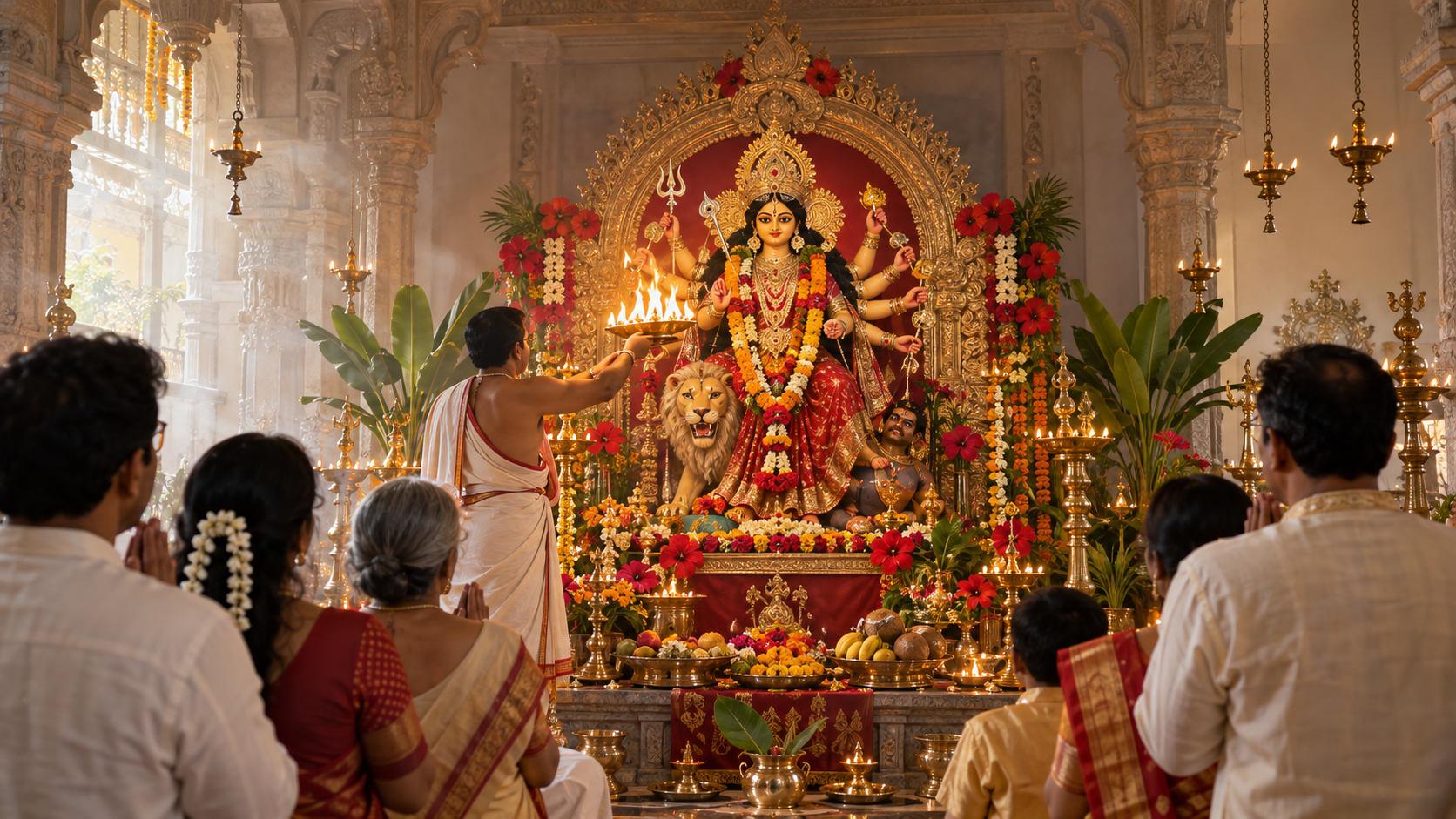
You want to observe Durga Ashtami sincerely, but the choices can become confusing: a detailed vrata or a simple puja, worship at home or darshan at a temple, your family’s method or a regional celebration you have never encountered before. The right starting point is not to collect every available ritual. It is to identify the tradition you are actually following.
A coherent observance can be simple. Confirm the local tithi, choose one reliable ritual framework, prepare your offerings before worship begins, and let the temple set its own rules when you visit. That approach preserves both devotion and discipline without pretending that every Hindu community must celebrate Ashtami in exactly the same way.
Key takeaways
- Durga Ashtami is the eighth day of Navratri, observed on Ashtami during the Shukla Paksha of the month of Ashwin.
- Confirm the applicable tithi and puja schedule through your local panchanga, family tradition, or temple rather than relying only on a civil-calendar date.
- For home worship, use a complete method you already understand. Do not assemble an improvised ceremony from unrelated regional practices.
- A simple puja may include a clean worship space, a lamp, familiar prayers, suitable offerings, aarti, pranam, and the respectful distribution of prasada.
- At a temple, its schedule, alankaram, offering rules, queue discipline, and photography policy take precedence over your home routine.
- Regional differences in counting, decoration, public worship, and vrata practice are expressions of living tradition, not evidence that one community is observing the occasion incorrectly.
Fix the tithi before you plan the ritual
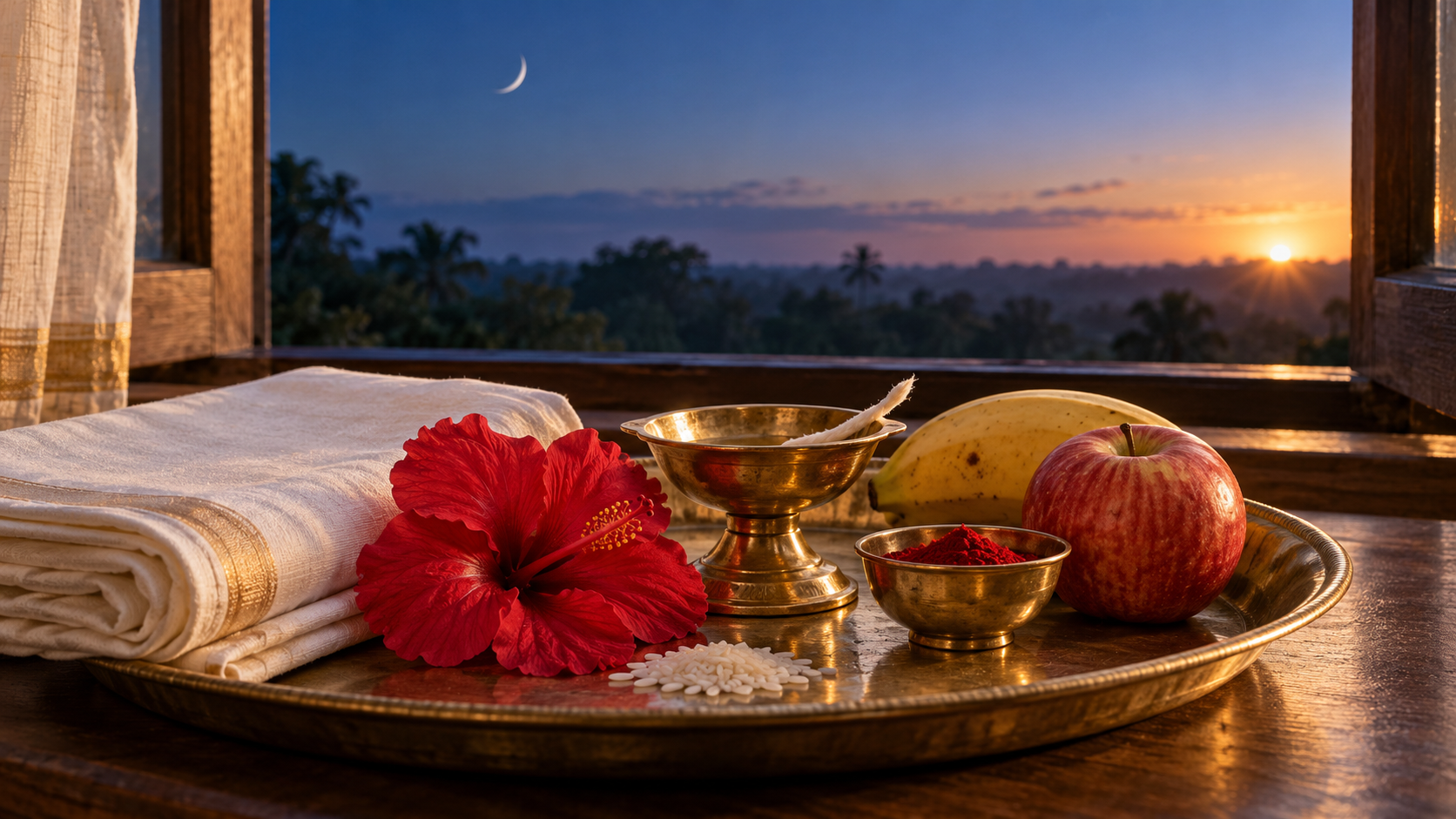
Durga Ashtami is defined by the lunar calendar: it is the eighth Navratri day, falling on Shukla Paksha Ashtami in Ashwin. That matters because a tithi does not necessarily begin and end with the midnight boundaries of a civil date. The suitable period for a household puja may therefore depend on the panchanga and customary rule used by your community.
Before inviting relatives, arranging a fast, or travelling to a temple, answer three questions: Which local panchanga are you following? Does your family observe the vrata at home, attend a temple, or do both? What time has the temple announced for the relevant worship or darshan? If these answers differ from a social-media calendar, follow the established authority for the observance you will actually perform.
This also prevents a common misunderstanding. The lunar identity of the day and the number assigned to a public festival programme are not always the same kind of count. In Bengal and several other eastern regions, Maha Ashtami is also the third day of the five-day Durga Puja celebration. Calling it the eighth day of Navratri and the third day of that Durga Puja sequence is not contradictory; the two counts begin from different liturgical frames.
If your household has a hereditary or guru-given practice, begin there. A generic checklist should not displace a living sampradaya. If no family procedure survives, ask a nearby temple or a trusted practitioner for a manageable method and keep a written copy ready. Continuity is more useful than adopting an elaborate new sequence each year.
Build a home puja you can perform attentively
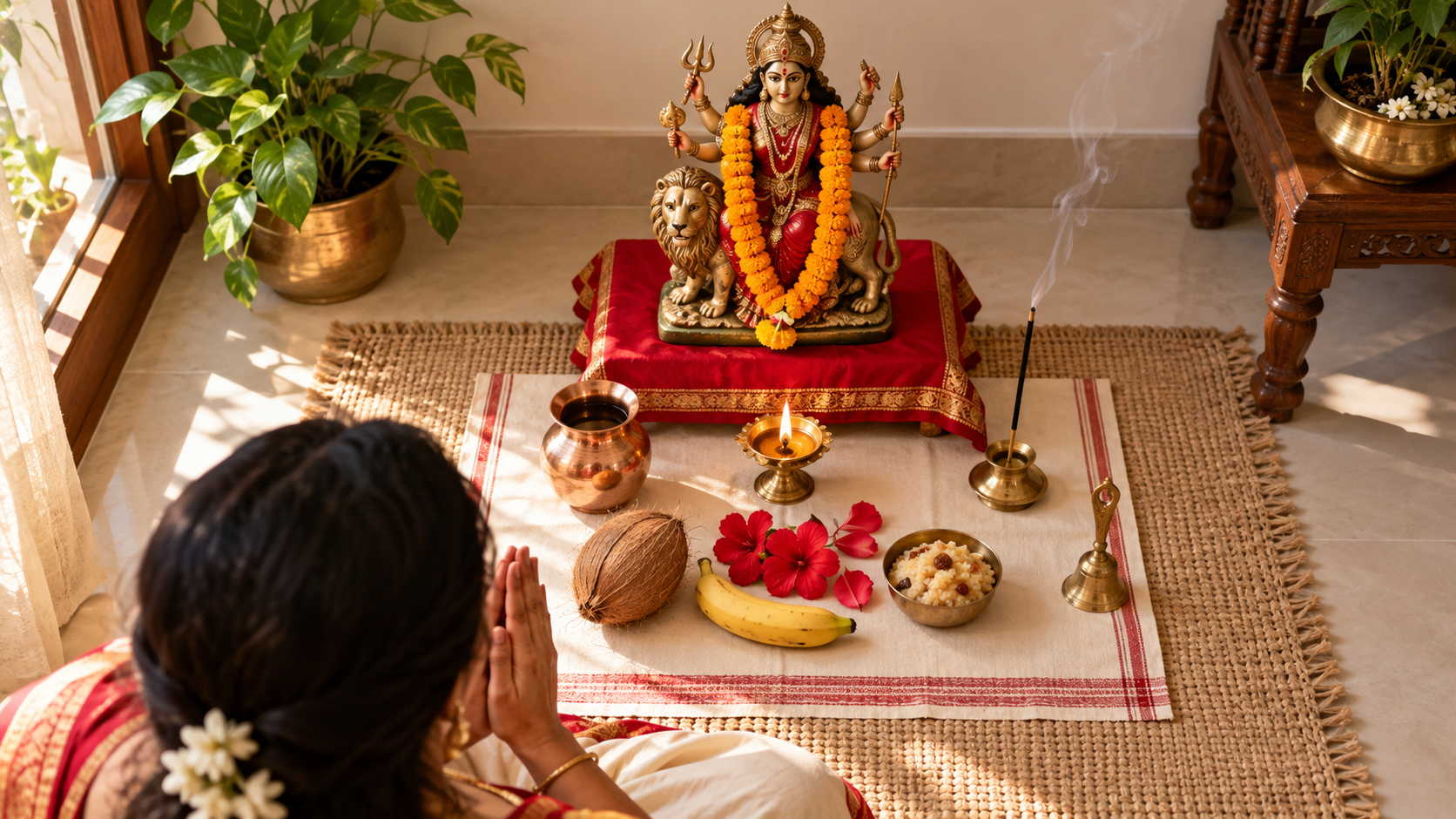
A formal Maha Ashtami vrata can have a defined puja vidhi, preparations, and observances. If you undertake that fuller vrata, use one trusted procedure from beginning to end. If you are making a devotional observance at home without that training, keep the worship modest and internally consistent.
- Prepare yourself and the space. Bathe or wash as your circumstances allow, wear clean clothes, clean the worship area, and place the murti or image securely on a clean surface. Finish ordinary household interruptions before you begin where possible.
- Set out only suitable offerings. Prepare the lamp, water, flowers, fruit, or cooked offering accepted in your household tradition. Use a stable lamp, keep it away from fabric, children, and animals, and never leave the flame unattended.
- Make a clear sankalpa. State whom you are worshipping, the occasion, and the intention of the worship. If you do not know a prescribed Sanskrit formulation, speak reverently in the language you understand unless your inherited method directs otherwise.
- Invoke Devi through a prayer you know. Use the Durga name, mantra, stotra, or reading familiar to your tradition. A prayer you can recite with attention is preferable to an esoteric formula copied without context or instruction.
- Present the offerings in an orderly way. Offer each item without haste. Do not add substances merely because they appeared in somebody else’s ceremony; an offering suitable in one temple or region may not belong in your household method.
- Complete the worship deliberately. Conclude with the customary prayer, aarti if that is part of your practice, pranam, and the respectful sharing of prasada. Extinguish or secure any flame before leaving the space.
The purpose of simplifying is not to make ritual casual. It is to remove the confusion that prevents attention. Decide the sequence before you sit down, keep the required items within reach, silence your phone, and allow enough time to finish without rushing to another commitment.
Fasting should be treated with the same sobriety. A vrata is a discipline, not a contest over who can endure the most discomfort. Follow the form accepted by your household or teacher. If strict fasting is medically unsuitable for you, worship without it and follow your clinician’s guidance; a devotional observance should not be used to override a health requirement.
Enter the temple as a participant, not a director
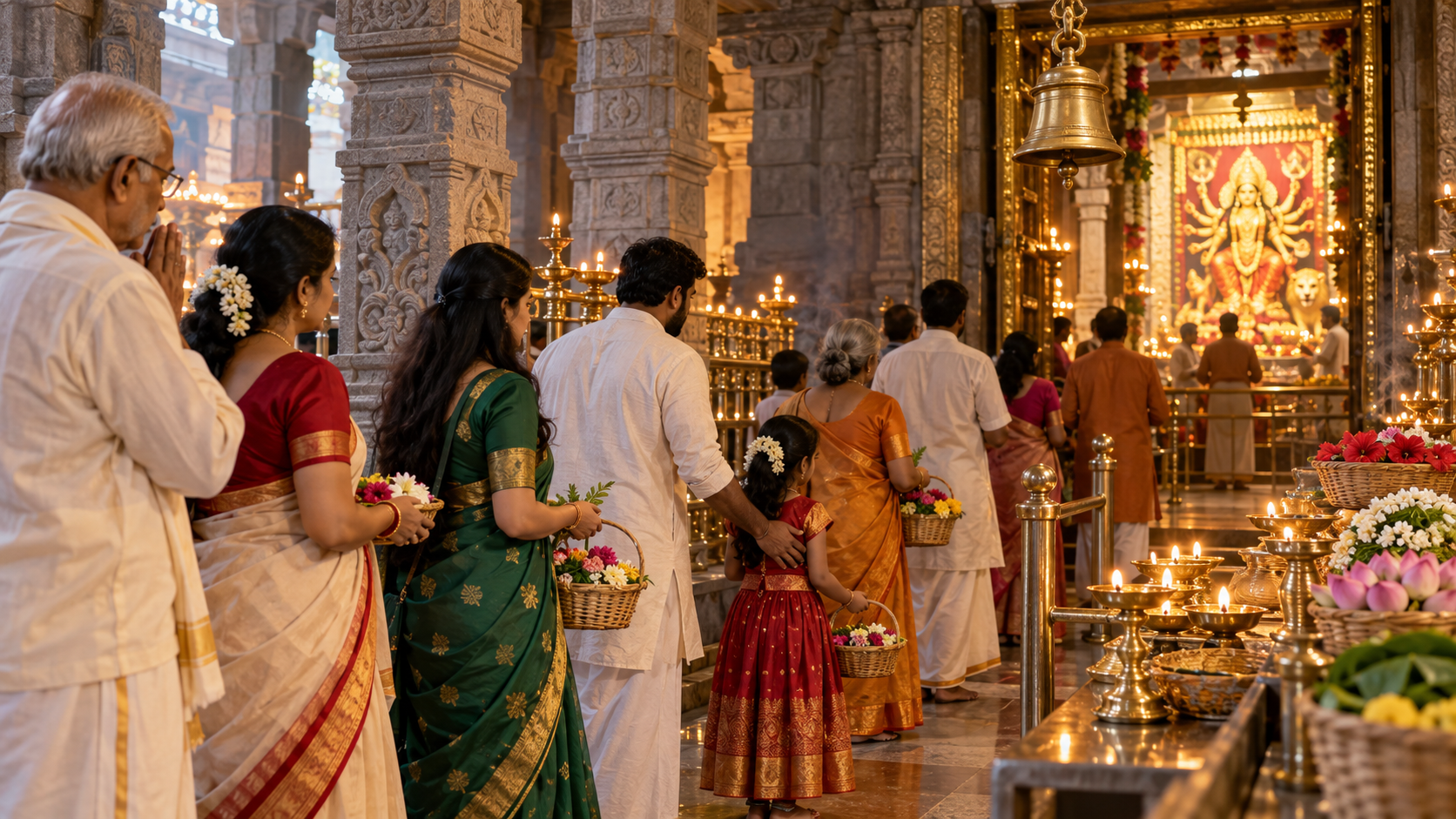
A temple visit is not simply your home puja conducted in a larger room. The deity, priestly tradition, daily worship cycle, festival programme, and management of the sacred space determine what happens there. Your role is to receive darshan and participate within that order.
- Check the temple’s own announcement. Confirm opening hours, aarti or special-puja times, queue arrangements, and whether advance booking or a separate entry line applies.
- Ask before carrying offerings inside. A temple may accept particular flowers, food, cloth, or other items while restricting the rest. Buying or preparing an offering does not create an entitlement to place it near the deity.
- Dress and behave for worship. Wear clean, modest clothing, silence your phone, speak quietly, and follow signs and volunteer instructions. If a footwear, entry, or movement rule is unclear, ask rather than imitate another visitor.
- Respect the movement of the queue. Prepare your prayer before reaching the sanctum. Do not block the line to arrange a photograph, repeat an offering, or demand a longer stop than temple staff permit.
- Treat photography as permission-based. A crowded festival or a visually striking alankaram does not make the sanctum a photo set. Keep the device away if photography is prohibited or if it obstructs worshippers.
- Receive what the temple gives. Accept prasada, tirtha, or other blessings according to local practice. Do not insist that the temple reproduce the sequence you use at home.
If you want to sponsor a puja, contribute offerings, or arrange a family sankalpa, contact the temple before Ashtami. Festival-day staff are usually working within a fixed programme, and a request made at the sanctum door may be impossible to accommodate without disrupting other worshippers.
Understand alankaram as a temple’s sacred vocabulary
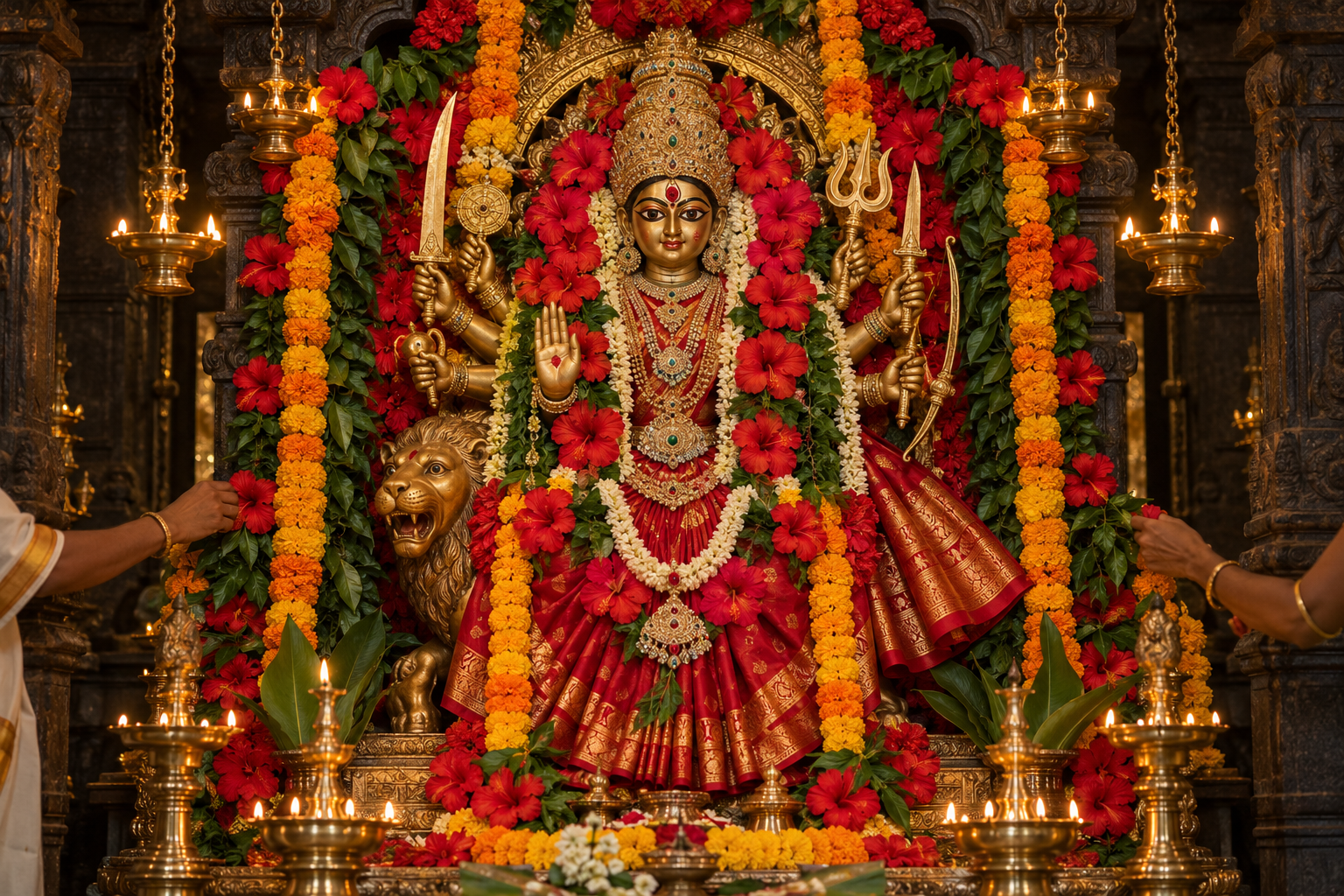
Alankaram is not merely an attempt to make the murti look festive. It allows a temple to present and worship a particular form of Devi through its own inherited liturgical and visual vocabulary. The appropriate response is first to learn which form is being manifested, not to judge the presentation against an image from another temple.
Kanaka Durga Temple in Vijayawada offers a clear example of a temple-specific Navratri cycle: a form of Goddess Durga is worshipped through the daily Dasara alankaram. For Durga Ashtami in 2026, observed there on 18 October, the announced alankaram is Durga Devi. That date and presentation are useful for anyone attending that temple; they should not be turned into a universal rule for every shrine or household.
When you encounter an unfamiliar alankaram, look for the name displayed by the temple and listen to the explanation given by its priests or official programme. Notice the form being emphasised and the place it holds in that temple’s Navratri sequence. This turns darshan into attentive participation rather than visual consumption.
The same discipline helps you approach regional difference. A Bengali Durga Puja programme, a Vijayawada alankaram schedule, and a family vrata may organise the occasion differently while remaining centred on Devi. You do not need to collapse them into one standard ceremony. Preserve the distinction, learn what each practice is doing, and follow the one for which you have actual guidance.
Before Ashtami arrives, make one practical move: confirm your tithi and temple schedule, then write down the exact home sequence you intend to follow. Once those decisions are settled, you can give the day what it asks from you most directly: disciplined, undistracted worship of Devi.
References
- Hindu Pad — Durgashtami Puja Vidhi in PDF (Procedure of Maha Ashtami Vrat)
- Hindu Pad — Durgashtami Alankaram in Vijayawada Temple Navaratri 2026 – 18 October | Durga Devi

Leave a Reply
You must be logged in to post a comment.