
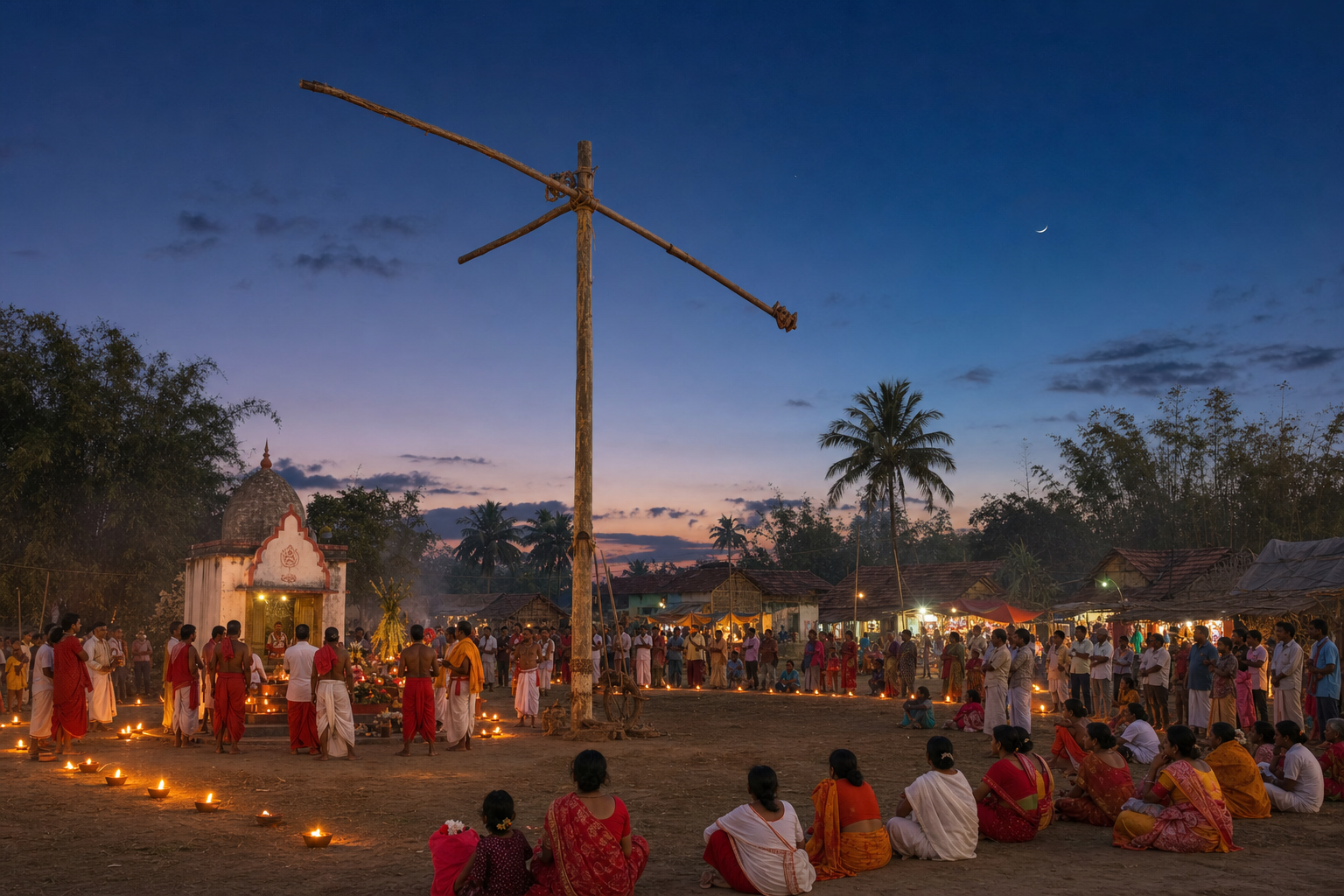
If you have encountered Charak Puja through an image of a towering pole and a devotee circling above a crowd, you have seen its most dramatic moment but not yet its meaning. The movement is easy to notice. The harder, more useful task is to see the vows, seasonal change, village relationships, and devotional discipline holding that moment together.
Charak Puja is best approached as a passage between years. It closes Chaitra, prepares a community for Vaishakh, and places Shiva worship within an agrarian and social rhythm. Once you understand that structure, you can attend an observance without reducing it to a spectacle or assuming that every village follows the same form.
Begin with the sunset before the new year
Charak Puja takes place on Chaitra Sankranti, the final day of the Bengali month of Chaitra. It usually falls on 13 or 14 April and corresponds to Mesha Sankranti, the Sun’s sidereal transition into Aries. Pohela Boishakh, the first day of the Bengali year, follows immediately afterward. The precise Gregorian date can vary, so use the relevant regional almanac and the local organizer’s announcement rather than assuming that last year’s date will apply.
This sequence matters. Pohela Boishakh opens the new year, but Charak Sankranti first gives the old year a disciplined ending. Fasts, vows, songs, offerings, and public worship create a pause between what has been completed and what is about to begin. If you attend only for the rotating swing, you may miss the festival’s central movement: not the body’s circle around the pole, but the community’s passage from one seasonal cycle to another.
The timing also belongs to rural life. Charak closes the dry-season arc and turns attention toward Vaishakh, hoped-for rain, and the agricultural work ahead. Field blessings, reverence for water bodies, and household altars place livelihood within sacred time. Agriculture is not merely a picturesque background to the festival. It helps explain why prayers for health, rain, harmony, and collective well-being belong together.
When you observe Charak at dusk, therefore, notice acts of closure: fulfilled vows, shared food, prayers for the coming season, and the gathering of households in a common space. These quieter actions explain the calendar more clearly than the spectacle alone can.
How vows, the Charak pole, and the village fair fit together
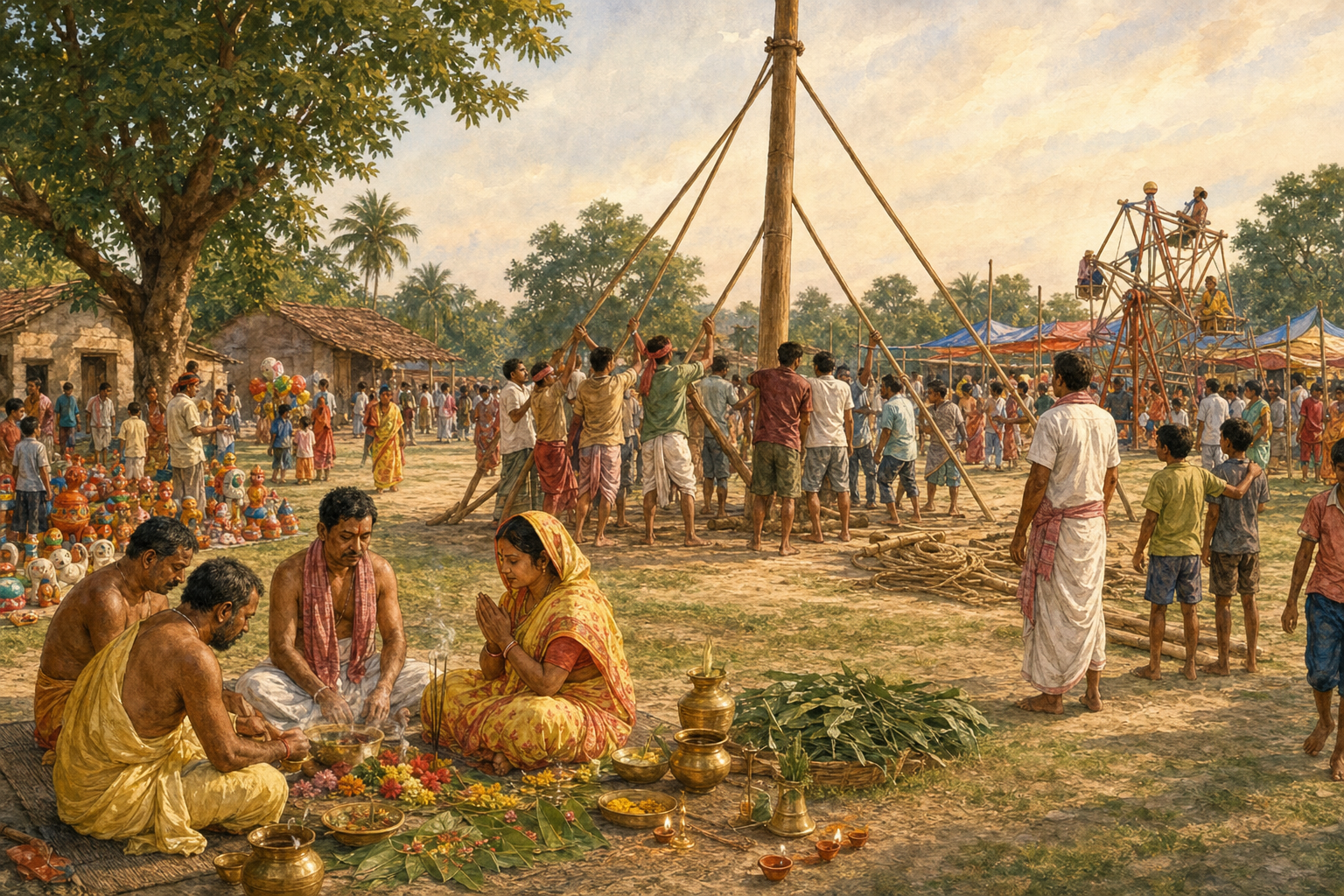
Local terminology can be confusing because Charak Puja is intertwined with the wider Gajan season and may also be called Nil Puja or Hajra Puja in particular places. Devotion to Shiva is prominent, while regional village deities may also receive offerings. Treat these names as clues to local practice, not as labels that must be perfectly interchangeable everywhere. The useful question at an observance is simple: what does this community call the rite, and which deity or vow is central here?
The festival’s parts form a coherent progression:
- Devotees undertake discipline. Participants commonly called bhaktas or sanyasis during the observance accept vratas, fasts, restraint, and nocturnal kirtans. These practices establish tapas before the public celebration begins.
- The Charak pole establishes the ritual centre. The charak gachh is usually made from a strong trunk fitted with a crossbar and rigging. It creates a visible meeting point for the village and can be read symbolically as an axis joining earth and sky, community and cosmos, and one seasonal cycle with the next.
- Rotation turns devotion into public movement. In the Charak swing, devotees travel around the pole in broad arcs while dhak drums, chants, and songs intensify the rite. The circle can be understood as a kinetic prayer of renewal rather than an isolated feat of daring.
- Offerings turn worship toward reciprocity. Households prepare food, distribute prasad, and extend hospitality. Dana and seva give the festival an ethical form: devotion is expressed through giving and service as well as personal austerity.
- The mela carries memory beyond the ritual ground. Jatra performances, crafts, devotional music, produce, and oral recollections make the Charak Mela a village commons. Younger people encounter the tradition through sound, objects, stories, and participation rather than through explanation alone.
The surroundings deserve as much attention as the pole. Mango-leaf toranas, painted shrines, terracotta icons, and alpanas can transform lanes and thresholds into sacred approaches. This public art does more than decorate the occasion. It allows families and artisans to place memory into the physical landscape, making the village itself an archive that is renewed through use.
This is why calling Charak merely a folk performance is inadequate. Folk tradition here does not mean theology without depth. It means theology carried through vows, bodies, seasons, craft, music, hospitality, and local memory. The festival is distinctly rooted in Hindu worship, especially devotion to Shiva, while its emphasis on self-restraint, giving, service, compassion, and communal welfare also makes its values legible across the wider Dharmic family.
Regional differences are part of the tradition
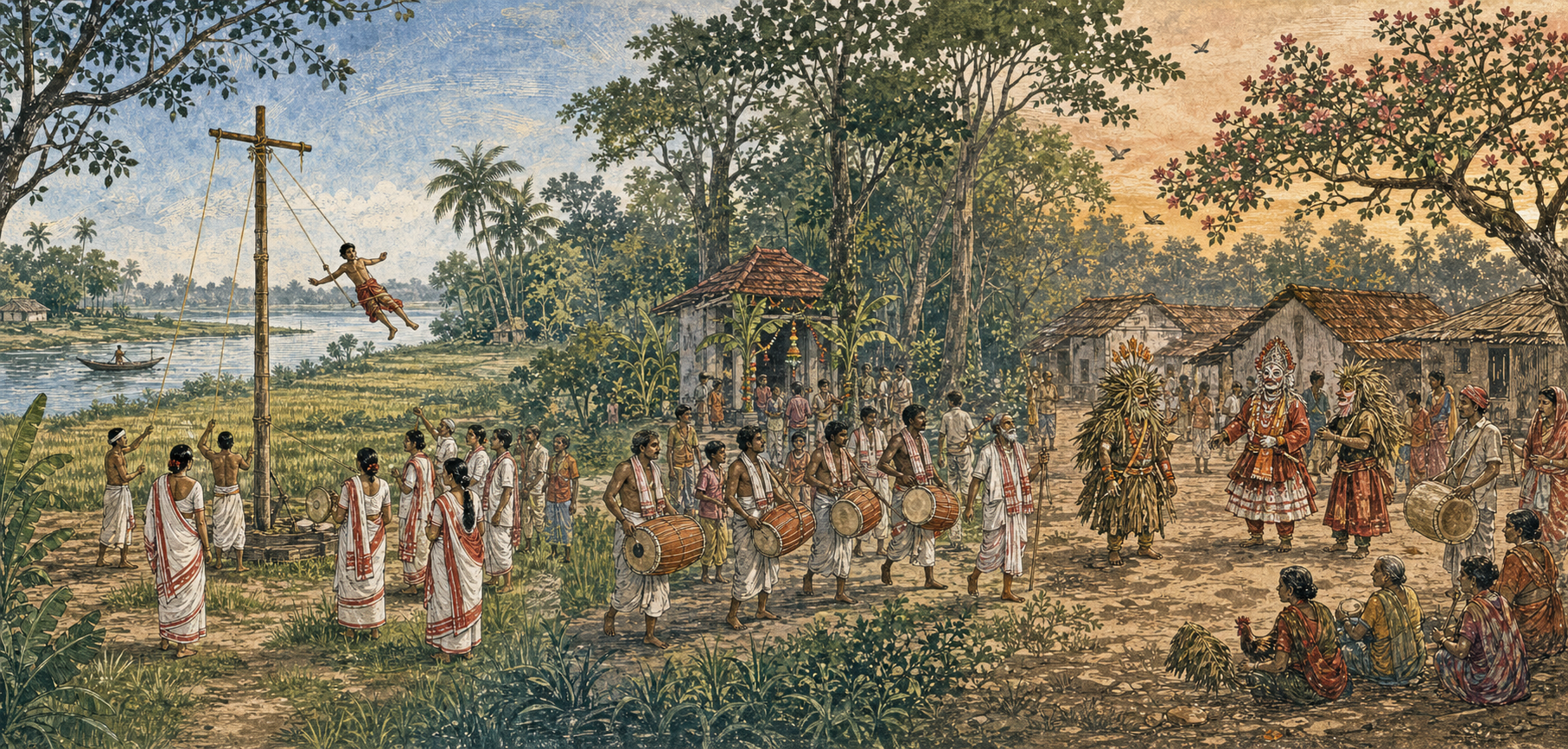
Charak Puja is especially visible in West Bengal, Tripura, and parts of Assam, but a shared calendar does not produce one standardized ceremony. Geography, community history, local deities, and Bengali-tribal interactions shape what you will see.
| Region | What to notice | What not to assume |
|---|---|---|
| West Bengal | In districts including Hooghly, Howrah, Birbhum, and South 24 Parganas, observances can have a strong connection to Shiva Gajan, with vows, processions, and riverbank rituals. | Do not assume that every district uses the same sequence, terminology, or balance between temple worship, procession, swing, and mela. |
| Tripura | Bengali and tribal cultural interactions are visible in broad village participation, shared community kitchens, and the distribution of prasad. | Do not treat the observance as a simple copy of a West Bengali model. Its local relationships are part of its identity. |
| Assam | Charak is prominent in culturally layered areas such as the western belt and the Barak Valley, particularly among Bengali-speaking and tribal communities. | Do not erase Assam’s local setting by describing the festival only through language or migration. Ask how the host community understands its own practice. |
The practical lesson is to document the local form precisely. Record the village or neighborhood, the name used there, the deity invoked, and the activities actually present. A label such as Charak, Gajan, Nil Puja, or Hajra Puja should begin your inquiry, not end it. This approach preserves variation instead of forcing a living family of traditions into one supposedly authoritative template.
How to attend without turning devotion into spectacle
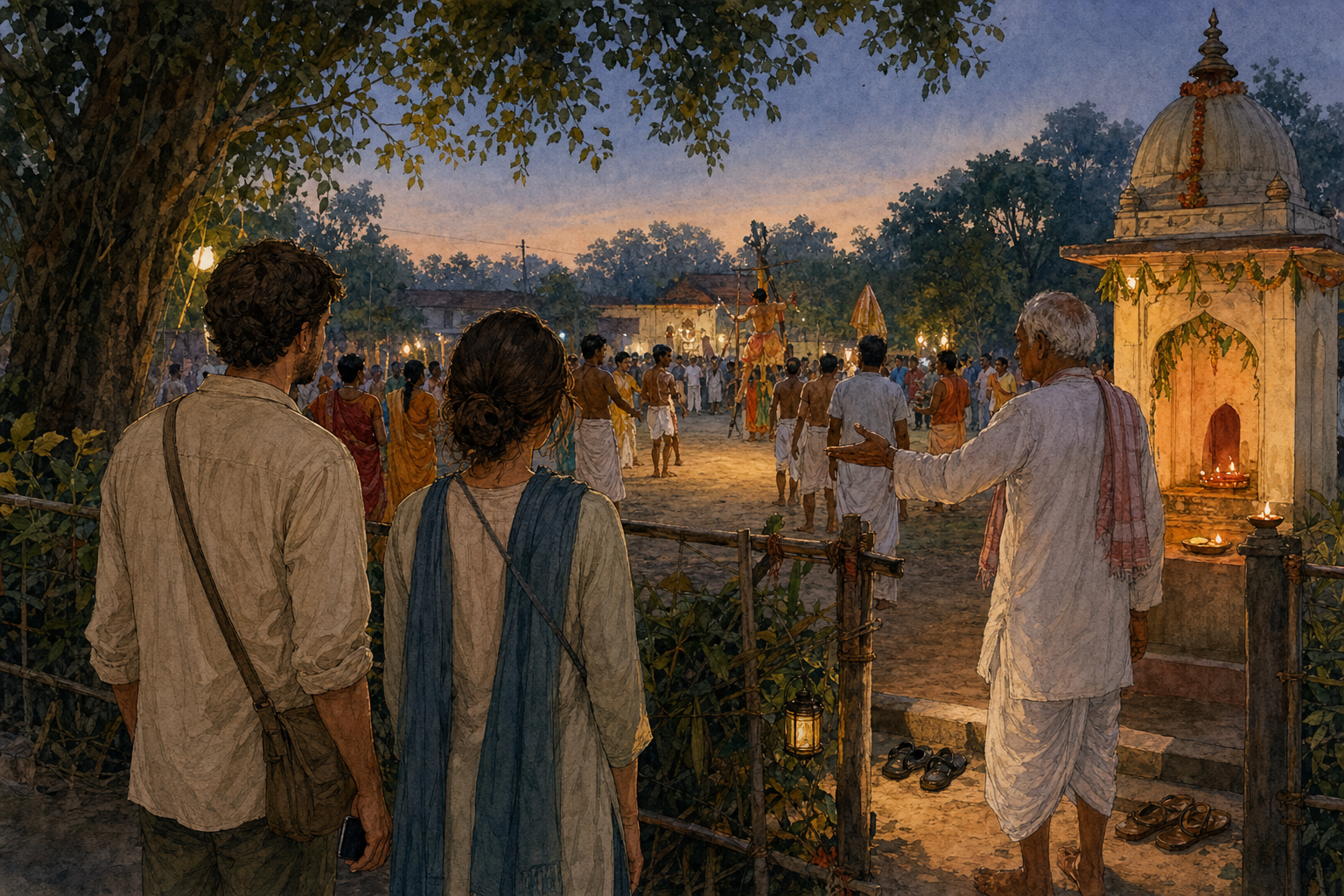
A respectful visit begins before you reach the ritual ground. Charak belongs to a community’s devotional calendar, not to a performance schedule created for outsiders. A few concrete choices will help you see more while intruding less:
- Confirm the date and local program. Because Chaitra Sankranti may fall on 13 or 14 April, check a regional panjika or almanac and then verify the time with the temple, village committee, or organizer.
- Learn the local name. Ask whether people describe the observance as Charak Puja, Gajan, Nil Puja, Hajra Puja, or another local form. Use the community’s own term when speaking about it.
- Distinguish vowed participants from spectators. Bhaktas and temporary sanyasis may be completing disciplines that began before the public event. Give them space during worship, processions, kirtan, and preparation.
- Watch the whole sequence. Notice household altars, water or field-related worship, decorations, food preparation, songs, and prasad distribution. These elements reveal what the swing alone cannot.
- Ask before photographing people. Permission is especially important around private prayer, demanding devotional acts, food distribution, and children. Do not ask a participant to repeat or intensify an act for a photograph.
- Support the commons. Engage respectfully with craftspeople, performers, seasonal produce sellers, and the mela when participation is open. The fair is part of the tradition’s social life, not an unrelated attraction attached to the ceremony.
- Write down context, not just imagery. If you publish photographs or notes, include the place, date, local name, and regional form. An unexplained image of bodily endurance can easily turn worship into exotic spectacle.
Safety requires particular care. Historically dramatic forms of physical endurance have increasingly been replaced by harnesses and methods accepted by the organizing community. This adaptation does not empty the rite of devotion. It places care and non-harm within the way devotion is practiced.
Do not imitate an endurance act, encourage someone to take a greater risk, touch the rigging, or enter the rotating area. Follow barriers and organizers’ directions. If crowd separation or safety arrangements are unclear, observe from farther away, particularly when accompanying children or elders. Proximity to danger is not a measure of reverence, and the ethical centre of Charak is tapas, dana, and seva rather than injury.
Key takeaways
- Charak Puja closes Chaitra on Chaitra Sankranti, usually 13 or 14 April, immediately before Pohela Boishakh.
- Its calendar joins a solar threshold, the end of a dry-season cycle, and preparation for a new agricultural year.
- Charak, Gajan, Nil Puja, and Hajra Puja can overlap, but local terminology and ritual emphasis should not be assumed to be identical.
- The charak gachh and its rotating rig are one part of a larger observance built from vows, Shiva devotion, music, offerings, service, public art, and the village mela.
- West Bengal, Tripura, and Assam preserve related but regionally distinct forms shaped by local histories and Bengali-tribal cultural interactions.
- Safety-conscious adaptation protects the living tradition; observers should follow local directions and never encourage dangerous displays.
Before the next Chaitra Sankranti, choose one local observance and learn its name, date, deity, and community setting. Then arrive prepared to notice the vow before the swing, the service around the worship, and the careful ending that makes a new beginning possible. That is where Charak Puja’s folk wisdom becomes visible.
References
