

If an aging parent now needs more time, coordination, or physical help, Shravana Kumara can feel like an impossible standard. Few people can leave every competing duty behind, much less carry their parents from one sacred place to another. Read carelessly, his example produces guilt: a devoted child never tires, disagrees, or needs assistance.
Read more carefully, and Shravana offers something far more useful. He gives you a way to test filial dharma: Does your affection become dependable service? Does that service answer what your parent actually needs? Does it preserve dignity? And when your power affects another person, is it governed by attention and accountability?
What Shravana’s burden actually means

Shravana lives with his elderly, blind parents and devotes himself to their care. When they long to undertake a tīrtha-yātra, he places them in two panniers suspended from a yoke and carries them from one sacred place to another. The journey is not his private spiritual project. He uses his strength to make their aspiration possible.
The journey ends in tragedy. While fetching water at night, Shravana is struck by an arrow released by prince Daśaratha. Daśaratha, renowned for shooting by sound, mistakes the noise at the water for a deer drinking. He discovers the dying youth, brings water to the blind parents, and confesses what he has done. Overcome by grief, the parents pronounce that Daśaratha will also die in anguish caused by separation from a beloved son. That consequence is fulfilled when Rāma is exiled and Daśaratha dies in sorrow.
The young ascetic is not explicitly given the personal name Shravana in the earliest textual form of the episode in Vālmīki’s Ayodhyā Kāṇḍa. Later Sanskrit, vernacular, and oral traditions made Shravana Kumara the enduring name. That textual nuance need not diminish his place in cultural memory. It helps us see how a brief epic episode became a widely recognized model of mātṛ-pitṛ-bhakti.
The yoke is a powerful image because it makes responsibility visible. Love is no longer an emotion hidden in the heart; it has weight, requires balance, and moves in a direction chosen for the parents’ benefit. Shravana does not merely praise his parents or announce his gratitude. He accepts inconvenience so that something meaningful to them can happen.
You do not have to imitate the physical act to understand the standard. Modern filial service may mean arranging accessible transport rather than carrying anyone. It may mean coordinating meals, accompanying a parent to an appointment, adapting the home, preserving prayer time, or ensuring that isolation does not quietly become the shape of old age. The form changes. The test remains: has reverence become reliable care?
Filial dharma is reverence made operational
The injunction Mātṛ devo bhava, Pitṛ devo bhava places reverence for mother and father within sacred life. It does not ask you merely to feel grateful. It asks you to behave as someone who recognizes that your life did not begin with you.
The traditional framework of three debts gives this obligation a wider setting: deva-ṛṇa, the debt to the divine powers; ṛṣi-ṛṇa, the debt to sages and teachers; and pitṛ-ṛṇa, the debt to parents and ancestors. Pitṛ-ṛṇa is not an invoice that can be settled by a gift or an annual ceremony. It names a condition of human life. You inherit a body, language, memory, culture, and place in a lineage before you are capable of earning any of them.
That debt should produce gratitude, not servility. Revering a parent does not require pretending that every parental judgment is infallible. Nor does filial duty cancel your responsibilities to a spouse, children, livelihood, health, or truth. Dharma requires discernment among real obligations. A dramatic promise that collapses under pressure is less useful than a modest commitment that can be kept.
Before accepting or refusing a request, ask four practical questions:
- Does this answer an actual need expressed by my parent, or is it mainly a performance of my own guilt or virtue?
- Will the arrangement preserve the parent’s voice, privacy, and dignity?
- Can I sustain what I am promising without silently abandoning another serious duty?
- Who else in the family or community should help carry this responsibility?
These questions protect filial dharma from two distortions. The first is neglect disguised as independence: insisting that parents need nothing because acknowledging their vulnerability would inconvenience us. The second is control disguised as care: taking over decisions because efficiency matters more to us than their agency. Shravana’s service is directed toward his parents’ cherished aim. That detail matters.
The underlying ethic also has recognizable counterparts across the Dharmic family without making the traditions interchangeable. The Buddhist Sigālovāda Sutta describes reciprocal duties between parents and children. Jain ethics brings ahimsa and compassionate responsibility into household life. Sikh dharma elevates seva as a path through which devotion becomes conduct. In each setting, gratitude becomes credible when another person’s welfare changes what you do.
Build a care practice that can survive ordinary life
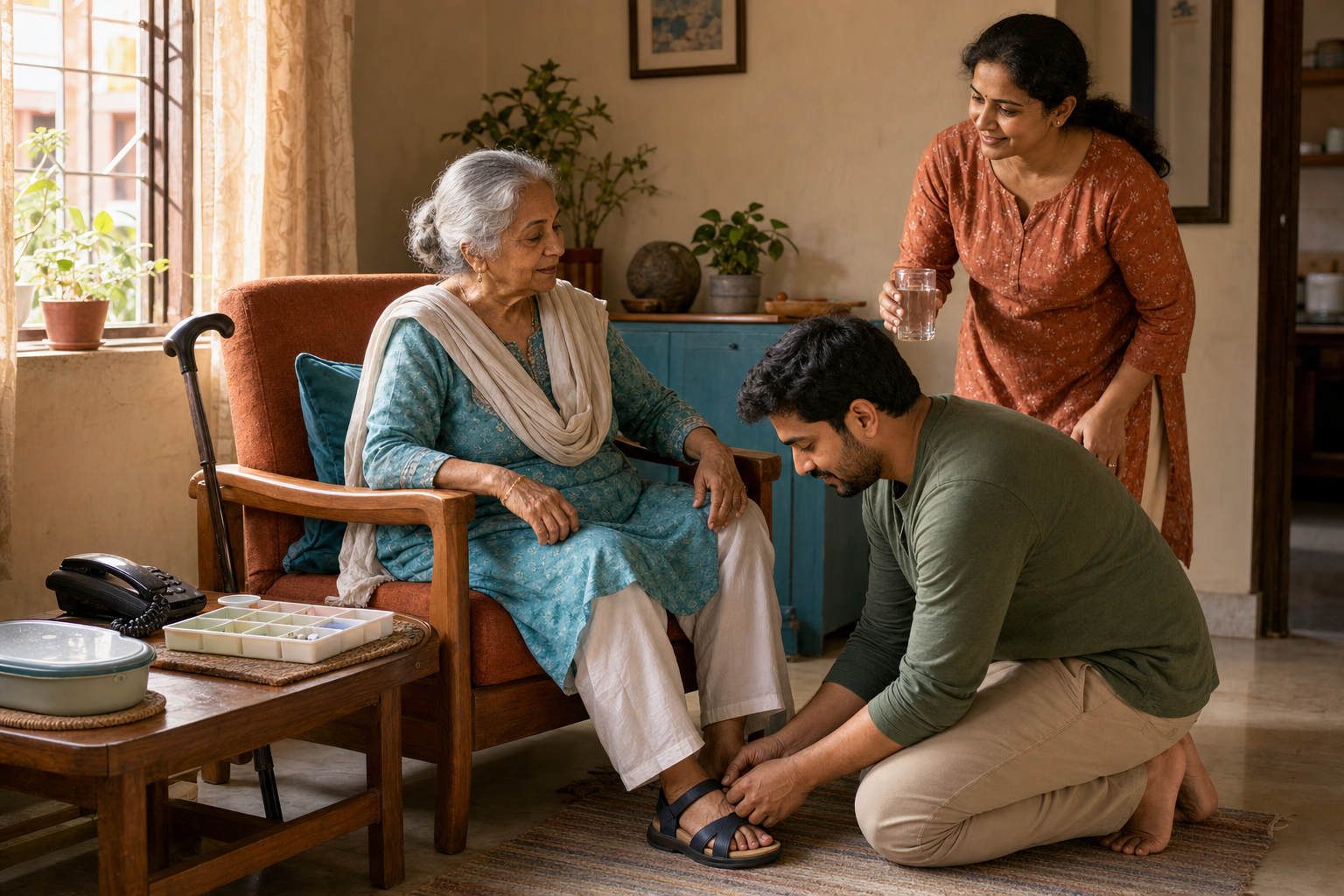
Most families do not fail for lack of affection. They fail in the handoff between affection and organization. Everyone cares, but no one knows who is arranging transport, checking the home, making the next visit, or responding when the usual caregiver is unavailable. Filial dharma becomes dependable when responsibility has a name, a rhythm, and a backup.
- Begin with the parent’s own account. Ask what has become difficult, what they most want to continue doing, and what kind of help would feel intrusive. Listen before proposing a complete solution. A parent may value a temple visit, conversation with familiar people, or control over a daily routine more than the convenience you first planned to provide.
- Turn concern into named responsibilities. Separate recurring needs from occasional ones. Meals, transport, household tasks, bills, companionship, worship, and communication with relatives do not have to be handled by the same person. Assign each accepted responsibility clearly so that everyone knows who owns it.
- Share the yoke openly. Siblings, relatives, neighbors, and community networks may contribute different forms of seva. One person may live nearby while another has more financial capacity or administrative skill. Shared care does not reduce anyone’s bhakti. It prevents devotion from depending on a single exhausted person.
- Include spiritual aspiration in the care plan. Shravana responds to his parents’ desire for pilgrimage, not only to their physical dependence. Ask whether a parent wants to visit a tīrtha or temple, observe a festival, hear scripture, continue a daily pūjā, or pass family memories to younger generations. Adapt the form to mobility and circumstance rather than treating sacred life as an optional extra.
- Revisit the arrangement when circumstances change. Health, mobility, income, housing, and caregiver availability do not remain fixed. A plan that once preserved independence may later create danger or isolation. Honest revision is not failure. It is the attentiveness that keeps seva aligned with reality.
Capacity must also be discussed before resentment becomes a crisis. Concealing exhaustion does not make a caregiver more dharmic. State what you can carry, identify where relief is needed, and distinguish an enduring duty from the belief that you must perform every task personally. The moral weight belongs to ensuring care, not monopolizing it.
Pilgrimage offers a particularly clear example. Repeating Shravana’s external feat is neither necessary nor always safe. The relevant question is what sacred participation can realistically be made possible. Depending on the parent’s wishes and mobility, that may be a well-planned journey, a nearby temple visit, participation in worship at home, or regular time for shared recitation. The purpose is not to stage a heroic photograph. It is to keep spiritual belonging alive.
Daśaratha’s warning: power must pause before action

Filial devotion is only half of the episode. Daśaratha’s arrow supplies its other enduring lesson. His celebrated skill allows him to strike a target by sound, but skill cannot compensate for a false identification. He acts on a fragment of information in a situation where the consequence cannot be recalled.
This is not an argument against competence. It is an argument for governing competence with discernment. The more authority you have in a family, institution, or state, the greater your obligation to verify before acting. Confidence can become dangerous when it converts an assumption into an irreversible decision.
Family care creates quieter versions of this error. An adult child hears a partial report and assumes a parent can no longer decide. One relative interprets silence as consent. Another treats urgency as permission to arrange everything without consultation. Speed may sometimes be necessary, but urgency does not erase the need to establish the essential facts: what has happened, what the parent wants, who will bear the consequence, and which decision can safely wait.
Daśaratha cannot undo the arrow. He can still approach the people harmed, bring the water Shravana had gone to fetch, tell the truth, and face their grief. His remorse does not cancel the result. That is precisely why the episode carries such moral force. Good intentions do not make consequences unreal.
When your own care decision causes harm or humiliation, begin with accountability rather than a defense of motive. State what happened. Attend to the immediate need. Apologize without demanding quick absolution. Then change the process that allowed assumption to replace attention. A sincere apology matters, but repaired conduct is what makes the apology trustworthy.
The parents’ curse gives this principle a karmic and narrative form. Daśaratha once causes parents to lose their son; he later dies in the pain of separation from Rāma. The point is not that every tragedy can be mapped to a simple punishment. It is that actions continue beyond the instant in which they were chosen. Dharma therefore asks you to consider consequence before displaying power, not merely to regret the outcome afterward.
Key takeaways
- Shravana Kumara represents mātṛ-pitṛ-bhakti because he turns gratitude into sustained, practical service.
- Pitṛ-ṛṇa recognizes what you inherit from parents and ancestors; it is not a demand for blind obedience or unlimited personal control.
- Good care begins with the parent’s stated needs and preserves agency, privacy, spiritual aspiration, and dignity.
- Sharing tasks with family and community can make seva more reliable. Filial dharma does not require one person to become indispensable.
- Daśaratha’s mistake warns you to verify before acting and to accept responsibility when unintended harm follows from your decisions.
The next step need not be grand. At your next conversation, ask your parent which present difficulty most limits dignity or spiritual life. Choose a responsibility you can genuinely carry, identify who can support it, and keep the promise. That is how Shravana’s yoke enters a modern home: not as spectacle, but as steady and discerning seva.
References
