
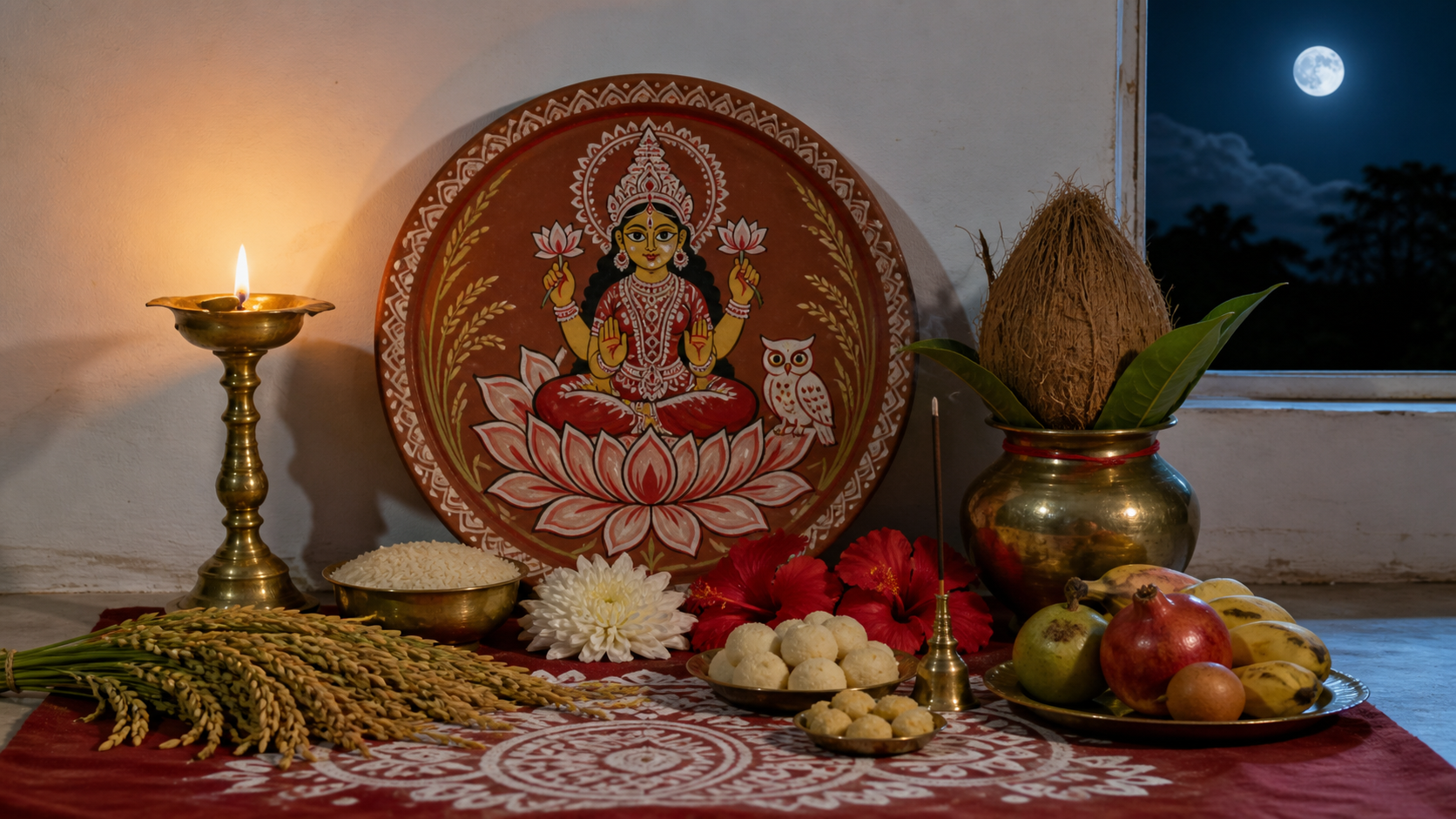
If you have inherited a Lakshmi Shora, or are bringing one home for the first time, the difficult part is rarely finding enough ritual objects. It is knowing what must be preserved, what may remain simple, and how to avoid inventing a ceremony your family never practised.
The soundest approach is to make the shora the centre of the altar, arrange the familiar materials of Bengali household worship around it, and let your family’s received custom govern the finer details. Kojagari Puja becomes meaningful when image, grain, recitation, wakefulness and household conduct remain connected.
Choose a shora as a sacred object, not seasonal decor
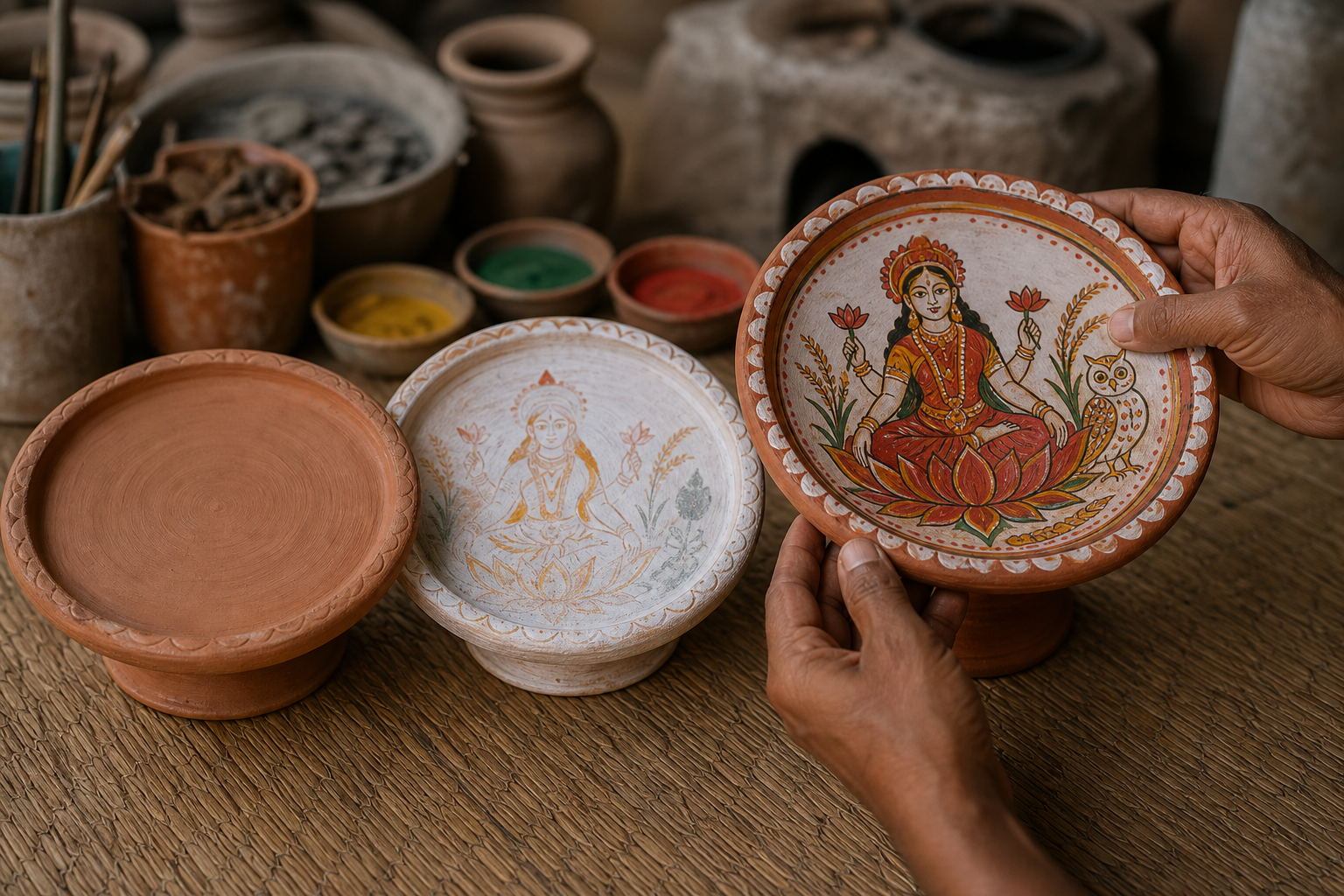
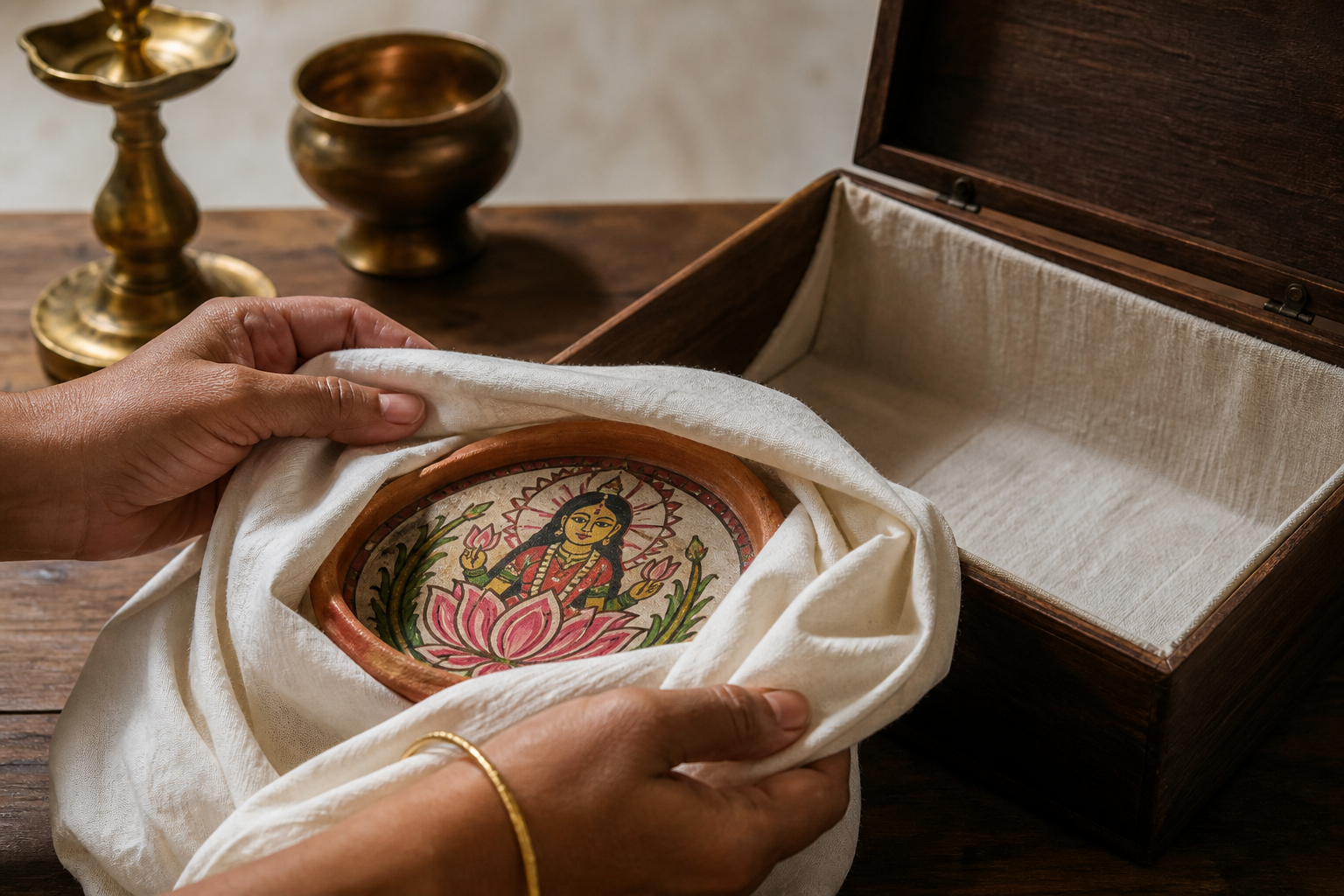
A Lakshmi Shora is a circular clay disc traditionally made by kumars and painted by hand. A disc may be sun-dried or kiln-fired. Its painted surface can present Lakshmi through a stylised figure or through signs associated with her, including the lotus, owl, paddy and alpona-like ornament.
Do not reject a shora merely because it does not resemble a sculpted murti. Its visual language may be deliberately simplified or aniconic. The circle, colours and surrounding motifs work together, so the sacred presence does not depend on portrait-like realism.
When choosing one, look closely for visible brushwork, layered colour and the texture of clay. Regional motifs may differ, and that variation belongs to the tradition. You are looking for the signs of an artisan’s hand, not mechanical symmetry. Buying directly from a kumar para, where possible, keeps your purchase connected to the potter community that sustains the practice.
If your family came from East Bengal, ask an older relative how the shora was displayed, which motifs were familiar and whether it returned to the altar on Thursdays. Even a partial memory can help you distinguish an inherited family practice from a recently assembled one. Record the answer for the next generation rather than expecting children to reconstruct it later.
Arrange the Kojagari altar and plan the night
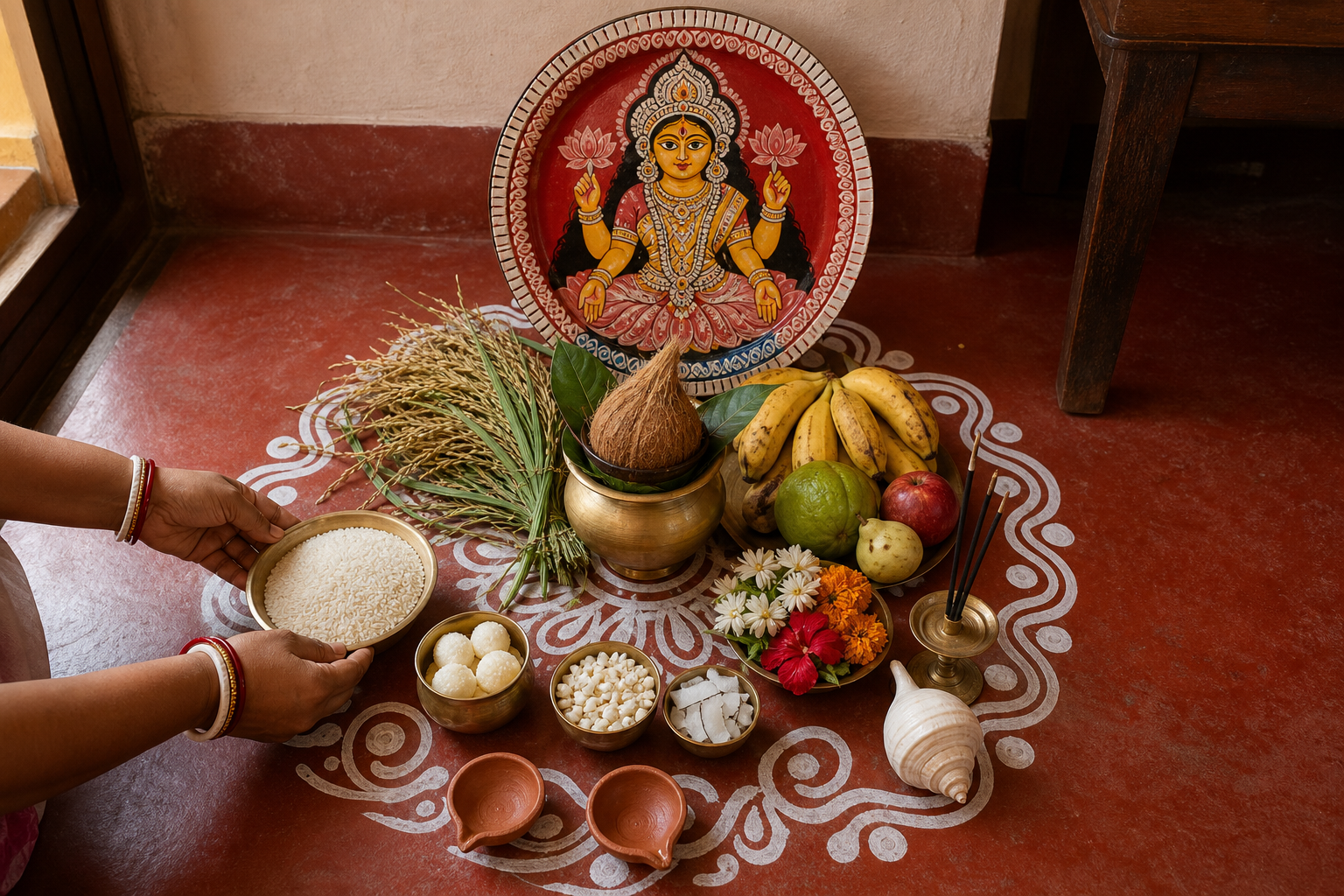
Build the altar around a few meaningful elements
Bengali Kojagari household worship commonly places the shora on a low wooden piri and surrounds it with rice, paddy, seasonal fruits, a kalash and alpona. These are not miscellaneous decorations. Together they locate prosperity within earth, harvest, nourishment and the order of the home.
- Give the low piri a clear, stable place and treat it as the visual centre of the arrangement.
- Place the shora on the piri so that its painted face can be seen without being crowded by other objects.
- Arrange rice and paddy deliberately. Grain is part of the ritual meaning, not filler for an empty altar.
- Add the kalash and seasonal fruits according to your household custom.
- Draw alpona around the sacred arrangement, allowing its lines to frame rather than obscure the shora.
- Keep the Lakshmi Panchali ready and decide beforehand who will read it, especially if several generations are participating.
This is a practical core, not a universal manual for every Bengali family. Directions, mantras, offerings and the order of observance can belong to a particular household lineage. If your family has a recognised paddhati, preserve it. If it does not, a restrained observance built from the established Kojagari elements is more coherent than borrowing unrelated rules from several regional traditions.
Make recitation and wakefulness part of the preparation
Kojagari Lakshmi Puja is observed on the full moon of Ashwin. The household shora becomes the focus of worship, the Lakshmi Panchali is recited, and families traditionally maintain a night-long vigil. Plan for that vigil before the evening begins. Decide who will read, how family members will share the night, and which memories or family stories should be told.
The vigil should not become empty endurance while everyone separately watches a screen. Its purpose is better served when wakefulness remains attentive: listen to the Panchali, speak about the people who carried the custom into your present home, and express gratitude for food, livelihood and shelter. Children can draw part of the alpona, arrange fruit or grain, and read an age-appropriate portion rather than being left as spectators.
This also keeps the festival from collapsing into a request for wealth. Lakshmi worship in the household joins prosperity to diligence, fairness in livelihood and generosity. Before the puja, therefore, ask one concrete question: what must this household do more responsibly if it seeks greater abundance? The answer may concern waste, careless spending, unfairness, neglected work or an obligation to share.
Read the painted symbols as instructions for the home
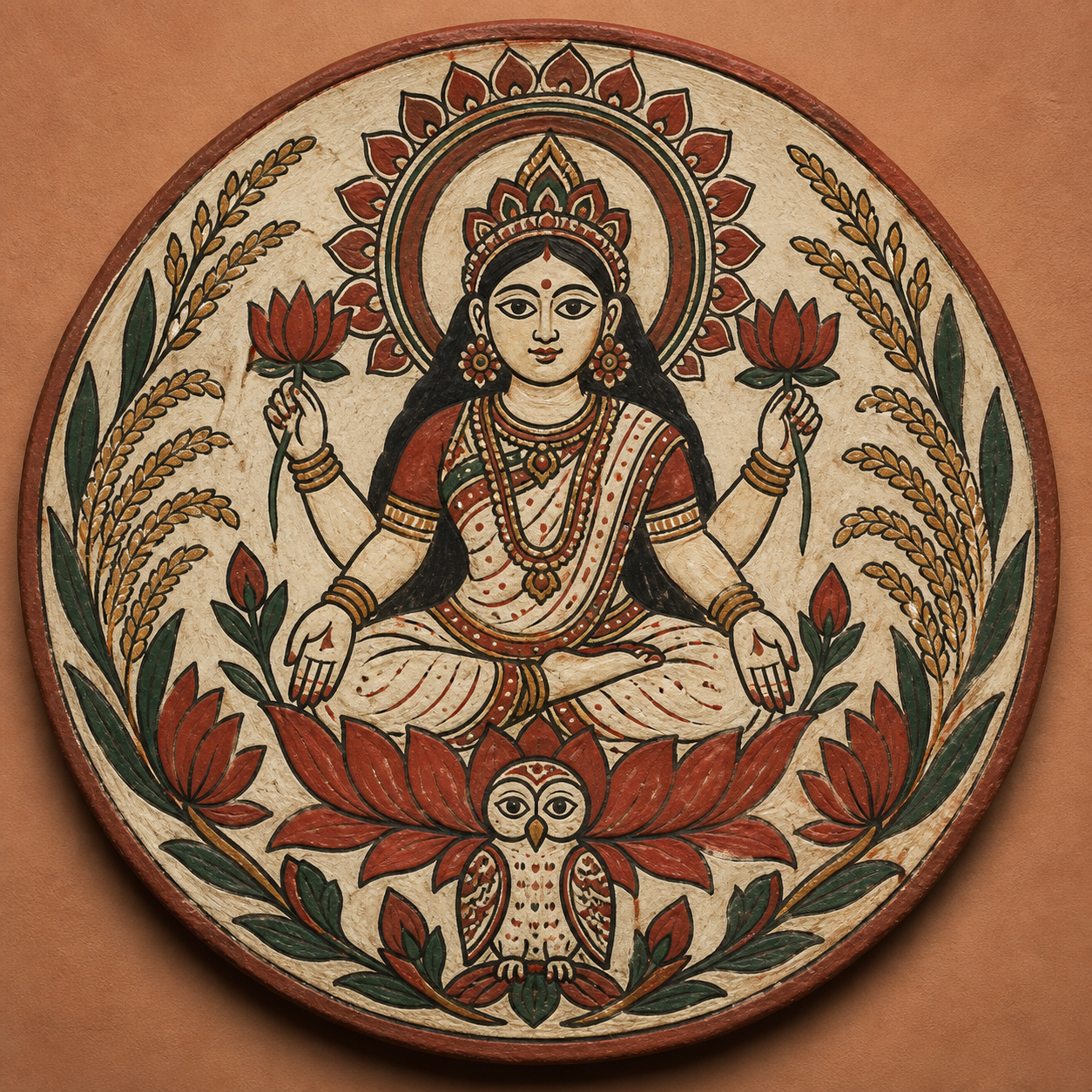
The motifs on a Lakshmi Shora are not simply a catalogue of auspicious signs. Each can direct your attention toward a different responsibility. Reading them this way turns the disc from a beautiful object into a household discipline.
| Element | Traditional significance | What it asks you to notice |
|---|---|---|
| Clay | Nurturing earth and humility | Prosperity begins with dependence on land, labour and materials; keep the observance grounded rather than ostentatious. |
| Circle | Cycles of season and grain | Abundance is renewed through recurring work and care, not secured once and possessed forever. |
| Lotus | Purity and renewal | A new ritual year should be accompanied by some renewal of conduct, not only a renewed altar. |
| Owl | Alert wisdom and the safeguarding of wealth without attachment | Look for both carelessness and hoarding; stewardship requires vigilance without making wealth the household’s master. |
| Paddy | Fertility and community sustenance | Measure prosperity by whether the household nourishes life and can share, not merely by what it accumulates. |
| Red and white palette | Auspiciousness, clarity and serene balance | Let the altar remain ordered and legible instead of covering every open space. |
| Alpona-like borders | An auspicious and protective frame | Treat the boundary around the sacred arrangement as part of the worship, not an afterthought. |
You do not need to force a separate prayer onto every painted detail. Notice the whole composition first. Clay, grain, vigilance and renewal reinforce one another: wealth is received from a living world, protected through discernment and made worthy through responsible use.
Keep the tradition alive between annual festivals
Use Thursday worship to turn an annual ideal into habit
In many Bengali homes, especially those with East Bengali roots, devotion to Lakshmi continues on Gurubaar, or Thursday. The shora may return as the focus of simple offerings, vows and readings from narratives of the Goddess.
Keep this weekly observance modest enough to repeat. Prepare the sacred place, make the simple offering recognised in your home, read the customary narrative, and connect the prayer to one act of household dharma. That act might be completing neglected work, conducting a transaction fairly, reducing avoidable waste or setting something aside to share. The point is continuity: Thursday practice prevents Kojagari’s ethical promise from disappearing after one night.
Renew the shora without discarding its memory
Many households install a new shora each year. The previous one may be retired respectfully through visarjan in clean water or by placing it beneath a tree. Follow the custom received in your family and use a method appropriate to the materials and place available to you. Annual renewal supports artisans, but reverence requires that the older sacred object not be treated as ordinary rubbish.
Before retiring it, photograph the shora and note where it was obtained, whose household custom it followed and which family members took part. This is especially valuable in the diaspora, where the physical object may be renewed but access to elders and artisan communities can be intermittent.
The tradition already carries a history of movement. Families displaced from places including Jessore and Khulna after Partition brought the shora into new neighbourhoods in Kolkata and beyond. Its compact clay form became both shrine and bearer of memory. If that history belongs to your family, name the place during Kojagari storytelling. A child who knows that place-name understands why this particular disc matters.
Questions families often face
Does a Lakshmi Shora have to show a realistic image of the Goddess?
No. Shoras can use stylised or aniconic forms alongside the lotus, owl, grain and geometric ornament. Judge the disc within Bengal’s own visual tradition rather than by how closely it resembles a sculpted image.
Must you replace the shora every Kojagari Puja?
Many households install a new one annually, but the inherited practice of your family should guide the decision. If you renew it, obtain the new shora from an artisan when possible and retire the previous one reverently rather than throwing it away.
What if your family no longer remembers the complete ritual?
Begin with the elements that define the household observance: the shora on a low piri, rice and paddy, seasonal fruit, a kalash, alpona, Lakshmi Panchali and attentive wakefulness. Ask relatives or a trusted Bengali ritual community about family-specific details, and record what you recover. Do not present a newly assembled sequence as an ancient family rule.
Your most useful preparation can begin well before Kojagari night: speak to one elder, locate one artisan-made shora, find the Panchali your household will read, and give each family member one real responsibility. That is enough to move the tradition from admiration into practice.
References
