
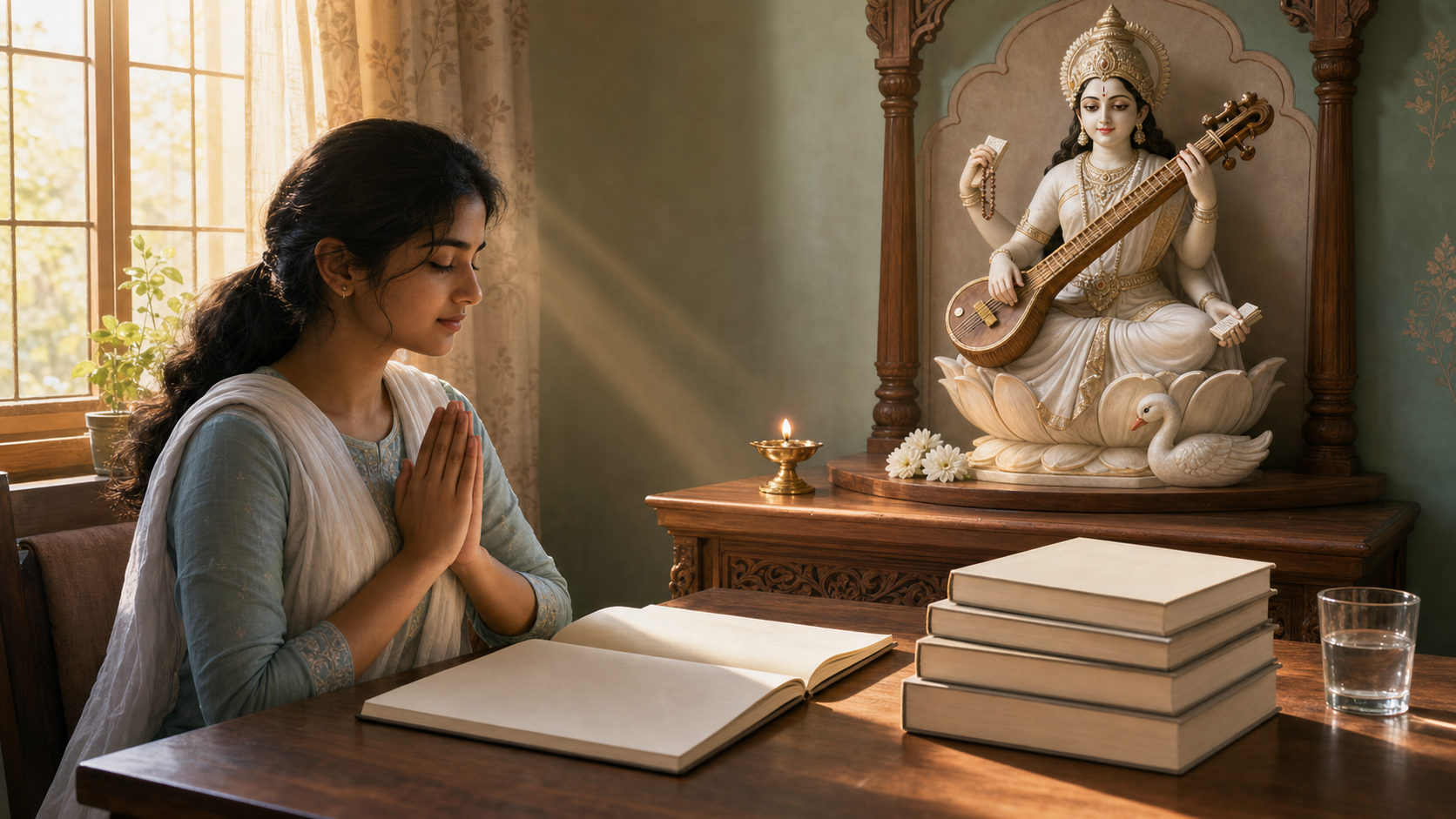
You sit down with a book, but your attention keeps leaving the page. The examination matters, the unfinished work is growing, and forcing yourself to concentrate only makes the mind more restless. At that point, you need a reliable transition from agitation to study.
Saraswati devotion can provide that transition when you treat it as a discipline rather than a bargain for marks. A short period of dhyana and mantra japa prepares the mind; focused reading, recall, revision, sleep, and honest effort do the learning. The routine below joins the two without confusing their roles.
Make devotion a commitment to learning, not a request for results
Maa Saraswati represents more than the accumulation of information. She is associated with vidya, refined speech, music, art, and the discernment needed to use knowledge well. Approaching her before study therefore changes the question. Instead of asking only, “Will I get the marks I want?”, you ask, “Can I make my attention, speech, and conduct worthy of what I am trying to learn?”
Her familiar iconography joins the white lotus and garments, hamsa, manuscript, mala, and veena. These symbols can become practical instructions at your desk. Purity means removing what does not belong in the study period. The hamsa points to discernment: distinguish genuine understanding from the comfortable feeling of merely recognizing a page. The manuscript directs you back to the material. The mala represents repeated practice. The veena reminds you that sustained learning needs rhythm rather than frantic effort.
Set one small vrata, or commitment, for each session. You might resolve to complete a defined problem set, explain a difficult idea without copying the textbook, revise the errors from your last attempt, or keep your phone out of reach until the block ends. This gives devotion a visible expression. Without such a commitment, even a beautiful puja can remain separate from the work waiting on your desk.
This is a specifically Hindu devotional practice, but reverence for knowledge reaches across Dharmic traditions in distinct forms. Jain traditions honor Saraswati in connection with learning and scriptural study. Certain Buddhist traditions invoke Sarasvati as a patron of eloquence and protector of Dharma. The Sikh path is not deity-centered, yet it gives profound importance to gyan, shabad, and kirtan. These traditions should not be flattened into one ritual. Their useful point of meeting is the conviction that knowledge requires disciplined attention, truthful expression, humility, and ethical conduct.
Follow a simple 5–15-minute Saraswati study ritual

A sustainable practice does not need to be elaborate. A steady session of 5–15 minutes is more useful for a daily study routine than an occasional long observance that you cannot maintain. Early morning is traditionally favorable, but the most workable time may be immediately before your main study block.
- Prepare the work before you sit. Clear the desk, place the required book and writing materials within reach, silence digital distractions, and name the task you will begin after japa. A precise target such as revising one weak topic is better than the vague instruction to study.
- Take a stable seat. Sit comfortably with the spine aligned. Rest your hands gently on your thighs. Close your eyes or soften your gaze. Comfort matters because physical fidgeting can become an easy route away from the work.
- Let the breath become even. Take a few slow breaths without straining or trying to manufacture a special state. The purpose is simply to notice that you have arrived and are no longer following the momentum of the previous activity.
- Bring Saraswati to mind. Visualize her luminous white form, the veena, the manuscript, the mala, the lotus, or whichever traditional image supports your devotion. Hold a simple intention: may this study become clear, truthful, and beneficial.
- Begin mantra japa. Use the accessible mantra Om Aim Saraswati Namah. Repeat it internally or in a soft voice at a natural pace. Silent japa is often especially suitable before study because it preserves the quiet you are trying to establish. You may use a mala to keep rhythm or let the breath support the repetition; neither method should turn the practice into a race.
- Close with a clear dedication. Offer the coming effort to Saraswati and acknowledge your teachers, family, and everyone whose labor made your education possible. Then recall the exact task you prepared.
- Begin immediately. Open the book or problem set before checking messages, adjusting the room again, or searching for additional motivation. The first act after japa teaches the mind what the ritual means.
Do not judge a session by whether you felt unusually peaceful, devotional, or inspired. Judge it first by whether you crossed into your work with less resistance. Attention will still wander. The discipline lies in noticing that movement and returning, just as you returned to the mantra during japa.
The distinction between spiritual support and academic work matters. Japa can organize breath, attention, and intention, but it cannot supply material you have not learned. Revision, effective notes, focused intervals, balanced breaks, and adequate sleep remain essential. Extending the ritual while avoiding the difficult chapter reverses its purpose.
Carry the devotional rhythm through the whole study session

The opening ritual is only the threshold. Focus becomes more dependable when the rest of the session has a recognizable shape. Use dhyana and japa at natural transitions rather than waiting until distraction has already consumed the day.
| Moment | Devotional action | Study action |
|---|---|---|
| Before the main block | Brief Saraswati dhyana and mantra japa | Begin one predefined task immediately |
| When changing subjects | Pause for a few quiet breaths or inward repetitions | Put away the previous material and state the next objective |
| After distraction | Recall Saraswati without self-reproach | Return to the exact line, question, or step where attention broke |
| At the end | Offer gratitude for what could be learned | Recall the key material without looking and record the next starting point |
| Before an examination | Use the same familiar, brief practice | Read each instruction carefully and answer from what you actually know |
Give every study block an observable output. “Read chemistry” does not tell you when the work is complete or whether you understood it. “Explain the reaction in my own words and correct the gaps from the text” does. For history or philosophy, close the book and reconstruct the main argument. For mathematics, solve rather than reread a worked example. For language study, produce the word, sentence, or explanation without looking. The attempt reveals what recognition can hide.
When you find a gap, return to the material, correct it, and try again. This cycle expresses abhyasa: repeated, attentive practice. The devotional frame protects that repetition from becoming mechanical. You are not merely chasing a score; you are refining the instrument through which knowledge is received and expressed.
Guard the environment as carefully as the ritual. If notifications remain active and entertainment is one gesture away, repeated interruptions will keep asking attention to change direction. Put the device outside your immediate study space when possible, or restrict it to the function the task requires. An uncluttered desk is not a decorative spiritual gesture. It removes decisions and makes the next action obvious.
Close the session deliberately. Without looking at your notes, bring back the central idea, method, vocabulary, or sequence you worked on. Identify what still feels uncertain and write down where the next session should begin. Then offer gratitude. This prevents the following day from starting with the avoidable question, “Where was I?”
Know what to do when distraction or exam anxiety returns
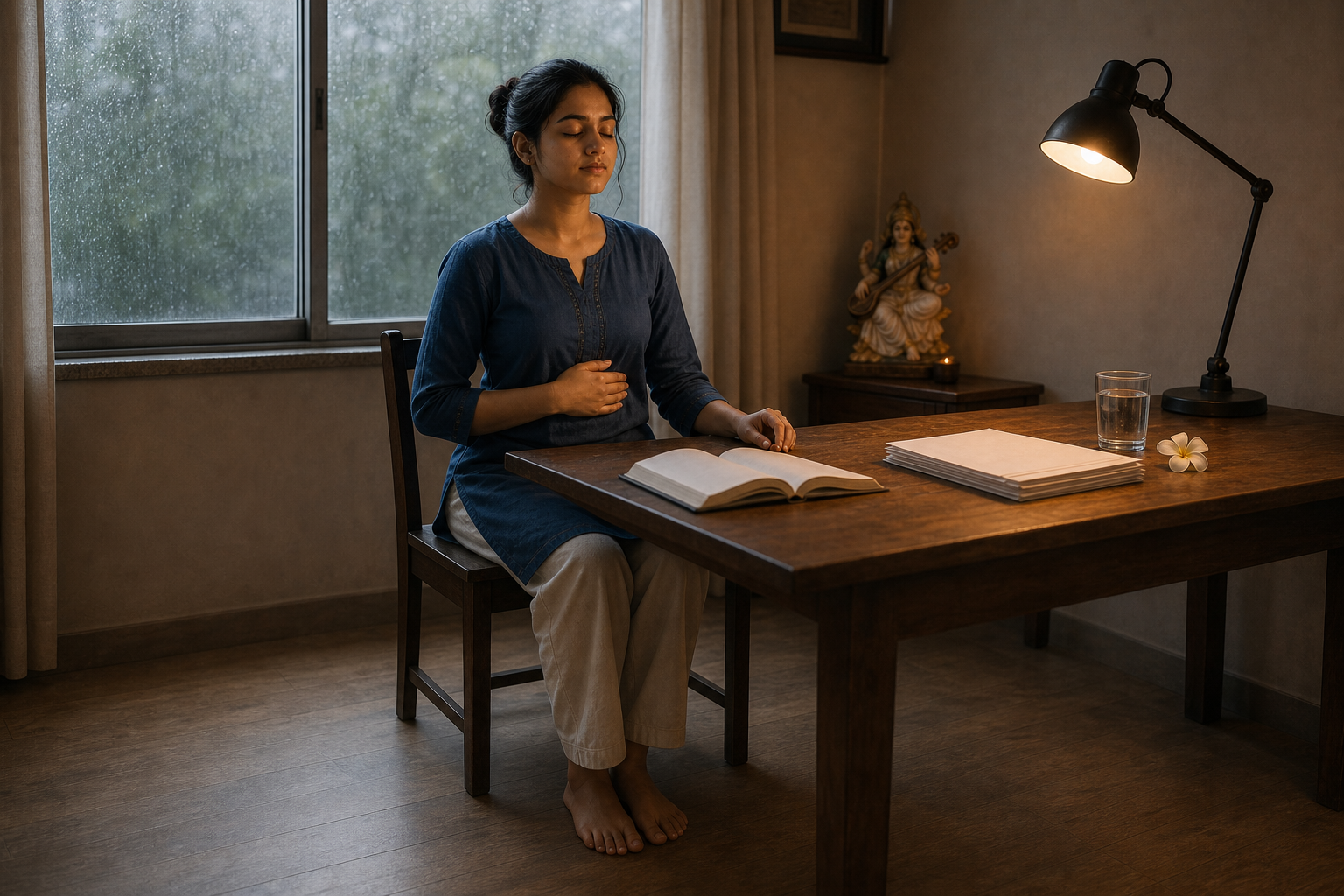
A restless day does not prove that Saraswati devotion has failed. Japa is not a promise that unwanted thoughts will disappear. It gives you a practiced route back to the task. The useful response depends on where the difficulty actually lies.
- If you cannot begin: shorten the distance to the first action. Settle the breath, repeat the mantra quietly, and open the material at the exact place you already chose. Do not wait for perfect willingness.
- If you feel calm but remember little: the problem is probably not the devotional opening. Replace passive rereading with recall, problem-solving, correction, and revision.
- If every notification breaks concentration: treat it as an environment problem. Remove the device or disable the interruption before asking the mind to resist it repeatedly.
- If the ritual keeps growing while the work keeps shrinking: set the end point before you begin. Devotion has become avoidance when another round of preparation repeatedly postpones the textbook.
- If you fall behind: reduce the task to a manageable next unit and resume. Do not make extravagant vows to compensate for lost time; rebuild the ordinary rhythm.
On an examination day, rely on the practice you already know. A new, lengthy observance can add another demand to an already pressured morning. Use a familiar period of dhyana and japa, gather what you need, and arrive ready to follow the examination process. If the setting does not permit your usual routine, inward remembrance and an even breath can still mark the transition.
If your mind goes blank during the examination, stop searching every corner of memory at once. Let the breath settle, recall the mantra briefly, and read one question with care. Identify what it is asking and begin with what you do know. You do not need to feel completely calm before you can take the next correct step.
Persistent anxiety that seriously disrupts sleep, study, or daily functioning needs appropriate support from a qualified counselor or health professional. Saraswati devotion may remain part of your spiritual life, but it should not be used to avoid needed care.
There is also an ethical test. Truthfulness in scholarship and respect for teachers and peers belong inside Saraswati practice. Cheating, copying, manipulating a result, or using eloquence to conceal ignorance contradicts the qualities being invoked. A lower honest mark can show you what to repair; a dishonest mark hides the gap and damages the learner.
Key takeaways
- Use Saraswati devotion as a transition into disciplined study, not as an exchange for guaranteed marks.
- Prepare the desk and define the first task before beginning dhyana, so the ritual leads directly into work.
- Keep the daily practice sustainable: sit steadily, settle the breath, visualize Saraswati, and repeat Om Aim Saraswati Namah at a natural pace for a session within the traditional 5–15-minute range.
- Silent japa suits a quiet study routine; a mala or breath-based rhythm may help, but speed and large counts are not the goal.
- Pair devotion with recall, correction, revision, good notes, focused intervals, balanced breaks, and adequate sleep.
- Use brief inward remembrance between subjects and after distraction, then return to a clearly identified next action.
- Measure the practice by steadier attention, honest effort, clearer understanding, and better conduct—not by whether every session feels peaceful.
Choose one subject and prepare its first task tonight. At your next study period, follow the short routine and begin as soon as the japa ends. Repeat it long enough for the sequence to become familiar. Vasant Panchami is a meaningful time to initiate or renew this commitment, but you do not need to wait for a festival: the next honest encounter with your books is already an offering to Saraswati.
References
- DharmaRenaissance Blog — Students’ Guide to Saraswati Dhyana & Mantra Japa: Focus, Memory, and Exam Success
- DharmaRenaissance Blog — Maa Saraswati: Timeless Goddess of Music, Learning, and Inner Harmony in Dharmic Traditions
