
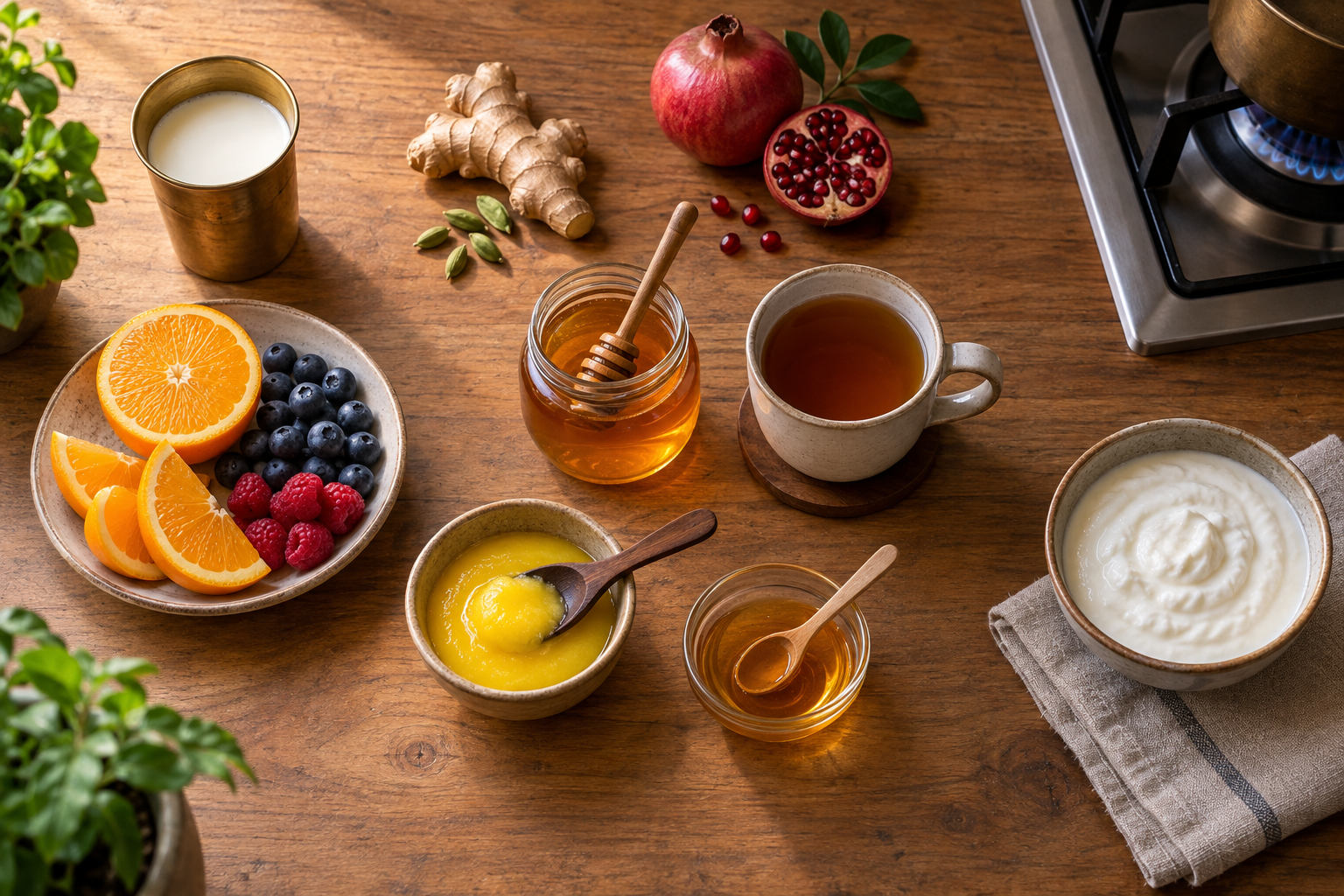
You may already choose fresh food, cook at home, and still wonder whether a milk-and-fruit smoothie, honey in hot tea, or curd with dinner fits Ayurvedic practice. Ayurveda does not answer by labelling each ingredient permanently good or bad. It asks whether the pairing, proportion, preparation, sequence, season, and your own condition make the meal compatible.
You do not need an enormous forbidden-food chart to use this idea. Start with the combinations you repeat: heated honey, milk with acidic fruit, curd that is boiled or eaten at night, equal quantities of honey and ghee, and abrupt switches between hot food and very cold water. Those changes capture the practical heart of viruddha ahara without turning every meal into a source of anxiety.
A healthy ingredient can still be a poor fit
Within Ayurveda, sesame oil, ghee, and honey can serve as balancing substances for Vata, Pitta, and Kapha respectively. Yet the same ingredient may become unsuitable when its dose, preparation, or companions change. That apparent contradiction is intentional: the food is not being judged in isolation.
Charaka describes substances that oppose the body and its tissues because of their qualities, combination, processing, place, time, quantity, or inherent nature. His practical test is whether a food pattern provokes or dislodges doshas without helping the body eliminate them. In this classical physiology, doshas are organising principles and dhatus are bodily tissues. Viruddha ahara is therefore broader than two ingredients that should not share a plate.
Charaka identifies eighteen forms of incompatibility. The following forms are the most immediately useful when you are planning an ordinary meal:
| Form of incompatibility | Question to ask | Classical example |
|---|---|---|
| Samyoga, or combination | Do these ingredients belong together? | Milk with acidic fruit, fish, or horse gram; jackfruit with fish |
| Matra, or proportion | Does the ratio change the result? | Honey and ghee in equal quantities |
| Samskara, or processing | Has heating or cooking altered the food? | Heated honey or boiled curd |
| Krama, or sequence | What was taken immediately before or after? | Hot water after honey or ice-cold water after a meal |
| Kala, or time and season | Does the food oppose the time of day or climate? | Curd at night, raw salad during monsoon, very spicy food in peak summer, or cold food in winter |
| Virya, or potency | Do the foods have conflicting energetic effects? | Horse gram with watermelon |
| Parihara, or contraindicated follow-up | Does the next item work against the first? | Cold water immediately after a hot beverage |
This distinction prevents unnecessary restriction. If night is the problem with curd, it does not automatically follow that curd is forbidden at every time. If heat is the problem with honey, the useful change is in preparation. If equal quantities create the conflict between honey and ghee, the rule concerns the ratio rather than a permanent ban on either ingredient.
Viruddha ahara should not be confused with a food allergy, infection, intolerance, or a modern toxicology finding. Those are biomedical categories with different causes and consequences. Classical descriptions of a food as harmful or toxic do not by themselves prove that one accidental serving causes acute poisoning.
Start with four high-impact kitchen rules
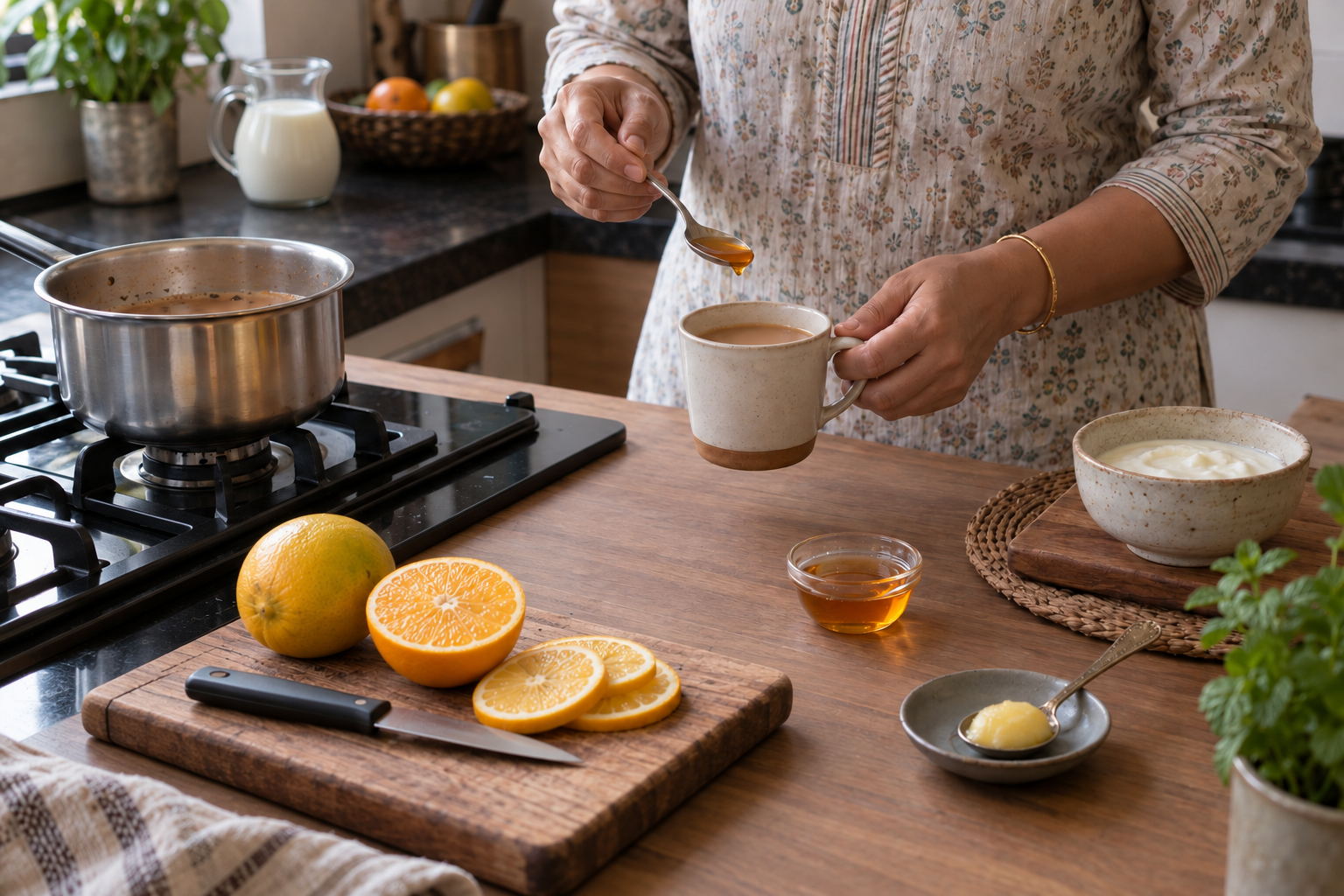
The easiest rules to apply are attached to familiar ingredients and visible kitchen decisions. Fix these recurring habits before worrying about rare combinations you may never encounter.
Keep honey away from heat
Ayurveda treats heating honey as samskara viruddha, an incompatibility produced by processing. This includes adding it to a hot drink. Taking hot water immediately after honey is also discouraged, but as a problem of sequence rather than preparation. The popular hot honey-water ritual therefore conflicts with the classical rule instead of representing an Ayurvedic detox practice.
If you want to follow the instruction strictly, use honey without heating it and do not chase it with a hot beverage. No precise temperature boundary is supplied, so claims that a particular degree is guaranteed safe go beyond this guidance. The cleanest household rule is simpler: do not cook honey or stir it into something that is still hot.
Honey and ghee create a different issue. Each is valued on its own, but equal quantities are classified as matra viruddha. The traditional rule of thumb is that one should be twice the quantity of the other. Because a casual spoonful of each makes the ratio easy to mishandle, the practical home choice is to avoid combining them equally. If both appear in a therapeutic or classical formulation, use the preparation method supplied by a qualified Ayurvedic practitioner rather than improvising the ratio.
Separate milk from acidic fruit
Milk with citrus or other acidic fruit is a standard example of samyoga viruddha. Acid can visibly curdle milk, and Ayurveda regards the resulting combination as heavy, Kapha-provoking, and difficult to digest. The simple correction is to choose either a fruit preparation or a milk preparation at that eating occasion instead of blending them into one smoothie, milkshake, or fruit bowl.
Do not invent a universal waiting interval. No exact separation in minutes or hours is established here. Treating fruit and milk as separate eating occasions is more faithful than promising that an arbitrary gap neutralises the pairing. Milk with fish or horse gram, and jackfruit with fish, also appear among the classical combinations to avoid.
Banana and milk deserve proportionate caution. A reported animal experiment involving repeated exposure found changes in liver-enzyme levels, but one animal finding does not establish that the combination causes liver injury in humans. You may separate the foods to follow Ayurveda, but you should not use that limited result to diagnose damage in yourself or frighten someone who has consumed a banana milkshake.
Treat curd as a question of time and processing
Curd illustrates why a flat list of good and bad foods fails. The classical caution is directed especially at habitual night consumption and boiling. If you want to observe the rule, move curd to a daytime meal and keep it out of preparations in which it will be boiled.
Black pepper, moong dal soup, and gooseberry pickle are recommended traditional accompaniments when curd is eaten. Think of them as part of Ayurvedic meal design, not as medical antidotes. They do not make curd safe for someone with an allergy, a clinically diagnosed intolerance, or another condition that requires professional dietary guidance.
Avoid abrupt hot-cold transitions
Ice-cold water immediately after a meal and cold water directly after a hot beverage are both flagged, though under slightly different forms of incompatibility. You do not need to avoid water altogether. Choose non-iced water and avoid an immediate swing from one temperature extreme to the other.
Do not turn that instruction into a universal fluid quota. Hydration needs differ, and this framework supplies no quantity that is safe for every person. If a clinician has given you instructions about fluids because of a diagnosed condition, those instructions take priority over a general dietary rule.
Check the meal in the order you actually make it
You will apply viruddha ahara more consistently if you inspect a routine rather than memorise disconnected prohibitions. Before preparing a meal you eat often, run through this sequence:
- Check the pairing. Look first for milk with acidic fruit, milk with fish or horse gram, jackfruit with fish, or horse gram with watermelon.
- Check the proportion. If honey and ghee are both present, do not use equal quantities.
- Check the processing. Ask whether honey will be heated or curd will be boiled.
- Check the sequence and temperature. Notice hot water after honey, ice-cold water after a meal, or cold water immediately after a hot drink.
- Check time, season, and place. Reconsider curd at night, raw salads during monsoon, very spicy food in peak summer, and cold food during winter.
- Check repetition. Give priority to a conflict built into your daily routine rather than an unusual pairing you encountered once.
Seasonal advice requires judgement. Monsoon, summer, and winter describe climatic conditions, not identical calendar dates across the world. Charaka includes both time and place among the variables, so apply the principle to the climate you actually inhabit. A cold dish may oppose a harsh winter day but make little sense as the first concern in a hot environment.
Change one repeated habit at a time. Replace the hot honey drink with an unsweetened hot drink and use unheated honey separately. Make a fruit dish instead of a citrus milkshake. Move curd from dinner to a daytime meal. Choose non-iced water after hot food. Once the new routine becomes ordinary, inspect the next frequent meal.
If you keep notes, record what you ate, how it was prepared, the time, and what you noticed afterward. Do not treat one episode of heaviness or bloating as proof that a classical mechanism has been medically confirmed. A log can reveal a repeatable pattern worth discussing; it cannot diagnose its cause.
Treat classical warnings as a framework, not a diagnosis
Viruddha ahara offers a relational way to think about food. It can help you notice that preparation matters, that timing changes a meal, and that two respected ingredients do not automatically form a suitable combination. That is a more careful approach than treating every fashionable ingredient as beneficial in every form.
Its categories are not interchangeable with laboratory toxicology or human clinical evidence. Milk curdling in the presence of acid is observable; the fact of curdling alone does not prove a specific disease outcome. A traditional warning about accumulated doshic disturbance is also different from evidence that a single serving creates an emergency. Keep those claims separate.
If you accidentally eat a listed combination and feel well, do not panic, force vomiting, begin an improvised cleanse, or compensate with severe fasting. Simply avoid making the combination a routine if you wish to follow the tradition. Severe symptoms, a suspected allergic reaction, or persistent digestive problems require medical assessment rather than a food-combination remedy.
Seek individual guidance before making a highly restrictive diet for a child, during pregnancy, while managing a diagnosed condition, or while following a clinician-directed nutrition plan. A qualified Ayurvedic practitioner can help interpret the classical framework, while an appropriate medical professional or registered dietitian can assess symptoms, nutritional adequacy, and clinical risks. One should not be used as a substitute for the other.
Key takeaways for your kitchen
- Viruddha ahara is not merely a list of bad foods. It examines combination, quantity, processing, sequence, time, season, place, and potency.
- Do not heat honey, cook with it, add it to a hot drink, or immediately follow it with hot water if you are observing the classical rule.
- Avoid equal quantities of honey and ghee. Do not improvise therapeutic ratios.
- Keep milk separate from acidic fruit; milk with fish or horse gram is also classically discouraged.
- Do not boil curd, and move it away from habitual nighttime use if you want to follow Ayurvedic timing.
- Avoid ice-cold water directly after a meal and cold water immediately after a hot drink, without turning the rule into unsafe fluid restriction.
- Start with the incompatible pattern you repeat most often. An occasional mistake is not a reason for fear or an extreme cleanse.
- Use the framework to organise food, not to diagnose symptoms or replace appropriate medical care.
At your next familiar meal, identify one concrete conflict and change it while you prepare the food. Once that choice becomes effortless, examine another routine. This keeps Ayurvedic discipline precise, proportionate, and practical enough to live with.
References

Leave a Reply
You must be logged in to post a comment.