

If you have seen the phrase pan-Islamic NATO attached to a meeting in Mecca, your immediate question is probably simple: does Bharat now face a binding military alliance led by Pakistan, Saudi Arabia and Turkey?
The sober answer is that a three-country meeting and an announced intention to build a NATO-like Islamic grouping deserve attention, but they do not by themselves establish an operational collective-defence pact. India should neither dismiss the alignment nor grant it capabilities that have not yet been demonstrated. The right response is to test the claim, identify the forms of cooperation that could actually hurt India, and watch for the institutional signals that turn rhetoric into military power.
First ask whether an alliance actually exists

The word agreement can describe anything from a political understanding to a signed treaty. The word NATO carries a much heavier implication: a defined mutual-defence obligation supported by standing institutions, joint planning, interoperable forces, financing and repeated exercises.
Before you accept the NATO comparison, apply six tests:
- Constitutive text: Is there a signed and published instrument naming the parties, its legal status and its geographic scope?
- Activation threshold: What event triggers assistance? An invasion, an attack on military forces, a strike on terrorist infrastructure, a cyberattack and an internal rebellion are not interchangeable.
- Nature of the obligation: Must every member use military force, or may it choose diplomatic, financial, intelligence or logistical support?
- Decision-making machinery: Is there a council, secretariat, standing military committee or combined command? Who decides whether the threshold has been crossed?
- Forces and money: Are units assigned in advance? Is there a common budget, procurement system, logistics network or deployment plan?
- Entry and exit rules: Can other states join, and can a member refuse a particular operation without leaving the grouping?
The character, operating method and financing of the proposed arrangement remain unresolved. No mutual-defence clause, activation procedure or combined command is established in the information presently available. Those are not administrative details. They mark the difference between a diplomatic platform and a usable military alliance.
For now, proposed security framework is more precise than Islamic NATO. That wording can change if a treaty, command structure and assigned capabilities appear. Precision matters because an exaggerated label can produce panic, while a dismissive label can conceal steadily growing coordination.
The three states bring complementary strengths and conflicting interests

The proposed grouping is strategically interesting because its members possess different forms of leverage. In theory, Saudi financing, Turkish defence production and Pakistani strategic capabilities could reinforce one another. In practice, each state also carries constraints that could prevent political solidarity from becoming automatic military action.
| State | Potential contribution | Constraint to watch |
|---|---|---|
| Pakistan | Nuclear and missile capabilities, armed forces and longstanding security ties with Saudi Arabia | Economic fragility, dependence on outside support and the domestic cost of entering another state’s war |
| Turkey | A substantial defence industry and military technology that could support procurement, training and interoperability | Economic limitations and no publicly defined obligation to defend either partner in a specific crisis |
| Saudi Arabia | The financial capacity to sustain a wider security initiative and strong convening influence in the Islamic world | Heavy reliance on the United States for security and limited evidence of an independent combined-war structure |
Past conduct provides an essential reality check. Pakistan and Saudi Arabia already had security arrangements, yet Pakistan declined to join the Saudi campaign against the Houthis in Yemen. That episode shows why religious affinity and security cooperation should not be mistaken for an unconditional promise to fight. Domestic politics, military risk and national interest can still override expectations of solidarity.
The same caution applies to the grouping’s purpose. Michael Kugelman has been cited as assessing that Iran is the immediate focus, while Pakistan may seek participation from Egypt and Jordan. If that assessment is right, Mecca may have produced an expandable regional platform rather than a treaty designed solely for conflict with India.
That does not make the platform harmless. It tells you where to look for internal friction. Saudi Arabia’s rivalry with Iran is not identical to Pakistan’s security preoccupation with India or Turkey’s regional ambitions. A pan-Islamic slogan cannot erase those differences. If the members cannot agree on the principal adversary, they are less likely to accept automatic military obligations. They may still coordinate weapons, intelligence, financing and diplomatic pressure in selected crises.
The global danger lies in crisis linkage, not a single grand war
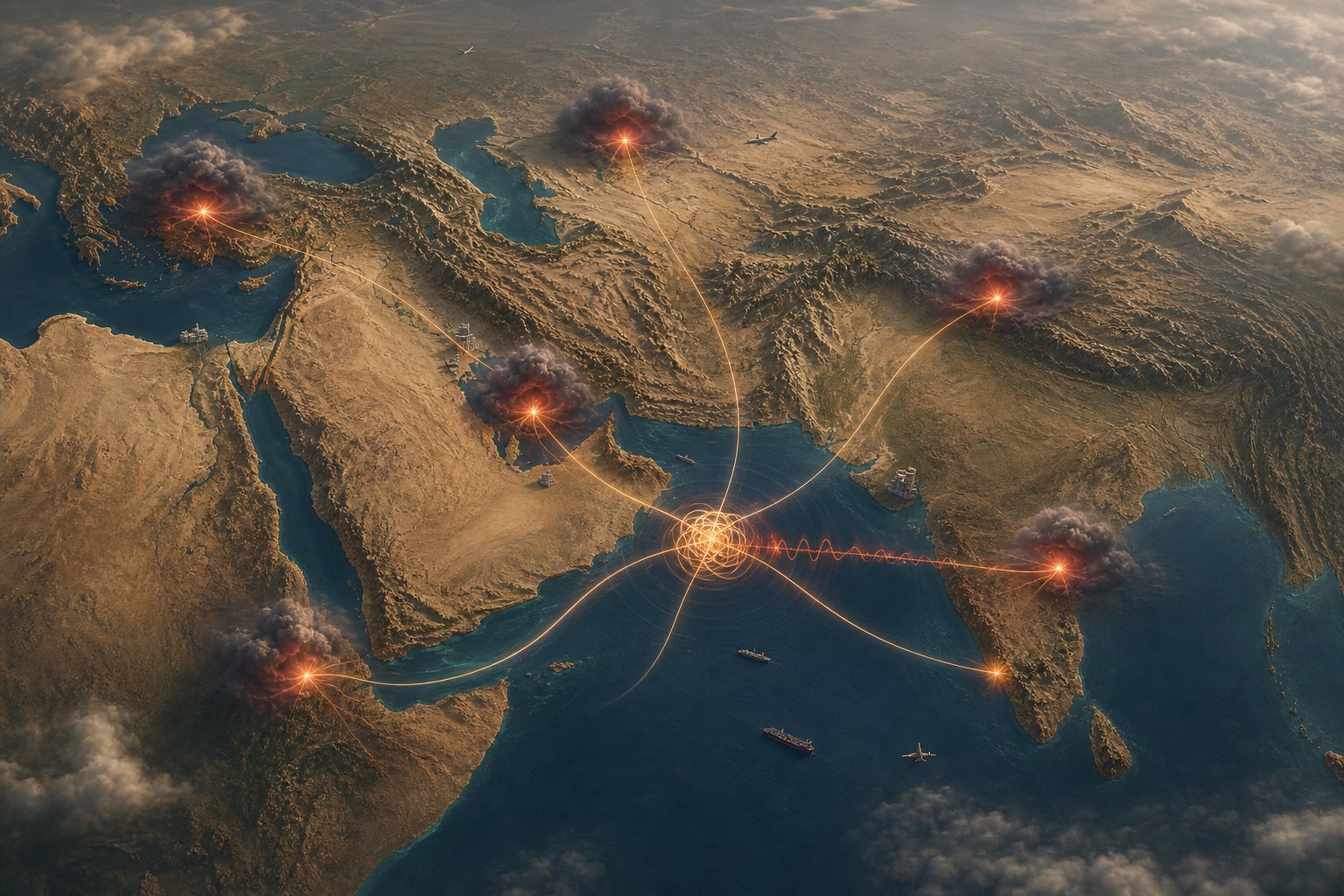
The most dramatic prediction is a world divided into Muslim and non-Muslim camps. That binary is strategically weak and socially dangerous. Muslim-majority states compete with one another, Sunni and Shia powers have conflicting security interests, and governments do not automatically command the political loyalty of Muslim citizens living elsewhere.
A more credible danger is crisis linkage: a dispute that begins between two states acquires new financial, technological and diplomatic participants because a loose framework already exists. The result need not be a three-country invasion to change India’s security environment.
For Bharat, the trigger language matters most
Defence analyst Brahma Chellaney has warned that a future Indian operation resembling Operation Sindoor could be portrayed by Pakistan as an act of war, followed by a request for Saudi and Turkish assistance. The decisive issue would be whether any eventual agreement treats an Indian strike on terrorist infrastructure as an armed attack on Pakistan that activates collective support.
Do not reduce that scenario to the question of whether Saudi or Turkish troops would cross India’s borders. Assistance could remain below the threshold of direct combat while still changing the balance:
- Emergency financing could help Pakistan absorb the economic cost of mobilization.
- Accelerated delivery of drones, air-defence components, ammunition or spare parts could extend military endurance.
- Intelligence, surveillance, training and technical personnel could improve the performance of systems already in Pakistani service.
- Coordinated diplomatic messaging could portray Indian counterterror action as aggression before India presents its evidence.
- An ambiguous promise of outside support could encourage Pakistani decision-makers to accept risks they would otherwise avoid.
These are scenarios, not established commitments. India’s planners should nevertheless model them because formal alliances often matter through logistics, expectations and deterrence before a partner fires a weapon. The practical Indian question is not merely, “Will all three declare war?” It is, “What assistance could reach Pakistan during the first phase of a crisis, through which channels, and under whose authorization?”
For Iran, a pan-Islamic label conceals a sectarian contradiction
An arrangement initially organized around the Saudi-Iran rivalry would inevitably be read through the Sunni-Shia geopolitical divide. That creates a basic contradiction: a grouping cannot convincingly claim to unite the Islamic world while positioning itself against a major Shia power.
Pakistan and Turkey also do not share Saudi Arabia’s precise relationship with Iran. Their willingness to support Riyadh would depend on the crisis, the requested contribution and the costs imposed on their other interests. This divergence reduces the credibility of an unconditional bloc, but it can increase regional uncertainty. Iran and aligned armed groups may respond to the possibility of coordinated containment by strengthening their own partnerships, dispersing weapons or testing the coalition’s limits.
For Israel and Western powers, alignment creates new dilemmas
Israel has reason to watch whether political hostility from Pakistan and Turkey becomes regular military coordination. The relevant evidence would be shared doctrine, exercises, intelligence arrangements, coordinated procurement or contingency planning directed at an Israeli conflict. Without those indicators, a claim that the framework is already an anti-Israel war alliance goes beyond what is established.
Saudi Arabia’s continuing security dependence on the United States creates another constraint. A Saudi-funded framework could bring together partners whose regional agendas do not consistently match Washington’s. Western governments would then have to distinguish ordinary bilateral cooperation from capabilities made possible by Western-origin protection, equipment or training.
The broader global implication is therefore not an inevitable civilizational war. It is the emergence of overlapping coalitions that can connect South Asian, West Asian and Mediterranean crises. A platform built for one purpose can later supply consultation, finance or weapons for another. That adaptability is precisely why India should watch institutional development rather than argue only about the founders’ declared intentions.
Use this evidence ladder for every new announcement

You do not need privileged intelligence to judge whether the proposed framework is becoming more serious. Compare every new announcement with this evidence ladder:
- Political signal: leader meetings, photographs, broad declarations of solidarity and phrases such as shared security. These show intent, not operational capacity.
- Administrative coordination: recurring ministerial meetings, working groups, a secretariat or named liaison officers. These show that cooperation may survive beyond a single summit.
- Material commitment: an identifiable common budget, multi-year procurement, shared maintenance, technology transfer or prearranged emergency financing.
- Military integration: joint exercises built around a common scenario, interoperable communications, shared air-defence data or assigned formations.
- Operational access: basing rights, transit guarantees, pre-positioned equipment, logistics hubs or standing permission for another member’s personnel.
- Binding obligation: published language defining an attack, the decision process and the assistance each party must provide.
- Crisis invocation: a member formally invokes the arrangement during a real confrontation and the other members deliver support they would not otherwise have supplied.
The last test is the strongest. Always ask the counterfactual: would Saudi Arabia have provided financing, or Turkey have sold equipment, even without the Mecca framework? If the answer is yes, bilateral activity does not prove a new alliance effect. The framework becomes strategically distinct when it causes members to coordinate earlier, contribute more, accept greater risk or act under a common decision.
India’s policy response should also follow the evidence rather than the slogan:
- Disaggregate the triangle. Engage Saudi Arabia, Turkey and Pakistan according to their separate interests. Treating them as an already unified front can help turn a flexible alignment into the bloc India fears.
- Prepare for support below formal war. Counter-drone capacity, resilient air defence, intelligence sharing, secure communications, spare-part planning and financial endurance matter even if no foreign combat unit enters the conflict.
- Clarify escalation thresholds. India should communicate the legal and operational distinction between action against terrorist infrastructure and indiscriminate war, while preparing evidence that can be released rapidly during a crisis.
- Track money and maintenance, not only weapons. Financing, technicians, software updates, munitions and repair networks often determine whether imported systems remain usable during sustained operations.
- Build issue-based partnerships. India gains more from coalitions organized around counterterrorism, maritime security, sovereignty and open trade than from creating a mirror-image religious bloc.
A Dharmic response must also maintain the distinction between a government’s pan-Islamist strategy and the conduct of individual Muslims. Turning a foreign-policy concern into blanket suspicion of Indian citizens would weaken Bharat’s internal cohesion and give outside powers an opening for influence. Judge institutions by their capabilities, political movements by their programmes and individuals by their actions.
Key takeaways
- The Mecca initiative should be treated as a proposed security framework until a treaty, activation clause, command structure, funding mechanism and assigned capabilities are visible.
- Its potential strength comes from complementary assets: Saudi finance, Turkish defence production and Pakistani nuclear, missile and military capabilities.
- Its principal weakness is divergent national interest, illustrated by Pakistan’s past refusal to join the Saudi campaign against the Houthis.
- India’s most plausible risk is layered assistance to Pakistan during a crisis, not necessarily a simultaneous three-state invasion.
- The clearest proof of transformation will be standing institutions, common money, operational integration and support delivered specifically because the framework was invoked.
- Bharat should answer a religiously framed alignment with military readiness, precise diplomacy and civilizational confidence—not domestic communal polarization.
You do not have to decide from a slogan whether the Mecca Agreement is a new NATO. Save the six proof tests and apply them to the next declaration, exercise or procurement announcement. If there is still no clause, command, budget or assigned force, you are looking mainly at political signalling. If several of those elements appear together, India’s planning assumption must change before the first crisis tests them.
References
