

You see Pakistan seeking American financial support while depending on Chinese weapons, and the obvious question is whether Islamabad has chosen Washington or Beijing. That question is too simple. Pakistan’s relationships are built on different dependencies, so its alignment can move in one direction while its military, economic and regional constraints pull in another.
For you, especially if you are assessing the consequences for Bharat, the useful question is this: what happens when Pakistan can no longer satisfy one power without imposing a direct cost on the other? That is where diplomatic hedging becomes a forced choice.
Balancing does not mean standing halfway between two powers
Pakistan has practised a Sino-US balancing strategy for decades. It tries to obtain security, investment, diplomatic room and market access from both relationships without becoming completely dependent on either. But a balancing strategy does not require equal closeness. It only requires enough freedom to avoid a final choice.
That freedom is narrower than it appears. Pakistan’s recent political and security engagement has tilted more heavily toward the United States. At the same time, China remains a major trade and investment partner, supplies most of Pakistan’s imported military equipment and shares Islamabad’s strategic view of India. A warm meeting with one power therefore does not erase the structural leverage of the other.
You can distinguish three stages of balancing:
- Routine hedging: each relationship supplies a different benefit, and Pakistan can work with one power without directly injuring the other.
- Strategic friction: the two powers make competing demands, but Pakistan can delay, narrow or obscure its response.
- A forced choice: one decision would materially threaten the interests, personnel or credibility of the other patron. Delay itself then becomes a decision.
This distinction prevents a common analytical error. A new loan discussion, military visit or infrastructure announcement may change the atmosphere without changing the underlying balance. A verified weapons transfer, trade penalty, basing agreement or cancellation of financial support is different because it closes options and creates costs.
Pakistan’s leverage map is uneven by design
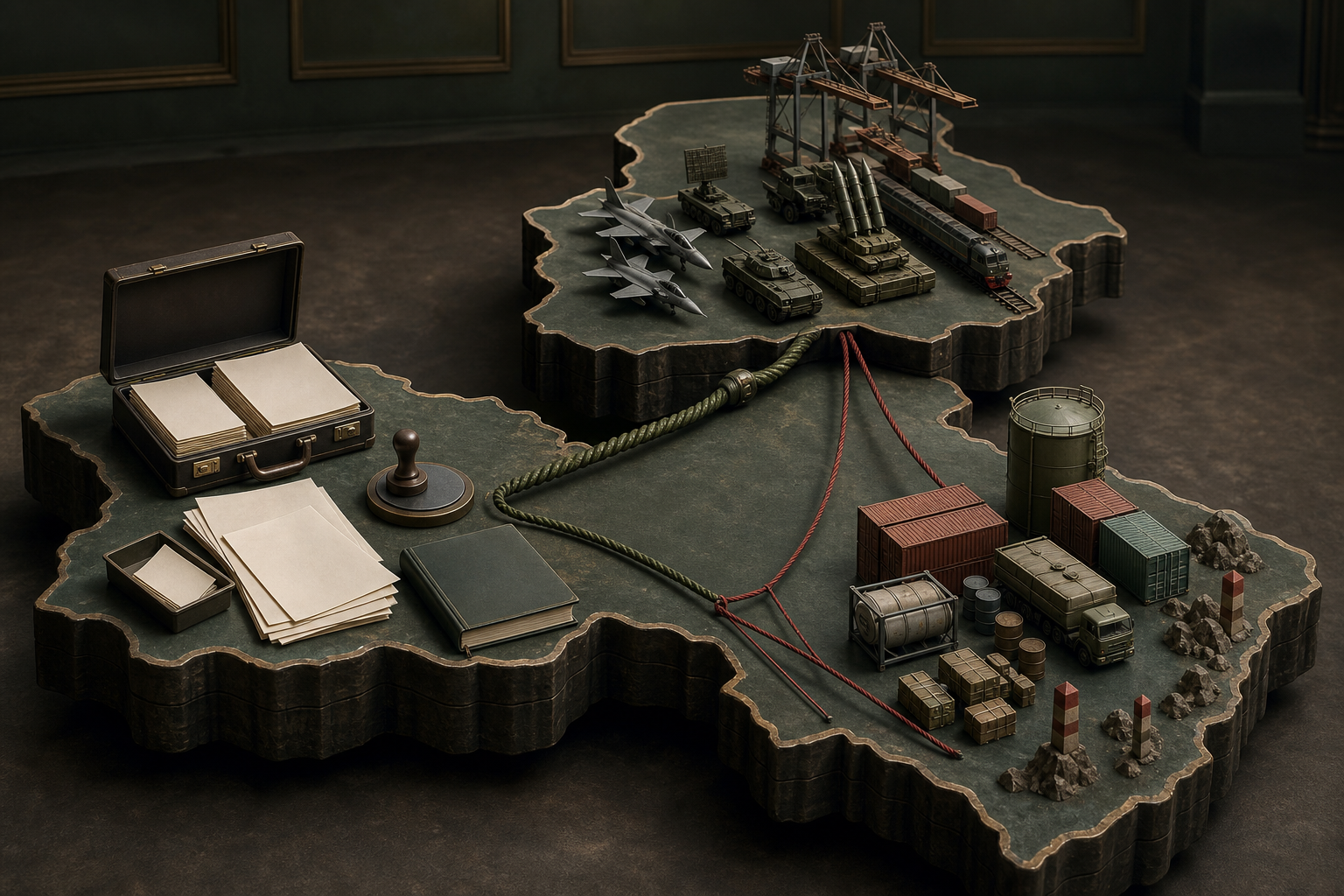
To judge which power has more leverage, do not add up meetings or official statements. Examine each dependency separately. Ask how painful interruption would be, how quickly Pakistan could find a substitute and whether the cost would arrive immediately or over several years.
| Relationship | Concrete dependency or interest | What it can constrain | What you should watch |
|---|---|---|---|
| Chinese military supply | SIPRI reported that China accounted for 80% of Pakistan’s arms imports during 2021-2025. | Pakistan cannot quickly treat China as an ordinary or replaceable defence vendor. A serious rupture would create military-technical costs even if political ties with Washington improved. | Changes in the origin of new military purchases, not isolated exercises or ceremonial visits. |
| American market access | The United States is identified as Pakistan’s largest export market. | Tariffs or other trade restrictions could turn a foreign-policy dispute into domestic economic pressure. | Formal tariff decisions, affected product categories and whether threatened measures are actually implemented. |
| American financial support | Pakistan has reportedly been seeking a multibillion-dollar bailout from the United States. | A pending request gives Washington leverage before money is approved or delivered. It also raises the cost of visibly helping an American adversary. | Approval, delay, denial or new conditions. A request is not the same as an agreed package. |
| Chinese investment | The China-Pakistan Economic Corridor, the flagship Belt and Road project in Pakistan, has been scaled back as implementation slowed. | The slower pace weakens claims that political closeness will automatically produce rapid new investment, but it does not eliminate China’s economic importance. | Construction, financing and completion of named projects rather than memoranda or broad declarations. |
| Regional security alignment | China and Pakistan continue to share a threat assessment centred on India. | This strategic affinity can preserve cooperation even when investment slows or Islamabad improves relations with Washington. | Operational coordination and policy toward Bharat, not merely the tone of Sino-Pakistani diplomacy. |
| Afghanistan and possible US access | Closer US-Pakistan cooperation has been linked to a possible exchange involving American counterterrorism assistance and access connected with Bagram Airbase or Central Asia. | If implemented, an access arrangement would carry more strategic weight than a general promise to cooperate against terrorism. | Verified basing, transit or operational agreements. The possibility of an arrangement is not evidence that one exists. |
The pattern is clear. Washington’s strongest immediate levers lie in finance, exports and potential security cooperation. Beijing’s leverage is embedded in military supply, investment and a shared posture toward Bharat. Pakistan may lean toward the United States in current diplomacy while remaining deeply constrained by Chinese defence ties. Both statements can be true at once.
The reported missile route is a stress test, not an established fact

The sharpest test involves an allegation that Iran could receive up to 400 Chinese-made shoulder-fired air-defence missile launchers through Pakistan. China and Pakistan denied the allegation. Trump also said that Xi had assured him China and Chinese companies would not provide weapons to Iran. Those denials and assurances do not prove what will happen, but they mean the proposed transfer cannot responsibly be treated as confirmed.
It still deserves attention as a scenario because it shows exactly how a balancing strategy can break. Man-portable air-defence systems are designed to threaten aircraft. If Chinese systems reached Iran through Pakistani territory and were then used against American aircraft, Washington could view Pakistan as having enabled a direct military threat. Islamabad would no longer be distributing separate benefits to two partners; it would be helping one partner impose a potentially lethal cost on the other.
Analyse that possibility as a chain, with each link tested separately:
- Verify the equipment claim. Establish whether the launchers exist, whether they are Chinese-made and whether the reported quantity is credible.
- Verify the route. A proposed route through Pakistan is not proof that a shipment entered Pakistani territory.
- Establish state involvement. Geography alone does not demonstrate authorization by Pakistan’s government or military. Deliberate facilitation, tolerated transit and illicit smuggling would carry different political consequences.
- Identify the first-order response. Financial support, trade access and security cooperation would be the most visible areas in which Washington could impose costs.
- Separate immediate consequences from later predictions. Punitive US tariffs, a breakdown in rapprochement or a stronger American turn toward India are possible outcomes, not automatic ones. Each would require an observable policy decision.
This sequence matters because geopolitical commentary often moves directly from an unverified transfer claim to the collapse of an alliance. You should refuse that shortcut. The missile allegation is relevant because of the collision it could create, not because the collision has already occurred.
Pakistan would also have to consider the cost of refusing China. Its dependence on Chinese equipment makes Beijing difficult to dismiss, but that does not prove Pakistan would accept a transit request. China might retaliate against a refusal, tolerate it or find another route. The available information does not settle that question. By contrast, Pakistan can reasonably expect acute American pressure if it knowingly helps deliver weapons that are subsequently used against US forces.
What Bharat should watch before declaring a realignment

For a Bharatiya reader, Pakistan’s difficulty may look like an opening. It could become one, but wishful interpretation is not strategy. A US-Pakistan rapprochement does not erase the China-Pakistan military relationship, and a quarrel between Islamabad and Washington would not automatically produce a permanent US alignment with Bharat.
Use these indicators to decide whether the balance is actually changing:
- Weapons transit: look for independently verifiable evidence of the cargo, route and Pakistani authorization. Treat anonymous or single-channel claims as allegations until corroborated.
- Financial decisions: distinguish Pakistan asking for American support from Washington approving and disbursing it. Conditions attached to support reveal more than the headline amount.
- Trade coercion: a tariff threat matters less than a published measure with a start date and defined coverage. Implementation would show that Washington is prepared to convert political anger into economic cost.
- CPEC execution: track whether named projects resume, stall or disappear. Physical progress and released financing are stronger evidence than another declaration that the corridor remains important.
- Military procurement: the 80% Chinese share during 2021-2025 is a baseline. Future diversification away from Chinese systems would be more consequential than warmer rhetoric toward Washington.
- Afghanistan access: demand confirmation of any basing, transit or operational arrangement involving Bagram or Central Asia. Counterterrorism discussions alone do not establish an American military return.
- Behaviour toward India: observe whether Pakistan and China alter operational cooperation or their shared threat assessment. If that foundation remains intact, a US-Pakistan thaw should not be mistaken for a strategic separation from Beijing.
These indicators also protect Bharat from two opposite mistakes. The first is to assume that every improvement in US-Pakistan ties comes at India’s expense. The second is to assume that one Pakistani action against American interests would cause Washington to abandon Islamabad permanently. Major powers often preserve limited relationships with difficult partners when access, intelligence, geography or crisis management still have value.
Bharat’s sounder course is to make its own strategic value durable rather than contingent on Pakistan committing an error. That means reading transactions more carefully than speeches, maintaining independent capability and presenting Washington with a positive case for cooperation. A relationship built only on shared frustration with Pakistan will remain vulnerable whenever Washington’s short-term needs change.
Key takeaways
- Pakistan’s Sino-US balancing does not depend on equal closeness. It depends on retaining enough room to avoid a final choice.
- Washington holds important leverage through Pakistan’s export market, financial needs and possible security cooperation.
- China’s leverage is embedded in arms supply, investment and a shared strategic posture toward India. SIPRI’s 80% figure for 2021-2025 shows why this relationship cannot be discarded quickly.
- The alleged transfer of up to 400 Chinese air-defence launchers through Pakistan remains unverified and has been denied. It should be treated as a stress-test scenario, not a completed event.
- A genuine break would become visible through transactions: authorized transit, financial denial, implemented tariffs, altered arms procurement, changed CPEC execution or a verified access agreement.
- Bharat should not base its strategy on a predicted US pivot. It should judge each power by observable decisions and strengthen its own value independently of Pakistan’s choices.
The next time a headline claims that Pakistan has changed camps, build the dependency map first. If no costly transaction has changed, the balance may be under pressure, but it has not yet broken.
References
