
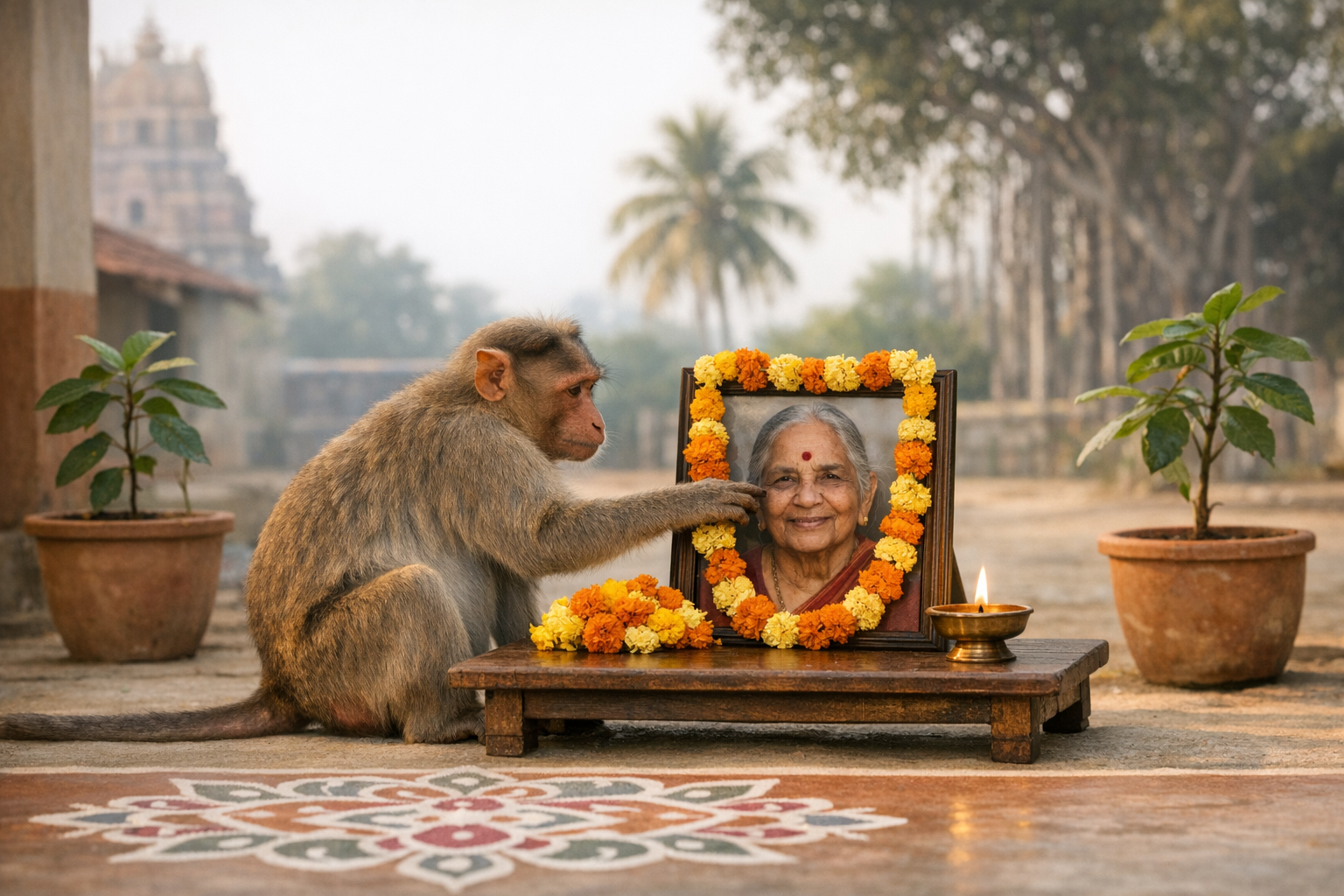
A solemn scene in Rayara Doddi, Channapatna near Bengaluru has drawn nationwide attention: as the body of an elderly womanknown locally for routinely feeding free-ranging monkeyswas brought home after a fatal heart attack, a monkey approached, remained by her side, and briefly embraced her. The video documenting this quiet, unexpected gesture has gone viral, prompting a broader public conversation about human–animal bonds, dharmic compassion, and the ethics of feeding wildlife in India.
The behavior, while emotionally striking, is best understood within the well-documented ecology of urban and peri-urban primates in southern India. In and around Channapatna and Bengaluru, bonnet macaques (Macaca radiata) commonly inhabit temple precincts, village edges, and roadside groves, where long-term, predictable food provisioning by people can establish stable patterns of cross-species familiarity. Repeated, peaceful interactions often produce individual recognition, reduced flight responses, and affiliative proximity from monkeys toward familiar humans.
From a behavioral science perspective, the monkey’s quiet proximity and gentle tactile contact align with a cluster of primate affiliative behaviors that can appear during heightened arousal or social uncertainty. Studies across macaque and baboon societies have described “consolation-like” responses (e.g., embracing, grooming, and sustained close presence) that function to regulate stress, reaffirm social bonds, or reduce group tension. While caution against over-interpreting animal emotion (anthropomorphism) remains essential, the convergence of proximity-seeking, stillness, and tactile contact is consistent with socio-emotional responsiveness in macaques.
Several plausible mechanisms can coexist: conditioned orientation toward a familiar caregiver who regularly provided food; stress-regulation through contact; and the expression of learned affiliative scripts that macaques typically display with conspecifics, adapted here to a trusted human. Regardless of the precise mechanism, the moment underscores how repeated, calm, and respectful interactions can embed a recognizable relationship pattern between humans and non-human primates.
At the same time, the scene invites a careful examination of the human–wildlife interface in India’s rapidly urbanizing landscapes. Routine feeding can unintentionally increase habituation and boldness, elevate bite risk, displace natural foraging, and intensify conflicts near homes, marketplaces, and places of worship. It can also facilitate disease transmission pathways and malnutrition when monkeys receive energy-dense, non-native foods. Conservation practitioners therefore recommend measured, evidence-based approaches that protect both animal welfare and public health.
Dharmic ethics offer an instructive framework for reconciling compassion with responsibility. Hindu Dharma emphasizes ahimsa and reverence for all beings; monkeys, linked with Hanuman, are often included in acts of seva and dāna. Buddhism cultivates maitri and karuna toward all sentient life; Jainism enshrines ahimsa at the center of daily conduct; Sikhism advances the ideal of Sarbat da Bhalaseeking the welfare of all. Read together, these traditions affirm a shared civilizational insight: compassion must also be wise, sustaining the long-term well-being of living beings and their habitats. In this sense, the moment in Channapatna resonates with Vasudhaiva Kutumbakam, the vision of a world family, while still calling for practices that minimize harm.
Practical, compassionate steps emerge from this synthesis. Communities moved by such videos can collaborate with the Forest Department and local panchayats to shift from ad hoc feeding to habitat-supportive measures: planting native fruiting trees along green corridors; managing organic waste to avoid attracting troops into dense residential areas; and using monkey-proof bins near temples and schools. Public education that discourages hand-feeding and promotes safe distances, quiet observation, and avoidance of plastic-packaged offerings can substantially reduce conflict and injury risks.
Culturally, Karnataka and the Bengaluru region have long integrated temple towns, sacred groves, and community commons into everyday life, where people encounter macaques during festivals, pilgrimages, and routine errands. Within such contexts, acts of offering often blend spirituality and custom. The Channapatna incident suggests that when offerings evolve into predictable, daily provisioning, primates may come to understand certain humans as reliable members of their extended social environment, eliciting affiliative responses that look strikingly familiar to human observers.
Psychologically, the video elicits what social scientists call moral elevationthe warm, upward emotion that follows witnessing an exemplary act of care or loyalty. These emotions can, in turn, catalyze prosocial behaviors: volunteering with local animal welfare groups, supporting conservation programs, or joining neighborhood efforts to plant trees and improve waste stewardship. Harnessing this moral resonance toward constructive, science-aligned action honors both the woman’s compassion and the community’s safety.
Public health and safety remain vital considerations. Avoiding direct contact, refraining from hand-feeding, and maintaining a calm, respectful distance protect humans and animals alike. Where monkey–human conflicts already exist, coordinated responseshumane deterrence, better waste governance, and habitat augmentationtend to outperform piecemeal or punitive approaches.
In sum, the widely shared embrace in Rayara Doddi near Bengaluru is more than a viral video. It is a mirror held to a much larger story about India’s evolving human–primate relationships, the ethical depth of dharmic compassion across Hinduism, Buddhism, Jainism, and Sikhism, and the need to align heartfelt care with ecological wisdom. The tenderness seen on camera can guide thoughtful action off cameranurturing a culture where kindness to animals is expressed through practices that safeguard their freedom, nurture their habitats, and preserve shared spaces for generations to come.
Inspired by this post on Hindu Human Rights Blog.
