
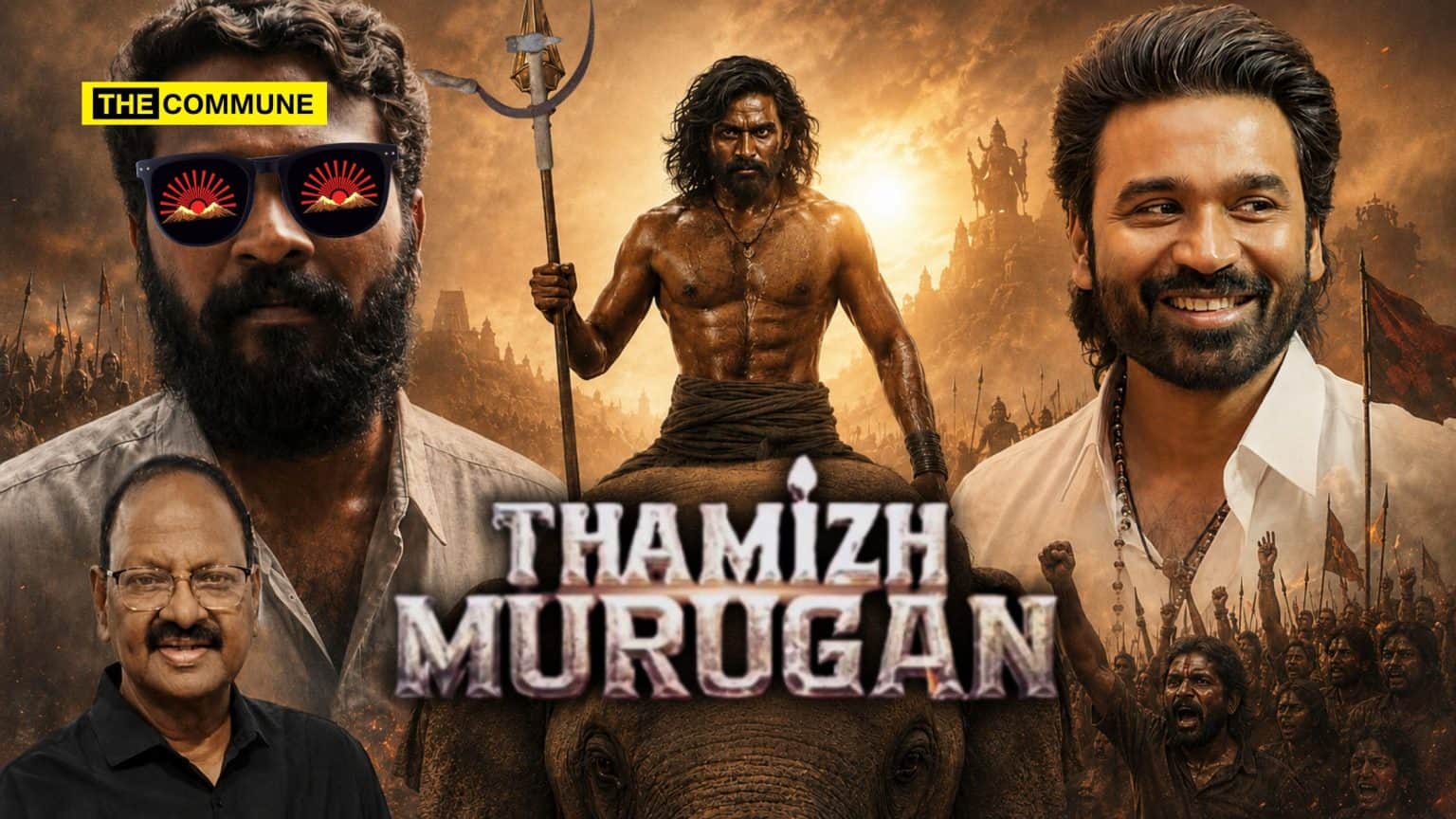
The announced film Thamizh Murugan has become the focus of a larger argument about who may interpret a Hindu deity and whether regional identity can be separated from a wider civilizational inheritance. The available source does not provide a plot summary or evidence from a completed film, so the controversy must be assessed as a debate over intentions and framing rather than a verdict on the finished work.
That distinction matters. Hindu audiences have legitimate reasons to examine how cinema represents sacred traditions, but a sound cultural critique should separate reported facts, political context and predictions about material that viewers have not yet seen.
What Hindu Post reports about the project
Hindu Post relays a commentary originally published by The Commune. According to the excerpt, Thamizh Murugan is set to star Dhanush and be directed by Vetri Maaran. It is said to draw on a book by Arivumathi, although the supplied material offers no details about the book’s narrative or the extent of the proposed adaptation.
The commentary places considerable emphasis on Vetri Maaran’s political background. It reports that his maternal uncle, Ela. Pugazhendi, was a three-time DMK legislator from Cuddalore and that Pugazhendi’s father, Elamvazhuthi, was also a DMK legislator who worked with E.V. Ramasamy Naicker, C.N. Annadurai and Karunanidhi. These associations explain why the source approaches the announcement with suspicion, but political lineage by itself cannot establish what a screenplay will contain.
The central concern is cultural separation
The source’s substantive allegation is that the film will present Murugan as an exclusively Tamil figure while weakening or rejecting his place within the broader Hindu sacred world. Hindu Post describes this prospect as cultural erasure presented as heritage recovery. That remains the source’s interpretation, not a demonstrated feature of the film in the material provided.
Regional devotion and pan-Indian belonging do not have to compete. Murugan’s profound place in Tamil culture can be celebrated without treating Tamil Hindu identity as isolated from Shaiva traditions or the larger Hindu civilizational family. The source contrasts Thamizh Murugan with another announced, pan-Indian production from the Telugu film industry starring Junior NTR, whose promotional framing reportedly identifies Murugan as Shiva’s son and emphasizes a journey across regions.
Key takeaways
- The controversy concerns an announced film, not a completed work available for examination.
- Hindu Post reports that the project stars Dhanush, is directed by Vetri Maaran and is said to be based on a book by Arivumathi.
- The source fears an ideological separation of Tamil Murugan devotion from wider Hindu tradition.
- A credible assessment will require evidence from the screenplay, promotional material or finished film rather than assumptions based only on political associations.
A Dharmic standard for evaluating adaptations
Sacred storytelling has never required mechanical uniformity. Hindu traditions themselves preserve multiple names, local forms, theological perspectives and devotional languages. Cultural unity is strongest when it protects that diversity while refusing narratives that manufacture hostility between a regional tradition and its civilizational setting.
The same principle supports solidarity across the broader Dharmic family. Hindu, Buddhist, Jain and Sikh traditions remain distinct, yet their communities all understand the importance of inherited memory, living lineages and freedom from reductive ideological treatment. Unity should not flatten those differences; it should create a shared expectation of accuracy, dignity and good-faith engagement.
Viewers can therefore ask concrete questions when more material appears: Does the adaptation respect worshippers? Does it acknowledge the deity’s established Hindu relationships? Are regional traditions enriched or weaponized against a wider identity? Does artistic invention remain recognizable as invention? These standards test the work itself and avoid turning criticism into guilt by association.
Judgment should follow evidence
The source raises a legitimate cultural question but supplies too little information for a final judgment on Thamizh Murugan. The responsible course is alertness without premature certainty. As a trailer, synopsis or film becomes available, audiences will be better placed to determine whether the project honors Tamil devotion within Hindu continuity or advances the separation feared by its critics.
Inspired by this post on Hindu Post.
