
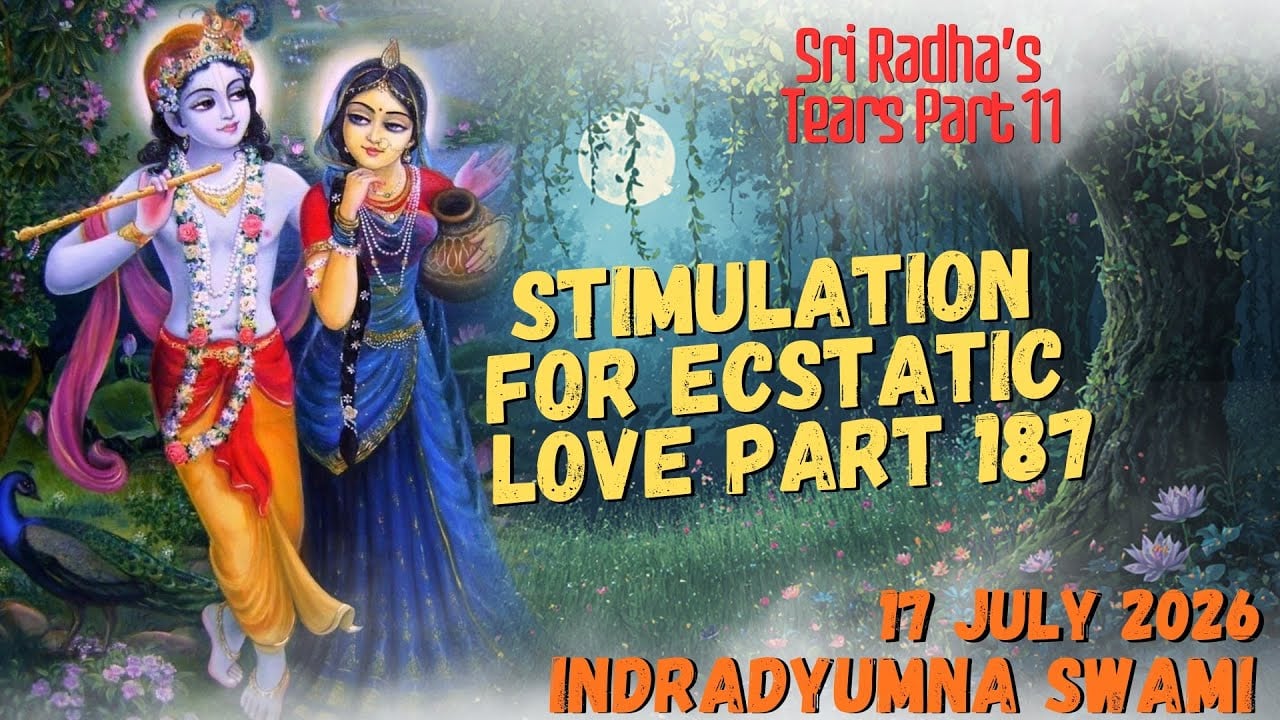
Dandavats presents a video installment centered on Sri Radha’s tears and the devotional idea of ecstatic love. Because the listing contains no transcript or written synopsis, its precise teachings should be learned from the recording rather than inferred from its title.
What can be offered responsibly is a framework for approaching the theme: what the source confirms, what tears commonly signify in bhakti, and how devotional emotion can be related to disciplined dharmic practice.
What the Dandavats listing actually provides
The source identifies the recording as “Stimulation for Ecstatic Love Part 187 – Sri Radha’s Tears Part 11.” It also names the hosting channel as Indradyumna Swami Official. The numbering places the video within an extended series and within a continuing treatment of Sri Radha’s tears, but the listing does not explain the argument, cite passages, identify a speaker, or summarize any conclusions.
Readers should therefore distinguish between information supplied by Dandavats and broader devotional context. Any account of the video’s detailed message without hearing it would go beyond the available text.
Reading tears as devotional language
Within Krishna bhakti, Sri Radha is revered as the exemplary embodiment of loving devotion to Krishna. In devotional poetry and teaching, tears can express longing, joy, surrender, remembrance, or the pain of separation from the Divine. This general background helps explain why tears may be treated as spiritually meaningful rather than merely sentimental.
That context should not be mistaken for a summary of this particular recording. Nor does visible emotion by itself establish spiritual attainment. Bhakti gives emotion direction through remembrance, worship, ethical conduct, service, and guidance within a living tradition. Ecstatic love is thus best approached as a devotional category, not as a spectacle or a claim that can be judged from outward appearance alone.
Key takeaways
- Dandavats supplies a video, title, series numbering, and channel identification, but no textual explanation of the teaching.
- The title signals a sustained exploration of Sri Radha’s tears within the broader subject of ecstatic love.
- In general bhakti usage, tears may communicate intense devotion, longing, remembrance, or surrender.
- Devotional feeling is most responsibly understood alongside sadhana, character, scriptural study, and service.
A shared dharmic discipline for listening
The theme also points toward a wider dharmic principle: inner experience gains credibility when it transforms conduct. Vaishnava bhakti emphasizes loving remembrance and seva; Buddhist traditions cultivate attentive awareness and compassion; Jain dharma joins inward discipline with ahimsa and restraint; Sikh dharma gives central importance to remembrance and selfless service. These paths retain their distinct teachings, yet they share a refusal to separate spiritual aspiration from the way a person lives.
This common ground can strengthen dharmic unity without flattening genuine differences. A listener need not treat every tradition as identical to recognize the shared disciplines of humility, compassion, self-mastery, reverence, and service.
Let contemplation mature into practice
The recording is best approached with patience and close attention, especially because the source provides no written substitute for it. Its devotional theme can then become an invitation to deeper study and steadier practice, allowing sacred emotion to bear fruit in compassion, humility, and service.
Inspired by this post on Dandavats.
