

You may have seen one sentence used as a final verdict: Rana Sanga invited Babur into India, so he betrayed Bharat. If you want to know whether that charge is historically sound, do not begin with loyalty or outrage. Begin by asking exactly what is alleged, who recorded it, and how much weight the chronology can bear.
A disciplined reading leads to a narrower conclusion. Babur claimed that Sanga proposed coordinated action against Ibrahim Lodi, but Babur did not need Sanga to create his interest in Hindustan. Nor does disputed diplomatic contact, by itself, prove that Sanga wanted permanent Mughal dominion. A possible alliance, an alleged broken promise, a strategic mistake, and treason against Bharat are four different propositions.
Separate the four questions that usually get collapsed
The controversy becomes confused when the word invitation is asked to carry an entire moral verdict. It should be divided into four questions:
- Did any communication take place between Rana Sanga and Babur?
- If it did, did Sanga propose a coordinated campaign against Ibrahim Lodi?
- What did each ruler expect to gain from that arrangement?
- Would such an arrangement make Sanga a traitor, and to whom?
Each question has a different burden of proof. Evidence of an envoy can establish contact without revealing the sender’s full intention. A plan to attack the Lodi state can establish tactical cooperation without proving support for Babur’s permanent rule. Even a broken promise to Babur would be a breach between rulers, not automatically treason against a modern nation-state.
This distinction is the first practical test you should apply whenever the accusation appears. Ask the person making it to identify which of the four claims is being defended. If the answer moves directly from contact to treason, two essential stages of reasoning have been skipped.
What Babur actually alleged, and what remains unknown
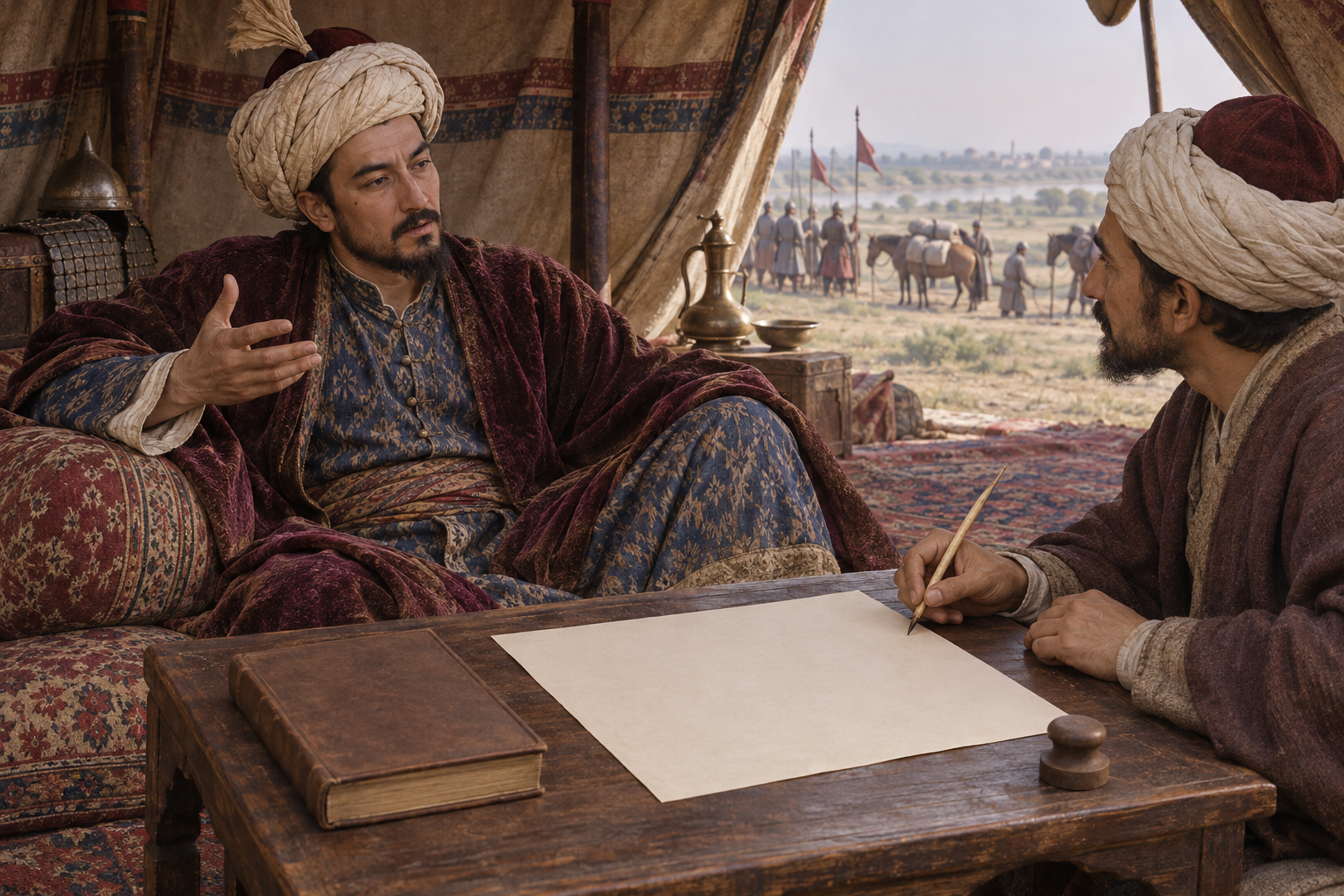
The most concrete allegation comes from Babur himself. In his memoir, Babur describes an envoy from Rana Sanga offering coordinated action against Ibrahim Lodi. Babur was to advance on Delhi from the north while Sanga moved toward Agra, after which the territory would be divided between them.
Babur later accused Sanga of failing to act on Agra after the victory at Panipat and therefore of breaking faith. We consequently have a direct allegation from the ruler who says he received the proposal. We do not have a corresponding explanation from Sanga that tells us what he authorized, what he intended, or how he understood the commitment.
That makes the testimony important but incomplete. Babur sometimes wrote with unusual candor, which is a reason not to dismiss his account merely because it is inconvenient. He was also an interested participant describing a diplomatic dispute from his own side. Candor does not provide access to another ruler’s unrecorded intention.
The strongest responsible formulation is therefore precise: Babur alleged that an envoy acting for Sanga proposed a two-front campaign and a division of territory; Babur also alleged that Sanga did not perform his part. Whether the envoy conveyed Sanga’s exact position, whether the proposal was a firm commitment, and why Sanga did not make the promised move cannot be established with the same confidence.
The word invited also needs discipline. If it means that Sanga allegedly proposed military coordination against Lodi, it is a fair shorthand for Babur’s claim. If it means that Sanga asked Babur to establish permanent dominion over Hindustan, the allegation does not prove that. Seeking an outsider’s help against a rival and consenting to that outsider’s indefinite sovereignty are not the same act.
Babur and Sanga already had ambitions of their own
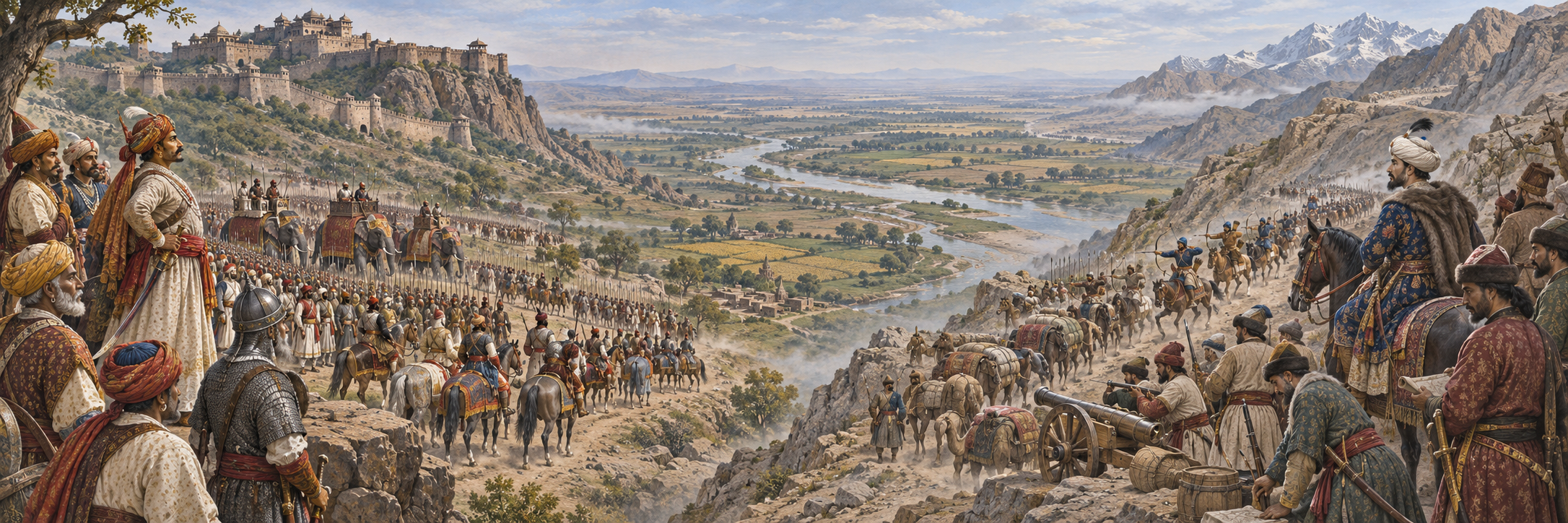
Rana Sanga cannot be treated as the creator of Babur’s interest in Hindustan. After losing his struggle for Samarkand and establishing himself at Kabul in 1504, Babur turned toward Hindustan for reasons independent of Mewar. He made four or five incursions into Punjab, took places including Bhira and Sialkot, captured Lahore during the campaign of 1525-26, and defeated Ibrahim Lodi at Panipat on 21 April 1526.
Other Indian contenders were also trying to use Babur against Ibrahim. Punjab governor Daulat Khan Lodi asked him to intervene while expecting that Babur would take plunder and withdraw. Ibrahim’s uncle, Alam Khan Lodi, approached Babur in connection with his own claim to the throne. These approaches show that Babur entered an existing field of rebellion and competing ambitions; he was not a passive weapon waiting for one decisive summons from Sanga.
Daulat Khan’s expectation also gives you a useful warning about retrospective judgement. A regional ruler could seek Babur’s military power while badly misjudging what Babur would do after victory. That motive is recorded for Daulat Khan, however, not for Sanga. It would be improper to borrow one man’s expectation and insert it into another man’s silence.
Ibrahim Lodi’s weakening position made such manoeuvres possible. He inherited the throne in 1517 amid unreliable governors, strained relations with the nobility, and a politics of suspicion. He imprisoned relatives of suspected rebels and replaced commanders with men he believed he could trust. Babur, Sanga, Daulat Khan, and Alam Khan were not responding to a stable imperial order; they were competing around a sultanate already under severe internal pressure.
Sanga was not a minor chief waiting to be rescued by a Central Asian conqueror. Crowned Maharana of Mewar on 24 May 1509, he had defeated Malwa, extended Mewar’s reach toward northern Gujarat, and repeatedly confronted Lodi forces. His major encounters with Ibrahim’s armies included Khatoli in 1517, Dholpur in 1519, and Ranthambore in 1521. Eighteen battles and more than eighty wounds are attributed to his career, including injuries to an eye, arm, and leg.
By the early 1520s, Mewar’s influence had moved toward the Agra region, though it had not absorbed Agra itself. That geographical and military position makes a proposal for simultaneous pressure on Delhi and Agra intelligible as realpolitik. It does not prove that the proposal occurred, but it explains why Babur could regard Sanga as a consequential potential partner rather than a peripheral ally.
The religious setting mattered, but it did not operate as a simple two-sided board. Mewar was a Hindu kingdom surrounded by Islamic sultanates as well as rival Rajput powers. Dynastic competition, territory, marriage, and immediate military advantage also shaped alliances. Recognizing those layers does not diminish Mewar’s Hindu character. It prevents us from mistaking later political categories for a complete description of early sixteenth-century conduct.
The familiar claim that Sanga united all Rajputs is likewise too broad. He assembled an unusually large coalition, but several houses remained outside it and participating chiefs retained control of their own forces. The coalition that met Babur at Khanwa in 1527 was formidable, yet it was not a unified Rajput state.
Why the traitor verdict outruns the available proof

Before calling Sanga a traitor, ask the elementary question: traitor to whom? Mewar was not subject to Ibrahim Lodi. Sanga had fought Lodi armies repeatedly and was pursuing the interests of his own kingdom and coalition. If he promised Babur a coordinated attack and then withheld it, Babur could accuse him of breaking an agreement. That would not make Sanga a traitor to the Lodi sovereign he opposed.
A broader civilizational judgement is possible, but it requires more than changing the object of the accusation from Lodi to Bharat. You would need to show that Sanga intended to enable enduring foreign conquest, or at least that he knowingly accepted that likely consequence. Babur’s allegation establishes neither intention. It describes a proposed campaign against a common enemy and Sanga’s alleged failure to carry it out.
That does not mean every possible decision by Sanga was wise. If the proposal was genuine, using Babur to weaken Lodi may have been a major strategic miscalculation. A ruler can advance an immediate interest while failing to anticipate the power he is helping to strengthen. But strategic error, cynical diplomacy, a broken alliance, and civilizational betrayal are not interchangeable charges. The more severe the moral label, the more specific the proof must be.
Sanga’s later conduct also blocks the simplest version of the accusation. In 1527, he led a Rajput coalition against Babur at Khanwa. That confrontation does not disprove an earlier proposal against Lodi; former partners can become enemies. It does show that Sanga cannot accurately be portrayed as a continuing collaborator who invited Babur to conquer Hindustan and then accepted the result.
Several interpretations remain possible. Sanga may have made a genuine bargain and then reneged. He may have intended only limited coordination while Babur understood a firmer commitment. The communication may have served as a strategic feint. Babur may have described an ambiguous exchange in the terms most favorable to himself. The first interpretation most closely follows Babur’s allegation, while the alternatives account for the missing move on Agra. None can recover Sanga’s private purpose without evidence from his side.
A pro-Hindu understanding of history does not require either inherited accusation or automatic acquittal. Rana Sanga’s record of resistance, physical courage, and coalition-building deserves recognition. His diplomacy can still be examined critically. The honest limit is this: possible coordination against Lodi is historically defensible; the claim that Sanga caused Babur’s invasion or betrayed Bharat is not demonstrated by that fact alone.
Key takeaways for judging the controversy
- Babur claimed that an envoy from Rana Sanga proposed a coordinated attack on Ibrahim Lodi, with Babur moving on Delhi and Sanga moving toward Agra.
- Babur also claimed that Sanga failed to carry out his part after Panipat. We have no matching explanation from Sanga that establishes his intention.
- Babur’s designs on Hindustan predated the alleged proposal. His repeated Punjab incursions and other invitations from within the Lodi order make Sanga unnecessary as the original cause of the invasion.
- An alleged promise to fight Lodi does not prove that Sanga wanted Babur to establish permanent rule in Hindustan.
- Even if Sanga broke faith with Babur, breach of an agreement between rival rulers is not automatically treason against Bharat.
- The most proportionate verdict is that political contact and proposed coordination deserve serious consideration, while the accusation of civilizational betrayal remains unproved.
When you encounter the claim again, ask for a complete sentence: what precisely did Babur allege, and what evidence establishes Sanga’s intention beyond that allegation? Then check whether the argument distinguishes Babur’s existing ambitions from Sanga’s possible tactical role. If it does not, it is assigning one disputed diplomatic episode more causal and moral weight than it can carry.
You do not have to defend Rana Sanga from every possible mistake to reject an unsupported verdict. Treat the alleged proposal as a real historical problem, Babur’s independent programme as indispensable context, and betrayal as a conclusion that still requires proof. That is the standard Dharmic history deserves from those who wish to defend it.
References

Leave a Reply
You must be logged in to post a comment.