
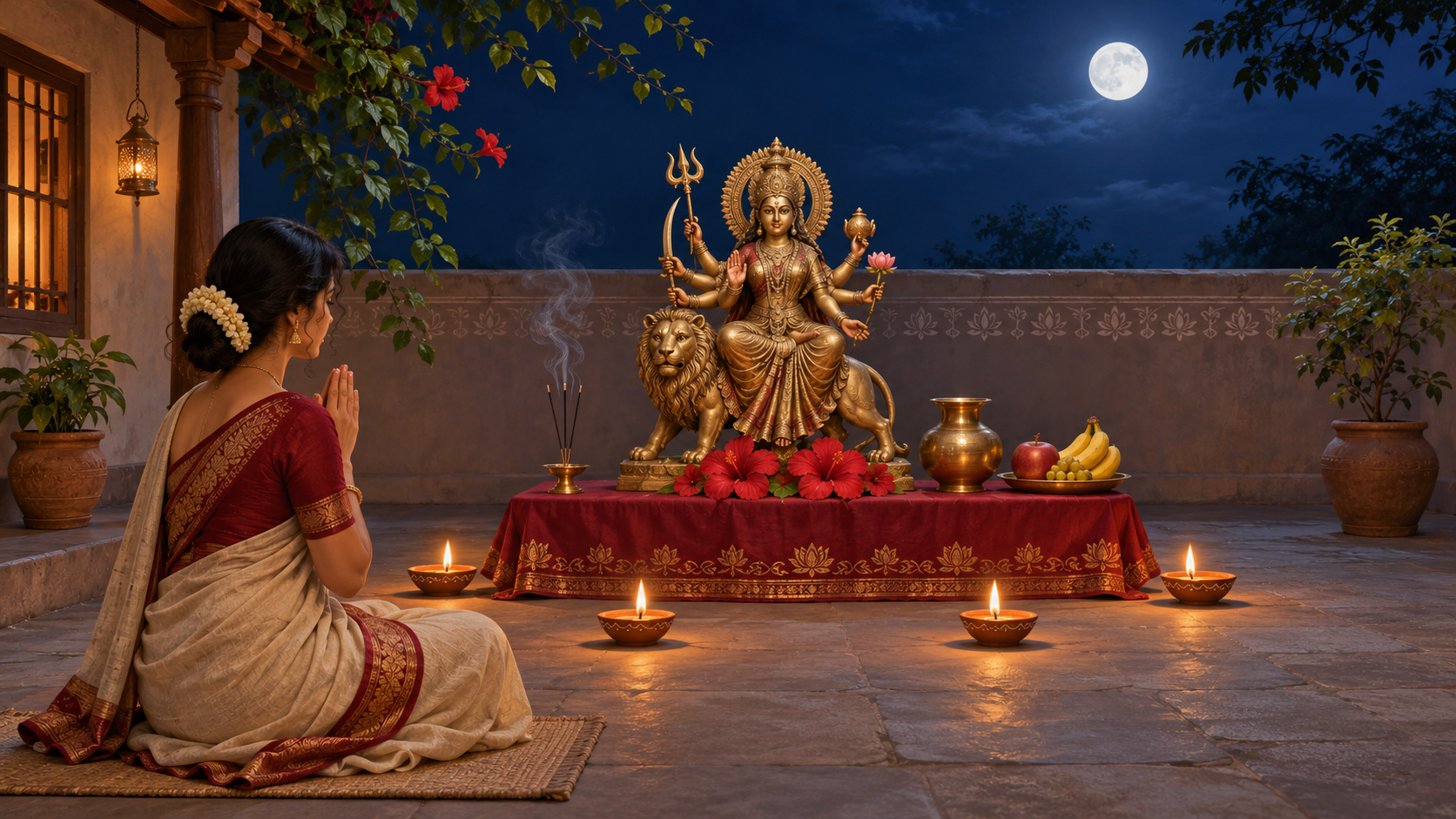
You want to reserve a regular lunar day for Devi, but the panchanga seems less straightforward than expected. Panchami, Ashtami and Navami appear in both halves of a lunar month, Amavasya may begin or end partway through a civil day, and different calendars can display different dates.
The practical answer is to treat Panchami, Ashtami, Navami and Amavasya as four especially suitable tithis for Shakti worship, then use your local panchanga and inherited tradition to decide exactly when and how to observe them. They provide a rhythm for worship, not a rigid ranking of Devi’s forms or a ban on praying on other days.
Start with the four tithis, but identify them precisely
A tithi is a lunar division, not another name for a weekday or a fixed Gregorian date. Panchami is the fifth tithi of a paksha, Ashtami the eighth and Navami the ninth. Each can therefore occur in Shukla Paksha, the waxing half of the lunar month, and Krishna Paksha, the waning half. Amavasya is the new-moon tithi.
| Tithi | Place in the lunar cycle | What you need to verify |
|---|---|---|
| Panchami | Fifth tithi of a paksha | Whether the intended observance falls in Shukla or Krishna Paksha |
| Ashtami | Eighth tithi of a paksha | The paksha, local tithi interval and any family or temple convention |
| Navami | Ninth tithi of a paksha | The paksha and the part of the day relevant to the observance |
| Amavasya | New-moon tithi | Its local start and end times rather than the date label alone |
This distinction prevents a common mistake: seeing “Ashtami” in a calendar and assuming that every Ashtami carries exactly the same ritual instruction. A tithi name identifies a place in the lunar cycle. It does not, by itself, tell you the paksha, the prescribed Devi form, the mantra, the vrata rules or the decisive time of day.
If your family practice specifies Shukla Ashtami, Krishna Navami or another particular combination, preserve that qualification. If you inherited only the tithi name, ask the family priest, guru or temple that carries the tradition before turning it into a new household rule. Until you can do that, a simple devotional puja is more responsible than claiming an elaborate prescription you cannot trace.
Amavasya also deserves careful attention. Its inclusion among these sacred occasions means it should not be dismissed merely as an unusable or uniformly inauspicious day. Within Shakti worship, the dark-moon tithi can be approached as a valid occasion for reverence, subject to the discipline of the tradition you follow.
Use a local panchanga instead of copying a calendar date

A civil date runs from midnight to midnight. A tithi follows the lunar cycle and may start in the afternoon, continue overnight and end the following morning. That is why two calendars can place the visible label on different dates without necessarily disagreeing about the underlying interval.
Location matters as well. A tithi interval displayed for Bharat may not transfer unchanged to Canada, the United Kingdom, the United States or another region. If you live outside the place for which a calendar was prepared, do not simply reproduce its printed date.
- Select your actual location. Use a panchanga calculated for your city or time zone.
- Read the tithi’s start and end times. Do not rely only on the large date heading or coloured festival label.
- Confirm the paksha. Panchami, Ashtami and Navami recur in both waxing and waning halves of the month.
- Look for a specific observance rule. A temple festival or inherited vrata may depend on the tithi present at sunrise or during another ritual period. Follow that rule rather than inventing one.
- Choose a workable worship period inside the valid interval. If no more specific rule governs your simple home puja, select a quiet time when the required tithi is actually present.
- Record what you used. Note the panchanga, location, paksha and local interval so that the next observance does not begin with the same uncertainty.
The useful habit is to plan from the tithi interval outward. Starting with a convenient civil date and trying to force the lunar observance into it reverses the order and creates most timing errors.
Choose one coherent form of Devi and stay with it
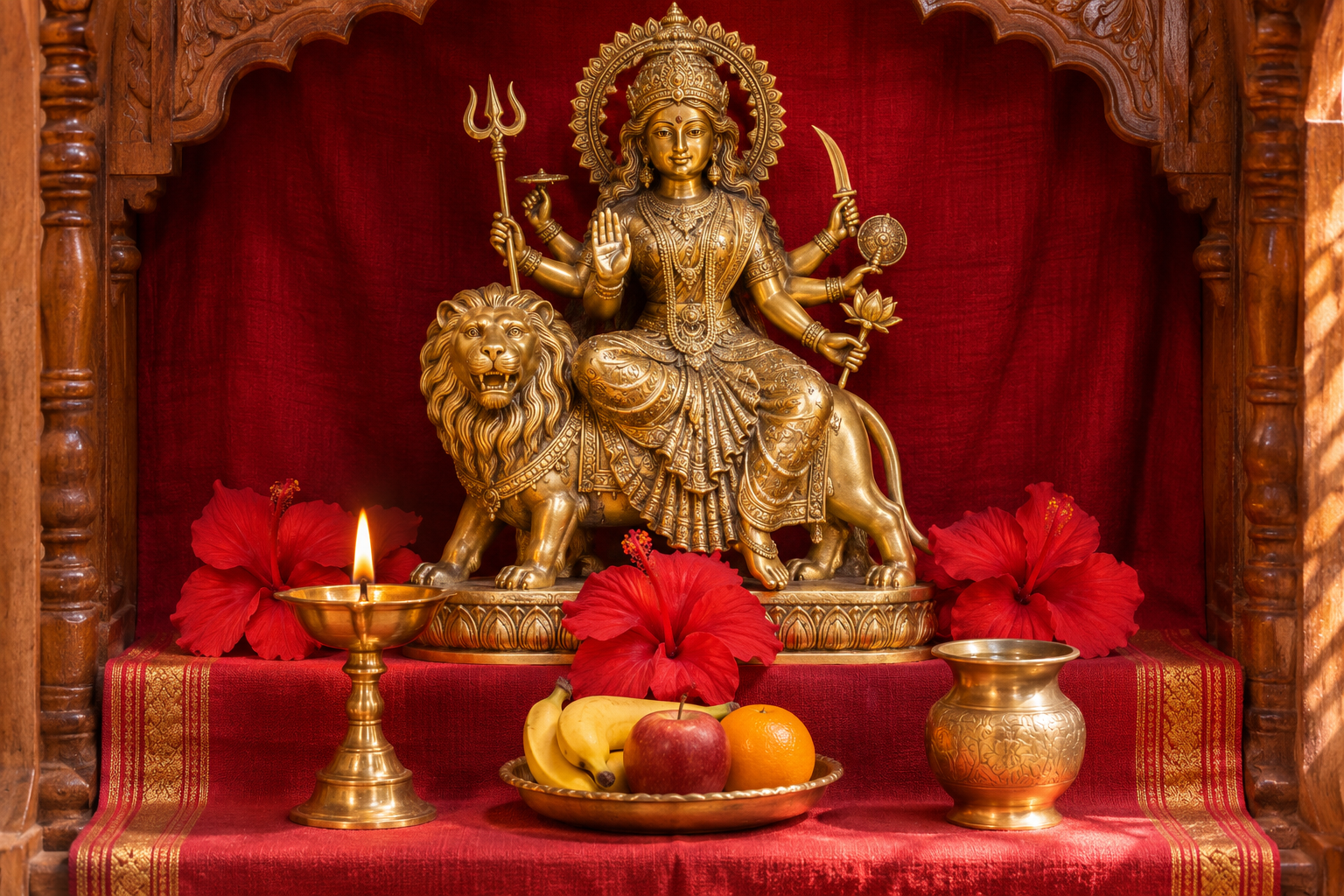
Shakti is revered as the Divine Mother and as the power active in creation, preservation and transformation. That power is worshipped through forms including Durga, Kali, Lakshmi, Saraswati, Parvati and Lalita Tripurasundari. The theological breadth is important, but it should not be mistaken for permission to combine every name, mantra and ritual system into one improvised ceremony.
The four-tithi framework does not establish a universal one-to-one chart in which Panchami must belong to one form, Ashtami to another and Navami to a third. Particular communities may preserve such associations, but they need to be learned within their own context. When you encounter a confident chart online, ask which sampradaya, temple calendar, regional custom or scripture its assignments represent.
Use this order of priority when choosing your practice:
- Follow your initiated practice. If a guru has given you a mantra, sequence or observance rule, that instruction takes precedence over a general list.
- Preserve your kula or household tradition. If your family has long worshipped a particular form of Devi on one of these tithis, continuity is itself meaningful.
- Follow the temple whose observance you are joining. Use its announced tithi, form of Devi and ritual discipline rather than running a competing private calculation during the ceremony.
- If you have none of these, keep the home practice simple. Choose a familiar form of Devi, use a name or prayer you understand, and avoid esoteric procedures whose requirements you have not learned.
Coherence matters more than variety. An image or murti of the Devi you actually worship, a familiar prayer and a sincere offering form a clearer practice than a collection of unrelated bija mantras and ritual fragments. If a practice is reserved for initiation in the tradition from which it comes, do not treat its appearance on a website or video as initiation.
Build a simple home observance you can sustain
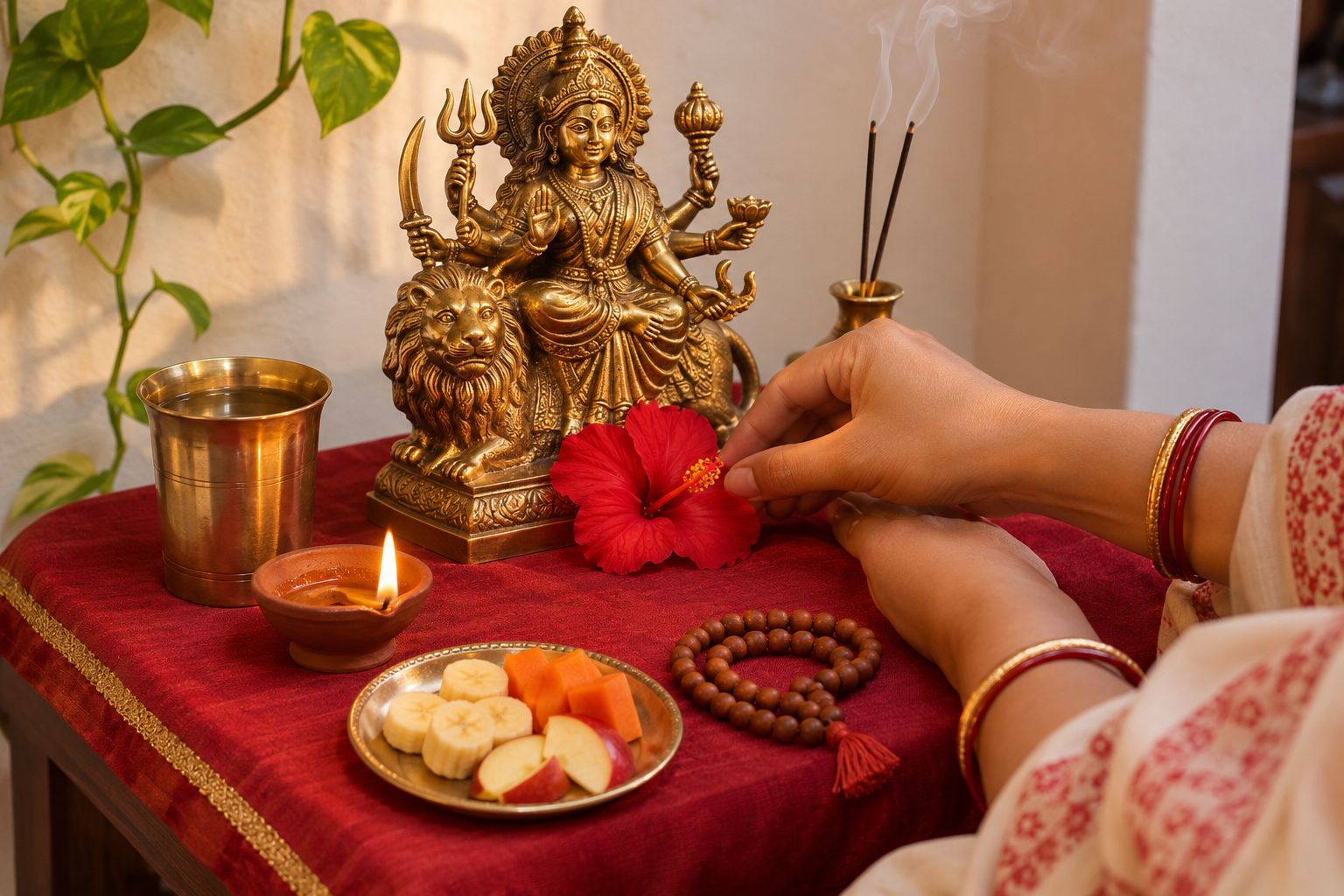
You do not need to make every sacred tithi into a large festival. A modest practice repeated attentively is more useful than an elaborate arrangement that collapses after one month. We would begin with the smallest observance that remains recognisably part of your tradition.
- Confirm the local tithi window. Write it down before arranging the puja so that timing does not become an afterthought.
- Set one clear sankalpa. State whom you are worshipping and why you are setting aside this time. Keep the intention honest and concise.
- Prepare the place. Clean the worship area and arrange the image, murti or other focus used in your household. Place any lamp where it cannot be knocked over or left unattended.
- Begin respectfully. Settle the mind, offer namaskara and invoke Devi in the familiar manner of your tradition.
- Make appropriate offerings. Water, flowers, fruit, prepared food, incense or a lamp may be used where they belong to your practice. Do not assume that every offering is prescribed for every form of Devi.
- Give the central practice your full attention. Recite the mantra, names, stotra or prayer you have actually learned. If you have no established recitation, sincere prayer and quiet contemplation are preferable to guessing at complex ritual language.
- Close the puja properly. Offer gratitude, perform aarti if that is customary, bow and distribute or consume prasada according to your household practice.
The tithi list alone does not impose a fasting rule. A vrata may include fasting in a particular lineage or household, but its form, permitted foods and exemptions come from that practice, not merely from the words Panchami, Ashtami, Navami or Amavasya. Do not adopt a severe fast from an isolated calendar label, especially when it conflicts with health needs or medical advice; prayer, japa, seva and a simple puja remain available forms of observance.
What to leave out
- Do not copy a date calculated for another location without checking the local tithi interval.
- Do not treat Shukla and Krishna Paksha as interchangeable when your tradition names one of them.
- Do not manufacture a rigid Devi-to-tithi mapping from the four names alone.
- Do not combine practices from several traditions merely to make the puja look more complete.
- Do not perform fire rites or other specialised procedures without the knowledge, preparation and supervision they require.
- Do not conclude that a missed tithi makes all later worship pointless. Note why you missed it, correct the practical problem and resume at the next suitable opportunity.
This restraint is not a reduction of devotion. It protects the integrity of the practice and keeps attention on Devi rather than on ritual display.
Key takeaways
- Panchami, Ashtami, Navami and Amavasya are especially suitable recurring tithis for worship of Shakti.
- Panchami, Ashtami and Navami occur in both Shukla and Krishna Paksha, so the tithi name alone may not fully identify an observance.
- A tithi is not confined to a Gregorian calendar date; check its start and end times in a panchanga calculated for your location.
- Let guru, family and temple traditions determine any specific Devi, mantra, vrata or ritual rule.
- If you have no inherited procedure, choose one familiar form of Devi and keep the home puja simple, coherent and repeatable.
- The four tithis are favourable occasions, not the only days on which you may remember or worship the Divine Mother.
Open your local panchanga now and mark the next one of these tithis, including its paksha and exact local interval. Choose one familiar Devi practice for that occasion and prepare only what you can offer with attention. Let consistency, not complexity, turn the lunar calendar into a living rhythm of Shakti upasana.
References

Leave a Reply
You must be logged in to post a comment.