
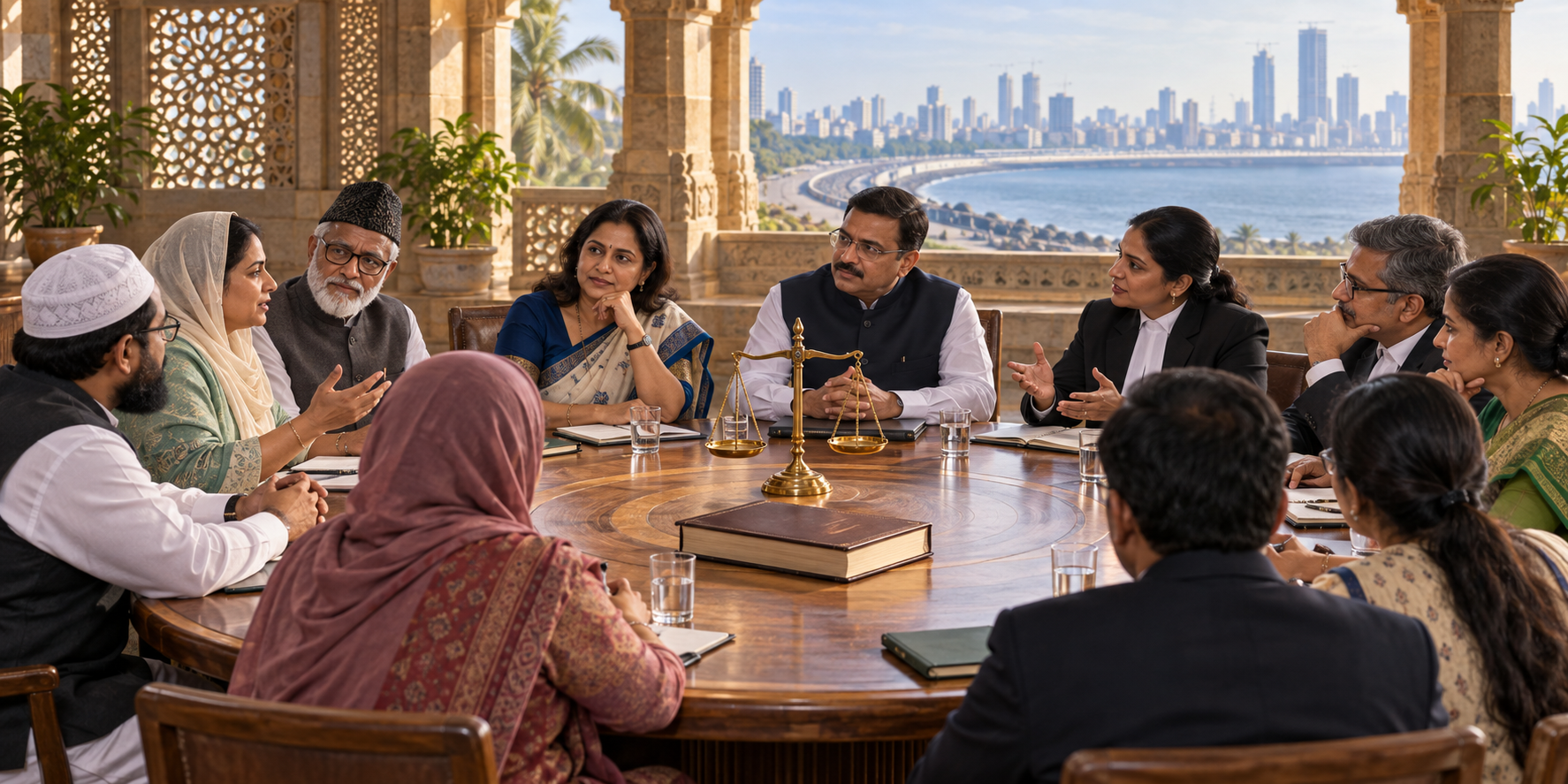
If you’re trying to decide whether opposition to Maharashtra’s proposed Uniform Civil Code is a defence of religious liberty or a defence of unequal personal law, don’t begin with either side’s slogan. Begin with the rule that would change, the person whose rights would change, and the power the state would exercise.
That approach lets you support equal citizenship without treating every religious practice as a legal problem. It also lets you take a genuine freedom-of-religion objection seriously without granting any organisation an automatic veto over civil reform.
What the opposition establishes, and what it does not
Representatives of various Islamic organisations have opposed the proposed Uniform Civil Code in Maharashtra, arguing that it could infringe religious freedom and personal laws. That establishes the existence and stated basis of the opposition. It does not, by itself, establish that a particular religious freedom has been infringed.
The distinction between a claim and a demonstrated injury matters. The phrase “religious freedom” can identify a serious concern, but it can also conceal the central question: which provision restricts which practice, and what legal consequence follows?
The burden of explanation runs in both directions. Opponents should identify the provision they object to, the religious practice involved, and the precise burden they foresee. Those proposing a common code should identify the civil problem being addressed, explain why a general rule is needed, and disclose every exception. Citizens should then compare effects rather than communal labels.
- Ask whether the objection concerns belief and worship, or a rule governing enforceable civil rights.
- Ask whether an actual provision has been identified, or whether the argument is directed only at the idea of uniformity.
- Ask who would gain or lose a right, remedy, obligation, or legal status under the proposed change.
- Ask whether the same principle would apply to every community, including the majority community.
If a full proposal is not available for examination, keep two judgements separate. You can support or oppose the principle of common civil rules, but you cannot responsibly pronounce on the fairness of clauses you have not seen.
Separate religious practice from state-enforced consequences

A useful UCC debate distinguishes several layers that are often bundled together:
- Belief, doctrine, and religious teaching.
- Worship, rites, and ceremonial forms.
- Voluntary observances within a religious community.
- Civil status, obligations, and remedies recognised or enforced by the state.
The closer a measure comes to controlling belief or worship, the stronger the religious-liberty concern becomes. When a measure governs a civil consequence enforced by courts or public authorities, equal citizenship and the rights of other people enter the analysis.
For example, communities could retain distinct wedding rites while the state applies common rules to legal capacity, registration, and civil remedies. The ceremony answers a religious question; the enforceable status answers a civil one. This is only an illustration of the distinction, not a description of any provision in the Maharashtra proposal.
The same logic applies whenever a personal-law rule affects more than a willing individual. Freedom to observe a discipline voluntarily is not automatically a right to have the state impose that discipline on a spouse, child, heir, or dissenter who does not consent. Family-law disputes are rarely contests between an abstract religion and an abstract government. They usually involve individuals within the same family whose interests may differ.
This is why community leadership cannot be the sole measure of religious freedom. A religious organisation has a legitimate voice in public debate, but individual believers also possess conscience, agency, and civil rights. A sound assessment must hear both.
The Dharmic case for equal citizenship without cultural erasure

A pro-Dharma position need not choose between cultural continuity and common civil protection. Dharma is larger than a state code, and the state’s civil law need not prescribe a single theology, ritual, or way of worship. Uniformity of civil rights is not uniformity of belief.
Dharmic society contains many schools, disciplines, ceremonies, and local customs. That plurality shows why cultural life cannot be reduced to one statutory form. It does not follow that every custom must produce a different state-enforced legal consequence. Ritual diversity and legal equality can coexist when legislators draw the boundary carefully.
There is an equally important warning for UCC supporters. A code does not become neutral merely because it is called uniform. If it copies one community’s customary rule, presents that rule as the national default, and scrutinises only minority practices, the label of uniformity will not cure the unequal design.
Test neutrality through the rule’s operation. Does the same legal trigger produce the same obligation and remedy for every citizen? Are exceptions described in civic terms that anyone meeting the condition can use? Or does identity determine who receives a right or bears a burden? Those questions are more reliable than speeches from either camp.
The standard must also apply to Hindu customs. A reform loses moral force if it audits only one community while treating another community’s practices as presumptively beyond examination. Equal citizenship requires a genuinely general rule, not selective reform dressed in universal language.
Muslim organisations therefore have the right to object, organise, and explain their concerns. They do not acquire an exclusive right to determine the civil rights of every Muslim individual. Consultation is part of democratic lawmaking; a communal veto is not the same thing as consultation.
Questions that reveal whether a proposal is sound or selective

When you encounter a claim for or against Maharashtra’s proposed UCC, use the following questions. They turn a charged communal argument into an examination of law and consequences.
- What is the exact provision? Ask for the clause or official wording. If a speaker cannot identify it, treat the statement as a position on principle rather than evidence about the proposal’s actual effect.
- What civil subject does it govern? “Personal law” is too broad to settle anything. Identify whether the dispute concerns the formation of a legal relationship, its dissolution, financial obligations, succession, guardianship, registration, or another defined matter.
- What changes for the individual? State the current and proposed outcomes in plain language. Who gains a right, loses a remedy, assumes an obligation, or faces a new administrative requirement?
- Does the measure regulate worship or a state-enforced consequence? A rule that dictates a rite raises a different concern from a rule that determines the civil effect recognised after the rite.
- Is the rule genuinely general? Check whether it applies across communities and whether any exception depends on a neutral condition or on religious identity.
- Whose freedom is being defended? Include the believer who follows the community rule, the believer who interprets it differently, and the person born into the community who does not consent to that rule.
- How would existing arrangements be handled? A credible proposal should make its treatment of prior legal relationships, property arrangements, ongoing disputes, and future cases intelligible rather than leaving families to guess.
- What remedy exists if officials apply the rule incorrectly? Clear procedures, review, and access to adjudication matter because an equal rule on paper can still be administered unequally.
These questions also improve public discussion. Instead of asking whether someone is “for Muslims” or “against Hindus,” ask which clause they support, which right it protects, and whether they would accept the same principle when applied to their own community.
Do not alter a marriage arrangement, succession plan, property decision, or other legally significant family matter because of political claims about a proposal. If an official measure may affect your situation, obtain the actual text and advice from a lawyer qualified to address Maharashtra law. Anticipated legislation and enacted law are not interchangeable.
Key takeaways
- Islamic organisations have opposed Maharashtra’s proposed UCC on religious-freedom and personal-law grounds, but the stated objection is not proof that a legal infringement has occurred.
- The decisive distinction is between voluntary religious observance and a civil consequence enforced by the state.
- Religious organisations deserve a hearing, but individual members of a community also possess conscience and civil rights.
- A common code is defensible only if its principles and burdens are genuinely general, including when applied to Hindu customs.
- A code called uniform can still be selective in substance, so examine its clauses, exceptions, effects, and remedies.
- Until you can compare an exact provision with the rule it would replace, keep your judgement provisional.
Your next step is practical: locate the official proposal when it is available, mark every provision that changes a right or remedy, and ask whether the same principle applies to every citizen. Support, oppose, or seek amendment only after making that comparison. That is how you take religious liberty seriously without allowing the phrase to end the conversation before the law itself has been examined.
References

Leave a Reply
You must be logged in to post a comment.