
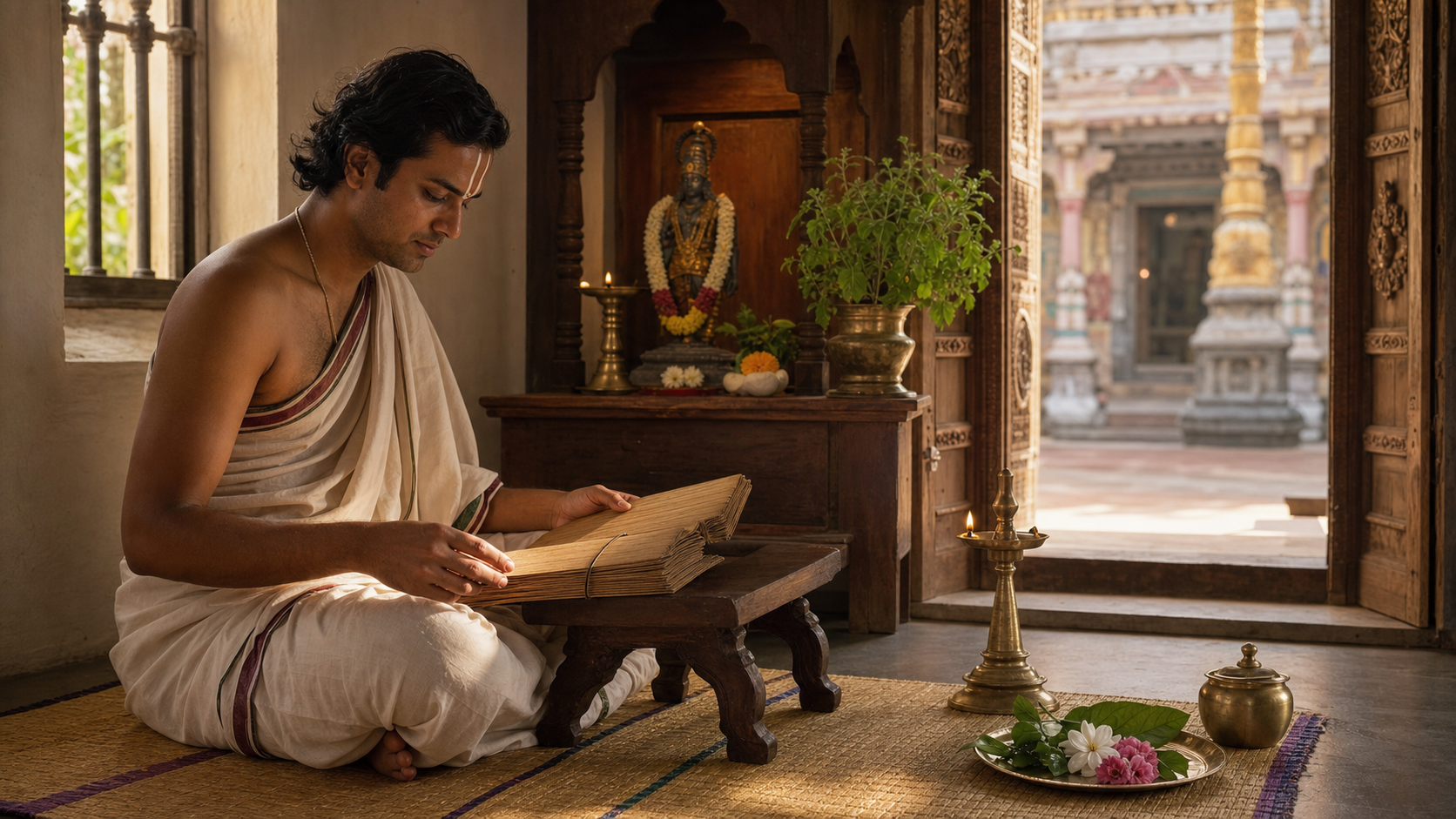
You may have found the name Aniruddha Samhita while looking for a serious Vaishnava practice, only to meet a harder question: what, exactly, should you do with it? Reading a sacred text, maintaining household devotion, and performing a formal Pancharatra rite are three different undertakings.
You do not have to choose between leaving the text untouched and turning every translated instruction into a do-it-yourself ritual. The sound approach is to understand what kind of passage you are reading, practise at the level for which you are prepared, and seek an acharya when initiation or ritual transmission is part of the method.
Where the Aniruddha Samhita sits in Pancharatra practice
Pancharatra is a Vaishnava tradition in which theology and worship belong together. It does not treat spiritual knowledge as an idea to admire from a distance. Knowledge is expected to shape contemplation, ritual order, devotion, and conduct.
Within this sacred corpus, the Aniruddha Samhita holds a significant place as a meeting point between Vedic wisdom and practical spiritual application. It is also revered as the Aniruddhasamhita Mahopanishad. Its reported 34 chapters should immediately correct one common misreading: this is not merely a short prayer that can be detached from its theological and ritual setting.
That practical orientation is precisely why you must read carefully. A sacred manual may move between principles, contemplation, rules of worship, qualifications of the practitioner, and procedures whose earlier prerequisites are assumed rather than repeated. A translated command can look self-contained even when it belongs to a larger sequence.
Before turning any passage into an action, identify what it is doing:
- Is it explaining a theological principle or the nature of the divine?
- Is it directing meditation or devotional remembrance?
- Is it describing an ordinary act of worship that accords with your established household custom?
- Is it prescribing a formal rite for an initiated practitioner or temple setting?
- Does it assume a received mantra, consecrated image, ritual office, or previous purification?
This classification prevents two opposite errors. The first is reducing Pancharatra to abstract philosophy. The second is treating a complex ritual tradition as a collection of isolated techniques. Its distinctive strength lies in the ordered relationship between understanding, eligibility, worship, and transformation.
Choose the right level of engagement
Your first decision is not which ritual looks most impressive. It is which level of engagement honestly matches your present preparation. The three levels can overlap, but they should not be confused.
| Level | Your immediate aim | Appropriate action | Boundary to respect |
|---|---|---|---|
| Scriptural study | Understand the vocabulary, theology, sequence, and purpose | Read a coherent passage, compare a reliable translation with the Sanskrit when possible, and record unfamiliar terms | A readable translation does not by itself confer ritual authority or initiation |
| Household devotion | Let study deepen regular remembrance and ethical discipline | Use prayers, names, offerings, and forms of worship already accepted in your family or sampradaya | Do not label a personally assembled routine as the prescribed Aniruddha Samhita method |
| Formal Pancharatra ritual | Perform a transmitted rite in its intended order | Learn its mantras, actions, prerequisites, and corrections from a qualified acharya or established temple lineage | Diksha, ritual competence, a consecrated setting, and other qualifications may be integral rather than optional |
Most readers can begin with study and modest household devotion together. That is not a lesser form of sincerity. Formal ritual has different conditions, while attentive study and uncomplicated bhakti already demand patience, truthfulness, regularity, and restraint.
Use three questions whenever an instruction attracts you. Who is being instructed? What has already happened before this step? What setting and result does the instruction presume? If you cannot answer those questions from the surrounding passage and a trustworthy explanation, you have found a point for inquiry, not a licence to improvise.
A home discipline that does not imitate initiation
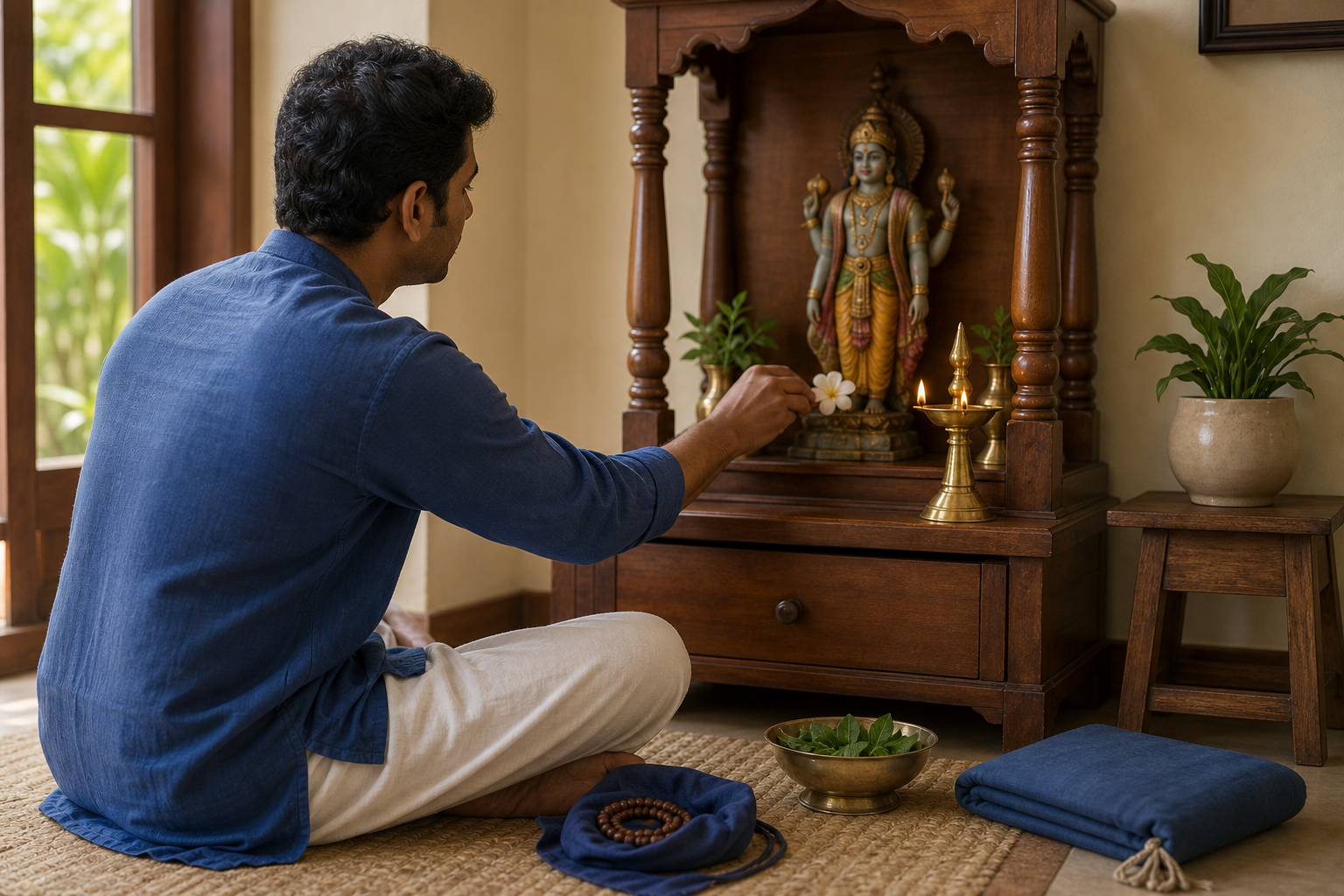
You can make the Aniruddha Samhita part of your spiritual life before undertaking its specialized rites. The following sequence is a framework for disciplined reading and familiar devotion. It is not presented as a reconstructed ritual from the Samhita.
- Prepare a clean and settled place. Put away the devices and interruptions that would turn the session into casual browsing.
- Begin with a salutation to Narayana or Vishnu that already belongs to your family practice or recognised sampradaya. If you have received a mantra from your guru, follow the instructions attached to that mantra rather than altering it to fit the reading.
- Read one complete unit of thought. Do not extract a dramatic line while ignoring the instruction immediately before or after it.
- Separate terms you understand from terms you only recognise. Write down unfamiliar Sanskrit words, ritual objects, divine names, and practitioner qualifications. Look for a precise explanation before assigning them a meaning.
- Where your household custom permits, make the simple offering you already know how to make. Water, a flower, or another familiar offering need not be expanded into a ceremony merely because the text being studied is ritual in character.
- Ask what the passage requires of your conduct. If it teaches order, attention, reverence, purity, or self-restraint, identify one concrete place where that principle should govern your day.
- Close according to your established custom. Record the edition, chapter or section, the question that remains, and anything you plan to ask a teacher.
The record matters more than it may seem. Sacred-text discussions often become confused because people quote different translations, omit the surrounding procedure, or remember a paraphrase as an exact injunction. Writing down the edition and location lets you return to the actual passage and ask a useful question.
Keep received mantra practice and exploratory study distinct. Seeing a mantra in print does not tell you how it is pronounced, whether nyasa accompanies it, who is eligible to use it, how errors are corrected, or what observances belong to it. Visibility is not the same as transmission.
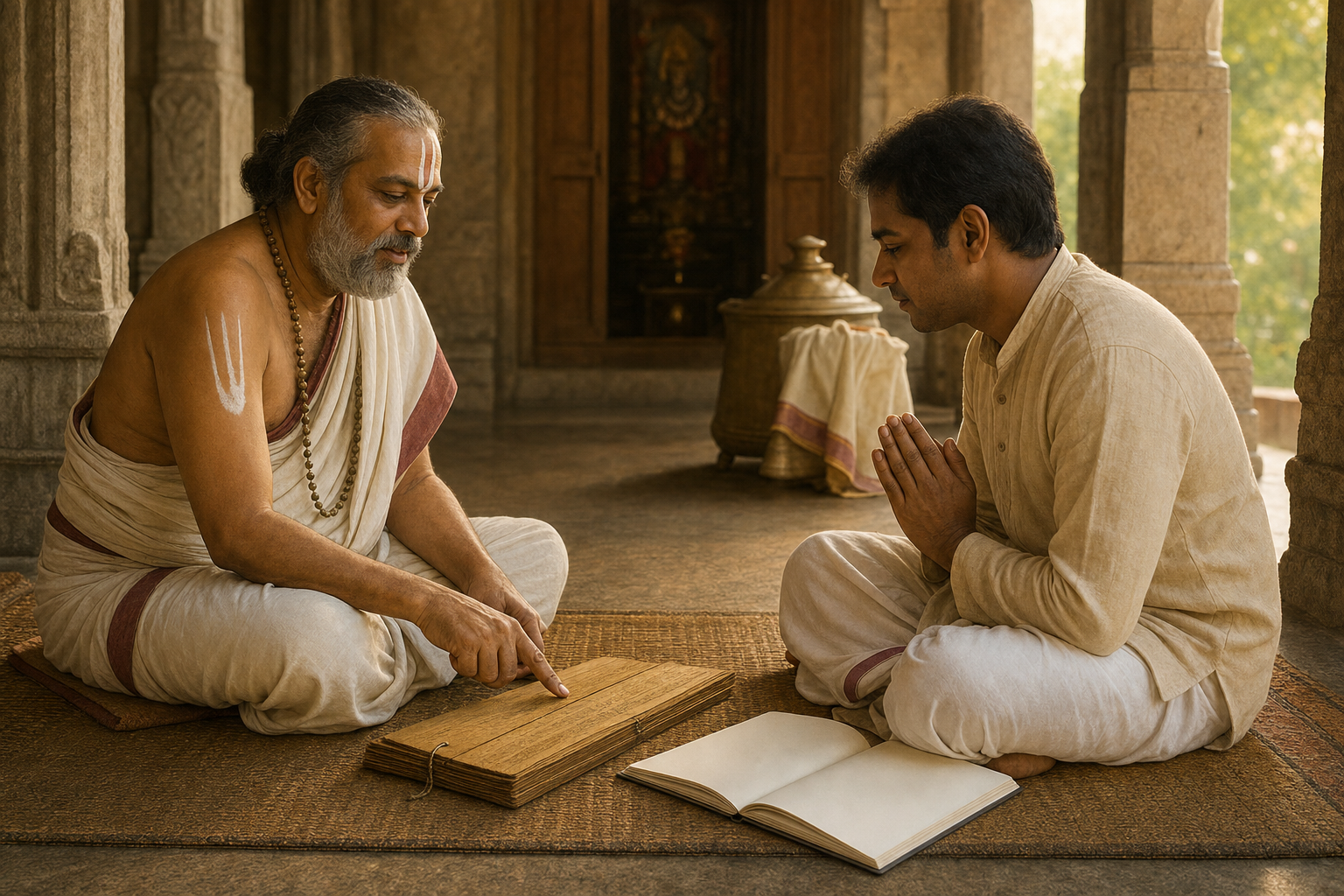
Know when the passage requires an acharya
Test the context before copying a procedure
A ritual passage should be read as part of a system. Test it against the following questions before attempting any action:
- Who is the intended practitioner: a general devotee, an initiated practitioner, an officiant, or someone responsible for temple worship?
- Does the procedure assume diksha, prior purification, a consecrated murti, or a ritual space prepared in a particular way?
- Is the stated purpose ordinary worship, meditation, temple service, consecration, protection, or another specialized aim?
- Does the passage give a complete mantra and method, or does it use an abbreviation that an initiated reader would already understand?
- Are mudra, nyasa, mandala, homa, or formal archana involved? These are technical elements, not decorative additions.
- Does your translation explain variant readings and technical vocabulary, or does it silently choose one interpretation?
Nyasa, for example, is not merely touching parts of the body while reciting words; it belongs to a specific ritual understanding of mantra and embodiment. A mudra is not simply a visually appealing hand pose. Homa involves both ritual competence and ordinary fire safety. Prana-pratishtha and temple installation carry continuing responsibilities that cannot be reduced to a checklist found online.
Pause where transmission is part of the practice
Seek direct instruction when a passage calls for initiation, a specialized mantra, mantra placement, a fire rite, consecration, temple installation, or a formal sequence you cannot reconstruct without guessing. Pause as well when two editions appear to disagree. Combining fragments from different lineages may produce a procedure that belongs to none of them.
A useful consultation with an acharya begins with specific questions:
- Which Pancharatra lineage and textual edition inform this explanation?
- Is the passage meant for an initiated practitioner, a temple officiant, or a householder?
- What must be learned or received before the procedure begins?
- Which elements are essential to the rite, and which reflect a local temple or family custom?
- Is there an appropriate household adaptation, or should the passage remain a subject of study?
A qualified teacher should be able to distinguish a textual injunction from a lineage interpretation, a temple protocol, and a household accommodation. That distinction is more valuable than a promise of a rapid result. Pancharatra practice depends on right relationship and right order, not on collecting the largest number of esoteric actions.
Key takeaways for your next reading
- Approach the Aniruddha Samhita as an integrated work of wisdom and practice, not as a loose collection of mantras.
- Begin with coherent reading, careful notes, and the Vaishnava devotion already established in your household or sampradaya.
- Distinguish study, household devotion, and formal Pancharatra ritual before deciding what you are prepared to perform.
- Never assume that a mantra printed in an edition has therefore been personally transmitted to you.
- Check the intended practitioner, prerequisites, setting, and purpose of every ritual instruction.
- Take initiation-dependent, consecratory, fire-based, or technically complex procedures to a qualified acharya instead of filling gaps by guesswork.
At your next sitting, divide a page into three headings: meaning understood, practice already appropriate, and guidance still required. That simple discipline will let the Aniruddha Samhita move from curiosity toward lived dharma without making claims to a ritual authority you have not received.