The Great Nicobar development cannot be judged by asking whether national security matters more than conservation. Its strategic, commercial, environmental and social claims are interdependent: infrastructure that compromises water security, disaster resilience, ecological stability or community legitimacy could weaken the continuity it is meant to provide.
The supplied DharmaRenaissance analysis draws together official project descriptions, strategic arguments and public concerns. Because it is the sole member source provided, its figures establish the reported contours of the proposal rather than independent corroboration. The useful policy question is therefore conditional: what evidence and safeguards would make the development both strategically valuable and publicly defensible?
Key takeaways
- Great Nicobar’s location offers maritime reach and awareness near an important shipping corridor, but proximity does not amount to control of the Strait of Malacca.
- The port, airport, power system and township form one interdependent system, so the weakest component could limit the value of the others.
- A transshipment terminal needs more than deep water and a favourable location; it also depends on demand, competitive costs, reliable operations and shipping-line participation.
- Ecological protection, indigenous-community safeguards, freshwater security and disaster readiness are strategic operating requirements, not peripheral concessions.
- A long construction programme is most defensible when each phase depends on published tests of demand, affordability, compliance, resilience and social impact.
What the location can provide – and what it cannot
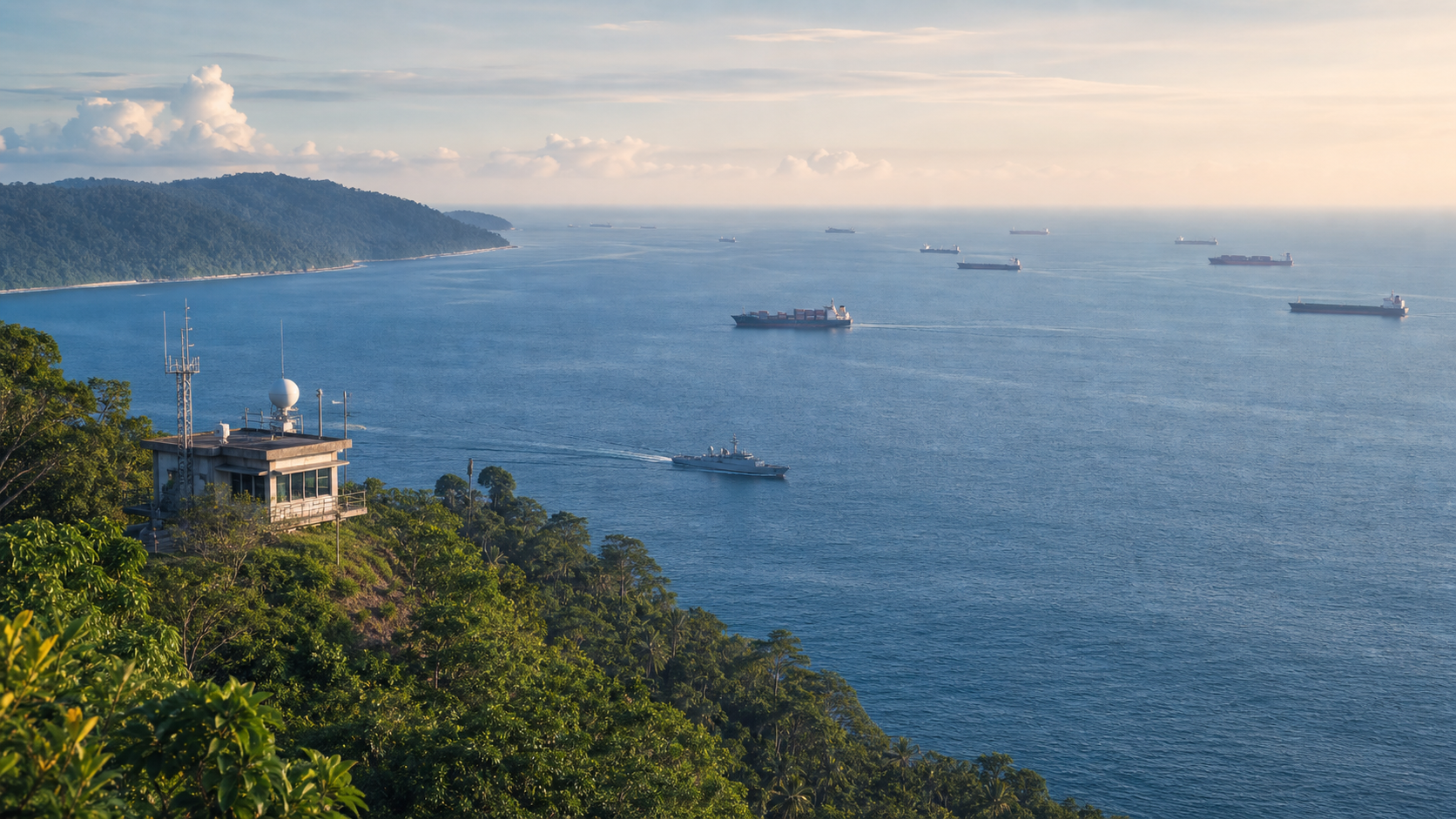
The source reports that Great Nicobar lies near the western approaches to the Strait of Malacca and that the proposed port would be about 40 nautical miles from a major international shipping route. It also reports natural water depth exceeding 20 metres at Galathea Bay. Together, those characteristics could reduce route deviation for large vessels and support a sustained Indian presence near traffic moving between the Indian and Pacific Oceans.
The strategic benefit should be described precisely. An Indian facility on Great Nicobar could improve maritime-domain awareness, logistics, communications, search and rescue, emergency response and the ability to sustain operations away from the mainland. The source also argues that it could complement the existing tri-service architecture, including the naval air station at INS Baaz. None of this gives India unilateral command over a strait bordered by Southeast Asian states and governed by international law and navigational practice.
This distinction produces a more credible security case. The project’s value would lie less in a claim to control passing traffic than in the practical ability to observe events, service ships and aircraft, protect communications and respond when ordinary supply chains fail. Civil infrastructure can create strategic options without turning every commercial facility into a military installation.
That optionality also has a peacetime dimension. The source identifies evacuation, medical support, disaster relief, refuelling, repair and regional search-and-rescue work as possible functions. A resilient hub could therefore contribute to both deterrence and humanitarian assistance, but only if its own power, water, communications and access systems remain usable during an emergency.
The commercial case must support the entire system
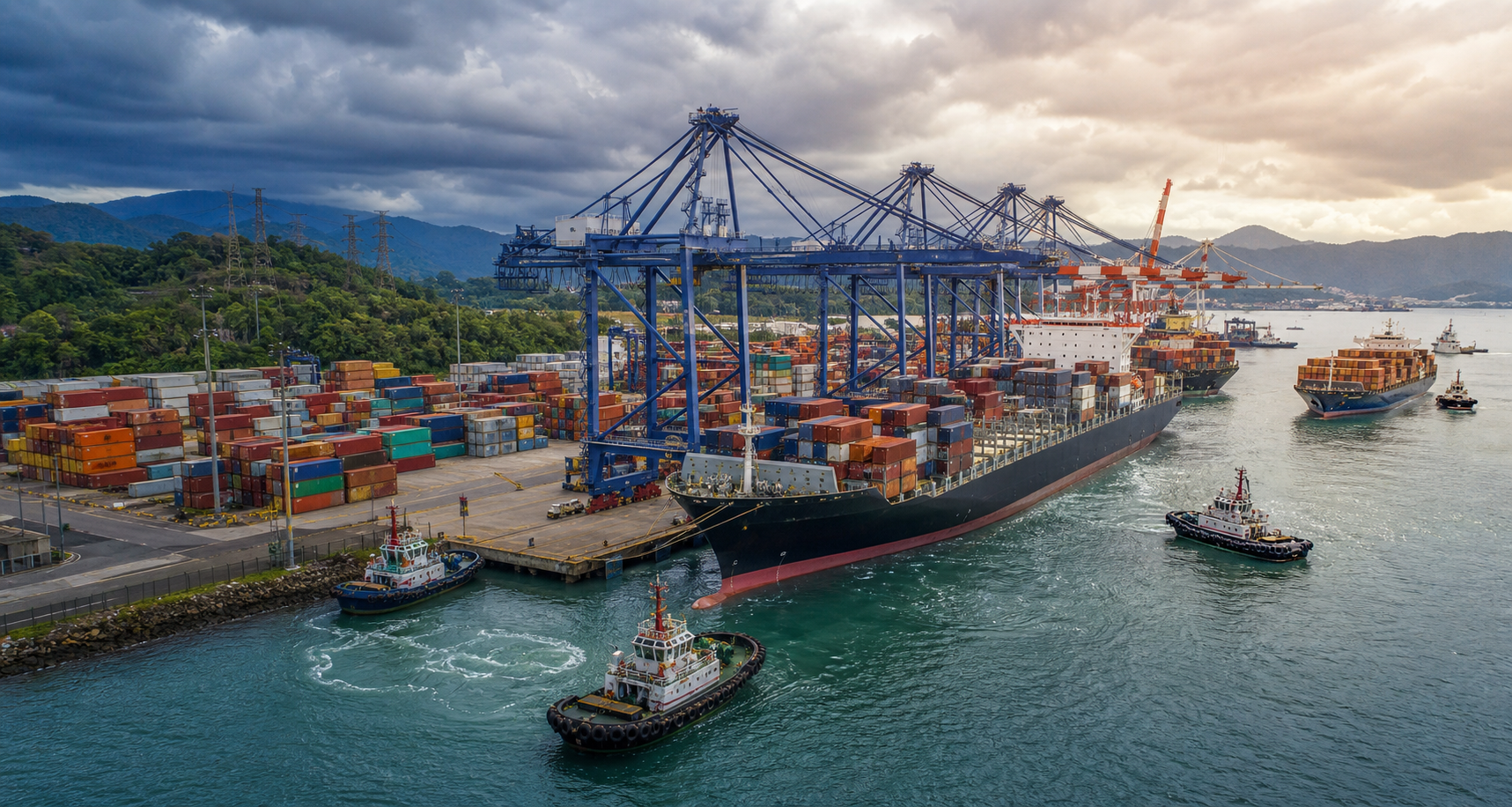
The development is not simply a container terminal. As reported by the source, the plan combines an International Container Transshipment Terminal at Galathea Bay, a greenfield international airport, a gas-and-solar power system and a new township with supporting utilities and transport. ANIIDCO is identified as the implementing corporation. The source, citing a May 2026 Union government account, reports a terminal capacity of 14.2 million TEUs, an airport designed for 4,000 peak-hour passengers, a 450 MVA power system and a total planning area of 16,610 hectares.
Those figures describe scale, not demonstrated utilisation. TEU is a measure of container capacity, while MVA measures apparent electrical power and cannot automatically be read as the same number of megawatts. More importantly, every major component depends on assumptions made elsewhere in the plan. The port needs reliable electricity, water, communications, roads and workers; the airport and township need enough continuing activity to justify their scale; and the power system must match the demand that actually materialises.
Transshipment adds another layer of uncertainty. In this business, containers move between large long-distance vessels and smaller feeder services. Geography and depth matter, but shipping lines also compare terminal productivity, charges, schedule reliability, feeder networks and the cost of deviating from established routes. The source reports that some Indian cargo has historically moved through Colombo, Singapore and Port Klang. A domestic hub could retain more handling activity and add supply-chain options, but capacity alone would not cause carriers to change their networks.
The fiscal baseline consequently needs regular renewal. The source cites a March 2025 Lok Sabha reply recording Department of Expenditure in-principle approval dated August 8, 2023, with a tentative whole-project cost of about Rs 81,000 crore over 30 years. It also notes an earlier figure near Rs 72,000 crore and later media estimates above the stated baseline. These changing figures make a component-wise cost statement essential: capital requirements, financing, escalation assumptions, operating support and contingencies should be visible separately.
The commercial and strategic cases overlap, but they are not interchangeable. A facility may retain security value even if cargo growth disappoints; if that possibility is part of the rationale, the strategic premium should be identified rather than hidden inside optimistic traffic forecasts. Conversely, the language of security should not shield commercially testable assumptions from scrutiny.
Island safeguards are measures of strategic performance
Great Nicobar’s constraints are unusually consequential because they occur together. The source describes the island as seismically active, environmentally sensitive and internationally recognised as a biosphere reserve. It also records concerns about tropical-forest loss, wildlife habitat, freshwater resources and effects on the Shompen and Nicobarese communities. These are reported concerns requiring project-level evidence; they should neither be treated as automatically disproving the development nor dismissed because the site has strategic value.
Ecology and water: Baseline studies should lead to measurable operating limits, not merely descriptive reports. Construction footprints, water withdrawals, habitat disturbance, waste, pollution and restoration commitments need indicators that can be independently checked. Cumulative effects matter because a port, airport, township, roads and utilities can impose pressures that are not captured when each component is assessed in isolation.
Communities and legitimacy: Safeguards for the Shompen and Nicobarese communities should address more than physical displacement. Access, health exposure, livelihoods, cultural continuity, representation and grievance resolution are relevant to long-term stability. Engagement should be continuous across planning, construction and operation, with responsibilities and corrective procedures publicly defined.
Disaster resilience: The source highlights earthquakes, cyclones and tsunamis as risks relevant to island infrastructure. A strategic facility must therefore be judged by degraded-mode performance: whether essential power, communications, medical support, freshwater access and evacuation routes continue to function after a severe event. Redundancy may increase initial cost, but an asset unavailable during a crisis cannot deliver its central strategic promise.
The synthesis is straightforward: environmental and social safeguards do not sit outside national security. Healthy ecological systems, dependable freshwater, trusted institutions and locally credible emergency plans help determine whether the island can sustain people and operations over time.
A stage-gate compact for a long-duration project
The source reports a three-stage development schedule extending from 2025 to 2047 within an approximately 30-year project horizon. Such phasing can reduce risk only if later stages are genuinely conditional. A calendar-based expansion, in which elapsed time substitutes for demonstrated performance, would surrender the main advantage of building in stages.
Demand gate: Before adding capacity, decision-makers should publish updated cargo forecasts, route-deviation assumptions, evidence of shipping-line interest and actual utilisation of commissioned assets. Forecasts should include downside cases rather than a single growth path.
Environmental and community gate: Each phase should require independently reviewed evidence that ecological limits, water protections, rehabilitation duties and community safeguards from the previous phase have been met. Material breaches should trigger correction before expansion.
Fiscal gate: Updated component costs, financing obligations, operating requirements and contingencies should be compared with the benefits achieved to date. This would allow strategic expenditure to be acknowledged openly while keeping commercial claims testable.
Resilience gate: Emergency systems should be exercised under realistic failure scenarios before the next stage proceeds. The test is not whether plans exist on paper, but whether essential services can operate when transport, power or communications are impaired.
Accountability gate: Monitoring results, independent audits, grievances, corrective actions and reasons for approving the next phase should be published in an accessible form. Oversight is meaningful only when poor performance can delay, redesign or halt a component.
Great Nicobar’s geographic importance will outlast any individual construction timetable. The strongest next step is therefore a binding framework that converts strategic claims and safeguard promises into evidence-based conditions for every phase. If those conditions are enforced, development can add durable capability; if they are treated as formalities, scale itself will not make the project secure.